|
A. September 3, 1939, War
|
|
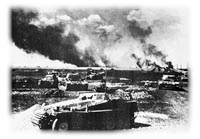
(a) Poland Invaded, Britain Declares War, Australia Follows
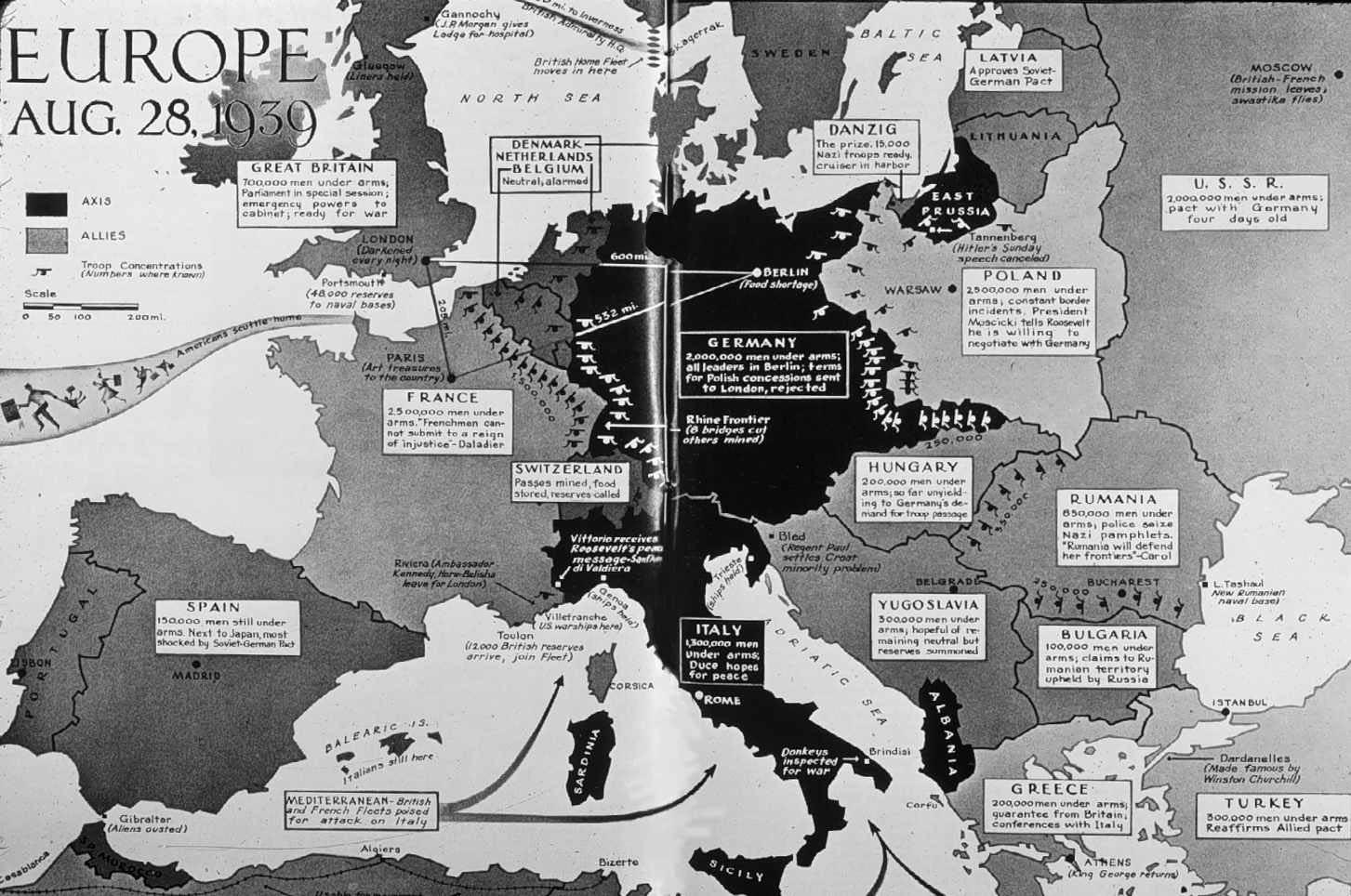
German forces having invaded Poland on September 1, 1939, Britain declared war three days later. And within an hour and a quarter of Neville Chamberlain's declaration, Australia's Prime Minister Robert Menzies, without consultation or debate, followed suit in the following terms: (JMcC,1)
"Fellow Australians, it is my melancholy duty to inform you officially that, in consequence of the persistence of Germany in her invasion of Poland, Great Britain has declared war upon her, and that as a result, Australia is also at war."
This comes across as a reflex action of someone more intent on demonstrating his 'loyalty' to the Old Country's (largely pro-Hitler) Conservative government than in conferring with members of his own Government and Opposition, let alone with Australians more widely, before any such commitment.
And notwithstanding all the display, neither in Britain or Australia did any plans exist for the defence of Poland. As Churchill pointed out, Britain's 'guarantee', to support Poland in the event of German invasion was completely empty since there was little means and certainly no intention of such military intervention. In Churchill's words, "France and Britain remained impassive while Poland was in a few weeks destroyed or subjugated by the whole might of the German war machine." (WC4i,376) With terrifying 'efficiency' Germany's invasion had gone ahead, the sole opposition coming from the forces of Poland itself, and since these were comparatively minuscule, it had taken just 4 weeks. For Hitler the only real hold up, and that only temporary, was Russia's prompt occupation of eastern Poland, its troops rapidly advancing to the demarcation line agreed by their mid-August "Non-aggression Pact".
(b) Britain continues 'Standing By' - the Phoney War
Thus it was all over and the British government had no plan for any action towards its 'declared' war. Chamberlain referred to the subsequent 'prolonged and oppressive pause' as the "Twilight War" (WC4i,376) but it was more popularly and realistically known as the "Phoney War." However, the British government did at least appoint Churchill to its War Cabinet, returning him to his old role (held pre-WWI through to the Gallipoli defeat) of 'First Lord of the Admiralty'. This he took on with enthusiasm, doing his utmost to get the Royal Navy in top order and secure its bases against attack. Since the British enjoyed a clear superiority in capital ships, that might have been a straightforward matter, but the reality of Germany's far greater strength in air power and submarines (so 'designedly' promoted by Britain's Conservatives throughout the 1930s) was to gravely undermine that advantage. (c.f. Chapter 8A)
(c) German U-boat and Air Superiority
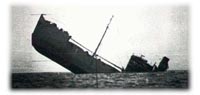
Indeed Germany's U-boat force promptly set about sinking Britain's merchant fleet wherever it found them at home and abroad, thus threatening its vital imports and challenging its very survival, 135,000 tons sunk in the first month. (WC4i, 390) German U-boats also attacked the Royal Navy's ships, early sinking the aircraft carrier Courageous with the loss of 500 mostly young lives. Even more disastrously, by mid October they had penetrated Britain's Scapa Flow, its 'secure' northern naval base, where a U-boat sank the battleship Royal Oak with the further loss of 833 young sailors. (WC4i ,439) The 'successful' raid had been carefully planned by Admiral Doenitz, Germany's U-boat chief.
At the very least Britain's supposed superiority at sea should have guaranteed not only the protection of its own shipping, but the ability to drive all Germany's commerce off the sea, thereby blockading all of its overseas trade, including essential imports. A Ministry of Economic Warfare was formed to guide this very policy (WC4i, 379) but the fact of Germany's superiority in both U-boats and air power made nonsense of Britain's claim to 'naval superiority'. And it completely undermined Churchill's September 12 'Catherine' scheme to have the Royal Navy establish a permanent presence in the Baltic Sea, a presence intended to threaten Germany's plans for Poland and beyond. (WC4i,415-9;495-6;626-8) Most significantly, it would have enabled the Royal Navy to blockade Germany's imports of Swedish iron ore, material absolutely essential for its war's prosecution. Similarly, as occurred 6 months later, Germany's U-boats and air power were to frustrate Britain's plan to occupy Narvik, the all-year Norwegian port through which so much of the Swedish ore passed. (see B(a) below)
In the meantime, Britain and France, neither of which had seriously considered supporting Poland's resistance to invasion by attacking Germany from the West, were nevertheless forced to contemplate how they might defend themselves should Hitler decide to move westwards. They knew that of Germany's 116 divisions, they would have to face at least 42 or, depending on eventualities in the East, up to a 100. Against this threat, France had 86 divisions, but this left a serious shortfall because Britain offered only 4 - 'available by mid-October', - (this compared to the 90 divisions Britain had in the field towards the end of WWI). (WC4i, 429-30) Not only that, but in the event the 4 promised divisions did not arrive in France until March 1940! (WC4i, 502) Whichever way you look at it, as Churchill wrote, "The British Expeditionary Force was no more than a symbolic contribution." (WC4i,429)
Such lack of commitment was not only in division strength. Politically the governments of both Britain and France were seriously divided over how to respond to Hitler and his war plans. Sympathies in Hitler's direction, strong before the war, continued at the highest levels to play a major role in both countries. Added to that were the memories of the carnage of WWI coupled to the knowledge of Hitler's ruthlessness and the terrifying efficiency of his military machine. This, together with the feeling that Hitler represented protection against the 'virus of Communism' which might 'infect' their long-suffering populations (affected still by the on-going effects of the Great Depression) continued as potent influences.
As indicated above, although a long-time opponent of appeasing Hitlerism, Churchill had been admitted to the British War Cabinet. However, his position there remained tenuous, many in favour of a peace settlement with Germany wanting him removed. Essentially similar attitudes existed within the government of France. For them, since Hitler's long-stated intention was to expand eastwards into Russia, there seemed reason to hope he would concentrate on that and avoid conflict with France. And given the strong Maginot and Siegfried defensive fortifications along the Franco-German border it was easy for such people to continue 'prosecuting' a Phoney War, simply waiting to see what, if anything, might happen - and just hoping it would not involve them at all!
For Churchill, that was not good enough. He advocated building the British army up to 55 divisions, to bringing Canadian and Australian armies to France (WC4i,452), and to greatly increasing the numbers of British bombers - since while Germany had 2,000, France and Britain together had only 950. (WC4i, 430) He also supported his Government's arrangements for the Dominions to supply young aircrew for the RAF's use in Europe, under what was termed 'The Empire Air Training Scheme' (EATS) a scheme formally agreed in November 1939. (see Note, below & 9F (a-e)) For Australia it was an arrangement negotiated between the Menzies government and Britain's Lord Riverdale who, as Sir Arthur Balfour, had from the early 1930s enthusiastically advocated the rearmament of Germany. (see 8A(b)) Significantly, it seems, in Churchill's "The Gathering Storm", his history of the period, there is no reference whatever to this EATS Agreement - or of its tragic effects through the RAF's bombing campaigns, on so many young British and Dominions' airmen - not to mention the tens of thousands of innocent German men, women and children civilians. (see F(c-e) below )
Churchill also continued to be active in the naval field, especially in attempting to counter the devastating effects of Hitler's submarines and magnetic mines on British shipping and trade, including imports vital for the nation's survival. By April 3, 1940, Churchill's long-standing proposal to mine the approaches to the Norwegian port of Narvik had finally been approved by Cabinet. (WC4i, 522) As a northerly port having direct rail connection to Sweden's rich iron-ore deposits at Gallivare, Narvik played a critical role in supplying Germany's iron and steel needs. Although Narvik was well within the arctic circle, the Gulf Stream assured its all-year accessibility. Thus the planned mining operation, if fully successful, could have interfered with Germany's ability to continue the war.
|
|
B. Early Defeats
|
|
(a) Norway, then France, Fall
Yet there remained the serious obstacle of Germany's U-boats and air superiority. And besides this problem, to guarantee its own iron and steel 'security', it was quite possible that Hitler might be planning to occupy Norway, - which, indeed, he was. However, on April 8, the mining off Narvik went ahead, Norway's government being notified later. (WC4i, 531) On the same day Germany invaded first Denmark then, with 7 divisions, Norway - all its main ports, including Narvik, being in German hands within 48 hours. Notwithstanding the radically changed situation, British plans, which by then included a military operation to recover Narvik and other German-held territories went ahead despite the fact that the 2 British divisions (originally destined for Finland) were unavailable - they having been sent to France. Thus only 11 battalions were ready to go on the night of April 10, the rest, together with a French Alpine division, being due 3-4 days later. (WC4i, 540) Yet writing on April 10 to Admiral Pound about the enemy's occupation of the Norwegian ports, Churchill expressed the view that "....large-scale operations will be needed to turn them out of any of them. .....Narvik must be fought for. Although we have been completely outwitted, there is no reason to suppose that prolonged and serious fighting in the area will not impose a greater drain on the enemy than on ourselves." (WC4i, 540-1)
But why the optimism for, as Churchill was later to write, the starker picture was that: "It was from the beginning obviously impossible for us to rescue Southern Norway. Almost all our trained troops, and many only half trained, were in France. ....... Still we felt bound to do our utmost to go to their aid, even at violent derangement of our own preparations and interests. Narvik, it seems, could certainly be seized and defended with benefit to the whole Allied cause. ...... The troops which had been released from the Finnish project, and a nucleus kept on hand for Narvik, could soon be ready. They lacked aircraft, anti-aircraft guns, anti-tank guns, tanks, transport, and training. The whole of Northern Norway was covered with snow to depths which none of our soldiers had ever seen, felt, or imagined. There were neither snow shoes nor skis - still less skiers. We must do our best. Thus began this ramshackle campaign."
(WC4i, 547)
Notwithstanding that reality, within a week of writing to Admiral Pound, Churchill on April 17, 1940, outlined to the Supreme War Council his plan (Operation Hammer) for a landing at Trondheim using a 2,500-strong French Brigade supported by 1,000 Canadians and "...about 1,000 men of a Territorial brigade as a reserve.", the landing to be on April 22 - a second demi-brigade of Chasseurs Alpins due on the 25th. (WC4i,561) And so it went ahead using the forces of other nations as much as possible, a long-established feature of British military campaigns. In the event, however, in both the Trondheim and Narvik areas, Germany's vast superiority in U-boats, land, and air power soon overwhelmed the small, ill-equipped forces valiantly attempting to gain a foothold. Consequently, throughout May, one-by-one, these forces had to be evacuated, the last from Narvik in Norway's far north on June 8.
Moreover, even as Churchill and Prime Minister Chamberlain met with the Supreme War Council in Paris on April 22, an early German invasion of Western Europe was being planned. In fact it occurred within weeks, but before that, on May 7 the British government had reached crisis point, its Opposition forcing a debate on leadership, many on both sides of the House insisting Chamberlain step down. The outcome, hastened by Germany's invasion of Holland, Belgium and France on May 10 - was a new broad coalition National government brought in with Opposition support - on condition it be led by Churchill (not Lord Halifax or other Hitler sympathiser!). (WC4i, 573-4; 593-601)
Hitler's attack on Western Europe was a demonstration of overwhelming military force applied at lightning speed. With 136 divisions, many armoured, and backed by 2,500 aircraft, it was indeed a 'Blitzkrieg', a lightning war, one carried out with ruthless 'efficiency', including the bombing of cities like Rotterdam and the machine-gunning of refugees fleeing the highways. By May 21 German forces had reached the Channel and Churchill was preparing to evacuate his fast-retreating troops. Broadcasting to the British people for the first time as Prime Minister, Churchill was to say "This is one of the most awe-inspiring periods in the long history of France and Britain. .....It is also beyond doubt the most sublime." (One is used to accounting for various views, but "sublime" ?!!) Churchill then went on to proclaim how Britain and France would have to conquer, "....as conquer we must, as conquer we shall." Hitler's response was one of elation, commenting "The British can have their peace as soon as they return our colonies to us." (MG2,309)
There followed the successful evacuation of over 300,000 British soldiers from Dunkirk, 150,000 from other ports. Grave times indeed, for on May 28 as the first 30,000 were embarking, British, French, Polish and Norwegian soldiers were being landed at Narvik, 150 being lost in the assault - all unaware that the decision for their complete withdrawal had already been taken! (MG2,311) Although the evacuations from northern France rescued a total of 338,226 British soldiers, some 34,000 remained behind, along with most tanks, vehicles, guns and other equipment. All the above was 'good news' for Hitler who, cock-a-hoop, was heard saying to one of his generals how he could now " ..begin the final scores with Bolshevism." Towards that task he soon had the added support of Italy when on June 10 Mussolini, having seen the British evacuation and stricken state of France, 'valiantly' declared war on both countries. (MG2, 316)
Of course Hitler had still to subdue the rest of France, but with help from sympathetic collaborators at the highest levels this was soon accomplished. German troops freely entered Paris on June 14, the government making a separate peace with Germany on June 16. Marshall Petain, replacing Reynaud as Prime Minister, was delegated to administer the southerly regions of unoccupied France (with Vichy as its capital) along with France's colonial possessions. While all this 'success' for Hitler came with apparent ease, there were in fact great human losses, including 100,000 military deaths. As in WWI, the French had paid the West's major cost, losing 92,000, Belgium next with 7,500 and Germany with 5,000, while Britain's loss was 3,500 and Holland's 2,900. (MG2, 323)
Clearly the situation was extremely grim. As Britain's Prime Minister Churchill wrote, although he would not "...enter into any peace negotiations with Hitler ...... obviously I cannot bind a future government which, if we were deserted by the United States and beaten down here, might very easily be a kind of Quisling affair ready to accept German overlordship and protection." (MG2,325) That situation was a real possibility because there followed a full year, from mid June 1940 to June 1941, in which Britain and its Dominions, bereft of all former allies - France, Russia, Italy, Japan, United States - literally 'stood alone' against the threat of German, Japanese and Italian aggression. But 'standing alone' is exactly what it was, for (even had it been so motivated) as long as Britain was 'alone' it was powerless to challenge Hitler's Germany, let alone the combined military force of the Axis Powers. It was in fact a rather precarious, and (fortunately for Britain) temporary stand-off. And this remained the situation until June 25, 1941 when Hitler, in one absolutely 'brilliant' move, ordered Germany's invasion of the USSR, thereby both relieving the pressure on Britain and ensuring his own country's eventual defeat. The only other country that could have added to that certainty was the United States which, following Japan's Pearl Harbour attack on December 7, 1941, it did.
(b) A British Settlement with Hitler?
But going back to1940, despite Churchill's determination to hold fast, there was within Britain's upper circles much serious consideration of the necessity, even desirability, of a settlement with Hitler. Lords Halifax, Londonderry, Lothian, Astor, Beaverbrook, Hoare, together with Neville Chamberlain, Geoffrey Dawson, David Lloyd George, and many other influential figures long sympathetic to Hitler's aims, were not satisfied with Churchill's approach to Britain's predicament, an approach they saw as wildly brash, quite unreal. In view of his past war-time Prime Ministership, as well as known sympathies, Lloyd George (then aged 76) was favoured by many as the preferable leader. (DD2,11) On January 24, Sir Alexander Cadogan, top Foreign Office civil servant noted in his dairy discussing with Lord Halifax possible 'peace terms'. (DD2,15) Lloyd George, himself believed it was only a matter of time before a compromise peace must come, a view promoted by Lord Beaverbrook through his newspapers. (DD2,17) Also, as research of official government documents by Australian historian David Day revealed, essentially similar views were held by Prime Minister Robert Menzies and other prominent Australians. (DD2,14-6)
Throughout this period, although the United States had been supplying Britain with war materials, technically it remained 'neutral'. But by July 1940, matters were complicated for the US, its interests threatened by Japan moving to take over the Far Eastern colonial 'possessions' of defeated European powers, France and Holland. Initially that meant it occupying certain ports of French Indochina (now Vietnam). Already concerned about Japan's deep invasion of China (since 1937) and even more so at what further far-reaching objectives Japan might have in mind, alarm bells rang in the USA. Indeed, by then the US was so concerned it put an export embargo on aircraft parts and other strategic materials, which soon included oil, iron and steel. (MG2,331)
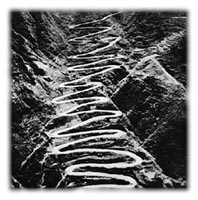
At this stage, Japan had been putting pressure on Britain to close the Burma Road, a supply link enabling war materials to reach China via British Burma. Fearing that refusal could precipitate a Japanese attack on its own colonies in the Far East, and preoccupied with the possibility of a German invasion, Britain agreed. (MG2, 331) Naturally, all of this greatly concerned the Australian government as it could see Britain's home concerns leaving the more distant parts of the Empire, including Australia, totally unprotected against a likely Japanese assault. Indeed, that had long been an Australian concern. According to David Day, as early as September, 1939, Prime Minister Menzies had cabled Dominions Secretary, Eden advocating that to offset Japanese threats in its Far East, Britain should work towards a 'settlement', that would include pressure on China to 'accommodate' Japan's demands. (DD2,9) Similarly, on July 9, 1940, Menzies had cabled Bruce, Australia's High Commissioner in London, to support the closing of the Burma Road, commenting that he could not "...understand why some trifle of this kind should be allowed to stand in the way of a Japanese settlement.", further advocating Japan be allowed to "...establish her commercial position in East Asia and get some assistance in what must be her real economic difficulties". (DD2, 26) (Oh, how our national morals were so easily compromised - altogether similar to the British government's response to Japan's invasion of Manchuria in 1931.- see 7C (d))
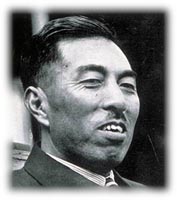
Obviously Prince Konoye, Prime Minister of the new Japanese government which came to power that July, could only have agreed. Japan had long wished to emulate the pattern of forced colonisation that other major powers had established over past centuries. Accordingly, in explaining his government's policy of setting up a 'New Order in Greater East Asia', he did not 'rule out' the use of force, - code for what to expect. (MG2,331) As did Hitler, the Japanese and their puppets sought to justify their ambitions on the grounds that all their predations were for the good of the local people and in defence 'against Communist activities'. (MG2, 357)
In July, 1940, Hitler ordered preparations to invade Russia in mid 1941. And in August 1940 he began his air offensive against Britain, including the bombing of industrial and civilian targets in many cities. At the same time Churchill was planning an offensive air war against Germany that began on August 23, 100 RAF aircraft bombing Berlin. Germany's raids on London, which included incendiary bombs, were aimed at breaking morale, but as we know, the English people's response was rather to be utterly appalled by the barbarity, - to be determined not to give in, and to 'fight back'. By the end of October more than 6,000 British civilians had been killed, including 643 children. (MG2, 345) Over the following months, the size of the raids in both directions was to escalate, though initially Britain suffered greater losses, 4,588 being killed in November alone, many more injured and tens of thousands made homeless. (MG2, 352)
In October 1940 Mussolini sent his troops into Greece, but within 5 months the Greeks had repelled them. Similarly, in September, Italian forces had entered Egypt from Libya, creating a colonial problem for Britain, but by December British and Indian troops had expelled them. (MG2, 349-55) Indeed, by the end of January 1941, British and Australian troops (three Australian Divisions having at Britain's request been present there since early 1940 (DD1, 40, 50, 53)) had pushed the Italian army as far back as Tripoli, eventually taking 130,000 prisoners. (MG2, 362) Feeling confident, Churchill began in March 1941 to send what would be a total of 100,000 troops, including Australia's 6th and 7th divisions, to combat the Italian forces in Greece. (WC4iii, 195) That commitment had been made without prior Australian government consultation or approval. (DD2, 84) As frequently occurred over the past (and still to the present day) Australia and Australians were simply 'taken for granted'.
That aside, Britain's earlier successes against the Italians in North Africa and, for a while, in Greece had for some time decided Hitler to intervene with German troops. By April 8, 1941, these had invaded through Yugoslavia and Bulgaria, advancing as far as the Aegean port of Salonica. (MG2, 364-6) And by April 16, things were going so badly for the Allies that the Greek Commander-in-Chief, General Papagos, anticipating surrender, urged all British, Australian and New Zealand and Polish forces to leave so as to save his country from total devastation, - but that was refused. However, since on April 23 the Greek army surrendered, moves were made for the evacuation of all Allied troops, a force of British, Australians and New Zealanders valiantly holding the narrow Thermopylae pass to enable the rest to get through and embark. According to figures quoted by David Day, of the 53,000 Allied soldiers in Greece, only 43,000 got away, 500 of whom were lost at sea. (DD2, 166)
The evacuees were then transferred to Crete, the last arriving on April 25, for what Churchill hoped would be a successful stand. But to no avail. Since Britain continued to reserve almost all its aircraft for the North African campaign, Germany had complete control of the skies. As New Zealand's General Freyberg later reported, "A small ill-equipped and immobile force such as ours cannot stand up to the concentrated bombing that we have been faced with during the last seven days." (WC4iii, 261) Hence holding Crete was impossible. (MG2, 369) On May 20, Germany launched a massive airborne paratroop assault plus air attacks which over the following week overwhelmed the Allied force, causing 1,742 deaths. Beginning May 26, evacuation followed, but the ongoing air attacks resulted in 2,265 more deaths. (MG2,372) In addition, very significant naval losses in both ships and lives occurred during the final rescue efforts. (WC4iii, 258-9, 269)
The whole campaign had been an absolute disaster, the more so because so many troops had been diverted from North Africa over the very period the German army, under Rommel, had rapidly regained Libya, - in the process laying siege to Australian forces in Tobruk. Indeed, already by the end of April, Rommel's army had begun its advance into Egypt, towards Cairo and the Suez Canal (MG2, 369) All of these reverses and losses put Churchill's reputation and future on the line. They also greatly concerned P.M. Menzies, then in London to confer on prospects for future naval and air defence support for both Singapore and Australia itself. Australia's three AIF divisions were fighting in the Middle East, as were many of its naval vessels, and a steady stream of RAAF air crew were being supplied to Britain. Yet at the same time, for its home defence Australia had almost no military aircraft and no aircraft industry. Indeed, the British government had dissuaded Australia from developing one, claiming Britain should be its sole source of military aircraft. (DD2, 88,95,110,146) And when in April Menzies had sought Hurricane fighter planes, he was put off with the suggestion that Brewster Buffalos (a quite inadequate US plane) would be a good match for Japan's Zeros! (DD2, 120) He did about as well with his request for naval support. Clearly the Middle East had total priority.
(c ) Challenge to Churchill's Leadership fails
The reaction in British ruling circles to the defeats and losses in the Middle East by those who had long been dissatisfied with Churchill's leadership was to increase their efforts towards his replacement. More than ever convinced that further war with Hitler was certain to bring only further defeats, they wanted someone whose past outlook and experience might guarantee favourable terms of settlement with Hitler. Lloyd George seemed one possibility, Eden a less favoured one. Aware of these undertones and anticipating serious fall-out from the recent military disasters, - especially his decision over Greece and the utter failure of the campaign, - Churchill brought on a parliamentary debate on May 7 for a 'vote of confidence' in his leadership. That was a very astute move not only because dissatisfactions with his leadership were almost always covert, but because he had always stated that the struggle would be difficult and long. So he was able, in effect, to mute the criticism by again stressing these difficulties, along with the need of 'sticking together' if final victory was to be attained. And although the Astors, Bedfords, etc., etc., had a very different idea as to the preferred outcome - i.e., of 'accommodating' Hitler, - it was not one they were prepared to go public on, especially since the general public were far more sympathetic to Churchill's approach. Lloyd George and Hore-Belisha led the attack, but when it came to the House vote, 447 to 3 supported Churchill's confidence motion. (DD2, 179-81)
But of course with the further disaster of Crete and the visit to Britain of Nazi leader Rudolph Hess just around the corner Churchill was still anything but secure. A day before Hess flew in, parachuting into Scotland on May 10, London suffered its most severe bombing attack. The same day, the Duke of Bedford proposed Lloyd George should make a public statement setting out possible peace terms with Germany. As Lord Beaverbrook outlined to his fellow editors and correspondents, "Hess had come over to explain that we are beaten and had better give way". David Day makes the point that although Churchill knew he could never have negotiated with Hitler, the official records of his note to Eden, show how Churchill believed, "...that the British Empire could at this time get out of the war intact, leaving the future struggle with a Germanised Europe to the United States". Certainly that was a possible way out - one that would leave the eventual decision and war fighting to another and more powerful country. (DD2, 184-5) But that was a policy utterly opposed by Churchill.
Meanwhile in Libya, matters had not improved and by June Rommel's army was still holding Egypt's western border region with General Wavell anything but confident he could drive it back beyond besieged Tobruk. (Wavell to CIGS; WC4iii, 304) Nevertheless, Wavell's attack with British and Indian forces began on June 15. Although at first all went well, within 48 hours things had gone seriously wrong, his forces having to fall back within the Egyptian border. Rommel, still awaiting reinforcements, did not pursue them. Wavell was replaced by General Auchlinleck and there followed a prolonged "....lull in the German offensive in the Middle East..." (WC4iii, 313-4) Indeed, it was a 'lull' that was to last almost 5 months.
|
|
C. Germany Invades Russia
|
|
(a) Germany Invades Russia, June 22, 1941
From that time on things would be very different, for on June 22 there occurred a German offensive of profound significance. That was Hitler's invasion of the USSR. As earlier documented by Churchill, the Russians had all along expected that it was only a matter of time before Hitler, making good his long-held ambition, would move to invade Russia's extensive lands. (WC4i, 95-8) It reflected the fact that neither Germany nor Russia had ever believed the 'Russo-German Non-Aggression Pact' to be other than a temporary device. As Churchill had early recognised, it was in Russia's case a desperate holding move, the only option left them once his own and Russia's bid to get the British government to support a 'Grand Alliance' (i.e.,of Russia, France and Britain) that would have put Hitler on notice to stop further unilateral aggressions across Europe - had, finally, been rejected yet again. (WC4i, 347-8)
However, notwithstanding these underlying insights found in volume 1 of Churchill's WWII series, by volume III, Chapter XX, "The Soviet Nemesis", he was adopting a very different line, accusing the Soviet government of ignorance of Russia's imminent threat of invasion (they having "no inkling that Hitler had for more than six months resolved to destroy them."); of failing to prepare adequate defences; and of having failed to engage in the war against Germany for 18 months 'while Britain stood alone.' Indeed, according to Churchill, Russia's fateful burden, - of subsequently having to bear virtually the full brunt of Germany's military might over the following three years was a thoroughly deserved one, since "They had shown a total indifference to the fate of the Western Powers, although this meant the destruction of that 'Second Front' for which they were soon to clamour." (WC4iii, 315)
Notwithstanding that later judgement (given post-war, long after the event) at the time of his broadcast to the nation on the evening of the invasion, June 22, 1941, Churchill had in fact recognised Britain's good fortune in acquiring a new ally which (unless it collapsed) would be opposing almost the entire force of Germany's military might. Even so his broadcast began with the words "The Nazi regime is indistinguishable from the worst features of Communism." Notwithstanding that equation, however, speaking of Hitler Churchill went on to say "We shall fight him by land, we shall fight him by sea, we shall fight him in the air, until with God's help, we have rid the earth of his shadow and liberated its peoples from its yoke. .... We shall give whatever help we can to Russia and the Russian people. ... Let us redouble our exertions, and strike with united strength while life and power remain." (WC4iii, 331-3).
Of course it must have been clear to Churchill that Germany's attack on Russia, with 3,200,000 troops, some 120 divisions, along such a greatly extended front - from the Baltic to the Black Sea - must reduce enormously Britain's threat of invasion and the pressure on British and Dominion forces in North Africa. Indeed, the sooner Britain and its allies (hopefully to include the United States) could establish a 'Second Front', whether in Western, Northern or South-Eastern Europe, the sooner would Germany's military machine be overpowered and the war brought to a close. Yet despite his 'fighting words', the above stirring rhetoric, and notwithstanding that for many months the German onslaught was so severe the Russians were driven back hundreds of miles, suffering the gravest losses of territory, people (both military and civilian) and equipment, and despite Stalin's urgent pleas for a European Second Front' to divert at least some of Hitler's forces from his sorely-pressed troops, that was not to be. Instead, notwithstanding Russia's highly precarious situation and possible defeat, all Churchill undertook to do was to send munitions and other supplies from the UK, including portion of the vast supplies from the USA originally destined for Britain. (WC4iii,346) As he explained, a European second front then was simply 'out of the question'. (WC4iii, 344)
By September the German armies had invaded so deeply into Russia, they were laying siege to Leningrad and had come to within 40 miles of Moscow, as well as extending far towards Russia's oil-bearing Caucasus. (WC4ii, 347) And although Roosevelt expressed his belief that the Russian front would hold, that Moscow would not be taken, Churchill was aware that "Almost all responsible opinion held that the Russian armies would soon be defeated and largely destroyed." (WC4iii, 350) Clearly, at the very least, the situation was so critical it could go either way. Yet despite Churchill's earlier proclamation that Britain would "... strike with united strength while life and power remain" (WC4iii, 331-3), and notwithstanding that if Russia was crushed, Britain would indeed be 'standing alone', Churchill's response was essentially to mark time, to 'wait and see'. And this, despite the fact that Britain was at the beginning of a 5-month 'pause' in its comparatively small North African campaign, even though Australian troops were still holding out under great difficulties and hardship against their siege at Tobruk. (WC4iii, 438) The North African campaign's relative smallness deserves emphasis here because, on the scale of things, it was for Germany a campaign of very limited significance. As Churchill admitted, it was never one favoured by the German High Command, its forces having been sent there only because of the Italian rout. (WC4iii, 491) In fact, it was destined to remain a minor theatre with but 90-100,000 troops on each side.
So the commitment of some 100,000 troops by the British (with its Allies) in Libya has to be compared with the 3.2 million by each side on Europe's 'Eastern Front'. Indeed, Martin Gilbert's History of the Twentieth Century indicates the number of troops along that front to have been even greater, a total of some 7,400,000, -(i.e., ~3.7 million each side). (MG2, 379) And of course that is besides the very large but unknown numbers of non-military, behind-the-lines, Russian partisan or 'guerrilla' fighters. Altogether it is impossible for us to gain a full realisation of the scale of that campaign, what it was 'really' like.
That aside, in his account of WWII, Churchill could be bizarrely contradictory about relative contributions. On the one hand he could write, "The entry of Russia into the war was welcome but not immediately helpful to us", - going on to stress how much Britain gave in the way of war supplies. (WC4iii, 350-1) On the other hand he could in contorted contradiction - within the one sentence - conclude, "Without the slightest degree challenging the conclusion which history will affirm that the Russian resistance broke the power of the German armies and inflicted mortal injury upon the life-energies of the German nation, it is right to make it clear that for more than a year after Russia was involved in the war she presented herself to our minds as a burden and not as a help." (WC4iii, 352) And just how many casualties, just how much suffering on both sides of that Russian-German conflict did that 'burdensome' year's interval entail for Britain?! One can only doubt Churchill's sincerity as to that 'burden', since when writing to President Roosevelt on October 20, 1941 about the future expectations of an expanded British army, he could explain such potential as "...rendered possible by the fact that we have not been engaged to any serious extent since the losses of Dunkirk, and that munitions and reserves have been accumulated instead of being expended on a great scale." (WC4iii, 485) (But, publicly, what a master of subterfuge, of 'ever-so-clever' rhetoric!)
All the above is pretty telling, and further analysis of Churchill's account simply confirms the impression of calculated 'wait and see' while these two nations progressively weakened one another, Britain simply standing aside, itself avoiding anything even faintly resembling comparable effort and sacrifice. By the end of 1941, Churchill was convinced that "The threat of invasion of our Island was removed so long as the German armies were engaged in a life-and-death struggle in the East." (WC4iii, 477) And yet, in cabling Stalin on November 21, he could carry on the pretence of comparable commitment and effort by concluding "It may well be that your defence of Moscow and Leningrad, as well as the splendid resistance to the invader along the whole Russian front, will inflict mortal injuries upon the internal structure of the Nazi regime. We must not count upon such good fortune, but simply keep on striking at them to the utmost with might and main." (WC4iii, 472) Well, as you might agree, given the circumstances, what else could he do but strike a pose of mutual effort?!
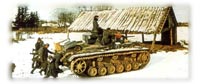
For long, Hitler was fully confident of a short sharp war, one with fast-moving armored divisions, one that would be over in a matter of weeks - certainly not one requiring winter uniforms! To expedite Russia's invasion, as well as to prepare the way for subsequent settlement and exploitation of its resources, he planned to be utterly ruthless. That applied of course to all who resisted, whether Russian troops or civilian partisans. And conveniently Hitler had designated all of Russia's original inhabitants, of whatever 'Non-Ayran' background, as 'inferior people' and therefore expendable. In his terms, better they be hugely reduced in number to make way for the newcomers. That applied not only to the Jews and partisans, but to Gypsies, the mentally and physically afflicted, indeed, to all who might interfere with his 'grand plans' for the region. To facilitate this approach, SS 'Special Task Forces' accompanied the invading armies. (MG2, 380)
As indicated above, in the face of Hitler's 'shock and awe' onslaught, Russia's armies had been forced back many hundreds of miles. Consequently, the Russians adopted a 'scorched earth' regime whereby all that could not be carried away was destroyed, nothing left to support the invaders. In addition there began in July, 1941 a program of transferring entire factories and their populations to the East, beyond the Ural mountains - to Siberia or Central Asia. But despite that effort, unavoidably most of the civil population was overtaken by the invaders and by mid July 1941 the SS Special Task Force had begun large-scale executions of Jews, partisans and others, - for example some 10,000 Jews being machine-gunned into pits in Kishinev and over 30,000 being similarly slaughtered when the German army entered Kiev. (MG2, 390-8)
But that was only the beginning, for what Hitler ordered and Goering and Heidrich, Head of the Reich Security Services then set about, was the systematic deportation of Jews and other unwanted 'inferior people' to specially set up camps where they were exterminated in gas chambers. As Hitler explained to visitors at his Rastenburg headquarters, "The law of existence prescribes uninterrupted killing, so that the better may live." In line with this thinking, his Field Marshall, Walther Reichenau's directive that day stated, "The most essential aim of the campaign against the Jewish-Bolshevist system is the complete crushing of its means of power, and the extermination of Asiatic influences in the European region." (MG2, 399)
In addition, in places like besieged Leningrad, Russians were dying from cold and starvation at the rate of 4,000 a day. At about the same time, 100,000 Russian military prisoners in German-occupied Poland, were surrounded by barbed wire and left in the open without food to perish in the cold. (MG2, 414) Looking forward to the near future, when 'victory was theirs', Hitler's 'most wonderful plan' (long referred to in Mein Kampf) was to tap the Caucasus for its near-inexhaustible quantities of oil, to have the Crimea provide Germany with citrus fruits, cotton and rubber, and to use the Ukraine to supply plentiful grain. He is reported to have said, "We'll supply grain to all in Europe who need it." It was to be the realization of his long-dreamed plan for German colonization, - not overseas like the West's - but close to home in Europe. The conquered Russian people would be denied any access to education. They would become the tillers of the soil for Germany. German settlers and rulers would control the whole region. "The least of our stable lads must be superior to any native." (MG2, 396) Indeed, by October 2, 1941 Hitler was anticipating the fall of Moscow and an early victory.
However, winter was soon to descend with a vengeance and while the Russians (who were both suitably equipped and used to it) stiffened their resistance, the German troops were caught with inadequate equipment and clothing. So in November, not long after Hitler was triumphantly renaming various Russian regions, giving them 'Ayran' names and boasting how he was deciding the fate of Europe 'for the next one thousand years', his soldiers at the front, enduring temperatures of 12 degrees below zero, were encountering equipment-failures and suffering the severest frost bite. (MG2, 401) By December 4, at minus-35 degrees Celcius, German tanks could not be started nor artillery pieces fired, and thousands of their young soldiers were dying from the cold. (MG2, 406)
None of this is to suggest that the Russian defenders were not also suffering. To the contrary, they were suffering and dying on an even more horrifying scale. After all, as explained above, there was a Hitler-driven policy of ruthless violence and extermination which applied equally to all Russians, whether military or civilian. Although the Russians 'won' eventually, it was throughout a hard-fought struggle of the most desperate kind which continued with no let up for the 4 terrible years of that awful campaign. In deaths alone, the figures provided by American historian David Kennedy reveal terrible and telling comparisons. The deaths for Germany, suffered by mostly young German soldiers, were approximately 6 million. Those for Russia amounted to 8 million military, to which must be added 16 million civilians. (DK, 10) Its all so hard to comprehend, but we should do our best to do so if we want in any way to understand the course of post-WWII history - with its immediate transition to the Cold War, supposedly 'justified' by the 'military threat' to Western Europe from an absolutely war-devastated Russia. For comparison, the United States lost 404,399 military dead, the UK 250,000, (plus 100,000 civilians - mostly killed in air raids). (Figures for other nations are given below, see 9H(a))
(b) Churchill and Roosevelt Meet - the 'Atlantic Charter'
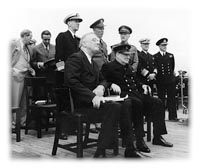
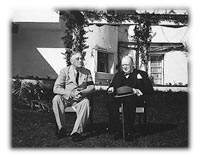
Meanwhile, in August, 1941 Churchill met with US President Roosevelt to review the progress of the war and frame a 'Charter' to guide post-war policy for a juster, more secure world. Later, commenting on its origins, Churchill was proud to declare: "Considering the tales of my reactionary Old World outlook, and the pain this is said to have caused the President, I am glad it should be on record that the substance and spirit of what came to be called the "Atlantic Charter" was in its first draft a British production cast in my own words." (WC4iii, 386) Indeed these show that Churchill had in fact a very clear idea of what was required to make the world a far better place for all and, even more significantly for his immediate needs, what would appeal to people everywhere to encourage their whole-hearted support for the war against Nazism, Fascism and the soon-to-be expanded Japanese militarism. Like the earlier League of Nations Covenant and the subsequent United Nations Charter, it contained commonsense declarations, all essential conditions for a far far better world for people everywhere, - i.e., in marked contrast to what had gone on between the two World Wars in blatant defiance of much wisdom in the League's Covenant! (see WC4iii, 393 for Atlantic Charter text)
What had gone wrong in not learning from the WWI catastrophe, in not taking seriously Lord Cecil's wise counsel and, in good faith, following the League Covenant's best principles had been played out not only in Europe with Hitler and Mussolini, but in Asia, with Japan also continuing to emulate the West's colonial exploitative behaviour - while the major Western Powers, ignoring their obligations under the Covenant, simply 'looked on'. (RC, 199). Only in recent years had some in the West begun to feel real unease at Japan's depredations in China and what they feared might follow. The United States, bordering the Pacific, had long had concerns about the sort of nation they had forcefully 'woken up' (by Admiral Perry, 1853 - see 3A(a) above) and, together with Britain, subsequently encouraged. (see below, D,(a)). And they were especially concerned at Japan's more recent behaviour in China and very recently in 'French Indochina' (Vietnam, Laos, Cambodia). On November 26, 1941, the United States informed the Japanese government that if the US oil embargo against it was to end, Japan must first withdraw its armed forces from both China and Indochina, an uncompromising stand encouraged by Churchill who desperately wanted to see the US join the war. (DD2)
|
|
D. Japan Enters WWII
|
|
(a) Early Lightning Gains - with historical roots
It was not so surprisingly then that before 1941 had ended, Japan became a major contender on the WWII stage when its forces attacked the US's Pearl Harbor fleet. As outlined above (3A(a)) it had, since the 1890s been at war, forcefully colonising various of its Asian neighbours, but this attack was 'different' precisely because, finally, it involved Japan taking on its models, its teachers, the Western Powers themselves.
Before saying more about Japan's role in WWII, its worth commenting on Churchill's views of that historical process. (seeWC4iii, 514) There is no doubt that despite his undoubtedly Conservative upbringing, Churchill had developed many informed insights, some of which he revealed publicly, as where he reviews the early influence of the West on 'modern' Japanese developments, thought, and history. It is highly informative to recount some of it, both for its content and for the realisation as to what he as a world leader understood. As he began, "Uncle Sam and Brittania were the god-parents of the new Japan. In less than two generations, with no background but the remote past, the Japanese people advanced from the two-handed sword of the Samurai to the ironclad ship, the rifled cannon, the torpedo, and the Maxim gun; and a similar revolution took place in industry. The transition of Japan under British and American guidance from the Middle Ages to modern times was swift and violent." (WC4iii, 515) Churchill then goes on to comment on Japan's earlier assaults on China, its 1905 defeat of Russia, how Japan "...took her place amongst the Great Powers", and how the Japanese leaders were "...astonished at the respect with which they were viewed." 'Respect'!, How telling! He further admits how he sided with them in the Russo-Japanese war, that he had welcomed the Anglo-Japanese Treaty (1902-&1904-1921) and 'rejoiced' when Japan, joining the Allies during WWI, took over Germany's 'possessions' in the Far East. My, as illustrated above, it certainly was a fast 'learning time' for the Japanese 'modernisers', those imitators of the West!
Yet, despite all such seemingly insightful revelations, instead of drawing the straightforward conclusion that Japan was simply emulating, ever so 'successfully', the behaviour of the Western Powers, he then goes to much trouble to show how 'different' they were, how one has to struggle to understand 'the Japanese mind'. "It was indeed inscrutable." (WC4iii, 516) Thus rather than interpret the tensions that developed during the inter-war period as a growing disagreement between Great Powers as to who should get what of colonial spoils 'available' in the Far East, Churchill seeks to explain such disagreements in terms of the 'difference' of the Japanese mind, and of Japanese militarism. At the same time he also admits there were elements in their leadership that were keen to avoid conflict with the West - even if for no better reason than that the United States in combination with Britain would prevail.
But as we have seen, the Japanese militarists were determined to continue their horrifying program of 'pacifying' China, just as they wished to extend such campaigns to other parts of the Pacific which, as 'local administrators', they regarded as their 'back yard'. And the Americans, fearful of where all that might lead, having cut off Japan's oil and other essential supplies, made clear that such would remain embargoed until it withdrew completely from China and Indochina. Hence, by November 26, the date of Washington's final 'ultimatum', it was virtually certain that Japan would respond by going to war with the United States. (WC4iii, 521-36)
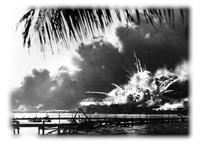
And so it came to pass on December 7, 1941, - Japan's 'surprise' attack on the US's Hawaian naval base of Pearl Harbor. Churchill was 'to rejoice', for it brought the United States into the war, and not only did the US declare war on Japan, but within days, Germany declared war on the US. That situation, - Germany, Italy and Japan, being opposed not only by Russia and Britain but by the USA, with its large population, vast resources and long-underused (seemingly unlimited) production capacity, - convinced Churchill that despite the coming difficulties, it must be only a matter of time before the Axis Powers would be defeated.
The Japanese bomb and torpedo attack on Pearl Harbor, made with some 366 carrier-based planes, had taken the US naval base unawares. The Arizona and three other battleships were lost, along with 1,777 sailors, the total killed in the raid being over 2,400. On December 9 the German navy was ordered to attack any US shipping encountered and, having declared war on the United States, Hitler felt confident that the Axis Powers' combination was unbeatable, bizarrely commenting, "Now its impossible for us to lose the war." (MG2,408) Oh, what insightlessly 'grand' delusions!!
The Japanese onslaught on the West had begun with great 'efficiency', more or less simultaneously on many fronts. Indeed, on the same day as Pearl Harbor there were air raids on both Hong Kong and the Philippines. Also on that day, a Japanese force of 24,000 landed just south of the Siam border, at Kota Bharu on the Malayan peninsula. The British Governor when informed by his military, is said to have responded: "Well, I suppose you'll shove the little men off." (MG2,408) There was indeed at the time a long-held view in British quarters that the Japanese were not only 'little' people, somewhat in-coordinate, short-sighted and subject to night blindness, but also generally inferior imitators of the West's technological accomplishments. It was a view that would change, but not before many many more tragedies had ensued.
As a morale-booster for the British in Malaya, Churchill had sent two of Britain's newest battleships, the Prince of Wales and the Repulse to Singapore. They had arrived on December 2, but in view of what had happened at Pearl Harbor, it was decided to have them join the two remaining battleships of the American Pacific Fleet on the US West Coast. It was to be a symbolic 'proud gesture'. (WC4iii, 547) However, as further Japanese landings were proceeding on the Malayan peninsular, a fateful decision was made to have the British ships assist in Malaya's defence, - notwithstanding that many Japanese ships had been sighted in the Gulf of Siam. Again, sadly, as Churchill indicated, "The efficiency of the Japanese in air warfare was at this time greatly under-estimated....". (WC4iii, 551), for these two 'top' British battleships were attacked by torpedo bombers and sunk with the loss of 840 young lives.
Churchill was concerned that attempts to defend Malaya might result in piecemeal defeats, resulting in the loss of troops needed to retain the British 'fortress' of Singapore - then claimed to be 'impregnable'. With that eventuality in mind, however, he recommended moving the 1st Australian division from Palestine - to add to our 8th division already in Singapore. (WC4iii, 565) Another proposal was to get another Australian division into India, since it too might soon come under Japanese attack. (WC4iii, 566) (Just moving the forces around, so reminiscent of the wonderful game of chess!)
On December 10, 1941 Japanese forces landed on Luzon. That was preliminary to their main force landing aimed at Manila. (WC4iii, 546) It was at this very time that Churchill, on his way to visit President Roosevelt (FDR) to discuss agreements relating to the further conduct of the war, wrote several Memoranda to share with FDR. The one of December 16, 1941, titled "The Atlantic Front" reveals his true evaluations of the significance of the Russian war effort. It is worth quoting the first two paragraphs. He writes:
"Hitler's failure and losses in Russia are the prime fact in the war at this time. We cannot tell how great the disaster to the German Army and the Nazi regime will be. This regime has hitherto lived upon easily and cheaply won successes. Instead of what was imagined to be a swift and easy victory, it has now to face the shock of a winter of slaughter and expenditure of fuel and equipment on the largest scale.
Neither Great Britain nor the United States have any part to play in this event, except to make sure we send, without fail and punctually, the supplies we have promised. In this way alone shall we hold our influence over Stalin and be able to weave the mighty Russian effort into the general texture of the war." (WC4iii, 574)
Indeed, from these memoranda we can begin to see something of Churchill's philosophy on 'how to win the war' against the very formidable Axis Powers. Marking time comes into it, as in the North African campaign. Using the forces of other nations plays another most important role, whether the forces of the Dominions or other Allies: Russians, Chinese, Free-French, Poles or whoever. And of course the Americans, at last brought in, though at this early stage with only some 30 divisions of trained troops, 5 armoured divisions (WC4iii, 620) a heavily-depleted Pacific navy and a still-to-be-developed offensive air force. Indeed, the use of air forces, specially bombing forces, was a major element in his concept of what 'the Allies' could most 'economically' do best, producing enormous levels of destruction on enemy cities and their populations at minimal human, economic and (domestic) political cost to the bombing side. To this end Churchill's early memorandum proposed that American bombing squadrons based in the UK should also target Germany, thus supplementing the British efforts in that direction. The idea was to affect "....German production and German morale by ever more severe and more accurate bombing of their cities and harbours, and that this,......may produce important effects upon the will to fight ....", to which end, "Arrangement will be made ...to increase....the Anglo-American bombing of Germany without any top limit from now on till the end of the war." (WC4iii, 576-7)
There were in addition two other considerations. One, shared by FDR, was for enormously-augmented American war production. For example, for 1942 alone the targets included 45,000 combat aircraft, 45,000 tanks, 500,000 machine guns, and 8,000,000 tons of merchant ships, targets to be greatly exceeded in 1943. (WC4iii, 611) The second consideration was of a Second Front, a land-based invasion of the European Continent, hopefully to encourage local resistance and, eventually, to invade the German homeland, - but only 'eventually'. Indeed, such an invasion was to be carefully timed so it would not occur until Germany was suitably weakened, 'the right moment'. As Churchill was later to comment on deferring the Second Front from summer 1943 to 1944, "The year's delay in the expedition saved us from what would at that date have been at the best an enterprise of extreme hazard, with the probability of a world-shaking disaster." (WC4iii, 586)
But what about Japan?! Well, despite all that 'holding back' on Germany, Churchill cleverly advocated a definite 'Germany First' policy which the US accepted, but which he did not discuss with or even disclose to Australia. He could see Japan's serious resource limitations and, despite its temporary naval strength in battleships (though not in aircraft carriers) the fact that their forces across the Pacific would be spread too widely to provide for strong defence of any one outpost. Hence, when the time came, these could be picked off one by one. (WC4iii, 578-81) Of course, that simple view of the future might apply, but only if Japan failed to occupy and exploit the resource-rich territories of South, and South-East Asia, China, Indochina, Burma, India, Indonesia, New Guinea, etc., - as it fully intended. Indeed, if it were totally successful in fully exploiting those areas it could well grow far stronger, more determined, and better able to accomplish further conquests. And should that occur, there would be no doubt that at some stage it would invade Australia, as Australians and the Australian government feared at the time.
Moreover, when Japan was moving south through Malaya, Churchill could, in fact, clearly see why Australia had good reason to be alarmed, for as he wrote in 1948 after the war, since "The command of the Pacific was lost; their three best divisions were in Egypt and a fourth at Singapore .... A mass exodus into the interior and the organising of a guerrilla without arsenals or supplies stared them in the face. Help from the Mother Country was far away, and the power of the United States could only slowly be established in Australian waters." Notwithstanding this clear insight, Churchill went on, to claim that 'he did not believe' that Japan would invade Australia. (WC4iii, 592) Understandably, however, the Australian people and government, acutely aware of both that risk and the country's own extremely poor state of defence preparedness - almost all its experienced army, navy and air force personnel far away protecting Britain and its Empire, leaving itself with but few troops, a handful of tanks and virtually no operational aircraft, - took a very different view. (DD1, 307-310)
Notwithstanding that precarious situation, one made clear to Churchill by John Curtin, Australia's Prime Minister, Churchill was at pains to reassure Curtin that fears of Singapore falling were groundless despite the fact that on January 10 he had indicated to General Ismay of his Defence Committee, "The Japanese, having obtained temporary command of the sea, and air predominance over considerable areas, it is within their power to take almost any point they wish, apart, it is hoped, from the fortress of Singapore." (WC4iii, 623) In retrospect, hardly a convincing reassurance, as his forebodings of approaching 'immense disasters' confirm. (seeWC4iii,625) Despite that, he was at the same time proposing to Curtin that one Australian division (then in Palestine) go to Singapore or India (!) while also stressing the need for fighter aircraft to be retained in Libya (time indefinite) before they could go to Singapore. (WC4iii, 592-3) Considering the urgency of the imminent threat, it seemed altogether strange that Churchill should at the same time be urging President Roosevelt to send 4 divisions of American troops to Northern Ireland rather than to Singapore for its defence!(WC4iii, 606-7) Again, all a matter of priorities.
To put it mildly, it was all one sided, a reflection of the traditional attitudes of British governments to Dominion and Colonial peoples. It was firmly held that these must serve the Empire (i.e., 'British interests') especially militarily, 'in time of need'. Yet, notwithstanding much placatory rhetoric to the contrary, there existed no reciprocal obligation. (JM) Although this had ever been so, Australians had never come to terms with the reality. Over the previous two years of the war, on the understanding that Britain would guarantee our defence in case of need, not only did Australia provide its top army divisions to serve Britain in the Middle East, and much of its naval strength too, but in November 1939, under the 'Empire Air Training Scheme' (EATS) it committed much of its eagerly ready-to-serve youth to supply Britain with aircrew. That commitment was to provide 36% of the 28,000 Dominions' aircrew committed over the following three years, all to serve under the control of the RAF. (JMcC, 21) Indeed, already by the end of 1941, some 9,000 young Australian airmen were serving in Britain, the Middle East and Malaya. Yet at that critical time, despite assurances on December 18, 1941, that "...very substantial naval, air and army reinforcements were already on the way or arranged for the Far East", Australia was left with no experienced army and little of its navy or air force - that is, almost no battle-experienced aircrew and but a few very inadequate Wirraways (over-weight cumbersome training planes) as the only 'fighter' planes for its home defence. (DD1, 214)
In January 1942, in response to the crisis, Australia stopped EATS trainees going abroad, - but did not recall its overseas aircrews or armies. However, as there were in any case far too few aircraft for our aircrews to use in Australia's defence, their continued retention was lifted the following month. That way it was hoped Britain would make good its promises of aircraft and other equipment for Australia's defence. In the meantime, our government continued producing more of the inadequate Wirraways and the less-than-adequate Beaufort torpedo bombers. (DD1, 214-5)
At this time, since Japanese forces were continuing their conquest of the Philippines, the United States was not ready to give Australia direct help. On January 20, as British General Pownall, on his way to relieve Brooke-Popham in Singapore, saw the situation, the "Jap war so far looks a long way from being a good show", going on to indicate in his diary that the loss of Singapore could. "..well mean losing Australia, if not New Zealand" - not "..to the Japanese, but to the Empire, for they will think themselves let down."(DD1, 220) But Churchill, in denial mode, while determined not to transfer significant arms from Libya, was at the same time reassuring Curtin that Singapore could be successfully defended. (DD1, 224) On December 27, Curtin's statement printed in Melbourne's Herald indicated that Australia must look to America for help, that we must refuse to accept that the Pacific war be treated as subordinate within the general conflict, that there must be a concerted plan aimed at "..hurling Japan back", further stressing that "...the United States and Australia must have the fullest say in the direction of the democracies' fighting plan". Churchill was 'deeply shocked' on hearing of Curtin's 'insulting speech'. (DD1, 227-8)
In Washington, Churchill had secured the US's renewed commitment to giving top priority to his 'defeating Germany first' strategy. Australia was still neither consulted nor even informed of this agreement. A further Washington decision was to appoint General Wavell to head a 'supreme command' of the 'south-west Pacific', a region to include northern Australia. (DD1, 234) Churchill proposed transferring Australian forces from the Middle East, not to defend Australia, but either India or Singapore where our 8th division had already been transferred. The Australian government agreed only to 1800 additional troops for Singapore, but its confidence was not improved when it learned on December 31 that General Wavell's area of responsibility was after all to exclude Australia and Papua New Guinea! At the same time it heard of the decision that the US Pacific Fleet was not to be responsible for Australia's eastern coastline. (DD1, 236-7)
Despite all that, Australia's war Cabinet agreed that its 6th and 7th divisions be transferred to the Netherlands East Indies (NEI) and that the 9th division remain in the Middle East. (DD1,241) Although Churchill continued to assure Australia of the security of the Singapore 'fortress', he was in fact anything but confident and by January 19, was focussing more and more on the need to defend Burma, especially as it was seen as the key to blocking a Japanese invasion of India. Indeed, Japanese forces moved from Thailand into Burma on January 20, following which Churchill was stressing that "...Burma was more important than Singapore". (DD1, 247) That threat could only have exacerbated Churchill's overriding fear, shared by all the colonial powers, of a pan-Asian solidarity movement directed against Western powers, one already being shamelessly exploited by Japan. (DD1, 244-5; JWD, 6-8, 262-5)
(b) Singapore falls; facing invasion, Australia fights back
Before long, by-passing Singapore and striking well south, a large force of Japanese planes attacked Rabaul, New Britain. (DD1, 248) Moreover, by February 8 Japanese forces had crossed to the island of Singapore, then defended by Britain's 18th division along with Australia's 8th. On February 10, Churchill instructed his commanders there to put aside any "...thought of saving troops or sparing the population. .... Commanders and senior officers should die with their troops. The honour of the British Empire and the British Army is at stake." Exactly five days later, on February 15, Britain's General Percival surrendered his forces. As David Day commented, it had been a bad fortnight for Britain, not only for the fall of Singapore, but also because two German cruisers, escaping the Royal Navy, had passed safely through the Channel; Rommel had turned the British advance on Tripoli into a retreat; and fresh moves were afoot for Churchill's demotion as leader. (DD1, 255-6)
On February 17, responding to the dire situation close to home, Australia put itself on a 'total war footing' for the "...total mobilisation of all resources...". Yet, as Britain's High Commissioner commented, "..the military situation had so worsened that Australia lay open to invasion whilst not possessing the means of effective resistance". At this stage the government met with appeals from our servicemen overseas wanting to return to defend their homeland. (DD1, 261-3) Indeed, the threat further heightened as Japanese forces landed in Sumatra. In light of this, Britain's Defence Committee stopped all reinforcements for Java, further ordering a fall-back to "essential bases" - Burma, Ceylon, India and Australia. Concerning the latter, Churchill acknowledged "..it would be difficult to refuse the Australians' request that their divisions should return home". The UK Defence Committee then instructed the British 70th division to go to Ceylon and Burma, and Australia's 7th division, about to board ship, to proceed home rather than to Java.
Notwithstanding that instruction, Churchill was determined that Australia's soon-to-be-shipped 7th division must be diverted to Burma, a view supported by a cooperative Roosevelt who proposed United States troops for Australia 'in exchange' for two AIF divisions for India or Burma. Despite that, Australia's war Cabinet maintained its insistence on the return to Australia of both its 6th and 7th divisions. Also made clear was an insistence on the early return of its 9th division, Curtin stating that the priority for the three divisions must be Australia's defence. Of particular concern was that such arbitrary diversions of one division, the 7th, might well lead to a dangerous and fruitless diversion of all three to Burma where, as almost happened earlier in Greece and Crete, they would likely be overcome and totally lost. (DD1, 264-8)
On February 19, 100 Japanese planes bombed Darwin. Notwithstanding Australia's predicament, Churchill kept insisting it give in to his requests for priority to defend Burma, but our government firmly resisted. So Churchill sent British troops from Cyprus, India and the Middle East. And as if to cap it off, not only against Curtin's clear instructions but unbeknown to him, on February 20, Australian troops in ocean transit were diverted to Burma. By the time Curtin learned of this and again insisted on their return home, the ships were so far off course they could not be re-diverted without being re-fuelled in Ceylon. (DD1, 268-70) Taking advantage of that eventuality, Churchill claimed his action was guided by the view that Britain "...could not contemplate that you would refuse our request and that of the President of the United States", further noting that the Ceylon re-fuelling would give Curtin time to sympathetically "review the position". At this stage (as throughout their long voyage) the diverted Australians were at high risk from Japanese submarines since, as Churchill had acknowledged, throughout the Indian Ocean the British Navy had lost all control. (DD1, 309) Thus it was by only the greatest of good fortune that they escaped being sunk.
In the event, however, Australia agreed to leave its 9th division in the Middle East for a further year and even to allow two brigades of its 6th division to remain in Ceylon for 4-6 weeks, i.e., until relieved by Britain's 'expected' 70th division. But once Churchill knew of Australia's commitment, he offered Wavell 2 brigades of the 70th for India and Burma which meant that Australia's 6th division did not return home until August 1942, too late to assist in the crucial battle to save Port Morseby. (DD1, 276-7) Moreover, as events proved, Burma was not defensible. Indeed, to escape the encircling Japanese forces, Rangoon's evacuation was ordered on February 27, its British defenders embarking on an enforced long march through northern Burma, the lucky ones reaching safety in India. (DD1, 277) As the British Governor, Dorman-Smith, later recorded, the Australians had a narrow escape, for had they been thrown into the defence of Burma, "Lud knows what we'd have done with them. They might have been thrown straight 'from ship to Jap' - with disastrous results. They'd have died gallantly or would have been rounded up by the Japs, as so many of our own and Indian troops were". (DD1, 271)
Although Singapore had fallen on February 15 and British troops would soon be forced to retreat from Burma to India, by February 18, Britain's Pacific War Council, had terminated further reinforcements for the Netherlands East Indies, as well as ordering the evacuation of Wavell's NEI Area Command headquarters. Yet, at that very time this War Council was advocating that the mixed garrisons of Dutch, British and Australian troops remain and fight it out with the Japanese. Naturally, the Australian government disagreed. With the evacuation of Wavell's command, Australia wanted to see the same for its 3,000 troops recently arrived from the Middle East. But that was refused, the result being their capture following the NEI surrender on March 12. (DD1, 277-8)
At this stage the situation for Australia looked extremely grave. When Britain's Chiefs of Staff documented their gloomy view of Britain's prospects against Japan, Churchill tried, unsuccessfully, to prevent it being seen by the Dominions. But his true view of the situation came through in his March 5 cable to Roosevelt in which he indicated it was "...not easy to assign limits to the Japanese aggression. All can be retrieved in 1943 or 1944, but meanwhile there are very hard forfeits to pay." (DD1, 280)
On March 13, 1942, Australia's Minister for Foreign Affairs, Dr H.V. Evatt, went to the US to seek help for Australia's effective defence. However, on leaving he (in common with his Cabinet colleagues) did not know of the secret Anglo-American agreement (code-named "W.W.I") to have Germany defeated before making serious efforts to overcome Japan. (DD2, 287) Indications of that reality were to come to Australia's leaders only slowly and indirectly, as piecemeal bits of information. While it was easy for them to recognise Churchill's priority in first defeating Germany, they believed the US to have been so outraged by the Pearl Harbor assault, that the Japanese threat would be taken at least as seriously. And in travelling to the US just 4 days after General MacArthur's secret arrival in Australia, Evatt's role was also to encourage that balanced viewpoint. (DD1, 288-9) As Churchill saw Evatt's visiting role, he "...was reputed to be one of the least friendly of the Australian Ministers, and most eager to throw himself into the arms of the United States"
(DD1, 296) - hardly an appropriate remark by the leader of the US's 'staunchest ally', but there you are! And, after all, it was known from Churchill's speech of January 28 in the Commons, that he had formally handed over Australia's protection to the Americans. (A, E & P, 157)
At all events, following General MacArthur's arrival, Curtin promptly acceded to an American request to nominate him "Supreme Commander of the South West Pacific Area" (AE&P, 157), believing that at last some importance would be given to prosecuting the war against Japan in our region. And Curtin was further encouraged to again insist on the return from Palestine of Australia's 9th division, which had been a condition of the temporary retention of the 6th division's two brigades in Ceylon. Also expected was that the United States would send to Australia significant forces for MacArthur's command. Through Evatt, Churchill was requested to return the 9th division, but again he refused to withdraw his claim on its command. (DD1, 297-8) A little earlier Churchill had again sought to reassure Australia that "...if you are actually invaded in force....we shall do our utmost to divert troops and British ships....to your succour, albeit at the expense of India and the Middle East". And as he later informed Evatt, "..not a day passes when we do not think of Australia", - on which Day comments, "This was certainly true, but not in the sense Churchill was trying to convey."
(DD1, 299-300)
Seemingly encouraging, a directive from the US Chiefs of Staff to MacArthur indicated that his objectives should include holding "...key military regions of Australia as bases for future offensive action against Japan" and that he should "...prepare to take the offensive". At the same time, however, US Army Chief General George Marshall was in London to discuss Churchill's earlier proposal for a European Second Front in 1942. Churchill's proposal had been made soon after Pearl Harbor with a view to having the US focus on Germany rather than immediate retaliation against Japan. Since then the British navy had suffered a series of serious losses - most recently from Japan in the Indian Ocean - but in any case as we have seen, in reality Churchill had long been averse to engaging in any major 'second front'. The outcome was that any invasion of Europe was deferred in favour of a later and more readily attainable joint Anglo-American occupation of North Africa. Notwithstanding that, yet again it was stated that the struggle against Germany would continue to be the Allies' prime focus. (DD1, 303-4)
On April 20, 1942, General MacArthur met with Curtin to discuss Evatt's progress in Washington for garnering material support via US Chiefs of Staff directives for the war in the SWPA. As MacArthur firmly believed that the necessary support in equipment and troops was yet to be committed by the US, he arranged with Curtin to meet with Australia's Chiefs of Staff to compile an agreed list of requirements - both for Australia's defence and for subsequent offensive action. That was done, but all to little effect, MacArthur being "..bitterly disappointed with the meagre assistance"
received as it was "...entirely inadequate to carry out the directive given him..." and it would "...leave Australia as a base for operations in such a weak state that any major attack will gravely threaten the security of the Commonwealth". You see, although Roosevelt had established a 'Pacific War Council' in Washington, it had no executive powers, - advisory only. So, whilst the existence of this Council, together with the US Chiefs of Staff 'directive' to MacArthur gave the impression of firm resolve and calmed the anxieties of some, it left Australia in the lurch, effectively by-passed by the priorities of the 'Germany first' policy and vulnerable still to Japanese attack. (DD1, 309)
Churchill had acknowledged the loss of British naval control East of Suez. Its ships were sticking close to the east African coastline, assiduously avoiding contact with the Japanese. So of course there was no question of having help in Australia's north from the British navy. At this stage, the Japanese were assembling expeditionary forces in Rabaul for an assault on Port Moresby. Yet in Australia there was no sign of air reinforcements from Britain in recognition of the contribution of Australian aircrews and the ongoing retention of its 9th division in the Middle East. Of the nearly 500 American aircraft in Australia, less than half were serviceable and in any case their crews were yet to be fully trained. Eighty of the 210 US tanks in Australia were of the two-man light variety and of limited use. On MacArthur's recommendation, Curtin requested two British divisions to meet the emergency. Learning of this and claiming it a threat to his 'Germany first' policy, Churchill contacted Roosevelt to question whether the SWPA Supreme Commander had "..any authority from the United States for taking such a line". As Britain "was quite unable" to accede to that request, coming from the Supreme Commander, it was "..a cause of concern", a highly embarrassing faux pas. Supporting Churchill, Roosevelt strongly rebuked MacArthur and, in effect, Australia for making such a proposal. (DD1, 309-10)
Britain's Defence Committee had just reaffirmed its commitment to the 'Germany first' policy, Churchill supporting the priority of aircraft for Russia arguing, "...it was in our vital interests to do so, as the Russians would shortly be engaged in mortal combat with our main enemy". Interesting comment, that! As Germany was about to mount its spring offensive, there was no doubt such assistance was needed. But since Britain was not behaving as if Germany was indeed its 'main enemy', what also was needed was the diversion of even a small allotment of fighter aircraft and other arms from Britain's imports of US armaments (its vast, ever-mounting home stockpile) for Australia's defence - but that was still firmly rejected. (DD1, 309-10)
While Evatt, first in Washington, later in London, had been inordinately slow in comprehending Churchill's and Roosevelt's overall war strategy, Curtin certainly came to understand its underlying reality, as all too clearly did MacArthur who was convinced that "...little assistance was to be afforded the Southwest Pacific Area. The President and General Marshall were under the influence of Mr Churchill's strategy.......General Marshall.....had said that if the Japanese overran the Commonwealth it would be just too bad. He could help the Australians no more than he could help MacArthur in the Philippines.". By early May, 1942, although there were 400,000 American troops in Australia, they were only part trained and ill-equipped to withstand a Japanese attack. Again, MacArthur urged Australia to demand the return of its 9th division, a call backed by our most senior General, Thomas Blamey. (DD1, 319-22) On May 6, Curtin put that issue to his Advisory War Council which fully agreed that its "....predominant concern is the security of Australia". Curtin cabled Evatt that while "..it would be very difficult to get the President and Mr Churchill to deviate from the view that all efforts have to be concentrated on knocking out Germany first", he should nevertheless again press for the return of the 9th division. (DD1, 323)
Most fortuitously for Australia, however, at that critical stage the first tide-turning battle of the Pacific took place. Occurring between May 5 and 8, this was a US naval engagement of a Japanese invasion fleet in the Coral Sea on its way from Rabaul to Port Moresby. Warned in advance via deciphered Japanese signals, the timing and positioning of the evenly matched intercepting US fleet (though it never sighted the invasion flotilla) allowed US carrier-based planes to make a surprise attack. Although the losses of one aircraft carrier each side were about equal, it was a caution for the Japanese who returned their fleet to Rabaul. Instead, Japan sent its army over the steep Owen Stanley Ranges on a land-ward attack aimed at Port Moresby. (DD1, 323-4)
Meanwhile, armed with figures MacArthur had provided, Evatt in London requested more aircraft for Australia's defence. Britain had supplied only 316 of the 2087 earlier ordered. Indeed, between January and August 1942, Britain supplied only 77 combat aircraft from its own production. A further 366 planes had arrived from Britain, but since these were for training Australian aircrew for RAF operations over Europe and the Middle East, they were entirely unsuitable for combat. On May 20 Churchill finally agreed to send 3 Spitfire squadrons to Australia, 2 of them Australian RAAF squadrons serving in Britain. Churchill was anxious that Britain make a visible, if token, contribution to our defence. As he remarked, he had to consider Britain's "..permanent relationship with Australia and it seems very detrimental to the future of the Empire for us not to be represented in any way in their defence." Evatt, was appreciative, believing that he had extracted from Churchill a 'guarantee' that the Spitfire squadrons would not detract from the existing commitment of American planes. But as MacArthur saw Britain's offer of the three squadrons, "Churchill was only giving back to Australia part of her forces and one R.A.F. squadron as a gesture. .... They and more should be forthcoming as a right." Evatt had also sought a contribution of British naval forces, though without success. (DD1, 332-6)
Not until May 28 did Evatt cable Curtin with "W.W.I", the formal text of the 'Germany first' Anglo-American agreement. But by then Curtin and his war cabinet had already a very clear understanding of its practical outcomes for Australia. In fact Evatt's trip had done little to improve Australia's security. The promised 48 second-hand Spitfires arrived nearly 6 months late, having been diverted to the Middle East. And the United States subtracted an equivalent number of aircraft from its Australian allocation, Churchill refusing to appeal that decision. MacArthur's judgement was bitterly critical of Britain's failure to provide effective help for Australia's security. As MacArthur noted, since his arrival Australia had not received from Britain "...an additional ship, soldier or squadron". Further, he berated Britain for not matching the assistance Australia had rendered it overseas, with its naval, military and air forces, contrasting Britain's 1,000 bomber raid on Cologne with the forty, mostly unserviceable bombers provided to his SWPA command. (DD1, 338-9)
(c) Midway Battle turns the Naval Tide
During the first week of June another and more decisive American-Japanese naval engagement occurred at the battle of Midway. To capture this island the Japanese navy had assembled 200 ships. Against that force the Americans could muster only 76 ships, MacArthur warning Curtin that Australia's fate would hang on the outcome. Since a Japanese victory would result in Australia's total isolation, he stressed the absolute necessity of the 9th division's return and the urgency of more combat aircraft. Meanwhile, and before Australia's Advisory War Council met to consider MacArthur's proposals, the Midway battle, by then under way, was to turn the tables dramatically. Despite the unfavourable balance, the US navy sank no less than 4 Japanese aircraft carriers, this resulting in a decisive victory which forced the Japanese onto the defensive for the rest of the war. (DD1, 338)
With much relief for Australia, the immediate crisis, - the threat of imminent invasion was at least deferred. At the same time the war as a whole was far from over and for Australia there remained still, moving towards Port Moresby, a Japanese army which had to be stopped. Initially success in that was extremely doubtful because no Australian soldiers with battle-experience were available for the task - almost all being either in Japanese captivity or far away, fighting in the Middle East.
(d) Young Australians repel Japan's forces aimed at Port Moresby
Hence at this critical time of the war for Australia, that most difficult and dangerous struggle was for some agonising critical months undertaken by totally inexperienced young home defence militia soldiers, members of the 39th Battalion, - about 700 mostly 18 and 19 year-olds who, having been called up the previous October, were barely trained. (PC, 142) Some feeling for what these young boys endured in their heroic efforts to stem the Japanese advance across the Owen Stanley Ranges is given in film-maker, Damien Parer's moving documentary, Kokoda Front Line, as well as from Peter Cochrane's graphic descriptions of the extreme difficulties, dangers and costs involved. These included combating not only the 4-to-1 superior numbers of experienced Japanese soldiers, but doing so in freezing rain at altitudes of up to 10,000 feet, lacking dry clothing, adequate food and suffering dysentery and malaria, while desperately hanging on for the long-delayed reinforcements essential to stem the enemy's advance. (PC, 142-51)
The campaign had begun on July 21 following the Japanese landings at Buna and Gona on the Solomon Sea coast. Quickly advancing, the 39th marched 120 kilometres across the narrow, ever-so-steep Track to Kokoda. But then, meeting the far greater force, their role was inevitably but a delaying-action, a gradual fighting-retreat aimed at stemming the tide long enough to allow reinforcements to arrive before they were driven back to Port Moresby. Through August and into September, with limited but welcome help from a small Papuan Infantry Force (about 30) and numerous 'Fuzzy Wuzzy Angels' to carry and sustain their wounded, - and only later supported by the 53rd Battalion, another militia force, - this task was heroically accomplished with enormous difficulty and at awful cost. (PC, 142-51) Eventually, with vital support from seasoned units from our 7th Division sent from Queensland, the Japanese forces, - by then a mere 50 kilometres from Port Moresby, - were not only blocked but, over the following months, forced back to the Solomon Sea. Indeed, by the end of 1942, the Japanese offensives in eastern New Guinea were at an end. However the eventual battle casualties had been high, amounting to some 5, 698: - 1,731 killed in action, another 306 dying of wounds, a further 128 from disease and other causes. In addition 3,533 had been wounded, - and 15,000 were suffering serious infectious disease. Japanese losses were very severe. Indeed, of its force of some 17,000 troops, approximately 12,000 had died. (PC, 157-61)
As a consequence of these military actions, by the end of 1942 no longer were there on-going concerns that Australia itself would be invaded. So, given that, let us consider what role Australia's military forces might best have taken through the remaining three years of the Pacific War.
(e) Its Security Assured, how then should Australia have fought the Pacific War?
To amplify that question: - given what we now know of the strategy employed by the US in the Pacific to win the war against Japan, we can ask what military strategy should Australia have followed during those final three agonising years of the war? 'What we now know' refers to information contained in several official Reports included in the "United States Strategic Bombing Survey (Pacific War)", (reports which, importantly, covered more than the air war) - especially one titled, "The War Against Japanese Transportation 1941-1945", and another, "Japan's Struggle to End the War". These are dealt with in greater detail below (c.f. 9G(a)). However, to explain in outline, the US 'attack on Japanese transport' entailed (i) employing enough naval (especially submarine) and air power in the Pacific to give the US total command of the seas and skies; (ii) to use that power systematically to sink all Japanese freighters and oil tankers linking Japan's home islands to its recently 'acquired' Empire outposts and (iii) to thus blockade Japan's home islands, -- that most successful strategy finally isolating and 'containing' its overseas forces and completely strangling both its domestic and war economies, this final result completely destroying Japan's ability to continue the war. (see 9G(a) and USSBS-1to3)
The issue of how best Australia should have conducted its own war policy is raised because, under General MacArthur's leadership, Australian forces were kept fighting 'up North' in one location after another in hazardous operations which, whether taken individually or together, neither shortened the war nor made its ultimate victory more certain. Each of these operations resulted in significant numbers of Australians and Americans being killed or wounded. And all to no advantage, since through the US's long-planned and successful home island blockade and by-pass strategies these isolated island-bound Japanese forces ultimately had no option but to surrender, as finally they did.
Unfortunately, however, the record shows Australian forces under MacArthur's command faithfully carrying out three years of unremitting campaigns, all at considerable cost, all only slowly beating back the Japanese forces - westwards along New Guinea's northern coast (eventually as far as Aitape), up the Markham-Ramu valley; eastwards, through the Huon Peninsula to Alexishafen, and well beyond - into New Britain and the Solomon Islands. Just as hazardous and inappropriate were the final campaigns in Borneo. Indeed, MacArthur planned operations not only to liberate the Philippines (with American troops) but, - in defiance of Roosevelt and Churchill's joint commitment to national independence proclaimed through their Atlantic Charter (see 9C(b)), - to restore the 'Netherlands East Indies' and other former colonies to the Dutch, its previous long-time 'owners'. (PS) Eventually that latter strategy was overridden by the US Joint Chiefs of Staff, but not before (within months of the war's end in 1945) Australians had been thrown into costly operations in Borneo - those of Tarakan, Labuan and Balikpapan, all with much unnecessary loss of life.
Sadly, all of these post-Kokoda campaigns which MacArthur had presented to Australia, were endorsed by our own government with the mistaken message that each was 'helping to win the war'. Well, MacArthur knew he was 'just marking time' until the 'real' Pacific war got underway - (as a proud General-in-charge of the SWPA, he had to be actively doing something didn't he?!). But that should not have meant our Australian government agreeing to go along with fruitless, irrelevant, casualty-producing operations. After all, by the end of 1942 Australia was secure from Japanese invasion, Japan's forces were increasingly isolated from their home islands and, as indicated, following Japan's ultimate defeat they would just have to give up and go home - i.e., exactly what finally happened.
In short, in view of the practical implications for Australia of the extraordinarily successful Japanese home island blockade employed by the US navy to defeat Japan, the most appropriate actions for Australian troops, naval and air forces should have been purely holding operations, - actions limited to keeping Japan's overseas troops immobilised where they were. That, and giving priority to strengthening Australia's home defence (the compelling need for any country) and hence a far greater emphasis on self-sufficiency, including the production of combat planes and other equipment for relevant overseas operations limited to the South West Pacific Area. And then top priority could have been given to serious efforts to liberate at least some of Australia's 8,000 prisoners of war, those suffering in Japanese prisoner-of-war camps. I say 'some' since misguided or poorly planned attempts could have resulted in even greater tragedy. Thus, it may not in fact have been feasible to liberate many, if any, in Thailand, Malaya or Singapore - for such attempts might have put our POWs at even greater hazard - yet with careful intelligence and planning, it might have worked out for many others.
With the Allies' capacity to decipher Japanese codes, information on POW transfers could have been ascertained, such providing opportunities for well-planned rescue raids. Obviously Australia's Army commandos working with our Navy and Air Force, (adequately equipped with long-range transporters, e.g., US Liberators or UK Sunderlands, with fighter escort) - all efficiently coordinated - could have played important roles. One of these would have been to intercept Japanese ships carrying Australian and other Allied POWs to Japan. Due to the US policy of sinking all Japanese ships, that periodic transfer operation placed the POWs at special risk from submarine attack, such truly horrifying tragedies being reported on numerous occasions. (MG2, 611-2; 622-3) (more details in Joan Beaumont's article, "Victims of War: The Allies and the transport of prisoner-of-war by sea, 1939-45", Journal of the Australian War Memorial, No.2, 1983) To have the cooperation of US intelligence would have served the dual purpose of alerting US submarine crews to the presence of POW 'cargos' and, at the same time, informing Australia of its opportunity to rescue that living cargo. Likewise, land transfers of POWs, for example in New Guinea or Borneo, especially those involving 'long marches', could have provided rescue opportunities.
Even though casualty rates among rescuers might well have been high, that contribution to Australia's war effort would have received the strongest support from fellow Australians. Of course such operations would have required first-rate equipment, only some of which Australia could have manufactured, and intelligence, much of which may well have had to come from US code-breaking sources. It is an open question, therefore as to whether these operations would have received the necessary Allied cooperation and assistance, but Australians should not have hesitated to make up their own minds, develop their own war strategies, and proceed towards the necessary rescue efforts.
Just how the Pacific war was concluded, - through the very effective blockade of Japan's home islands, the 'island hopping' (at great cost to the combatants of both sides) and, finally, the use of overwhelming air power, bombing Japanese cities and their civilian populations, will be covered later (see 9G (a-c)) - with suggested alternative approaches that could have greatly reduced the final awful death tolls. But first let us consider reasons for delaying the Second Front and the tragic effects of Britain's RAF-based approach to 'winning the war against Germany'.
|
|
E. Back to 'Germany First' - and further delaying the Second Front!
|
|
(a) The Strategy and Rationale
As indicated above, although Churchill, Roosevelt and their high commands planned for their armies to make a direct attack on Germany ultimately, they were strongly motivated to carefully 'time' that eventuality. Certainly by the end of 1942 those two nations between them already had the means to do so. Both from its own production and with US help, Britain had been stockpiling enormous quantities of armaments and the United States' industry, by then well geared up for war, was capable of providing vast quantities of all types of weaponry from its production lines. Indeed, as documented by David Kennedy, the United States' industrial capacity was so great, it very easily coped with all such demands without having to restrict civilian consumption levels in any manner. (DK, 9) And since Germany was their avowed 'prime enemy' there appeared no material bar to mounting a direct attack on Germany itself from the West at any time from 1942. After all, what otherwise should have been the logical 'Germany First' top priority ?!
But there were two major considerations holding them back. One was the political costs of the very high casualty rates inevitable with a major Second Front attack. That could be very unpopular and politically dangerous to those in government. The second consideration was their long-standing concern over what Russia/the USSR stood for politically/economically. That country was, ever since the end of WWI, a Communist state, one committed to its own version of 'collectivism' and opposed to 'private ownership of the means of production', an approach much disliked and feared by Western leaders, an idea they had long feared might 'catch on'. This was especially so since the Great Depression which from 1929 persisted throughout the 1930s, causing much unemployment, deprivation and civil unrest. Indeed, even in the US and Britain, profound economic collapse had been so serious a problem that it had persisted until relieved by the stimulus of war production and the military demands on man (and woman) power. (DK, 3, 8-9 )
From the earliest post-WWI days, there was no doubt, especially in Churchill's and Lloyd George's writings, of the desire to see Communism, this 'Russian experiment', fail. Indeed, that was the prime reason for the military intervention by the UK, France, US, other Western powers and Japan, in Russia's post-Revolutionary Civil War, expeditionary forces remaining there from 1918 through into 1920. Not that the Russians had any 'democracy' in their past history, but that aside, its no wonder they promptly set up a centralised government with far-reaching powers to protect their new-born state. In Churchill's terms, that prompt Western military intervention aimed to 'strangle the revolution at birth' - before it could get established, especially as the revolution might influence other desperate war-torn countries to 'go the same way'. (WC2, 163- ; 232- ; MG1, 669) So although Churchill was greatly opposed to Hitler and his aims, and sincerely sought his defeat, he was more than happy to see Germany and Russia 'fight it out', each greatly weakening the other in the process. (A modern parallel was the US encouragement to the mutual destruction involved in the Iran-Iraq war of the 1980s.)
So for Churchill it could not have been too difficult to reach agreement with the US to engage in more peripheral relatively small military campaigns (which, while they would contribute to eventual victory and divert a few German divisions from the Eastern front would limit the human and material costs of the Western Allies) and defer the timing of their final direct confrontation with what was left of Germany's military might. A parallel strategy was to be the joint Anglo-American air war, the plan to bomb German cities and their populations from bases in England. As that long-held plan involved aircrews from Australia and the other Dominions, it will be dealt with below in some detail. Suffice to say that while these bombing raids caused relatively low casualty numbers for the bombing countries (c.f., the Eastern and eventual Second Front), as percentage losses of the young aircrew lads involved, the casualty rates were extremely high.
Of course a genuine Second Front aimed at invading Germany would eventually become necessary since otherwise the Russians would finally have 'done it all' and the Western Allies might then play little part in the control of the defeated Germany. But in the meantime there occurred, besides the air offensive over Europe, those earlier pre-Second Front military campaigns. These began in November, 1942 with the US invasion of North-West Africa and its occupation of Algiers, Oran, and Casablanca. Then in mid-January 1943 there followed Churchill's meeting with Roosevelt at Casablanca. As documented by historian Martin Gilbert, there they agreed in secret to the following: First, their policy of 'unconditional surrender' (making difficult or impossible any separate peace with Germany's generals intent on overthrowing Hitler). Second, their plan to intensify the air war over Germany, to dislocate its "military, industrial and economic system", aimed also at "undermining the morale of the German people to a point where their capacity for armed resistance is fatally weakened" (a clear reference to terror bombing of civilians); And third, in "strictest secrecy", agreement that no cross-Channel Second Front would be attempted until the summer of 1944. (MG2,482)
Given the successful US occupation of Algiers and its encouragement to Montgomery's 8th Army, it was perhaps not surprising that by February 12, 1943, Rommel's forces had retreated back to Tunisia. And by May 7 British, French and American troops had taken Tunis, the take-off point for a joint invasion of Sicily, which began on July 10. Then, on September 3, 1943, four years to the day since Britain had 'declared war' on Germany, came the Allies first invasion of Europe, namely that of Sicily, the southern-most part of Italy. That was followed by Italy's prompt offer of an armistice, following which German forces took over the opposition, occupying Rome on September 8. Strongly resisted by these forces, the Allies' advance up the Italian 'boot' was slow. Indeed, the Allies did not finally liberate Rome until May 4, 1944, just one month before the opening of the cross-Channel Second Front. (MG2, 567)
(b) Post-Stalingrad Eastern Front : January 1943 - May 1945
After the greatest struggle to save Stalingrad under the most appalling freezing conditions and in the face of Hitler's directive to General Paulus that his surrounded and by then powerless Sixth Army must continue to fight on "..to the last man and the last round", - Paulus' forced surrender occurred on January 31, 1943. Stalingrad had ultimately been saved. Gilbert does not cite the Russian losses, but the German costs were horrifying, 160,000 dead, 60,000 taken prisoner. Then, slowly and at terrible cost, the tide began to turn, Kursk, another key city, being taken on February 8. (MG2, 486) The confidence of senior German military staff in Hitler's leadership was so greatly shaken by his role in this turn of events, that two further assassination attempts by his senior army officers occurred. Unfortunately the first on March 13 failed due to a defective fuse in the bomb placed on his plane. (MG2, 490) In the second attempt, planned for November, Baron Axel von dem Bussche, appalled by Hitler's callous incompetence towards his soldiers' suffering on the Eastern front, and due to demonstrate an improved winter great-coat to his leader, planned to kill both Hitler and himself using a bomb in its pocket. The plan fell through when, before his appointment, the entire great-coat prototype stock was destroyed by a British air raid, Baron Bussche soon after being returned to the Eastern Front where he was severely wounded. (MG2, 532)
Of course, while the saving of Stalingrad, Kursk, and other cities in early 1943 represented the turning point on the Eastern Front, it was, to quote a Churchillian expression, not so much 'the beginning of the end' but rather only 'the end of the beginning'. And yet already the losses on both sides were unspeakably awful. But Hitler, determined to be confident still, was insisting that with his leadership, Germany must prevail, no matter what the costs to his, (by now 'graduated') 'Hitler Youth'. After all, from the very beginning of the movement, that was always to have been their ultimate role: 'glorious sacrifice' in his distorted Cause of the Fatherland.
And, for the Russians, well, with backs to the wall, they were desperately determined to expel those invading their homeland. So, whether or not they were committed politically to the sort of societal organisation that had developed out of the 1917 Russian Revolution, understandably they were utterly opposed to any foreign takeover. And if some Russians were ambivalent on that score, Hitler and his SS 'exterminate the inferior' teams must have greatly augmented their resolve to at all costs resist,
And what a grim task that was, for even after Stalingrad the hoped-for turn of the tide was still but a desperate dream (competing with nightmares) since millions of enemy troops were still deeply embedded many hundreds of miles inside the USSR, along that highly extended front, - from Leningrad in the Baltic north, to the Black Sea and the Caucasus in the south. And as events proved, although from early 1943 the Russians began an offensive which eventually drove enemy forces from their land, that slow grinding traumatic process, always with horrifying losses on both sides, was to go on for a further two and a half years. For the human costs in deaths alone, see Kennedy's figures (DK, 10). Add to those, the awful human costs to those grievously wounded - in body and mind, the bereaved, - it is all past our proper comprehension. In addition, one should consider the vast material losses and opportunity costs to a country which had earlier suffered so very greatly as a result of WWI, the so-called Great War, the 'War to end all War', a country which, had long been grindingly impoverished at the sub-elite levels, yet had been trying to catch up to the living standards of many Western countries. Well, of course the Second World War could only be an enormous set-back to all such developments, to all such hopes.
(c) Britain's Contribution to 'Winning the War against Germany'
As we have seen, even after the inactive period of the Phoney War (September 1939-May 1940), the eleven months that followed, - marked by a series of military disasters (Norway, France/Dunkirk, Greece, Crete) - clearly demonstrated that, even if given the political will, Britain could not alone have made any direct land attack on Germany. Indeed, it was not until Russia came into the war that, pressure on Britain relieved, its elite Conservatives gave up thoughts of 'reaching a settlement with Hitler' (their preferred option) and began to support a war effort. But there were, all round, limits placed on what that effort should be. Early after Dunkirk there was the urgent issue of air defence against German bombers. And once that was successfully overcome, defending the Home Islands against the strangulating effects of submarine warfare came top of the list - a struggle which continued to mid 1944. Indeed, it was a struggle which occupied much of Churchill's war-time speeches. The next priority was defending Egypt (with its Suez Canal), India, and other colonial possessions not already swallowed up by Germany, Italy or Japan. Clearly, all these efforts were defensive. Not one threatened the defeat of Germany.
For all the reasons mentioned above, and notwithstanding all the talk of 'Germany First', there was no British intention to make a direct military territorial attack on Germany itself (even with America's support) until late in that terrible five and a half-year war. In the meantime, the elected strategy was to undertake limited military campaigns that would engage relatively small numbers of German divisions; and to supplement that with an increasingly violent night area-bombing campaign on German cities (new and old) and their inhabitants.
Indeed, as indicated by Churchill to his War Cabinet in September, 1940, the air war was to be Britain's prime contribution to 'winning the war' for as he said, "... the Navy can lose us the war, but only the Air Force can win it.... The fighters are our salvation, but the bombers alone provide the means of victory." Thus, quoting again a passage from Churchill's Memorandum to President Roosevelt dated December 16, 1941, this strategy was to attack "....German production and German morale by ever more severe and more accurate bombing of their cities and harbours, and that this,......may produce important effects upon the will to fight ....", to which end, "Arrangement will be made ...to increase....the Anglo-American bombing of Germany without any top limit from now on till the end of the war." (WC4iii, 576-7) Indeed, in further reviewing the war position in July 21, 1942, Churchill again emphasised this strategy in volume 3 of his Second World War history series. Here he writes: "In the days when we were fighting alone we answered the question, 'How are you going to win the war? by saying, 'We will shatter Germany by bombing.'", he then going on to proclaim, "....that the severe, ruthless bombing of Germany on an ever-increasing scale will not only cripple her war effort, including U-boat and aircraft production, but will also create conditions intolerable to the mass of the German population.' ..... "We must regard the bomber offensive against Germany at least as a feature in breaking her war-will second only to the largest military operations which can be conducted on the Continent until that war-will is broken." (see points 5 - 7 in WC4iii, 781-4 )
Thus, clearly for Britain, until the Cross-Channel Front in June, 1944 - almost five years into the war - that strategy was its prime effort directed towards 'winning the war against Germany'. However, as documented below, while the RAF's night area-bombing exceeded all expectations in the destruction of the buildings, men, women and children of these cities, it had no success in its stated objectives of reducing Germany's arms production or its factory workers' morale. Accordingly, (and leaving aside the issue of the immorality of 'winning the war' by bombing civilian men, women and children) that British Government/RAF strategy made no contribution whatever to winning or even shortening the war. And since some half of the RAF's aircrew came from Britain's Dominions, none of which was provided with any policy input on what occurred, it seems important to set straight the record on how these young people were so tragically involved. I begin with the background to that terrible entanglement for the young Australian and other Dominions' aircrews.
|
|
F. The Dominions and the RAF's Air War against Germany
|
|
(a) The Origins of the 'Empire Air Training Scheme' (EATS)
As indicated above, a mere one hour 15 minutes after Neville Chamberlain's declaration of war against Germany on September 3, 1939, Robert Menzies, Australia's Prime Minister, announced that 'consequently' Australia too was at war. On September 8, Britain's Dominions Office cabled its requirements for military assistance, and by mid October Menzies had stated his government's sympathy with the idea of an 'Empire Air Training Scheme' to supply Britain with aircrew from Australia. In fact, as explained in John McCarthy's highly informative monograph, "A Last Call of Empire: Australian Aircrew, Britain and the Empire Air Training Scheme", for Britain it was not a new idea, for as a contingency it had had such a scheme in mind since the end of WWI. And in 1939, Foreign Minister Eden had claimed that Britain itself would be able to train only half the 50,000 aircrew it expected to 'use' each year. On October 5, the Australian Cabinet gave in-principle approval, following which Menzies announced "It is no wonder that at this hour of suspense, or real peril, and of supreme effort, Great Britain should have turned to her children, the dominions, and to us perhaps not least of all."
(JMcC, 16)
To negotiate the agreement's details, a meeting was called for late October in Ottawa. Leader of the British delegation was Lord Riverdale, the Sheffield steel magnate who as Sir Arthur Balfour, is known to have supported Germany's rearmament from Hitler's earliest days in power. (see 8A(b); also N-B1, 125) Canada was represented by Mackenzie King and other senior ministers, Australia by the 43-year old J.V.Fairbairn who had just received his first portfolio as Minister for Civil Aviation and Air. (JMcC, 17)
On October 31, Lord Riverdale outlined Britain's needs. Twenty thousand pilots plus 30,000 other aircrew, some 9,000 pilots and 13,000 observers to come from the UK, the rest (near 60%) to come from the Dominions. All advanced training to be in Canada, and of the estimated total costs of 888,500,000 Pounds Sterling, Britain would 'contribute' training aircraft and equipment to the value of 140,000,000 Pounds, the balance to be met by Canada (359,000,000) Australia (300,000,000) and New Zealand (89,000,000). The Dominions' governments, prime among them Canada, were aghast. As a most experienced 'committee man', quick-thinking Riverdale promptly called for a large British order of Canadian wheat. Although Australia had also objected, after three weeks of wrangling Fairbairn signed the agreement on November 27, 1939. What 'Australia' had agreed to was a 4-weekly output of 432 pilots, 226 observers and 392 wireless operator-air gunners, all to be available for service with the RAF, all training costs (other than aircraft) to be met by Australia.
Although in Australia's case, two RAAF squadrons, 450 and 467, along with Coastal Command's No.10 squadron, were to remain Australian in name (though usually not in command) (JMcC, 26) all other aircrews would be integrated with the RAF. Indeed, it was British policy to avoid Dominion-identified and -commanded squadrons and thus to prevent Dominions governments from having any say in developing or altering British air-war strategy. (JMcC, 24-5) That was much to the distress of the Canadians who later had some success in negotiating limited control of RCAF squadrons. And under an agreement signed on April 17, 1941, Canada was entitled to 25 Dominion-designated squadrons, Australia 18, and New Zealand 6, - 'details to be sorted out' over the following 18 months! (JMcC, 26)
Despite the apparent advance in joint decision-making, the final outcome was as indicated by the situation at war's end when by April 1945, while 1,488 Australians were said to be 'serving in RAAF squadrons', 10,532 were still simply 'attached to the RAF'. Indeed, with regard to the squadron they served in, the types of operations carried out, (including the nature and timing of specific operations) all such 'attached' personnel were under the complete control of the RAF. Not only could RAAF authorities not play any role in making (or modifying) decisions but very commonly London's RAAF headquarters was not informed of RAF decisions. As McCarthy noted, in the Second World War RAAF-designated squadrons operating from the United Kingdom flew "....65,841 sorties. Not one kilometre, not a single sortie, had been endorsed by the Australian government or air staff." (JMcC, 26,29)
Symbolic of the underlying realities, the first 'recruit' into EATS, his role to manage it in Australia, was the RAF's Air Chief Marshall Sir Charles Burnett, appointed from February 1940 by Australia's Air Minister, Fairbairn during the 1939 Ottawa meeting. And since Menzies wanted a British Chief of Air Staff, Whitehall and the RAF had control of RAAF-EATS aircrew from the very outset. At that stage the RAAF had fewer than 160 training aircraft. And to train the 20,000 aircrew sought by March 1943 it would need at least 30 yet-to-be-established training schools. (JMcC, 30-2) As ever, answering their Country's 'call to service' and further attracted through their youthful sense of adventure, many young Australians from all social strata came forward to volunteer. (JMcC, 33-9) EATS aircrew trainees received the longest, most arduous and exacting training ever given to any volunteer force. Indeed, its overall failure rate was over 30%. By March 1945, a total of 27,387 Australian aircrew trainees had graduated through the EATS program. (JMcC, 59)
Initial selection was followed by enlistment as LAC2s. Next, their induction through an Initial Training School (maths, physics, meteorology, Morse-code, basic drills, etc). After this, successful trainees were mustered into training schools according to future aircrew roles, - pilot, observer, wireless-operator/air-gunner, etc. Then, over the following 12 months, off to a series of specialised training schools before final graduation as NCOs or officers. In many cases further training occurred in Canada before travelling to the UK and squadron posting. There, serving NCOs, if considered worthy, might be promoted to officers, an important matter dealt with below. (see also JMcC,49)
(b) EATS, and the Defence of Australia - Any connection?
As one may well ask, if the EATS program could help Britain early in the war in its 'hour of need' when subject to German air attack and possible invasion, might it not also have assisted Australia later in its defence against the threatened invasion by Japan? In December 1939, Menzies had claimed that Australian expenditure on the scheme would stimulate the local aircraft industry and produce aircrew to add to the Commonwealth's defence needs. In May 1940, Fairbairn claimed the RAAF would possess "...more than 1200 service aircraft with a very great striking capacity". (JMcC, 63) and by mid 1941, John McEwen the new Minister for Air, was stressing the "...1600 per cent increase in Australia's air power...". Yet, in January 1942, with Japanese invasion imminent, Curtin revealed that Australia possessed no fighter or bomber aircraft at all, but only 29 twin-engine reconnaissance Hudsons, 14 Catalinas and just 10 Beaufort torpedo bombers. All the rest were various types of training plane used to prepare Australian aircrews for European theatre use by the RAF. (JMcC, 62, 64)
Indeed, it has to be emphasised that the 1939 EATS Agreement was designed specifically to supply Dominions' aircrew to the RAF. Thus, its terms precluded EATS trainees from being employed in Australia's home-defence squadrons. Moreover, since the agreement stated no limit on the duration of service with the RAF, there existed no provision for 'right of recall' to Australia. In any case, without significant numbers of operational aircraft, withholding or recalling Australia's trained aircrew would have to be of limited value for their country's own defence. (JMcC, 63)
In December 1939, Australia's Air Board had urged a crash program for aircraft production, - not just for training planes, (e.g., Tiger Moths and Wirraways) but for Beaufort torpedo bombers and a twin-engine bomber-reconnaissance aircraft such as the Mosquito that the De Havilland Company had recommended for production in Australia. But by the end of 1941, aside from 1309 'trainers', only the above-mentioned 10 Beauforts had been produced. In June 1940, Cabinet approved the RAAF's expansion to 32 squadrons but, notwithstanding that by December 1941, 6,472 Australian aircrew were serving abroad with the RAF, attempts over the following 18 months to have Australia's orders for British aircraft filled met with no success. Indeed, the British view was very clear. As its Secretary of State for Air, Sir Archibald Sinclair, wrote to his Minister for Aircraft Production, Lord Beaverbrook, "...we must see that the Dominions do not strip us of everything". (JMcC, 64-5)
On December 9, 1941, the day after Pearl Harbor, the Curtin government suspended sailings of EATS trainees. However, in view of the gross lack of operational aircraft at home, that decision was reversed just 6 weeks later. Understandably Australia's predicament was greatly disturbing to many EATS trainees abroad since they very much wanted to return to defend their own country. (DC, 31; JMc C, 65, 67-8) It was a response that strengthened over the following months as the Japanese threat to Australia heightened, but aside from expressed concerns by many of our young RAAF boys in Canada and the UK, all went ahead according to the original British Empire Air Training Scheme (EATS) program.
On arrival in England, EATS graduates were lodged at 'Personnel Reception and Disposal Units', during which time they were assigned to one of the four RAF Commands:- Fighter, Bomber, Coastal, or Army Cooperation. Sadly, the vast majority went to Bomber Command. Following assignment, they progressed to an Advanced Flying School before being posted to an Operational Training Unit, - one linked to their assigned Command, - where 'crewing up' occurred. Characteristically crews were, in varying proportions, mixed British and Dominions personnel. By RAF policy design, even in so-called RAAF squadrons, all-Australian crews were rare. (JMcC, 70-88)
(c) Air Operations, Europe
While Australians served in almost all RAF squadrons in every European and Middle East operational theatre, the great majority were based in Britain within Bomber Command. Command service began as a 'tour' of operations. For Coastal Command that was defined as 800 hours of operational flying. For Fighter, and Army Cooperation Commands it was 200 hours, equivalent to about 80 sorties. (JMcC, 95) Bomber Command's tour, originally 200 flying hours, later became '30 sorties' plus, after a rest, an obligatory second tour of 20 more. When the Canadians proposed that Dominion crews should be returned for 'home leave' on completion of their first tour, the RAF deemed that 'not acceptable'.
For Bomber Command crews, the time to complete 30 sorties, commonly some 10 months, could be anything from 8 to 13. Also variable, was the time taken for individual sorties - anything from 4 to 10 hours. During sorties, there were multiple life-threatening hazards over and above those of flying Bomber Command's aircraft at night, the usual time of RAF operations. That this circumstance alone was hazardous is shown by the fact that night-time air accidents during operational training resulted in the deaths of 617 Australians, another 318 injured. Needless to say, far greater additional hazards occurred during operational sorties. (JMcC, 97, 100-05)
German fighter attack was a major hazard, anti-aircraft flak another, the weather yet another, particularly when already exhausted and not infrequently wounded crews returned in damaged planes to fog-bound airfields. For RAF/government policy reasons, whenever such conditions resulted in aircraft crashes and fatalities not the immediate result of enemy action, they were classed as 'accidents', such causing the loss of 6,000 lives every year of the war. For example, while 4,159 Australians serving with the RAF between December 1941 and March 1944, were killed 'on operations', a further 2,166 died from 'accidents'. (JMcC, 102)
And what were the chances of you surviving even your first tour? The greatest consumer of aircraft and crew was Bomber Command; thus of the 74,797 RAF operations-caused deaths that occurred between 1939 and 1945, over 60% were in Bomber Command. The aircraft loss rate per sortie was about 5%, so your chances of surviving a tour of 30 sorties was 1 in 4, 25%. But because of the 'obligation' to undertake a second tour of 20 sorties, your chances of surviving the total of 50 sorties was just 1 in 14. (JMcC, 107) Since most Australians serving with the RAF were assigned to Bomber Command, that was their prospect . This applied at least until late 1943, by which time the EATS program had trained such a vast surplus of all musterings that Arthur Harris, Bomber Command's Chief, reversed his absolute insistence on the second tour. Yet, since the rule itself remained, about a half of aircrew still went on to that second tour. (for Fighter Command, see JMcC, 106)
The hazards of Coastal Command were not necessarily better and could be worse. - depending on particular squadron assignments and types of operation. Crews on flying boats doing 1,000-hour tours in 1943 had a 40% chance of survival. Yet, a 500-hour photo-reconnaissance tour gave only a 11% survival chance and on a torpedo-bomber squadron only 4% survived a 300-hour tour. (JMcC, 108) Some squadrons doing long-range anti-submarine patrols over the Atlantic had a dismal survival record. For reasons not entirely clear that applied to No.53, my brother Allan's squadron which, like a number of others, operated from St.Eval in Cornwall during 1943 and 1944. From a squadron strength of 21 operational aircraft (each with crew of ten) 16 were lost between July, 1943 and November, 1944, - 13 within the year (July 1943 - July 1944), a loss rate near double that of many other Coastal Command squadrons. (personal communication, Jock Manson, 53 Squadron Historian)
(d) Ill-Used Australian Aircrew
For reasons given above as well as the following, one must seriously raise this issue. As we have seen, Australia was quick not only to support Britain's declaration of war on Germany, but to commit its young men to Britain's air war. As Bomber Command chief, Sir Arthur Harris said, "The training scheme has been the kernel of our air power. Without it we would have been nowhere, with everything in the shop window and no reserves on the shelves." (JMcC, 119) (Reserves? - an odd term since these Dominions' crews were not just there as 'reserves', but were fully used throughout!) Indeed, Harris' view is confirmed by Sir Charles Webster and Noble Frankland, Britain's official historians of the air war, who judged the EATS program a vital component of the UK's ability to man its air force, especially for its 'area-bombing' attacks on Germany. (W&Fiii, 285, 300) And one should recall here that it was these aerial attacks which Churchill claimed were, from 1941 to June 1944, Britain's major contribution to 'winning the war against Germany'. (c.f., 9E above)
Yet, although often promised, when Australia itself, under direct threat of Japanese invasion looked for help from Britain, it was absent. Indeed it remained absent long after there was any conceivable material bar to such assistance. Thus, even leaving aside that potentially catastrophic neglect throughout 1942, - when in June 1943 Australia requested a moderate number of heavy bombers (reduced by Curtin in October 1943 to 'at least two Australian (article XV) Lancaster squadrons' for its Pacific operations, Winston Churchill and RAF chief, Sir Charles Portal denied heavy bombers of any kind. As Churchill noted, "I don't see much in this." (JMcC, 122) Indeed, in December 1943, Portal insisted that Australia "...fulfil as far as she possibly can the obligation under the EATS and for the formation of Article 15 squadrons. We cannot agree to any transfers of complete squadrons to the SWPA from British theatres of responsibility and the return of trained men can only take place on completion of a tour with the RAF." (!) (JMcC, 123)
The underlying reason for these attitudes comes out in Portal's comments to his Vice Chief of Air Staff at the time, "Nothing must be done (which might) detract from the effort in Europe nor to reduce Australia's personnel commitment to the Royal Air Force." As RAAF historian, Alan Stephens, recorded, "His (i.e., Portal's) solution was elegant. Plain logic dictated that the fewer aircraft the RAAF was given for its own use, the fewer aircrew the Australian Government could demand to have sent home from England. Simply by controlling aircraft allocation the RAF controlled the RAAF." (Dr Alan Stephens, historian, The Canberra Times' 'Panorama', Oct.16, 2003, p.3 (AlS, 3-4)
We can only wonder at the self-serving brazenness of the above-cited UK-RAF attitudes. Indeed, these sadly-accepted unilateral decisions were all the more outrageous because at this very time, December 1943, the United Kingdom had at its disposal a vast surplus of its own trained aircrew! That first came to light officially in July 1943 when it was noted that the RAF had 945 more fighter pilots than aircraft. When Churchill called for a review, it was found that Bomber Command had a surplus of 338 complete crews. And by October 1943, Portal had to inform his Air Member for Personnel "The surplus of crews in Home Commands has now reached alarming proportions ...... large crew surpluses exist not only in Fighter but in the other two Commands." (JMcC, 123)
And yet at the very time that Chief of Air Staff, Air Chief Marshal Portal was admitting (but only internally!) the existence of such surpluses and calling for their 'urgent examination' he was exhorting the Canadians to maintain "...at this critical stage of the war, the output of aircrew adequate to match the growing output of aircraft". (JMcC, 124) But by April 1944 there was public concern and London's Evening Standard was also pointing to the number of Englishmen who were waiting up to eighteen months on the same deferred lists for training as pilots, navigators and bomb aimers. Indeed, a month earlier, Lord Balfour, referred to these numbers as "....the manpower of two divisions ....locked up in our deferred lists for a year or more...." . (JMcC, 125)
By November 1944, projected needs of aircrew strength for RAF squadrons was 18,840, while at that very time it had on strength 53,240 plus a known surplus of pre-OTU aircrew in training. (JMcC, 125) It is all so very strange. Clearly the over-supply of aircrew had in fact been recognised by the RAF since December 1943 when it closed 8 of its training centres in Canada. Yet, as mentioned above, at that same time Portal was urging Australia to fulfil its aircrew supply 'obligations', 670 Australian aircrew still arriving in the UK every 4 weeks. (JMcC, 125-6) Thus it appears altogether reasonable to conclude that a clear policy existed for the use, whenever possible, of Dominions' aircrew when replacing the ever-growing operational losses.
By June 1944 the build up in aircrew numbers in the UK was so great that without advance warning, Australia was advised by the UK Air Ministry that no further aircrew were needed! That suddenly left 16,666, mostly in transit through Canada, plus large numbers of part-trained aircrew in Australia - to fill a RAAF home establishment of 9,881 - and, even these still with too few operational aircraft for their needs.
Of course, for Australia there remained the war against Japan, but when in May, 1944, Curtin in London repeated his request for Australian Article XV squadrons to be sent home to serve in the Pacific, while at a Chiefs of Air Staff meeting he received Churchill's encouragement that "...it should never be said that we were willing to accept the help of others in our own extremity but were unprepared to take our share of the troubles of others...", not until April 1945 was it agreed that two Article XV squadrons could go the Pacific. But even then they were not destined for Australia's RAAF use, but to be included in the 10 British bomber squadrons to be based on Okinawa. (JMcC, 126) It would be hard indeed to exaggerate the contempt implicit in this outcome - as in so many earlier decisions, policies and actions emanating from the UK
(e) RAF Bomber Command and its Operations - (with Official UK, US, Reports!)
Since most Australian aircrew sent to Britain ended up in RAF's Bomber Command, I should say something about its role and 'effectiveness' as revealed in official UK and United States Survey Reports. As already indicated, until the opening of the Second European Front in June 1944, Bomber Command's program was Britain's principal effort towards 'winning the war against Germany'. It is not in any sense a happy story, nor was it effective towards its stated aim.
It was claimed to have truly significant results in reducing Germany's armaments production and morale, - both said to be aimed at shortening as well as winning the European war. Prior to 1942, various attempts were made to attain bombing accuracy against specific industrial targets in France, the Ruhr, etc. Since German fighter and anti-aircraft defences were so formidable in daylight, bombing was soon confined to the night hours. However, analysis of aerial photographs made clear that of those aircraft recorded as 'attacking the target', only one in ten got to within 5 miles, - only 1 in 15 if it was a full moon. (DS, 144) As the production of heavy bombers increased, it was decided by the 'strategic air war' planners to carry out area-bombing programs against broad industrial areas within Germany's cities. So while few (if any) bombs would hit the industrial plants themselves, most would explode within the surrounding built-up areas - assumed to be occupied by factory workers and their families. And by killing them, maiming them, destroying their homes and generally disrupting their lives it was hoped to wreck their morale, their will to go on producing arms. (W&Fii, 235)
Well, from 1942 on, Bomber Command followed that British government approach. It was a program that was to expand greatly as more and more heavy bombers and young aircrew from Britain, Canada, Australia, NZ, etc., came 'on stream'. As a result it became more and more 'efficient' in destroying larger and larger areas of German cities, killing and maiming greater and greater numbers of German men, women and children. From August 1942, the United States Air Force (USAF) joined the bombing campaign. While initially this was a small role, it expanded greatly from mid 1943. However, in contrast to the RAF's approach the USAF maintained a policy of daylight precision bombing of specific targets. (for its effectiveness, see (f) below)
In contrast to that, the general plan for area bombing developed by the RAF not only continued, but was greatly amplified. This involved having 'pathfinder' aircraft leading the attack of hundreds of bombers, the pathfinders aiming to bomb as accurately as possible and light up the target for the others to bomb the general area. And to maximise the damage to property and civilians, it was not long before incendiary bombs were used to set fire to vast built up areas, thus generating 'fire storms', with flames so intense few would survive.
The first really 'successful' one of these involved Hamburg on the night of July 28, 1943. That resulted in the complete devastation of eight square miles of the city, thirty five thousand houses and apartments destroyed, 42,000 people killed and unknown numbers horribly burnt and otherwise injured. As Martin Gilbert points out, because of the number of the city's itinerants, the full extent of casualties remains unknown, but must have included numbers of Allied prisoners and indented foreign workers on labour assignments. (MG2, 514-5) Many further such 'triumphs' were reported, including one on a German garrison in Le Havre in which 2,500 French civilians perished (MG2, 611-2) and others on Stuttgart - 1,171 killed; Heilbronn - 7,147 killed; Pforzheim, - 17,600 killed; and, late in the war, Dresden, with a death toll of at least 60,000. (MG2, 613-4; 627; 648; 641-2)
A broad indication of the 'progress' of such strategic bombing warfare is the increase in bomb tonnages dropped year by year through the war. The United States Strategic Bombing Survey, Overall Economic Effects Division, indicates the 'phenomenal increase' as follows. "In 1940, the RAF started out with an average monthly delivery of 1,128 tons which increased to almost 6,000 tons in 1942 when the USAAF joined the offensive. In 1943 the monthly tonnage was 26,000 tons, in 1944 it was 131,000 tons, and in 1945 170,000 tons." (USSBS-Gm, 1)
To see first-hand the official versions of the effects of such bombing with respect to its stated aims of both winning and shortening the war (as well as its effects on the victims on both sides) read the Reports of the United States Strategic Bombing Surveys. These are available on the web as follows -
European War
For Pacific War
The official British analysis on all this destruction, "The Strategic Air Offensive Against Germany 1939-1945" carried out by its official historians, Sir Charles Webster and Noble Frankland, but not published until 1961, is altogether revealing. (seeW&Fii) As they recorded, the RAF's 200,000 tons of bombs dropped on Germany in 1943 caused the deaths of some 200,000 people with far greater numbers injured, and the destruction of over 212,000 buildings. "Hamburg was devastated in a manner never before known..." and through the autumn and winter months Berlin was subjected to almost continuous assault and many other cities attacked "..with great success". (W&Fii, 224) Indeed, as these authors put it, "The area attack of this period was deliberately aimed at the destruction of the principal cities of Germany. The object was, as has been seen, to destroy the entire centre of the cities, the housing, public utilities and communications to such an extent that their inhabitants would not be able to go on working. ... it was the destruction of the living quarters of the towns which was the main object of the attack. The worker was to be deprived of the means of working by the devastation of his environment." (W&Fii, 235)
And then comes the 'punch line' on the effectiveness of that vast devastation when we learn that with all this 'success', "It was natural that those in Britain who surveyed this unprecedented destruction should think that German armaments production must have been sensibly reduced and the morale of the German people, perhaps, fatally undermined." But then follows, "In fact, however, armaments production was not only maintained but much increased during the first half of 1943. It remained at that level, with a slight fall at the end, during the second half and then rose steeply again in the first half of 1944, reaching its peak about the middle of that year." And, as to the effect on morale of the German and foreign (including coerced POW) workers, "....the refusal to accept defeat through anguish and terror must command respect and admiration." (W&Fii, 224-5)
All this is confirmed in the earlier-published United States Strategic Bombing Survey (USSBS) analysis of 1945 which clearly indicated that the area-bombing program carried out by the RAF, including the many devastating raids throughout 1943 to mid 1944, while extremely destructive of cities, their buildings and populations, not only failed to prevent a steady increase in Germany's armaments production but also failed to destroy the morale of the German people. (USSBS-Gm, see Summary) Perhaps that should not have been too surprising in view of the known defiance and determination shown by the British people in response to Germany's earlier bombing of London, Coventry and other cities. And compounding the tragedy of all this counter-productive devastation and killing in Germany, is the human cost on the 'bombing side', the many tens of thousands of young aircrew casualties, some 55,888 being killed, a further 9,162 wounded (1,255 fatally) while serving in RAF's Bomber Command. Of the killed, 38,792 were British, 9,913 Canadian, 4,037 Australian, 1,676 New Zealanders and 27 South African. (W&Fiii, 287) (John McCarthy, gives the total number of Australians killed while serving in all the RAF Commands- - quoting "War Report of the Chief of the Air Staff", - as 6,979. (JMcC, 118, 159.)
(f) The Contrast: US Air Force's Specific Target Bombing from mid-1944
The above is intended as a serious criticism of Britain's principal contribution to 'winning the war', the RAF's WWII programs of night area-bombing Germany. By contrast, the precision bombing approach of the US, through its 8th and 15th Air Forces, aimed at specific industrial plants was from mid-1944 on, to have an increasingly significant effect on limiting Germany's ability to continue the war. Initially that involved daylight raids deep into German territory, such resulting in heavy US bomber losses from enemy fighter aircraft. However the US approach became fully effective when P-51 long-range protective fighter escorts were used. Indeed, it became increasingly effective against a range of specific war-sensitive targets (e.g., production plants for fighter aircraft, synthetic oil, rubber, ball-bearings, etc) the initially crucial one being German fighter plane production. Progressive success in that area meant control of German air space and hence the ability to pound any target vital to Germany's war effort. And, in relation to the cross-Channel invasion of June, 1944, the ability to effectively disrupt German rail and water transport systems, that being vital for the advancement of the invading troops. (USSBS-Gm) Although from mid 1944, the RAF also engaged in precision bombing, it did not discard area bombing, as evidenced by its outrageous attack on Dresden towards the end of the European war.
However, in the closing phases of WWII, - the war against Japan - tragically the US, deviating from its precision bombing approach in Germany, was to do a great deal of horrifying incendiary area-bombing of Japanese cities, anti-civilian bombing which culminated in the also unnecessary atomic bombing of Hiroshima and Nagasaki.
|
|
G. Defeating Japan
|
|
(a) Victory Over Japan clinched by Economic Strangulation (not by Bombs)
"Based on a detailed investigation of all the facts and supported by the testimony of the surviving Japanese leaders involved, it is the Survey's opinion that certainly prior to 31 December 1945, and in all probability prior to 1 November 1945, Japan would have surrendered even if the atomic bombs had not been dropped, even if Russia had not entered the war, and even if no invasion had been planned or contemplated." (USSBS-1, 26; USSBS-2, 13)
As you can see from this quote from the official United States Strategic Bombing Survey (USSBS) of July 1, 1946, the point headlined above is not speculative. It is based on the official USSBS reports of 1945-1947 and their subsequent 10-volume report published in 1976. (see Sources, USSBS-1 to -6) Notwithstanding the 'Germany first' approach agreed to by the United States, the US early planned and took specific actions aimed at total strangulation of Japan's domestic and war-time economy, - what turned out to be highly successful actions which played an altogether crucial role in bringing about that country's ultimate defeat. Indeed, by late 1944, the net effects of these actions were such that Japan, no longer able to wage war effectively, was desperate to end it.
You see, as detailed in Volume 3 of the US Bombing Survey (USSBS-3) titled, "The War Against Japanese Transportation 1941-1945", going back to early 1942, conscious of Japan's small-island status, its marginal food sufficiency, its industries' total dependence on overseas minerals (including oil) and the vastly extended lines of communication to its newly-acquired S.E. Asian and Pacific 'Empire', the US recognised opportunities for literally strangling Japan's economy by blockading its home islands, progressively isolating them from its vast new territories and resources. Considering that virtually all of Japan's material trade, including its military needs, depended on its mercantile fleet, plans were laid to have US submarines sink simply all Japanese ships encountered. Remember, through its success at the naval battle at Midway in July 1942, the US had achieved naval ascendancy over Japan. Moreover, since the great range of US submarines allowed their free movement throughout the Pacific, these craft proved highly effective weapons for the task. As opportunities presented, the US Army and Navy Air Forces also played important roles in progressively reducing Japan's merchant and tanker fleets, - both by direct attack and the laying of mines. In addition American success in breaking Japanese communication codes assisted greatly in identifying, locating, and sinking the ships. (USSBS-3)
The various 'US Strategic Bombing Survey' studies cited (USSBS-1 to -6) provide illuminating details. Emphasising the point made earlier, the Survey titled "The War Against Japanese Transportation 1941-1945" begins, "No major power in the world was more dependent upon ocean shipping than Japan. Her entire economy in peace, and even more so in war, depended on shipping to provide the basic materials for industry and to fill out the supply of staples required to feed and clothe the population." (see USSBS-3, 1) Indeed, even though Japan had long sought to increase its shipping strength, building from 4.5 million tons in 1937 to 6 million by late 1941, that tonnage was even then barely sufficient. This was especially so since following its far-reaching Asian-Pacific expansion, its army and navy insisted on having their own separate shipping 'pools', these together amounting to just over 4 million tons, this leaving only 1.9 million tons for Japan's war production and home economy. (USSBS-3, 2)
Initially Japanese shipping losses were comparatively minor, only 600,000 tons being sunk in 1942, but rapid increases in the production of US submarines and their attacks rapidly changed all that. In 1943, over 1.5 million tons were sunk and in 1944 the losses soared to over 3 million (2.5 million due to submarines). In just 3 months in late 1944 the Japanese merchant fleet lost over 1.3 million tons - more than one third its remaining fleet. For Japan at that stage, navigation within the Sea of Japan and the Yellow Sea remained secure, but nowhere else. In mid January 1945 US carrier fleets sweeping the South China Sea, sank a further 10% of Japan's remaining merchant ships, forcing it to discontinue further convoys between the home islands and Singapore. Soon its merchantmen were confined to the Tsushima Straits and Yellow Sea and by late March 1945, after B-29s had mined not only its Korean seaports but its own home island waters, including the Shimonoseki Straits, Japan's shipping was totally paralysed. (USSBS-3, 2-6)
As the Survey commented, "It is possible that the social and political effects of the transportation attack would have been as effective in forcing a Japanese surrender as were the methods actually employed."- going on to conclude that there was "..a faulty assessment of the Japanese position, a failure to realise the full effects that had been secured by the massacre of shipping, and failure to recognise the vulnerability of the rail system or the effectiveness of its neutralisation in paralysing the Japanese economy and military potential." (USSBS-3,12)
Towards the war's end, this progressive and ultimately complete paralysis of Japan's vital shipping links and economy was accompanied by naval and land battles which enabled the island-hopping advance of American forces towards Japan's home islands. Beginning March 1944, and extending right across the Pacific this advance, via the Caroline Islands (June-July, 1944), the Marianas (July-August), the Philippines (Oct.'44-Feb.'45) and Iwo Jima (Feb-March '45), ultimately included Okinawa (March, '45) this providing a US military base close to Kyushu. In reality at that stage the US, with its overwhelmingly superior naval and air power, had virtually total control over all of Japan's external exchanges, and with essential imports reduced to critical levels, it faced "...a declining output of such war necessities as aircraft, oil, transport, steel, and coal." (USSBS-3, 3) In short, Japan's position was altogether untenable: it had lost the war.
Indeed, even as early as July 1944, stemming from the crippling effects of its shipping losses and mounting military defeats, Japan's fast-deteriorating situation had led to the fall of General Tojo's government, that which had ruled uninterruptedly since October 1941. Thus, by mid 1944 there were many in high places, including Rear Admiral Takagi, who, recognising Japan's inevitable defeat, sought a settlement before his country's ruin was complete. This aspect of events is detailed in the US Survey's report "Japan's Struggle to End the War". (USSBS-2, 2-3) Accordingly, Emperor Hirohito advised the incoming Prime Minister, Koiso, to make a 'fundamental reconsideration' towards ways to end the war. And while there remained some serious resistance to that, principally from within the army, - this resulting in broad agreement 'to continue the war', - that was only to improve Japan's prospects for 'acceptable' i.e., minimal loss peace terms. (USSBS-2, 3-5)
However, by December 1944 Japan's fast-deteriorating situation had made the need for peace even more urgent and in February 1945 the Emperor initiated a series of meetings with his senior statesmen. It was agreed that since it faced certain defeat, Japan should immediately seek peace on the basis of a return to its pre-1931 boundaries. We do not know what, if any, direct approaches Japan made to the Allies, but within a week of US forces landing on Okinawa the Koiso government was replaced by that of Admiral Suzuki who stressed the urgent need to end the war "....as quickly as possible". In May Japan's 'Supreme War Direction Council' discussed ways and means to do just that, hoping to enlist Russian diplomacy in the process. (USSBS-2, 5-6) As the Survey put it "Negotiation for Russia to intercede began the forepart of May 1945 in both Tokyo and Moscow. Konoye, the intended emissary to the Soviets, stated to the Survey that while ostensibly he was to negotiate, he received direct and secret instructions from the Emperor to secure peace at any price, notwithstanding its severity. Sakomizu, the chief cabinet secretary, alleged that while awaiting the Russian answer on mediation, Suzuki and Togo decided that were it negative direct overtures would be made to the United States." (USSBS-2,13)
While ending the war was desperately needed, the would-be negotiators hoped to ensure that the Japanese homeland - together with the Emperor's reign - might remain intact. On June 20 the Emperor, having called his 6 Council members together, reinforced that position, emphasising the extreme urgency. He wanted a special ambassador to go to Moscow, and Prime Minister Suzuki planned to send Prince Konoye. By July 10 the Emperor, concerned at the delay, was urging his Foreign Minister to get Moscow's response, but Moscow had required more detail and in its reply of July 13, stated that as Stalin and Molotov were away at the Allies' Potsdam Conference, no answer was possible until their return. Meanwhile, on July 12 the Emperor had called on Prince Konoye and again "...secretly instructed him to accept any terms he could get and to wire these terms direct to the Emperor." (USSBS-3, 7)
Notwithstanding Japan's realisation of inevitable defeat and its readiness to come to terms, even terms 'without conditions' (Konoye) the US had, since November, 1944, been carrying out long-range bombing raids from its Marianas' Saipan base against industrial targets on Japan's home islands. Since, from the highly successful naval blockade, Japan's industries were already in crisis, those raids were judged redundant. As the USSBS Survey Summary put it "Japan's economy was in larger measure being destroyed twice over, once by cutting off of imports, and secondly by air attack." (USSBS-1,19) In fact, as the study further points out, given that the aim was to totally undermine Japan's domestic support system, both to guarantee and expedite the war's closure, the logical additional bombing targets should have been Japan's highly vulnerable rail system.
Linked by ferry to Hokkaido and having only two tunnels connecting to Kyushu, there were just two main rail lines traversing the length of Japan's main island, Honshu. All these links were extremely vulnerable to interruption by blocking tunnel entrances, bombing bridges, cuttings, etc. Once accomplished, those interruptions (along with the existing sea blockade) would have brought literally all of Japan's economic activity to a standstill. (USSBS-3, 10) As the Summary Report put it, "This strangulation would have more effectively and efficiently destroyed the economic structure of the country than individually destroying Japan's cities and factories. It would have reduced Japan to a series of isolated communities, incapable of any sustained industrial production, incapable of moving food from the agricultural areas to the cities, and incapable of rapid large-scale movements of troops and munitions." (USSBS-1,19)
But, instead, beginning in March 1945, there began high-intensity urban bombing attacks. "The total tonnage of bombs dropped by Allied planes in the Pacific war was 656,400. Of this, 160,800 tons, or 24 percent were dropped on the home islands of Japan.", most by B-29s. (USSBS-1, 16) And the strategy was revised. Instead of targeting specific industries from 30,000 feet, incendiary bombs, clusters of napalm canisters, would be dropped by B-29s from 7,000 feet in patterns designed to burn Japan's principal urban centres systematically. Some 66 Japanese cities were thus attacked, the largest being Tokyo on March 9-10, 1945. "One thousand six hundred and sixty seven tons of bombs were dropped on Tokyo in the first attack. The chosen areas were saturated. Fifteen square miles of Tokyo's most densely populated area were burnt to the ground." ... "In the aggregate some 40 percent of the built-up area of the 66 cities attacked was destroyed. Approximately 30 percent of the entire urban population lost their homes." (USSBS-1,16-7)
(b) As the Japanese were Ready to Quit, why Fire- and Atom-Bomb Them?!
The standard answer to this question is that the months of incendiary fire bombing and, ultimately, atomic bombs were needed to 'force' Japan's surrender and thus to avoid the very high human casualties that inevitably would be involved in a military invasion of the Japanese home islands. As I well remember, that is what US politicians announced to the American people and the world at large and to the present day repeated since. But knowing now what the USSBS report tells us concerning the desperate state of the Japanese economy and military situation, including its account of how Japan was ready to surrender on virtually any terms (certainly on the terms ultimately accepted!) we have to look for other reasons that might have seemed important to the US political and military hierarchy of 1945.
I stress 'hierarchy' because most Americans, had they known the truth, - what the USSBS has told us, - would have been prepared to hold back and wait for that easily-attainable outcome, - via the very peace terms that eventuated. (Here it should be pointed out that the Japanese people were in the same situation during the war, always at the propaganda mercy of their own government.) Similarly, looking back on our recent experiences over Iraq, we can now well appreciate why, especially in matters of war, so many politicians and other 'leaders' go to so much trouble, to cover up, to camouflage the truth. In the US vs. Japan case, as in so many others, the motivation is likely to have been mixed, various interests stressing different 'good reasons' for bombing. I'll mention a few likely ones.
During wars, feelings about 'the enemy' nation and its people run high - particularly so when the racial card is thrown in. The urge to punish not just an enemy's leaders, but its people, can be very strong. During both WWI and WWII, as deliberate policy, the British government encouraged 'anti-German' feeling at home, the German people being characterised as 'the barbaric Huns', etc., - notwithstanding their common Anglo-Saxon and Christian heritage! It was all so convenient. And, as had long applied to colonised Africans or Asians, etc., - when it came to the Japanese it was even easier for people of European origin to be hood-winked into believing that these 'others' were not just 'different', but inferior. Indeed, during WWII, many saw the Japanese soldier (mostly conscripted civilians) as barely human, 'sub-human', as I recall. So, although Japan's foreign and military policies of the late 19th and early 20th centuries had been developed by its elite with absolutely no input from the ordinary men and women of Japan, many Americans (also British and Australians) could think that all Japanese deserved little if any sympathy.
Consequently, even though only a minority of American citizens would have sought some terrible retribution on all Japanese as punishment for Japan's military expansion and heinous war crimes, most war-time strategists, having additional motivations, might thereby have found the awful cost to Japan's ordinary people entirely bearable.
For US leaders and people alike, there was an understandably strong desire to finish the war 'as soon as possible'. And, remember, only the leaders knew of Japan's truly desperate need and desire to surrender. But, sensing their own people's valid concern for ending the war as soon as possible with minimal US casualties, they could take advantage of the widespread view of the Japanese as 'subhuman' to employ whatever means they found most 'useful' in terminating the war. They could open discussions on the surrender terms offered (and finally agreed to) and stand back pending settlement. Or they could follow other agendas, some designed to clarify the effectiveness of various aerial weapons on cities and their populations, others to clearly demonstrate to enemies and the world at large, America's overwhelming power. Sadly for all concerned, America's leaders of 1945 chose the second approach.
As far as testing the effectiveness of high explosive bombs on industrial targets was concerned, little could have been be gained since the German experience was so recently investigated and reported on. (USSBS-Gm) However, as the USSBS Survey Reports on Japan show, there was a very serious interest in the effects of incendiary bombs on densely-populated urban areas in an Asian context. The Japanese cities, especially their central areas, were known for their crowded timber buildings and high population densities. Yet, even if the Japanese had had high-pressure water supplies and highly efficient fire-fighting systems, (they had neither) there could be no surprise that the several forms of jellied petrol ('Napalm') cluster bombs dropped over central Tokyo (and 65 other cities) would cause high-temperature fire storms having altogether devastating effects on homes and people alike. For overall results, as the Summary Report indicates, "In the aggregate, 104,000 tons of bombs were directed at 66 urban areas;.... Some 40 percent of the built-up area of the 66 cites attacked was destroyed. Approximately 30 percent of the entire urban population of Japan lost their homes and many of their possessions."
(USSBS-1,17)
The most intensely fire-bombed city was Tokyo. To quote from the Survey Report, "The primary purpose of this study was to determine why the incendiary bomb attack of 9-10 March 1945 by the Twentieth AF on the densely-populated Incendiary Zone 1 of Tokyo was so highly successful." In 1944, Tokyo was known to have the world's third largest metropolitan area, with a population of 7 million. Incendiary Zone 1 "...was the most highly built-up portion of the city .....Its population density ranged from 90,000 to more than 135,000 persons a square mile and averaged 103,000. ......More than 95 percent of the buildings in Zone 1 were wooden and of typical Japanese construction.. ..... In this attack 9.48 square miles of the target were burned for each 1,000 tons of bombs dropped (or 1 square mile per 105 tons)." The cost of this 'experiment' to ordinary Japanese? "The number of persons made homeless by all attacks on Tokyo totalled 2,861,857 (1,008,000 by the attack of 9-10 March). All attacks killed 95,972 persons (85,793 in the attack of 9-10 March)." (USSBS-5, 67)
In general terms, such results should have been thoroughly predictable, making the 'experiment' totally unnecessary. However, for the newly-developed atomic weapons, some would have argued that such was not the case. The Uranium type had been tested in the New Mexico desert, so its power of destruction against structures and live animals was well established. All that had not been established was its effect on a city and its inhabitants. The planned devastation of Hiroshima and its people by a single bomb provided the results. But as the Plutonium weapon chosen for Nagasaki had never been exploded, its use on August 9, could be claimed as a further 'successful' experiment. Again the Survey paid great attention to the detailed results. Although the Plutonium bomb proved the more powerful in terms of physical damage and human casualties, its results were broadly similar.
As so 'perceptively' noted in the report, "The most striking result of the atomic bombs was the great number of casualties.", at the same time going on to point out that "The exact number of dead and injured will never be known because of the confusion after the explosions ..... estimates of casualties have generally ranged between 100,000 and 180,000 for Hiroshima, and between 50,000 and 100,000 for Nagasaki. The Survey believes the dead at Hiroshima to have been between 70,000 and 80,000, with an equal number injured; at Nagasaki over 35,000 dead and somewhat more than that injured seems the most plausible estimate." (USSBS-6,15) The nature of the injuries was similar to those caused by the incendiary and high-explosive raids, with the important addition of radiation-caused damage - on which the survey provides considerable detail. (USSBS-6, 15, 18-20).
However, as quoted above, notwithstanding all this 'valuable' military data gained from these individual studies, the Survey is frank in its overall conclusion that, "Based on a detailed investigation of all the facts and supported by the testimony of the surviving Japanese leaders involved, it is the Survey's opinion that certainly prior to 31 December 1945, and in all probability prior to 1 November 1945, Japan would have surrendered even if the atomic bombs had not been dropped, even if Russia had not entered the war, and even if no invasion had been planned or contemplated." (USSBS-1, 26; USSBS-2, 13)
As John Kenneth Galbraith, an American economist on the Survey panel commented, "I had no part in this conclusion. By the time it appeared in the summer of 1946, I had moved on to other duties, which included, in a remote sense, the government of Japan. Paul Nitze had replaced Henry Alexander as the effective head of operations for our work in the Far East. An attractive, self-possessed man, he devoted the rest of his life to studying the theory and practice of aerial destruction, emerging in the end as a devout partisan of the art. The effect on my mind and mood was different. I had none of the sense of discovery and excitement that had pervaded our earlier work in Germany. All I felt was the vast suffering visited on innocent people by their disastrous leaders and by unnecessary actions on our side." (JKG1, 233)
As this sensitive humane American described the scene, "The cities of Japan in those dark autumn days were a manifestation of unspeakable gloom. Here a burnt-out bank, there the walls of a community bathhouse, otherwise only ashes and gaunt, free-standing chimneys. ..... ....the B-29s, operating at maximum range, could best hit the cities so it was the attacks on the urban centers, mainly with incendiaries, that became the approved design for victory. Sixty-six Japanese cities were so attacked and levelled in a range from 25 to 90 percent. .... Industrial targets.....were taken up only as operations across the Pacific brought them within range or, as actually happened, the supply of incendiary bombs ran out." (JKG1, 231)
And to emphasise the point already made, he went on, "But no more than in Germany was it the bombing that won the war. Japan's defeat began with the luminous insanity of its own military leadership - of men who, already extensively engaged on the Chinese mainland, took their country into conflict with the vastly greater industrial power of the United States, and by an attack on Hawaii that was superbly designed to resolve all American doubts as to the need or justice of the war. There can be few better warnings from history of the limitless perversity and danger of what is called the military mind." (JKG1, 231)
(c) Japan Surrenders
Despite Japan's already impossible position and readiness for settlement on the terms finally agreed, it became the turn of the US 'military mind' to prevail. Yes, Japan's military leadership had indeed long been 'luminously insane', extremely cruel to its victims in China and across the Pacific, but the manner of Japan's final defeat, involving the targeting of its civil population by the US, provided the worst possible example for others to follow. After first Hiroshima (August 6) and three days later Nagasaki were atom-bombed, Japan formally surrendered to the United Sates on the very terms the emperor had earlier sought: - the Japanese home islands and emperor system to remain intact, all else forfeited . Under US influence the nature of Japan's economy and society were about to change. World War II was at an end and the Cold War about to begin. But before that, let's outline WWII's human costs - in relative national terms.
|
|
H. WW II's Human Costs
|
|
(a) Country by Country - historian David Kennedy's figures
Notwithstanding the truly horrifying human costs of the First World War, those of WWII were far greater. On reflection that should not surprise us for two prime reasons. First not only were so many more nations involved, but with China and Japan included, vastly more people were exposed. Secondly, the physical means for destruction were so much more technologically 'perfected'- and thus their effects vastly amplified - a simple reflection of industrial 'progress' made since 1918, a process that has continued to escalate to the present day, - the stark reality we must ever keep in mind.
Although already referred to, I will again quote overall numbers of WWII deaths, country by country, taken from David Kennedy's paper. (DK, 10)
| Country | Total War Dead | Civilian Deaths |
| United Kingdom | 350,000 | 100,000 |
| China | 10,000,000 | 6,000,000 |
| Yugoslavia | 2,000,000 | 1,500,000 |
| Japan | 3,000,000 | 1,000,000 |
| Poland | 8,000,000 | 6,000,000 |
| Germany | 6,500,000 | 1,000,000 |
| Russia | 24,000,000 | 16,000,000 |
| USA | 405,000 | 6 |
(figures not provided for France, Norway, Canada, New Zealand, Australia, etc.)
Since the figure given for total US military deaths includes those in the US Coastguard and merchant marine, there must have been more than the 6 civilian deaths that Kennedy records. However, the point stressed is that these 6 were the only war-caused civilian deaths to occur on the American homeland - in stark contrast to the civilian losses within the many other combatant countries. The other stark contrast is that of the combined human losses of the United States and Britain, compared to those suffered by all the other countries listed. And of course, as in WWI, besides the human fatalities, there were all the other costs to the people of so many countries - the terrible toll in shattered bodies and minds, the bereavement of relatives and friends, the simply vast material wastes, the ruined economies, the immeasurable opportunity costs.
Some Economic Outcomes
Here too are some stark contrasts, not only between 'victor' and vanquished, but among the victor states themselves. Although Britain's losses in war dead were so much smaller than in WWI, yet again a world war made it slip further down the international economic scale (vast indebtedness to the US, living standards down by a third) a situation further exacerbated by its loss of colonial 'possessions'. Its final position was in great contrast to that of the United States. However, like all other Depression-ravaged countries, the people of the US had been deeply impoverished throughout the 1930s, remaining so into the early 1940s when US unemployment still stood at 15% with 45% households below the poverty line. (DK, 3) But in the particular circumstances of that resource-rich country, all of this changed dramatically following the stimulus of war-time production. Then, not only did the US produce armaments at increasingly record levels, but record levels of civilian output as well, these together providing both full employment and, with money circulating, a 'healthy' market economy. In fact, throughout the war there were essentially 'no shortages', America's standard of living rising some 15%. (DK, 9)
Such an enormous economic upsurge had never before happened to any country engaged in such a war - so how was that possible? Certainly the stimulus of war production was a major factor, but others at least as significant were America's riches in natural resources, its effective isolation and immunity from homeland attack and its decision (along with Britain) to postpone any major military campaign against either Germany or Japan, until the closing phases of the war, in the meantime limiting its military combatant activities, instead concentrating on its submarine attacks on Japanese shipping and its air war against Germany. To these special circumstances must be added another important factor documented by David Kennedy, one connected to the great savings in manpower from its limited military involvement.
In 1942, on the basis of proposals that a Second European Front might be mounted in July 1943, the US had planned to generate 215 military divisions. However, in reviewing such needs in light of the USSR's progress on the Eastern Front, it was decided as early as October 1942 to gamble on cutting the 215 divisions back to 90. Since that was before the first Russian victory, that of Stalingrad, it was indeed a gamble. But once Stalingrad and other Russian military gains had occurred early in 1943, Roosevelt and Churchill felt more confident in their decision to postpone by a full year their direct confrontation with Germany. The Russians, holding up as they were, could be left essentially alone to carry on the land war. And this provided the US with the equivalent of 125 divisions, - available to increase its industrial output. As David Kennedy relates, Josef Stalin was all too aware of this situation, on one occasion summarising it to Roosevelt as "It seems that the Americans have decided to fight with American money and American machines and Russian men." Kennedy could only agree. (DK,9)
Certainly that was the reality, with the obvious consequences not only of an absolutely horrifying death toll among the Russians, but of the simply enormous numbers of wounded and the wide devastation of their cities, towns and countryside and of course their much diminished and delayed capacity to rebuild when it was all over. In American author, John Gunther's "Inside Russia Today", published in 1958, we learn of the 30,000 factories wrecked, 70,000 towns and villages destroyed, three quarters of all housing lost and 25 million made homeless. (JG, 65, 446) In commenting on relative military tolls, Gunther mentions that in just one battle, that of Kharkov, the Russian casualties were greater than the total of all American casualties in the war against Japan. (JG, 65) Such statistics are reflected in his further observation that in the 1950s, 30-year old Russian women outnumbered men seven to one.
|
|
I. WWII and the Origins of the 'Cold War'
|
|
(a) Contrived Origins
For those who survived the Second World catastrophe (with its 54 million dead and vast other costs), as for those of future generations, there remains the issue of why the world of 1945 progressed from one state of war to another, that is, immediately from WWII to the Cold War. From the above account you may already have a partial understanding of the 'logic' of it all, but the enormity of not only two World Wars in just over 20 years, but of the Second World War merging directly into yet another war, the so-called 'Cold War', with its ever-present threat of nuclear annihilation and terror, requires urgent re-examination and explanation. It certainly deserves far more critical examination and public debate, both lacking to date.
Briefly reiterating some background, WWII was fought by the US, USSR, Britain and their allies against the 'Axis Powers', Nazi Germany, Fascist Italy and the equally militaristic Japan, all these Axis Powers extremely anti-communist 'right wing' regimes intent on extending their economic and territorial empires by force of arms. By their aggressive invasions during WWII, (clearly expressions of competitive economic expansion) they saw themselves as taking part in what had been long-standing Western colonial practices. Indeed, for them, their aggressions of WWII in defiance of the League of Nations and international law, were but the extension of territorial invasions they had so recently engaged in during the inter-war period of the 1930s. And of course they were fully aware that these earlier invasions (Japan into Manchuria (1931) Italy into Abyssinia (1935) Germany into the Rhineland (1936) Austria (1938) Czechoslovakia (1938)) had gone ahead without challenge from the 'Great Powers'. And with hindsight, we can understand that such tolerance existed because at the time of their occurrence, they were not seen to threaten those Powers' 'vital interests'.
Thus, at the time these illegal acts were either ignored, - or when 'convenient, encouraged: - as when Britain turned a blind eye to Hitler's military conscription and rearmament (WC4i, 119-120) - then positively encouraged it, even to promote the re-building of Germany's submarines through the Anglo-German Naval Agreement of 1935 (WC4i, 123-8); as when the British government formally 'recognised' Italy's take-over of Abyssinia in 1938 (WC4i, 253); as when the British government went along with Hitler's territorial acquisitions, even those over Czechoslovakia (see 8B(f)(g)). (WC4i, 250-288; and LH, 3-15) Indeed, as explained by Churchill, this tolerance came to an end only with the West's belated realisation that the Dictator's territorial and other aims were so far-reaching that ultimately their 'vital interests' were at stake. So, in effect, like World War I, World War II was brought about by the same sort of 'competitive empire' conflict of economic interest that Hobson (like others) had done his best to warn the 'civilised' world of at the turn of the 19th Century, - in what should have been ample time to prevent the First World War! (JH, 11-3; 129-30; 138-9)
None of this discussion about 'competing empires', the aggressive economic competitions that have led to so many past wars, is in any way meant to exonerate the WWII dictators. Indeed, since they, their policies, their military aggressions, were manifestly hideous, - even long before WWII began, - they had to be stopped by military action. At the same time, however, we need to understand the validity of Hobson's 'aggressive economic competition' explanation as to why so-called 'civilised', 'Christian' nations went to war with one another in his day, as being every bit as applicable through to today. For if we fail to recognise this, and thus fail to remedy the flaws in that still-current aggressively competitive economic system and its outdated ways of thinking that have led us into so many international conflicts, then we are destined to continue down the same disastrous pathway.
If for us that seems fanciful - because everything in our lives so far has been 'just great' - consider for a moment the world's current economic disorder: the horrendous rate of environmental destruction, the growing poverty 'in the midst of plenty', the disaffection of marginalised people, the ever-increasing hunger for resources such as oil, the resource wars (masquerading as 'liberation') as in today's war on Iraq, (Doubting Monopoly players, please go directly to jail and read Ronald Wright's "A Short History of Progress" (RW)). Indeed, as long ago realised by Adam Smith, Hobson and others, the issue of economic disorder arising out of unprincipled greed and injustice is of absolutely central importance because only when the 'system' is fundamentally re-organised into something far more benign, stable, equitable and civilised, will our children, grandchildren, (and children everywhere) have any prospect of leading secure and happy lives. (AS; GD; JR; JKG2) It is planned to give this key issue additional consideration below. (see also Appendix E)
But for now, lets go back to what transpired following WWII, namely the ever-so-swift, indeed immediate transition into the 'Cold War', - the West vs. the communist or socialist nations, - and the extreme danger that ensued after it was claimed (and soon widely accepted on 'our' side of the world), that somehow, (magically?) the very very severely war-devastated USSR was both able and motivated to become a 'military threat' to the United States, Britain, and the other nations of Western Europe.
The publicity campaign to promote this 'threat' was one designed to convince people throughout the West that they should support what was in fact not just 'unnecessary', but an ever-so-wasteful and extremely dangerous nuclear-armed 'Cold War' stand-off and, if further 'called upon', yet another World War (this time nuclear) aimed at destroying the USSR and other communist and socialist states. But how were the huge outlays for armaments and other war preparations to be 'justified' when, after such a terrible world conflagration, people everywhere were (as following the awful traumas of WWI) desperately wanting the transition to peace and security? Well the case was that the USSR's army, which had at such tremendous cost to itself and the country as a whole, so recently fought its way across Eastern Europe into Germany, thereby constituted a military threat to Western Europe.
As well documented, it had been agreed by 'the Big Three' (Roosevelt, Churchill, Stalin) at their Yalta meeting that once the war was won, in deference to Russia's concerns for its future border security, Eastern Europe's states would lie in Russia's 'sphere of influence' - code for Russian dominance! We may reasonably consider that, like other such 'arrangements' around the world - e.g., the US's dominance in the Middle East, South America, etc.,- this was not justice, but as the Russians had done almost all the fighting on the ground, that is what was agreed (though not published until 1947). It was the very fact of Russia's military accomplishment in turning back Germany's military occupation of Eastern Europe (something the West had 'left her to') - coupled to the West's own agreement to support Russia's 'sphere of influence' throughout Eastern Europe, that Churchill and President Truman, Roosevelt's successor, seized on as the basis of their case that the USSR posed a military threat to the rest of Europe!(see Winston Churchill's Fulton Missouri speech - WC5)
And so it occurred that within days of Germany's surrender (May 9, 1945) Churchill's telegram of May 12 to Truman, referring to "....this enormous Muscovite advance into the centre of Europe....", and concluded that "Meanwhile the attention of our peoples will be occupied in inflicting severities upon Germany, which is ruined and prostrate, and it would be open to the Russians in a very short time to advance if they chose to the North Sea and the Atlantic." ! (MG2, 685-6) Planting 'paranoid fears' must have been Churchill's aim (as when in 1922 he and Lloyd George, 'sounding the alarms', claimed Kemal Attaturk's Turkish forces were about 'to invade Europe'! (see 7B(b), 10-12 above) for, given his knowledge of the war's extreme costs to Russia and its people, there is no way he could have believed it!! Even less could Churchill or Truman have believed in any such threat to Western Europe once Japan had been defeated, the US having by then demonstrated the dire effects of atomic bombs on the cities of Hiroshima and Nagasaki. And yet the case to 'justify' the Cold War to their people was built on this trumped-up proposition.
In fact it was a public facade to cover the real concerns and fears of leaders in the US, Britain and other Western states. In brief, such fears were broadly the same as those expressed by Lloyd George in his Fontainebleu Memorandum following WWI. (see MG3, 189-96) In so many countries, long plagued by traditional inequities, WWII had aggravated these and produced enormous destruction and chaos besides. Understandably then, most people were looking for a different future, not simply a return to the old business-as-usual approach to public affairs. Many in France, Italy and other countries were attracted to communism or some other form of socialism, so the very real concern of many Western leaders was that these ideas might spread, that demands for some radically different ways of organising economies, their own societies, might become irresistible. And it was not only Western Europe that could be affected, but Asia, Africa, Central, South America, anywhere at all might take to some form of 'socialism' or other form of cooperative mutual-support 'collectivism'. And the underlying concern there was that those Western economies, which had for so long dominated these regions, colonially and otherwise, might then no longer be able to do so. Yes, of course, they'd be able to trade, but they would not have unfettered access to others' resources and markets and they would not be able to control their currencies and financial credit systems.
Accordingly, it was considered crucial to ensure that people in the West would be brought to see that any economic systems involving 'socialism' were not the way to success, to present them as impoverished (they frequently were) drab, boring, oppressive and above all as military threats to the nations of 'the Free World', which of course they could never have been - even had the desire been there.
(b) ...and MAD Nuclear Options
As mentioned, by August 1945 the US had become a 'nuclear power', at that stage the only power with what is still the supreme 'weapon of mass destruction', the ultimate military tool to terrorise enemy peoples - whether civilian or army, - indiscriminately, the nuclear bomb. Helped by some of Germany's most gifted emigre scientists, it had been developed during WWII within the US, - lest Hitler get it first - supposedly as a precautionary measure. But as we have seen, ultimately it was 'tested' on Japanese cities and their people and then, through a crash programme, added to the US arsenal in ever-expanding quantities. With US help, Britain and then France followed and, though of course not intended, Russia before long too became a nuclear power.
So, the initial advantage of the United States (and its close supporters) of having exclusive possession of atomic weapons was soon lost. But then, with the prospect of an escalating nuclear arms race, instead of proposing a moratorium aimed at the universal abolition of nuclear arms, the US, with its enormous industrial capacity, sought to develop such a vast nuclear superiority - in numbers, power, and sureness of missile delivery, - that it could dictate terms to govern the post-war world. Not just for Americans and Russians, but for all the world's people that approach was an extremely destabilising, and hideously dangerous 'game'. Considering Russia's enormous weakening from WWII and that its industrial development had always lagged far behind that of the US, it may well have seemed that the US's nuclear dominance would soon be overwhelming. However, the USSR somehow managed to more or less 'keep up' with nuclear innovations, including the hydrogen bomb and advanced missile targeting systems, so giving it a degree of 'parity'. And of course in this 'game' even if you had far smaller numbers of weapons, anything over a few tens of nuclear-armed missiles targeted on major cities of the 'other' side amounted to a truly dire threat - and hence something of an 'equaliser'. Thus the US aim of gaining overwhelming superiority failed. Instead there developed between the US and the USSR a 'nuclear stand-off', the ever-present threat of nuclear annihilation on the grand scale, the acme of terrorism, destruction and death, which soon came to hover over both sides. (JS2)
This meant of course the temptation to 'strike first' (before 'they' struck first!) in the hope of inactivating 'their' weapons, delivery systems, leadership, etc. However, it soon became clear that each side had developed such a surplus of weapons and widely-separated launch sites that 'striking first' was anything but 'practical'. And so the nuclear stand-off between the US and the USSR persisted as that unstable 'arrangement' for 'Mutually Assured Destruction' (aptly shortened to MAD) which inevitably would occur in the event of either planned, accidental, or just wrongly-perceived nuclear launch from either side. (JS2) What a result! - a completely disastrous situation, the total denial of the true 'security' so desperately needed by all people in all nations!
(c) Non-Nuclear Strategies of the Cold War - and Civil Wars
Despite the on-going ever-so-precarious 'MAD' nuclear stand-off, the Cold War was nevertheless pursued by other means as well. Overt war between the major powers, even that using conventional weapons, was considered 'too dangerous' because it could too easily get out of hand and lead to a 'MAD', Mutually-Assured -Destruction nuclear war. Nevertheless, the Cold War was still carried on, not only at the propaganda and economic levels, but as 'hot' wars using proxy states. That meant supporting lesser powers in their Colonial or other wars; aiding one or other side in a civil war; or even participating directly in a civil war. Prime examples follow, these being the wars in (and on) both Vietnam and Korea.
|
|
|
|
Chapters
|
Chapter 1
Australia's Foreign Wars: Origins, Costs, Future?!
Chapter 2
Imperial Roots; the Boer War; WWI Early Background
Chapter 3
World War One: Origins
Chapter 4
World War One - and the Gallipoli Campaign
Chapter 5
World War One: Economic Origins
Chapter 6
World War One: Human Costs
Chapter 7
Outcomes of World War I - the Tragic Path to World War II
Chapter 8
Supporting Germany's Rearmament; and the Steady Slide to WWII
Chapter 10
The Cold War, 'French' Indochina, and the Vietnam Wars
Chapter 11
The Korean War - another Civil War in the Cold War
|
|
Appendices
|
Appendix A
Versailles Treaty Provisions Affecting Germany
Appendix B
The 1899 & 1907 Hague Peace Conferences to Prevent War & Weapons of Mass Destruction
Appendix C
Submission by MAPW to AustraliaOs Defence Review 2000
Appendix D
Survival Through the 21st Century
Appendix E
MAPW Submission on the Multilateral Agreement on Investment (MAI)
Appendix F
The adequacy with which Australia's policy and guidelines for controlling military transfers safeguard Australia's defence, security and international relations
Appendix G
Inquiry into the Implications of AustraliaOs Defence Exports
Appendix H
Ockham's Razor 'Arms and the ManO
Appendix I
Winston Churchill in 1929 on threat to Humankind from future Weapons of Mass Destruction
Appendix J
The Question of Terror' from Eureka Street
Appendix K
Australia and Our Violent Century: Time to Learn
Appendix L
Lord Gowries speech at opening of the Australian War Memorial
|
| Sources
|
Aplin, G. Foster, S.G., and McKernan, M., eds
Australians Events and Places
Fairfax, Syme & Weldon, Sydney, 1987
((A E & P))
|
Charlwood, Don
Journeys into Night
Hudson Publishing, Melbourne, 1991
(DC)
|
Churchill, Winston S
The Aftermath - being a sequel to The World Crisis
Macmillan, London,
1944
(WC2)
|
Churchill, Winston S
The Second World War Volume 1 The Gathering Storm
Penguin, London, 1985
(WC4i)
|
Churchill, Winston S
The Second World War Volume 3 The Grand Alliance,
Cassell, London,
1985
(WC4iii)
|
Churchill, Winston S.
The Sinews of Peace
, Speech at Fulton, Missouri,
March 5, 1946
(WC5)
|
Cochrane, Peter
Australians at War
ABC Books, Australian Broadcasting Commission, Sydney, 2001
(PC)
|
Day, David
The Great Betrayal: Britain, Australia and the Onset of the Pacific War
Norton, New York, 1989
(DD1)
|
Day, David
Menzies and Churchill at War
Oxford University Press, Oxford, 1993
(DD2)
|
Dower, John
War Withour Mercy: Race and Power in the Pacific War
Pantheon, NY, 1986
(JWD)
|
Dyer, Gwynne
War
The Bodley Head, London, 1985
(GD)
|
Galbraith, John K
A Life in Our Times: Memoirs
Houghton Miflin, Boston, 1981
(JKG1)
|
Galbraith, John K
Annals of an Abiding Liberal
Houghton Miflin, Boston, 1979
(JKG2)
|
Gilbert, Martin
A History of the Twentieth Century Volume 1
Harper Collins, London, 1997
(MG1)
|
Gilbert, Martin
A History of the Twentieth Century Volume 2
Harper Collins, London, 1997
(MG2)
|
Gilbert, Martin
The Roots of Appeasement
Weidenfeld and Nicolson, London, 1966
(MG3)
|
Gunther, John
Inside Russia Today
Hamilton, London, 1958
(JG)
|
Hobson, John A.
Imperialism: A Study
Allen and Unwin, London, 1902, 1905 &1938
(JH)
|
Kennedy, David.
Rise to Power
Professor David Kennedy on American History. ABC RN, Background Briefing, Sunday October 21, 2001
(DK)
|
McCarthy, John
Last Call of Empire: : Australian Aircrew, Britain and the Empire Air Training Scheme
Australian War Memorial, Canberra, 1988
(JMcC)
|
Mordike, John
'We Should do this Thing Quietly: Japan and the Great deception in Australian Defence Policy 1911-1914'
FRAAF Aerospace Centre, Canberra, 2002
(JM)
|
Noel-Baker, Philip
The Private Manufacture of Armaments>
V1, Gollancz, London, 1938
(N-B1)
|
Rawls, John
A Theory of Justice
Oxford University Press, 1973
(JR1)
|
Smith, Adam
The Wealth of Nations
Books I-V, (1776) Penguin, London, 1999
(AS1)
|
Saward, Dudley
Bomber Harris
Sphere Books, London, 1985
(DS)
|
Schell, Jonathon
The Fate of the Earth
Alfred a Knopf 1982
(JS2)
|
Stanley, Peter
Tarakan: An Australian Tragedy
Allen and Unwin, Sydney, 1997
(PS)
|
Stephens, Alan
, Nobbled by our powerful friends
In The Canberra Times, Panorama, p.3-4, October 16, 1999
(AIS)
|
United States Strategic Bombing Survey
Official Reports for European War
Pacific War
(USSBS-web)
|
United States Strategic Bombing Survey
The Effects of Strategic Bombing on the German War Economy
Overall Economic Effects Division, October 31, 1945
(USSBS-1)
|
United States Strategic Bombing Survey
Summary Report (Pacific War)
(Pacific Report #1) July 1946, Vol.7, ed.D.MacIsaac, Garland, New York, 1976
(USSBS-2)
|
United States Strategic Bombing Survey
The War Against Japanese Transportation 1941 - 1945
May 1947, Vol.9, ed.D.MacIsaac, Garland, New York, 1976
(USSBS-3)
|
United States Strategic Bombing Survey
The Effects of Strategic Bombing on Japan's War Economy
December, 1946, Vol.8, ed.D.MacIsaac, Garland, New York, 1976
(USSBS-4)
|
United States Strategic Bombing Survey
Effects of Incendiary Bomb Attacks on Japan
April,1947, Vol.10, ed.D.MacIsaac,Garland, New York, 1976
(USSBS-5)
|
United States Strategic Bombing Survey
The Effects of Atomic Bombs on Hiroshima and Nagasaki
June, 1946, Vol.7, ed.D.MacIsaac Garland, New York, 1976
(USSBS-6)
|
Webster, Sir Charles & Frankland, Noble
The Strategic Air Offensive Against Germany, 1939-1945
HMSO, London, 4 Vols. HMSO, 1961
(WandF i-iv)
|
Wright, Ronald
A Short History of Progress
House of Anasi Press, Toronto, 2004
(RW)
|
|