|
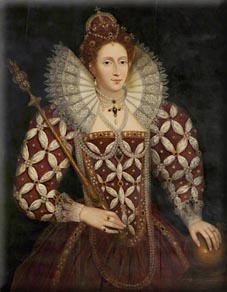
Queen Elizabeth was fortunate to ever achieve receiving the Crown of England. She was Henry VIII's third in succession but highly disputed by many. It was not automatic that she should ever become Queen of England. Her younger brother died of Tuberculosis and her elder sister died of Cancer of the Stomach - neither left an heir of their own. So when Elizabeth was approached to become the monarch in 1558, she was not entirely sure if the knights approaching her were to declare their allegiance to her or to kill her. Disagreements over religion had been unleashed by Henry's marriage to Elizabeth's mother Anne Boleyn. There were many who did not wish to see Anne's daugther become the Queen of England.
The one great concern for Elizabeth during her reign was security. She wanted to secure her own right to be Queen of England but that also entailed making sure that England was strong enough to withstand invasion from foreign, and in particular, Catholic nations. She was particularly apprehensive about her ex-half-brother-in-law Philip II of Spain. Spain had recently taken control of the low countries and was stifling trade with England whilst trying to stamp out Protestantism in what they referred to as the Spanish Netherlands. Elizabeth responded to Philip's threat by trying to encourage trade elsewhere and by buring a blind eye to pirates and corsairs taking the law into their own hands on the seas around England. In the early years of her reign, Spain did have the extra added complication of the rise and expansion of the Turks in the Mediterranean. This occupied much of the Spanish fleet and the King's energy at least until the battle of Lepanto in 1571.
By this time, Elizabeth had personally been identified as being the leading heretic by Pope Pius V who issued a Papal Bull in 1570 that required that all Catholics do all in their power to remove and destroy her and her dominion. The Catholic Church had basically declared war on Elizabeth and England. The dangers awaiting Protestants should the Catholics succeed were revealed in a bloody manner by the St. Bartholomew's massacre in France in 1572. With the permission of the Pope, the Catholic powers in France viciously and with no warning turned out the Protestant Huguenots - murdering many in their beds, homes or streets. Protestant England was shocked to the core by this horrific act and many French and Dutch Huguenots fled from the Catholic kingdoms to England bringing their entrepreneurial skills and detestation of Catholicism with them. The Ridolfi plot confirmed the dangers of an overthrow of Elizabeth when a conspiracy to free Elizabeth's Catholic cousin Mary from imprisonment and receive a Spanish army from the Netherlands and place the Duke of Norfolk on the throne was discovered. This demonstrated that Catholicism was a real and present threat to Elizabeth and so her attitude towards securing her kingdom escalated from a merely defensive nature to an offensive one that took the battle to her enemies.
One of her first concerns was the securing of Ireland which had an overwhelming Catholic majority. She granted extra powers and resources to her lords and adventurers to pacify this unruly kingdom that had been claimed by her father Henry VIII. Rebellions in the province were increasingly becoming identified with Catholicism and so she gave increasing grants of land to those courtiers who she believed were loyal or who could impose law and order on the territories that they controlled. Savage scorched-earth tactics were employed in her name and disease and famine took away the lives of many more as the attempt to instill her rule took up more and more money and effort during her reign and with seemingly less and less security the only result.
In the meantime, Elizabeth sought to replace the lost trade from the low countries by seeking new markets and routes but also to try and muscle in on rival, and especially Spanish, markets. Unofficial permission was given to John Hawkins to explore the African coast with a view to entering the Spanish slave trading business. This hostile trading mission would come to offer a blueprint for later Elizabethan tactics. Feeble attempts were made to take their own slaves, but when this proved too much of a hassle, Hawkins surmised that an easier approach was to take the slaves that had already been rounded up by the Spanish and Portuguese. He therefore raided forts and ships gathering slaves that were then taken across the Atlantic and sold, illegally, in Spanish colonies that were eager for the manpower and thankful at avoiding Spanish taxes and duties. In total, Hawkins was responsible for four such expeditions before the Spanish authorities finally discovered Hawkins at San Juan de Ulua - which he barely escaped with his life.
Not all attempts to find new markets were so antagonistic. Attempts were made during Elizabeth's reign to discover a North East passage to Cathay (China) through the Arctic Ocean and travelling around Norway and Sweden. The Muscovy company was established by Sebastian Cabot and several expeditions were sent North. The route was never discovered due to the arduous nature of the geography of the region, although links were made with Russians. The Muscovy Company started trading in furs, timber, wool, cloth and armaments. This last item had to be dropped from the trading missions when the Hanseatic League discovered that the guns and gunpowder were being used against their members in Eastern Europe. Further attempts were made to travel along the long navigable rivers of Russia, but the difficulty of traversing too many kingdoms and unstable areas made the process of trade too difficult to contemplate by this 'Northerly' route.
A more direct nature was set up by the creation of the Levant Company by William Harborne and put into operation by John Newbery. They set up trading posts in Constantinople and the Eastern Mediterranean with the permission of the Sultan of Turkey. This allowed the English to avoid Venetian middlemen and so make the spices and products of the Orient a little cheaper. Unfortunately for the Levant Company, attempts at opening up trading ports directly in the Indian Ocean were met with hostility from the Portuguese who held a monopoly on the trading rights of Asia thanks to their extensive navigational knowledge and thanks to the 1494 Treaty of Tordesillas that had divided the Eastern and Western spheres between the Portuguese and the Spanish. This was a situation that both were prepared to guard jealously.
It was actually the Spanish hegemony that was challenged by Sir Francis Drake. Drake had accompanied his cousin John Hawkins on his journeys and had his own burning hatred for Catholicism and Spain in particular. Drake set off in 1572 to discover the 'flota', the famed Spanish treasure fleet that brought back the Gold and Silver from Latin America to Spain twice a year. On this voyage, he sacked many ports and captured a number of Spanish ships who were unaccustomed to being challenged in their own backyard. He came close to seizing the bullion for a flota as it lay in Nombre de Dios. He was badly wounded and the attempt was abandoned despite being very close to success. The following year he joined forces with escaped slaves known as Cimarones and a French Huguenot by the name of Guillaume Le Testu and his crew. They all equally hated the Spanish and enthusiastically helped one another to seize a mule train carrying bullion to a flota. This coalition of forces would show that the Catholic powers did not have everything going their way - there were many who resented the success and wealth of the Spanish. By the time of Drake's return to England in 1574 he had become a hero and a wealthy one to boot. Elizabeth was ecstatic at the welcome additions to her treasury brought back by Drake, but the news that he had personally seen the Pacific Ocean (from a vantage point in Panama) made an even greater impact on the Queen and ushered another attempt at finding a route to Cathay that avoided the Spanish and the Portuguese.
Martin Frobisher set off on a number of voyages to ascertain if there was a North-West Passage to Cathay and the Indies. With the support of the Muscovy Company, who were disappointed not to have discovered a North-East Passage, he was able to fund three ships for his expedition With no maps to guide him, he set off hoping to find an inlet that would take them through to the Pacific Ocean. Hugging the coast of Greenland, he discovered Baffin Island and felt that he might be going in the right direction but the terrible conditions and the mysterious loss of two of the three ships convinced him to turn around. Before he did so though, he captured and brought back an Inuit to the sensation of the English court who had never set eyes on anyone from North America before. The fact that his features reminded some of the descriptions of the Chinese and Tartars excited them that Frobisher might be getting close to China after all. He also brought back some mysterious black rocks that was claimed to contain Gold Ore within them. For these reasons, more expeditions were set off in search of the fabled North West Passage and with the blessing of the Queen. These fleets brought back more of the mysterious black rocks but the hoped for gold was found to be nothing more than Iron Pyrites. Great expense had been sacrificed but without finding either gold or a trading route.
Sir Francis Drake had his own plan to find a route to the Pacific - rather than search for a new route, he would find for himself the route taken by the Spanish. He set off in 1577 with a small fleet of five ships to head back to the Spanish Main. He was fortunate to attack and capture a ship with a knowledgable Portuguese pilot, Nuno da Silva. Drake led his fleet down the South Coast of South America and endured great hardships before entering the Straits of Magellan. He would be only the second person to successfully navigate the painfully complicated and dangerous Straits at the foot of South America. He only got through with one ship out of the fleet, the others being lost, scuttled or in one case turned around and returned to England. Undaunted Drake went on and attacked the unsuspecting Spanish ports and ships of the Pacific Ocean with virtual impunity. His ship was filled with Gold before he set sail Northwards trying to find the North West Passage from the opposite side! He landed in modern day California and came into contact with Native Americans who were friendly and well disposed to his men. He claimed the land and the inhabitants as subjects of Queen Elizabeth in a ceremony where he named the new colony 'New Albion'. Aware that the Spanish would be searching for him and his treasure if he returned the way he came, he decided instead to turn his voyage into a Circumnavigation of the globe and set sail Westwards instead. His eventual return in 1580 caused a sensation - many had believed that his ship had been lost at sea and that he would never be seen again. The fact that he was bringing back a ship with even larger quantities of treasure than his 1572 expedition was even more exciting to his commercial backers and especially the Queen herself. Drake was knighted for his efforts which conferred legitimacy on his tactics and endeavours. It was clear that her belligerent policy of trading, raiding and exploring were paying handsomely. Merchant Adventurers nicely summed up the aggressive tactics of her subjects who sought to enrich themselves at the expense of the Queen's enemies.
Sir Humphrey Gilbert would revive attempts at discovering the North West Passage in 1578 and again a few years later. He had been given permission by Elizabeth 'to discover and inhabit some strange place not actually possessed of any Christian prince or people.' it was hoped that the template that had allowed Spain to grow fabulously wealthy from Southern America could be replicated in the North of America. It was also hoped that any new colonies could be used as a base to discover new routes to the Pacific, to find gold or silver in the area or be used as a base to attack the Spanish from. Elizabeth ensured that she would not be lumbered with an expensive legacy and responsibility by putting a 6 year limit within which Gilbert would have to settle his colony. The 1578 expedition was an embarrassing fiasco that barely made it past Ireland. Gilbert was given another opportunity some five years later where ideas were floated of using the new colony to transplant Catholics and remove them from Ireland. The 1583 at least made it across the Atlantic and entered Newfoundland and claimed it for the queen with much fanfare. Disaster would befall the expedition as disease ripped through the exposed settlement. Further exploration resulted in the loss of more ships. The remainder of the fleet set sail back to England, but Gilbert's own ship sank on the return voyage. Needless to say, there had been no hint of the fabled North-West Passage.
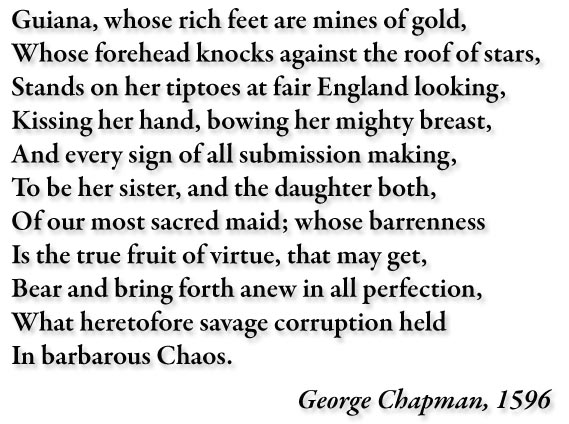
Colonisation attempts did not end with Gilbert though. His half-brother, Sir Walter Raleigh had already ingratiated himself with the Queen and managed to convince her to give him another opportunity at planting a colony. He had the foresight to curry additional favour by naming the location of the colony in her honour as 'Virginia'. She gave him permission to establish a colony on her behalf in the slightly longer time-scale of 7 years.
Elizabeth's reign saw England change from being a parochial introverted Kingdom into being a World player. This was done largely as a reaction to the threat towards Elizabeth and her Kingdom from the Catholic powers of Europe, but her reaction to the threat put England on a course towards an imperial player. The rising maritime power of the Kingdom would enable England to contemplate settling colonies in other parts of the world, to search for new trade routes and to barge in on existing trade routes when necessary. These were the essential preconditions for what would later be referred to as Empire. For Elizabeth they were a means to survival, they just happened to be tools that could be used offensively just as effectively as defensively.
|