|
George III has always had a controversial reputation. In 1957 Richard Pares wrote that the debate over George III's constitutional role was 'one of the most celebrated mulberry bushes in modern British historiography; historians began going round it in 1802 and are still going strong'. The historiographic disputes of the postwar era are a dim memory now. Indeed, despite the fact that he remains one of the most easily-recognised of Britain's monarchs, relatively little has been written on George III over the last twenty years. However, in this Jubilee year, the importance of his sixty-year reign and his role at its centre - Patriot Prince or absolutist bogeyman? - deserves fresh consideration.
After George III's death, Mrs Arbuthnot was by no means the only observer to bestow upon the late King the accolade of 'the father of his people'. Early Victorian historians, though, tended to follow John Adolphus's line of his History of England of 1802, congratulating George for attempting to dismantle the oligarchy of the self-serving Whig grandees in the 1760s, while berating him for his early reliance on the power-hungry Marquess of Bute. Writing in the mid-Nineteenth Century, William Thackeray saw George as 'a kindly partaker of honest pleasures', declaring that 'that good man's example, his moderation, his frugal simplicity, and God-fearing life, tended infinitely to improve the morals of the country and purify the whole nation'. By the time that Trevelyan's Early History of Charles James Fox was published in 1880, however, praise for George III's character was diluted by harsh criticisms of his constitutional presumptions. George not only strove 'to foster disunion among politicians' (as if this needed to be artificially encouraged) but, in Trevelyan's view, 'protected and prolonged a bad system' - and, worse still, secretly aimed to ape his absolutist contemporaries reigning in continental Europe. By the 1920s, Namier and his students - obsessed, still, with the first ten years of the reign - were regarding George III as the lynchpin of political corruption.
Since the 1960s, the pendulum has tended to swing the other way. George won widespread sympathy following the appearance of Ida Macalpine and Richard Hunter's George III and the Mad-Business in 1969, which diagnosed the King's 'insanity' (an issue on which historians as eminent as Plumb and Butterfield had nothing to say in the late 1950s) as porphyria, a condition only first defined thirty years previously.
Bolstered by the ensuing appreciation of what may have caused the King's evident physical and mental distress, George's reputation prospered. He was described as sincere, honest and well-meaning; brave and curious; loyal and stubborn; moral and, above all, dutiful. 'Almost alone of the earlier Hanoverians he lived with his consort a domestic life untouched by scandal', wrote Oliver Millar admiringly in 1969. George was, most now agreed, a Good Thing who was determined to be different to his culturally undistinguished and intellectually challenged Hanoverian predecessors.
This is not to say that he was a hugely gifted Renaissance man. Thackeray's judgement of the young heir as 'a man of slow parts and imperfect education' seems to be borne out by George's surviving school books at Windsor. 'His handwriting was not well-formed', notes a recent commentator, 'and the paper is often covered with ink stains, but we are left in no doubt of the Prince's dutiful pursuit of knowledge'. In 1758 his tutor Lord Waldegrave judged the twenty-one-year-old prince to be 'strictly honest but inclined to be censorious, with good powers of self-control, but with a tendency to sulk when thwarted'.
Nor was George the ideal diplomat or dinner guest. His frugality and thrift were particularly notorious. He liked simple food and drink: lamb or beef (on Sundays) with root vegetables, followed by a simple steamed pudding, eaten with all the family sitting round the table. He relished basic peasant food such as cow heels, pig's heads and sauerkraut, and was a great tea drinker and consumer of fruit and of bread and butter. (In July 1795, the King ordered the royal household to serve nothing but brown bread in order to set an example of belt-tightening in time of war.) He rarely drank wine and never drank spirits. Instead, he prescribed rising early (he himself habitually rose at 5am), long walks and open windows. He kept the interiors of all the royal palaces at a 'healthy chill'; in revenge, the rooms at George IV's alternative court of Brighton Pavilion were stiflingly over-heated.
Less excusable was George's meanness. He was especially miserly over his eldest son's allowances. He even reserved to himself the Duchy of Cornwall's revenues, although the Prince of Wales was titular Duke of Cornwall. He was more miserly with titles than any sovereign since Elizabeth I - ensuring, for example, that dukedoms were reserved for the royal family alone. (The exception was that of the creation of the 1st Duke of Northumberland in 1766.) In 1807 Malmesbury reported that there had been fifty-three applications for peerages, and that the King had refused them all.
The court of George III, too, was far from glittering. It was run according to strict rules of etiquette, which applied equally to the remodelled halls of Buckingham House and the stultifying surrounds of George's principal seaside retreat at Weymouth. Caricatures of the early 1790s showed George and his German wife Charlotte living lives of 'humdrum ordinariness'. But, in the same way that the dull George V became the ideal imperial figurehead a century and a half later, this was an ordinariness which the country both deserved and needed.
In 1819 W.H. Pyne attributed the success of the King's new interiors at Buckingham House to 'their plainness ... which in his Majesty George III were the offspring of a genuine love of domestic quiet in the bosom of his family'. A genuinely faithful spouse, he appeared devoted to his fifteen children - at least while they were in their infancy. In keeping with the times, George was a strict, church-going Anglican who nevertheless admired Nonconformists. (This admiration was often returned; 'When will England ever have a better Prince?' sighed John Wesley.) George openly despised his grand-father George II, even while he was alive, for cohabiting with his German mistress after his wife's death. Uxorious and with almost unreasonably high moral standards, George not only censured his sons for their amoral liaisons but even received Britain's hero, Horatio Nelson, with marked coldness following the revelation of the Admiral's affair with Lady Hamilton.
George's adoration of his small children tended to evaporate as they grew older. It is perhaps significant that the death in infancy of his son Octavius, to which he constantly referred during his semi-conscious ravings of 1788-89, was the episode in his children's lives that seemed to affect George III most. And it was widely suspected that the untimely death of his daughter Princess Amelia in November 1810 was the factor that pushed him over the edge into genuine insanity.
The sheer size of his family presented considerable financial problems. None of his children could be provided for from the Civil List, and they were therefore dependent on Parliament for their limited incomes. Parliament was in turn reluctant to vote more money to royal progeny who set the rest of the country such a bad moral and fiscal example. As John Brooke has noted, in 1800, forty years after George III's accession - 'only two of [the King's] sons were married (one living apart from his wife) and he had only one legitimate grandchild'. And this despite George's Royal Marriages Act of 1772 and his evident determination to leave behind him the unseemly morals of the earlier Hanoverian generations.
The King's fondness for his young family and his intellectual curiosity are difficult to equate with his treatment of his eldest son, the Prince of Wales, and in particular with the harsh and poorly-educated upbringing the latter suffered. Writing his pitiless account of George IV's life in 1830, Robert Huish was quick to blame the Prince's parents both for his poor education and for the vices he had managed to master even before he came of age. Huish was not the first nor the last to depict George III's court as one of Teutonic tediousness, infected with the lurking bacillus of continental absolutism. The young Prince's education was specifically designed 'to ingraft the free and independent spirit of the British constitution on the despotic and absolute principles of German aristocracy'.
The King and Queen's reaction to their eldest son's evident desire to escape the stifling straitjacket of home life was to restrict his social parameters still further. 'I shall not permit the going to balls or assemblies at private houses', the King informed the Prince in 1780; 'As to masquerades you already know my disapprobation of them in this country, and I cannot by any means agree to any of my children going to them'. The strict guidelines he drew up for his eighteen-year-old son included directions on when to go to church, how to travel, and with whom he should consort. Small wonder that the sensuous young Prince rebelled.
In contrast to many of the monarchs on the Continent, too, George III never involved himself in his son's education - except to administer a beating when the latter was deemed to have transgressed (which was often). More worryingly, the King never attempted to verse the Prince in matters of parliamentary practice, statesmanship or foreign policy. Instead, he sent his son a torrent of advice 'on the propriety of your conduct'. In particular, the King urged him to remember that he had been placed in his privileged position by God, urging his son to 'place ever your chief care on obeying the commands of your Creator. Every hour will shew you that no comfort can be obtained without that'.
The best type of education, in George's view, was a military one (although not even this option was offered to the Prince of Wales). George III himself knew all of the army list, the names of all navy units, and the details of the uniform of every regiment by heart. He delighted in his self-invented 'Windsor uniform', which he designed for everyday wear at the castle after 1786. Blue, red and gold, it borrowed its inspiration from the militaristic court disciplines of Frederick the Great of Prussia and its decoration from the hunting livery his father Prince Frederick had designed in 1729 - and also, more pertinently, from the colours of the national flag. By 1786, Fanny Burney noted, it was being worn not only by the King and his sons but 'by all men who belong to his Majesty and come into his presence at Windsor'.
On this, as on all other issues, George III's children were aware how stubborn he could be. He was certainly unhelpfully intransigent over America, continuing to believe long after 1783 that the repeal of the Stamp Act of 1766 had shown dangerous weakness and had thus encouraged the colonists' rebellion. But was he a bigot? George ostentatiously supported French Canadian freedom of Catholic worship. On learning that Cardinal Henry of York was penniless, he gave the Jacobite claimant #50 and a generous annual pension of #4,000 a year. Against this, however, is his adamant refusal to countenance Catholic Emancipation, even though it was a policy advocated by his political soulmate, William Pitt, and that no political threat was now posed by Britain's Catholic population. George III's biggest error was perhaps the public statement of his anti-Catholicism, which prompted Pitt's resignation in February 1801.
George was also slow to forgive. When the politician he blamed for his son's debauchery, Charles James Fox, entered into an unholy governmental alliance with Lord North in 1783, the King reacted in an irresponsibly juvenile manner, informing his son that he was seriously considering abdicating his English throne and retiring as the absolutist King of Hanover. George had for years told any who wished to hear that Fox was responsible for his eldest son's numerous failings, thus the addled King's declaration in December 1788 in favour of 'Mr Fox his friend' convinced all within earshot that the King had indeed gone mad. In George's view, it was he, not Fox, who was the guarantor of the constitution during the governmental tribulations of 1783-84; and the subsequent political isolation of Fox during the 1790s appears to vindicate his argument. Only after Pitt's death in 1806 - by which time, it could be argued, Fox was a spent force - did the King agree to lift his ban on Fox being admitted to government office.
George's hatred of Fox extended to the Foxite's 'court' painter, Sir Joshua Reynolds. The latter was asked to paint George in 1759 and a full-length of Bute four years later, but was not employed again by the King - despite being grudgingly made President of the Royal Academy in 1768 and knighted the following year - until 1779. Long after the artist's death, the King opposed the Royal Academy's proposal of 1805 to erect a monument to Reynolds at St Paul's.
Balancing George's long-held grudges, however, was his tenacious loyalty. When Lord George Sackville was sacked from the army after disobeying orders at Minden in 1759, George stood by him - as he was to, again and again, during the American War. The King was immensely loyal to his prime minister of twelve turbulent years, Lord North. 'You are my sheet anchor', the King told North in November 1775, and refused to let North resign until the disaster of Yorktown made the ministry's demise inevitable. Most famously, George was immensely, even embarrassingly, loyal to his first mentor: John Stuart, Earl of Bute (1713-92). Their intense relationship threatened to overwhelm the young monarch in the first decade of his reign, but it was a union from which George would learn a great deal. Never again would he allow himself to become so dependent on a court or ministerial figure, even when that figure was as close to him as was North or Pitt.
By 1760, George, aged only twenty-two, was enormously attached to Bute - who effectively became a substitute father. That year he asserted that, even if he was to be married, he would not 'bear to be in the least deprived of your company'. Handsome, talented and intellectual, Bute was one of the most upwardly mobile courtiers of his age, rising by 1760 to become First Gentleman of the Bedchamber and, ultimately, First Lord of the Treasury in May 1762. As early as 1758 George had expressed horror at the thought that Bute would not accept the role of his prime minister. 'The longer I live, the more I shall see how little trust can be placed in most men except yourself', he avowed in July 1759. In his dependence, however, George swiftly laid himself open to attack. On his accession, it was noted that the new King even unconsciously mimicked his favourite's Scots brogue.
Ironically, the factor that rescued George's reputation, and perhaps even his reign, was Bute's sheer incompetence in the political arena. Jealous of Pitt's victories of 1759, Bute tried to deflect public attention with a pitiful campaign against the national debt - the arguments of which only George seems to have swallowed. Bute's understanding of Parliament was flawed, limited and simplistic, and his instant judgements of people by turns moralistic and vindictive. His response to the Whigs' constitutional ripostes during his brief ministry was to take refuge in vague calls for a return to 'liberty and virtue' - a Back to Basics for the 1760s.
By 1762 even Bute realised that the experiment had been a disaster. After constant pleadings with his royal master, Bute was finally permitted to resign all his offices in September 1763. Yet for the rest of the decade, and indeed beyond, the Marquess was popularly believed to be the power behind the throne. For this George bears considerable responsibility, since he allowed his friend far more latitude than was politically necessary. In 1766, for example, George privately allowed Bute and his friends to vote against the government's - and the King's - American policy, a concession he was never to give to anyone else, not even to Pitt in 1801. As late as 1770 the King was being depicted by Gillray as Bute's dupe - long after Bute had ceased to enjoy any real political influence.
George's bruising experience as a political novice during the 1760s was something that the King determined never to repeat. Meanwhile he busied himself in the cultural arena, introducing his subjects to the novel concept of a Hanoverian sovereign who was actively interested in the arts and sciences. George was a particularly enthusiastic bibliophile. During the 1760s he spent approximately #3,000 a year on books; in 1762 he bought the vast Thomason collection, which included 32,000 items from the Civil War period and which he presented to the fledgling British Museum, and in 1765 he bought Joseph Smith's book and manuscript collection for the tidy sum of #10,000. In his new royal home of Buckingham House, the architectural emphasis was unmistakably on his books. William Chambers added the Great or West Library in 1762-64; the Octagon Library, lit by great lunette windows, in 1766-67; and the East Library in 1772-74. Exhibiting a characteristic generosity, George did not keep his acquisitions to himself, and these libraries were always open to scholars.
George III's achievements in the arts remain decidedly impressive. His collecting and building did not earn him public opprobrium, as did George IV's, nor were his cultural activities seen as politically suspect, like Charles I's. Most celebrated of his artistic endeavours was George's establishment of the Royal Academy in 1768. (He insisted, moreover, that the monarch should appoint its Treasurer - the first was William Chambers, who was also commissioned to redevelop the site of Somerset House as its permanent home.) George was also passionately interested in architecture. Significantly, during his recovery from illness in December 1788, the King turned to architectural drawing as a means of calming therapy.
Under the tutelage of Chambers (who had been employed by Bute to teach George in 1757) George had attained a reasonable level of skill with the pencil, and following his accession, the grateful monarch rewarded Chambers with a shower of official appointments and commissions. George III's prejudice against Chambers' talented rival Robert Adam mirrored Chambers' own poor opinion of the Adam clan, which the old architect expressed by means of sour diatribe in his Treatise on Civil Architecture (1791) - dedicated to a King for whom architecture provided 'the amusement of Your Majesty's leisure moments'. Chambers had railed against Adam's 'boyish conceits, and trifling complicated ornaments', which 'open a wide door to whim & extravagance'. Echoing his architectural mentor, the King now firmly declared that Robert Adam had 'introduced too much of neatness and prettyness' into British architecture.
Unlike the Prince Regent, George III built and remodelled, but was never architectually profligate. Designs for a new Richmond Palace, first made by Chambers in 1765, came to nothing; meanwhile, to save on costs while Chambers redesigned Buckingham House, George stripped old royal residences such as Hampton Court (abandoned after his grandmother's death in 1738) and Kensington Palace of their contents.
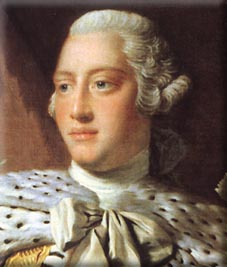
This balancing of cultural patronage with national interest and fiscal pragmatism - a principle which his sons consistently failed to grasp - was also seen in George III's patronage of artists. The first painter on whom honours were showered was, unsurprisingly, a Scot and another friend of Bute's. Allan Ramsay first painted George in 1758; three years later - having been made Principal Painter to the King - he produced an iconic three-quarter length of the idealistic new King in coronation robes, with which George was understandably delighted.
George was also a vigorous supporter of other native painters including Gainsborough, Beechey, Hoppner and Copley. Yet his favourite painter remained the vapid and pompous, American-born Benjamin West, whose moral certainties and romantic historical vision corresponded neatly with those of the King. West arrived in Britain in 1763, and in the subsequent decades replaced much of Verrio's work of a century earlier at Windsor Castle with his own 'phoney medievalisms' and produced a series of stilted royal portraits and historical pictures on turgid but worthy subjects. While Reynolds was busy courting the Prince of Wales, West was promoting a series of huge canvases on the subject of Revealed Religion for Windsor Castle (completed in 1789 but never installed). He reaped his reward not in heaven but on Reynolds's death in 1792, when he was predictably made President of the Royal Academy.
At the same time, George was a regular purchaser both of Old Masters and, intriguingly, of more contemporary Italian paintings. He bought fifty paintings and 150 drawings by Canaletto, and patronised the more obscure figure of Zuccarelli, who arrived in England in 1752, and was a founder member of the Royal Academy in 1768. Buckingham House's Grand Hall was hung with Canalettos and Zuccarellis from Consul Smith's Venetian collection that George acquired in 1763. He also bought the Old Master collections of Cardinal Albani and Dr Richard Mead in the 1760s. Unlike the fitful acquisition policy of George IV, though, George III's purchases tended to stay in the Royal Collection, and not be sold when his attention span waned.
George III carried his staunch patriotism into other areas of the arts. He showed himself to be a consistently keen supporter of native ceramic factories. Chelsea, Worcester and Wedgwood (Josiah Wedgwood was made Potter to the King) were all patronised in a way that his eldest son, for all his fine connoisseurship, was never to emulate. New furniture for Buckingham House was from the successful British cabinetmakers Vile and Cobb. A skilful musician and enthusiastic concert-goer, even after blindness took hold in 1806, George was a supporter of both native-born and emigre British composers. He patronised Bach after he arrived in England in 1762, bought the entire library of William Boyce, admired the eight-year-old Mozart on his visit to London in 1794, and throughout his life remained a fan of Handel, whose original scores he bought and whose works he knew by heart.
George was also a scientific patron. Like Louis XVI, he was a keen horologist, and was able to reassemble even the most complicated watches, and he amassed an impressive set of clocks for Buckingham House. He was the principal patron of the astronomer William Herschel, giving him both an annual pension and #4,000 for a 40-foot telescope at his Slough home. In 1768 Chambers built the King an observatory at Kew. The King took the initiative in medical matters, too. The Prince of Wales was inoculated against smallpox in March 1766, a precaution which demonstrated the enthusiasm with which his parents espoused the latest scientific advances. Most famously, 'Farmer George' ran one farm at Richmond and three at Windsor, where he bred cattle and sheep. Importing sheep from Spain and developing the ancestor of what became known as the Merino, he supported numerous agricultural innovations, and indeed corresponded (under an assumed name) with the agricultural commentator Arthur Young on these and other pressing agricultural issues.
Historians have generally preferred to ignore George III's record of patronage and to concentrate instead on the minutiae of the constitutional wrangling of the 1760s. With hindsight, however, their concerns appear less convincing. There is, for example, little evidence to brand George a closet absolutist. Compared to his continental contemporaries - Maria Theresa and Joseph II, Frederick II and his Prussian successors, Catherine the Great and the last Louis' - George III appears markedly liberal and, in modern parlance, 'hands-off'. Certainly he opposed concession to the American colonists, and staunchly supported the North government's increasingly distracted prosecution of the War after 1775. Yet in doing so, George III was far from the anachronistic ogre portrayed in Anglo-American myth. The American War was initially popular in Britain (the 1775 bill to coerce colonists passed the Lords by 304 votes to 105 and the Commons by 104 to 29), and only became less so with the entry of the Continental powers in 1778 and the economic dislocation that this caused.
Nor was George trying to turn the constitutional clock back to the Sixteenth Century. Even Namier admitted in 1930 that he had been unable to find the King 'arrogating power to himself'. And George consistently adhered to the principle of the primacy of Parliament, He would not, for example, have ideally chosen Rockingham in 1765 and Shelburne in 1782 as prime ministers, but he stood by Parliament's decision to do so. He did not lead the attack on John Wilkes in 1763: Grenville's government did. The King was certainly more involved in the Wilkes affair after the latter's controversial election for Middlesex in 1768; but there was nothing sinister in his motives: it was an understandable reaction against a radical challenge both to the government and to the crown. In practice, the King tended to leave decisions to those he felt would make them better - after 1770, to North and the younger Pitt - and generally deferred to the government over the direction of the wars which began in 1775 and 1793. George opposed many aspects of Pitt's conduct of the French war - most notably, Nelson's attack on the Danish fleet at Copenhagen - but was rarely heeded, and did not appear to mind unduly. It was only over the issue of Catholic Emancipation in 1801 that he felt obliged to draw a line.
Viewed from a time when the position and relevance of the monarchy is increasingly a subject for debate, it appears that, if the role of the sovereign is defined more as a job than as a right, then George III got the balance about right. It was he who most neatly encapsulated the ideal of the father-figure with which his subjects were happiest. As early as 1771 he was being depicted as a benign 'Farmer George', and by 1790 direct criticism of the King in satirical prints was rare. Neither Margaret Nicholson's crazed assault on George with a (blunt) knife of August 2nd, 1786, nor John Frith's rock-throwing of January 21st, 1790, was exploited by the more radical printmakers as the catalyst for attacks on the monarchy. Frith's assault actually became the subject of a staunchly pro-government satire of the Foxite Whigs by Isaac Cruikshank. Faced after 1793 with the threat from the French, George III was seen not as a constitutional liability but as a bulwark against revolution, the embodiment of British liberties, and as a plain-speaking John Bull.
Both John Bull and Farmer George were images that George cannily exploited to lessen the distance between the King and his public. Unusually for a British sovereign, George was at ease with intellectuals and country people alike. Dr Johnson was famously won over after a long conversation with the King in 1767, while numerous stories abound of the King visiting farms incognito. George III was thus in many ways the quintessential tabloid monarch: familiar, honest, outspoken - and chary of foreigners. (Astonishingly, George not only failed to travel to Europe - in contrast to his predecessors, he never went to Hanover - but never even visited Scotland or Ireland.)
Poignantly, the King reached the height of his popularity on the eve of his final descent into genuine madness. His golden jubilee of October 25th, 1810, was, in retrospect, his apotheosis. As Linda Colley has noted, the jubilee 'was the first royal event of this kind ever held' in the modern era, and was a great popular success - despite, or perhaps because of, the fact that Britain then stood almost alone against the French. The concept of the 'Patriot Prince' had originally been coined by Bute's propagandists in 1762; fifty years later, the aged monarch had truly grown into the role of Father of his People in a manner none of his continental rivals - and certainly not those recently manufactured by Napoleon - could boast. His tragedy was that illness prevented him from enjoying the fruits of this success; his fortune that he was thereby prevented from seeing how his heirs squandered his impressive constitutional legacy.
by Steven Parissien
|