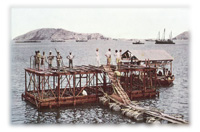
As India increased in importance, the British sought to secure access to and from its most important colony. To start with, they considered the waterless inhospitalible island of Perim at the mouth of the Red Sea. This was originally occupied in 1798 when Napoleon landed an army in Egypt. However, it was clearly inadequate and soon the British had to look to the near-by mainland for a base.
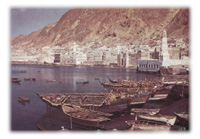
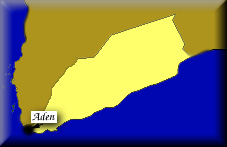
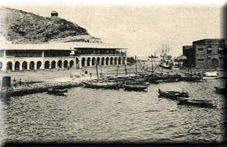
Their choice fell naturally on the superb anchorage at Aden, one of the
finest harbours between London and Bombay, and perfect to serve as a coaling station for the East India Company's first Nineteenth Century steamships.
Aden had once been known as the
prosperous "eye of the Yemen," a natural port of call on the Red Sea
route to the East and the outlet for the fertile Yemen mountains, 100
miles to the north. But after the Turks had conquered the interior in
the Sixteenth Century and Europe's merchants had discovered the Cape route
to India, Aden had declined into nothing more than a pirate village
preying on Indian Ocean traffic.
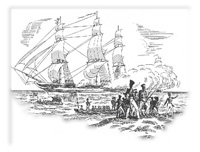
However, in the 1830s, Muhammad Ali in Egypt began challenging the Ottoman Sultan's power in the region and in 1833 went so far as to send an expedition to Mocha in the Yemen. The British, or rather British India, decided to allow Aden to at least remain open as a port to British ships as Muhammad Ali's rise in power in the region appeared to continue ominously. There was also the added consideration that the increasing use of steamships required regularly spaced coaling stations to allow them to refuel and continue their journeys. Therefore, in 1835 an agreement was made with the local Sultan to use Aden as a coaling station as it was midpoint between the Suez transit point and the Bombay Presidency in India. By 1837 the Bombay Governor Robert Grant felt that this informal arrangement required formalising: "I think that it will be absolutely necessary to have a possession of our own on or near the Red Sea.". The opportunity arouse when nearby locals were accused of maltreating the survivors of a shipwreck. The Sultan agreed to sell his share of the port to the Bombay government as restitution. However, the Sultan's son and other local chiefs objected when a Naval delegation arrived to finalise transferance. Therefore an expedition was despatched by the East India Company. In 1839 Captain Stafford Haines of the Indian Navy landed from Bombay with 700
men and a couple of Royal Naval sloops in support. At a cost of only 15
casualties he annexed Aden to the Bombay Presidency. It was the first imperial
acquisition of Queen Victoria's reign and one destined to carry some
flavour of the Victorian Age far into the 20th Century. It was soon to prove the strategic worth of its location when the main telegraph wires linking Britain to India came ashore in Aden in 1859. This was some 5 years before the main telegraph line linking Britain to India was functioning fully.
Haines, who was
appointed political agent in the territory, had a vision of restoring
Aden to its former commercial glory. And after the Red Sea route to
Europe was reopened in 1869, with the inauguration of the Suez Canal,
Aden's trade did indeed increase. Indian merchants moved in to exploit
the new commerce. Indian clerks manned the offices of the new shipping
agents, and behind the headland known as 'Steamer Point', where the P. &
O. vessels took on coal, a whole new Anglo-Indian town arose, full of
the characteristic wooden bungalows and box-wallahs of the Raj.
But
to the Indian officials Aden was primarily a military outpost. They therefore rejected the possibilities of commercial
co-operation with the Yemen and chose instead to strengthen the
defensive barriers between Aden and the interior by extending exclusive
treaties of British protection to all the principal rulers of the South
Arabian coast.
Not all the sheikhs received the British overtures, and
many lesser tribal rulers were ignored (a fact that was to cause troubie
for the British in later years, when favours offered to the treaty
sheikhs stirred the others to rebellion). But, one way or another, by
the end of the century some 30 ill-defined tribal states between the Red
Sea and the Sultan of Muscat's territory in Dhofar had been recognized
by Britain, thus creating that curious strip of pink on the old
schoolroom maps of Empire known as the Aden Protectorate.
Administration of the Colony
In Aden Britain's chief
official was also a Resident appointed by
the Viceroy. The Resident's staff was
recruited from the Indian Army, or even
the Indian Civil Service. Indian soldiers provided
ceremonial guards at the commissioner's compound. Indian
Army engineers built their characteristic
administrative compounds, Indian merchants
ran the trade, Indian rupees were
the standard currency and Indian words
and customs laid a veneer of Indian
culture on both the Arab and Persian
worlds.
The Aden Troop was created in 1855 to police the territory which was technically only 80 square miles but had a vast hinterland of 9000 miles of desert and mountain known as the Aden Protectorate. Its chiefs were nominally under the control of a political resident who was also the military commander.
The Aden troop was recruited from members of Scinde Horse and Poona Horse with an Arab Levy to act as guides. It later substituted its horses for camels and it was generally involved in patrolling against bandits. The troop was later used in Somaliland and existed until its disbandment in 1927.
Aden also took on the administration of various islands that the admiralty wished to keep an eye on to help suppress piracy or to warn ships lest they run aground on their treacherous shorelines. Kamaran Island and Perim Island in the Red Sea were two such islands, and the Kuria Muria chain which was received as a gift from the Sultan of Muscat in 1854 were also transferred to Aden for administration in 1886. That same year also saw the nearby island of
Socotra enter into a Protectorate agreement to be adminstered from Aden also.
By the mid 1930s the modern map of
Arabia was taking shape and a fitful sort
of peace was falling upon some of its
ancient tribal squabbles. In the Hadhramaut,
a young
political officer, Harold Ingrams, was
able, only a year or two later, to settle
1,000 years of quarrels almost singlehandedly.
In three years of lonely travel
and tribal negotiation between 1936 and
1939, Ingrams obtained the signatures of
over 1,300 local chieftains to a general
truce that became known as
"Ingrams' Peace."
At the same time, he signed a new series
of treaties with the five major rulers of
the area, promising them further British
help and protection if they, in return,
would accept the advice of the Governor
of Aden in matters concerning the welfare
and development of their territories. His
achievement was significant in two
respects. First, because the new treaties
were the first to give Britain any right to
interfere in the purely internal affairs of
Arabia and, secondly, because they
marked a transfer from the Indian
administration's influence to the authority
of Whitehall.
Increasingly preoccupied by the independence
struggle at home, Indian officials
no longer had the energy or the interest
to spare for the Arabian outposts of their
empire in 1937. The Colonial Office in
London assumed responsibility for the
Aden Protectorate and made Aden itself
a fully-fledged Crown Colony, with the
intention of pursuing a "forward policy"
of colonial development and defence to
safeguard Britain's interests. In 1940, it divided the Aden Protectorate into a Western Aden Protectorate (WAP) and an Eastern Aden Protectorate (EAP) for administrative purposes. However, the Second World War changed the strategic dynamics and plans for the colony.
The German advance in North Africa and the Japanese advance in South-East Asia revealed Britain's strategic weaknesses across the Empire as a whole. The loss of Singapore and the requirement to pull back to defend Britain showed that it could no longer defend the entire empire. Furthermore, the post war Labour government stuck a dagger through the strategic rationale for Aden by giving India its independence in 1947. If that wasn't fatal enough, the Suez debacle a decade later seemed to make Aden even more redundant and yet almost by default it would go on to became Britain's largest
overseas military base as oil became the new strategic commodity of choice.
The naval units in
the Gulf were strengthened, troops were
trained in the Oman Desert, and the
belated "forward policy" of the 1930s
became an urgent drive for military
security, economic development and
political reform. But the British were
running further than ever behind the
clock and, paradoxically, the more they
tried to catch up, the more they caused
events to accelerate out of their control.
In its new role Aden Colony grew
wealthy and the Indian shopkeepers and
Arab landlords of Steamer Point gladly
joined the treaty sheikhs of the Protectorate
in planning a Federation of
South Arabia that would unite the town
and the tribes to secure the British base and
British patronage - indefinitely. But
the same wealth encouraged a new influx
of Arab workers, who made a natural
seedbed for revolutionary anti-British
nationalist sentiment.
Outsiders jumped quickly on to the
nationalist bandwagon, rolling euphorically
onwards now in the post-Suez atmosphere
of Arab triumph and British
defeat. In the Yemen, the Imam Ahmed,
the son of Yahya who had challenged
British rule in Aden 40 years before, increased
his raids on the Protectorate
frontier and appealed to the United
Nations for. support. From Cairo the
Egyptian radio's Voice of the Arabs maintained
a steady stream of anti-imperialist
invective, while both the Soviet Union
and China took their first, cautious
steps into the treacherous quicksands
of the Arabian peninsula 's politics.
By 1957, as a result of Yemeni agreements
signed in Moscow and Peking, Russian
rifles were in use against the British
on the Protectorate border and Russian
and Chinese technicians had arrived to
build new ports and roads for the Yemeni
kingdom. As a result, the ancient tribal
skirmishes of the Protectorate soon engaged
more British troops and acquired
ominous international overtones.
Ostensibly established to defend the Gulf
oil-fields, the post-Suez base in Aden had
to devote most of its energies to protecting
itself from unrest in the colony and
tribal dissidence in the Protectorate, conditions
inspired partly by the very
existence of the base. By 1962 it seemed
that only desperate measures could succeed;
and in September of that year they
were duly taken when the colonial government
bulldozed through the Aden legislature
a Bill to unite Colony and Protectorate
in the mutually protective
Federation of South Arabia.
But once again the British were too
late. The next day a group of military rebels in the Yemen overthrew the Imam's
regime, proclaimed the birth of the Yemen
Arab Republic, and begged for Egyptian
help. Within weeks, tens of thousands of
Egyptian troops had arrived and both the
Yemen and South Arabia were plunged
into a multi-sided civil war. In the Yemen,
the Egyptians and Republicans, 'with
Russian and Chinese support, were locked
in battle with tribal supporters of the old
Imamate - who in turn were sustained by
money and arms from the Saudis, proclaiming
a holy war against Communism
and Nasserism on the sacred soil of Arabia.
In the south, the British and the Protectorate sheikhs sought alliance with
the Saudis and the Yemeni royalists,
while the Republicans and their allies
helped the Aden nationalists and the
dissident tribes to close the British base
and destroy the Federation.
In the end, practically every party to
the conflict was a loser. The Saudi regime
was shaken and the Yemeni royal family
was eclipsed. The Egyptians suffered five
years of humiliation and exhaustion in
vain attempts to subdue the hardy mountain
tribes; and after Egypt's catastrophic
defeat in the Six Day War with Israel in
1967, Nasser was compelled to withdraw
all his forces from the Yemen and abandon
his republican proteges to the perils of
compromise with their enemies. The
South Arabian Federation; too, was
destroyed and the British were forced to
evacuate Aden.
By the end of 1967 it was all over. The
British forces had suffered some 60 killed
and 700 wounded in the hardest anti-terrorist
campaigning since Malaya and
the indignity of their final departure
ranked with the retreat from Palestine.
There were no friendly ceremonies of
independence here, only bitterness and
the taste of failure. The last British High Commissioner had to be lifted out by
helicopter under armed guard to a naval
carrier standing well offshore,
He left behind the first avowedly Marxist state to take the place of Empire, the
(People's Democratic Republic of South Yemen) and a city racked by fear and
poverty that had come to resemble a
ghost town. "Gone Away - No Milk, No
Papers," was the message left by a soldier
on the wall of Aden's empty prison. It summed up Britain's abrupt departure after more than a century of continuous occupation and control.
Aden: The Curtain Falls: The Memoirs of Dick Eberlie: Part 4, 1965 to 1967 Dick Eberlie gives a full account of his time as the Personal Secretary to Sir Richard Turnbull in Aden during the turbulent years of the creation of the The Federation of South Arabia. This was something of an attempt in vain to establish a viable political unit for a fractious and unstable region. A change in government at home combined with too many enemies in the region to undermine the Federal structure and contributed to one of Britain's less successful extrications from Empire.
Britain's Arabian Oil Empire David Holden gives an account of how Britain's involvement in the Middle East mutated from a Nineteenth Century concern about security of maritime trade routes and the defence of India into a Twentieth Century preoccupation of guarding the flow of oil and attempts to contain rising nationalist aspirations in the region.
The Aden Emergency Jim Herlihy has written an extensive account of the final few years of Aden as a British Colony
Memories of WAP The Western Aden Protectorate was a vast arid part of the Empire which was politically and culturally distinct from the more famous port of Aden. Winkle Allen gives an account of what it was like to be one of the very few women in this overwhelmingly male dominated society.
The Royal Visit - Aden 1954 Bill Wickham gives an account of the visit of HM Queen and the Duke of Edinburgh to Aden in April 1954
Trial in Perim (1955) Bill Wickham explains how unusual it was for the British to become involved in judicial issues on the Island of Perim at the end of the Red Sea.
How the Colonial Service helped build Israel Michael Crouch explains the role that colonial officers in the Western Aden Protectorate played in assisting the ancient Yemeni Jewish population to reach the newly formed state of Israel.
The Inebriates of the South Arabian Political Service Michael Crouch recounts the antics of some of those political officers who over-imbibed despite living in an Islamic part of the world which looked down on the drinking of alcohol.
A Journey in the Hadhramaut Mary Reid gives an account of a remarkable journey she was privileged to take in 1963 along the Hadhramaut Wadi from the interior of the Eastern Aden Protectorate to the coastline. The journey was all the more remarkable for being undertaken by a woman in a deeply conservative and traditional part of the Empire.
A Game Warden's Permit for a Corpse: The life and
times of a Customs Officer Patrick B. Sweeney gives two extracts from his memoirs as a Customs Officer in the Middle East and East Africa. One extract explains his role in trying to levy duty on the addictive 'qat' in Aden. The other extract explains how he tried to control the flow of duty free goods to non-soldiers in the thirsty NAAFIs of Aden.
Famine in Arabia Mary Fletcher experienced famine in Arabia firsthand in the 1940s. She goes on to explain Britain's response and in particular what happened to a group of girls that found themselves being looked after by the Hadhrami Bedouin Legion.