|
Early History
|
|
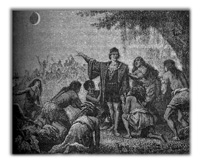
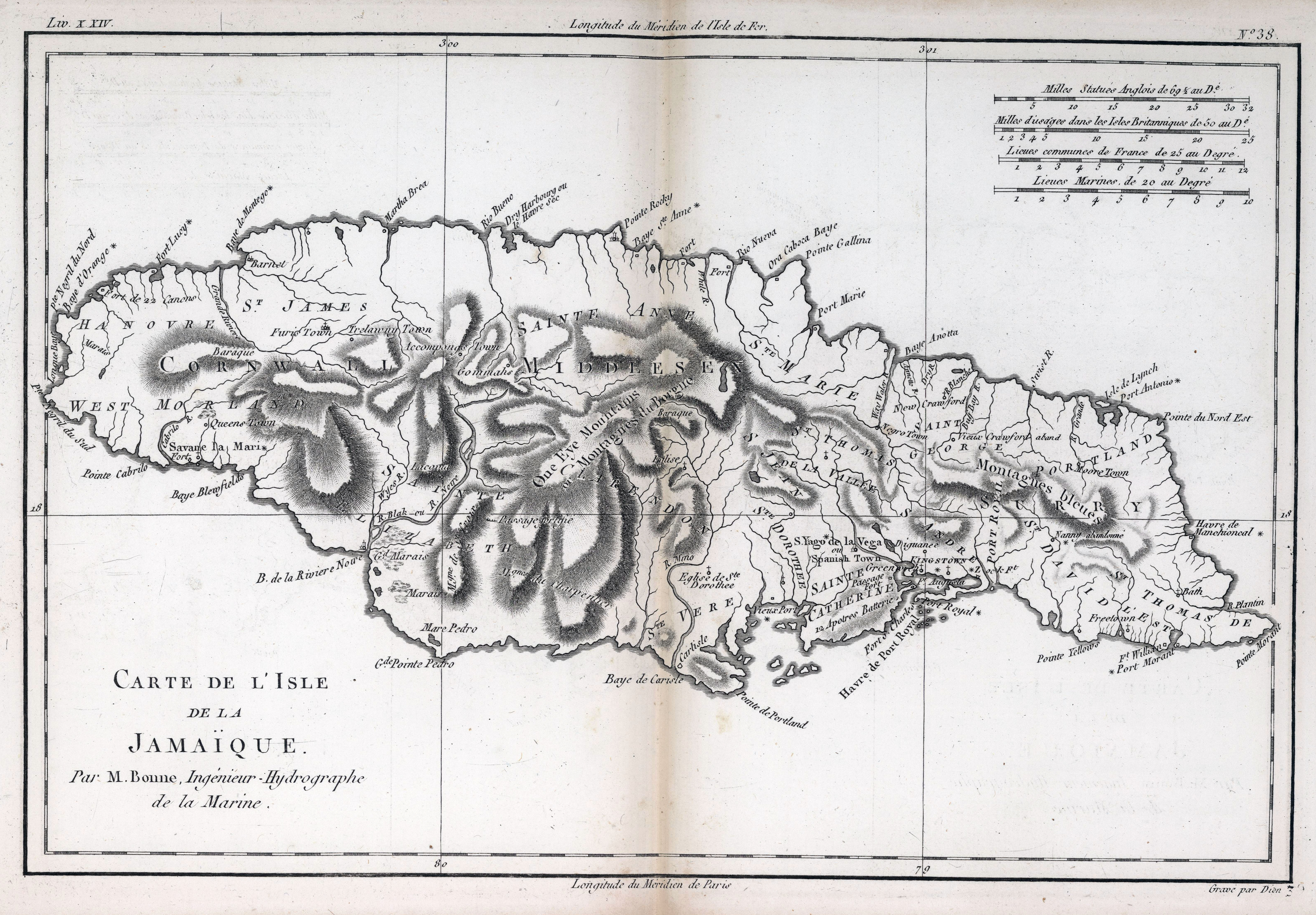
Jamaica was one of the islands of the Caribbean that was discovered by Columbus on his second voyage to the New World. He returned there once more on his fourth voyage when his small flotilla of ships was beached by a storm. He actually ended up remaining on the island for a year due to the governor of Hispaniola refusing to rescue Columbus and his men. One apocryphal story of his time on the island is when he apparently mesmerised the local population by correctly predicting a lunar eclipse using his navigational charts and tables.
Columbus gave the island the name Santiago but the Indian name of 'Xaymaca' remained in use by the indigenous population. Columbus was eventually rescued and returned to Spain. His description of the large island with plentiful food and new exotic crops encouraged the island's colonisation in 1509 when Juan de Esquival formally claimed it for the Spanish Crown.
Disappointed by the lack of gold, the Spanish authorities quickly identified the island as being a suitable provisioning base to expedite the colonisation of other parts of the Caribbean and Central/Southern America. The indigenous population was reduced by disease, violence and exploitation. The Spanish began the importation of African labour to replace the diminishing local population.
The first Spanish settlement had been established near St Ann's Bay and named Seville. However, disease and pestilence was a problem and so they moved it six miles into the interior to St Jago de la Vega in 1534. The English would later refer to this settlement as Spanishtown.
The English were lured by the wealth and success of the Spanish settlements throughout the region. Jamaica itself was relatively unimportant, but it was a hub of activity and had potable water and supplies which could be highly prized at times. There were several attacks against the island by the English, but the most significant early attack was by Sir Anthony Shirley in 1596. He successfully plundered and burned the small capital of the island. However, the Spanish merely reestablished themselves and rebuilt their settlement. The English returned again in 1635 under Colonel Jackson to raid the still small but self-sufficient Spanish colony.
|
|
The Western Design
|
|
It wasn't until the 1650s that the English changed from being raiders to conquerors. Oliver Cromwell agreed to export his Protestant Revolution outside of England's borders in the years following Parliament's victory in the Civil War. His 'Western Design' was supposed to avoid a direct war in Europe itself but instead to attack and seize the economically wealthy assets of England's Catholic rivals. Cromwell was partly convinced by an ex-Dominican monk turned Protestant by the name of Thomas Gage who had, unusually for an Englishman, spent time in the Spanish West Indies and the Spanish Main. Thomas Gage convinced Oliver Cromwell that the islands were teeming with wealth and were sparsely defended. The growing success of England's own sugar colonies in islands like Barbados, Nevis and St. Christopher further encouraged Cromwell and his advisors. The fact that many of the English colonists in the Caribbean had declared allegiance to the Crown gave an additional motivation to send Parliamentarian forces to the region to assert control and remind them who was now in power.
This Western Design was actually the first military investment into Trans-Oceanic Empire building by the English. Hitherto, all colonisation had been undertaken with a view to establishing new colonies in virgin territories by settlers inspired by profit or religion. Oliver Cromwell gave voice to the idea of seizing Catholic colonies and converting them into Protestant ones by force if necessary. This was a step change from merely raiding and privateering in and around the Spanish settlements.
Thirty-Eight warships carrying over two and a half thousand soldiers set sail from Spithead on Christmas day 1654. They were led by Admiral William Penn and Commander Robert Venables. They arrived in Barbados a month later and raised three to four thousand additional soldiers from indentured servants and freemen from the existing English island colonies. Most of these soldiers, however, were of very poor quality and had little formal training. Indeed, most of the 'volunteers' were motivated by plunder but were to be disappointed when told that all Spanish possessions were to be left intact in order to allow successful English colonies to supplant them. Their initial target was Hispaniola and the large Spanish settlement at Santo Domingo. However, this was repulsed with relative ease and led the commanders to consider a plan B in order to 'save face' by going on to the much less formidably defended Jamaica.
Jamaica had a Spanish population of just two and a half thousand in 1655 when the English arrived and perhaps only 500 of these were able to bear arms. There was also a sizeable population of slaves. This population was concentrated on the southern part of the island and had farms and plantations to feed themselves and to sell produce to ships that called in for resupply.
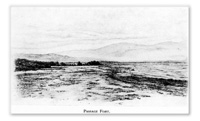
The English arrived off Kingston Harbour on May 10th 1655. They sailed a gunboat up to 'Passage Fort' which gave covering fire to smaller vessels which poured soldiers ashore. No one was actually hit in the invasion as the Spanish defenders rapidly abandoned their positions on seeing so many ships and soldiers come ashore. The English then set off for the Spanish capital at St Jago de la Vega which was located six miles into the interior. En route they encountered a Spaniard bearing a flag of truce and gifts for the invaders. Commander Venables was keen to rest his troops who were still weakened and weary from their unsuccessful campaign in Hispaniola. He is reported to have received the flag of truce with the words that 'we have not come to plunder, but to plant'. He wished to avoid unnecessary bloodshed and destruction and so considered their offer of surrender.
On 11th May, his troops entered St Jago de la Vega. However, some of them got carried away and ransacked churches and important buildings but they were generally disappointed to find that most items of value had already been taken into the interior by the fleeing Spanish. Commander Venables offered terms of surrender to the Spanish governor, Juan Ramirez. These were strict terms that replicated the Spanish terms imposed on the English to abandon their Providence Island colony back in 1641. Namely, all Spaniards had to leave the island within 10 days, forfeit all their property and forfeit for ever their claim to the island. Furthermore, the governor was to remain as hostage and the Spanish were to provide the English with cassava bread and 200 head of cattle per day to feed the huge English force whilst they considered the surrender terms.
The Spanish were surprised at the harsh terms. Most of the inhabitants were born and bred in Jamaica and considered it their home. They provided the English with provisions but primarily to buy themselves time to retire into the interior and prepare for a guerilla war whilst awaiting rescue from Cuba where word of the invasion had been sent.
Four precious days were bought by the Spanish allowing many of the non-combatants to escape to Cuba and also to release their remaining livestock and slaves into the interior. The Spanish gave the slaves permission to raid and attack at will with no fear of retribution or repercussions. Some Spanish officers even remained with small groups of what became known as 'Maroons'. English soldiers who ventured out of the settlement were often attacked and mutilated in what became a vicious guerilla war in the jungles and hills of the interior.
Commander Venables had been tricked into giving the Spanish time to retreat and organise themselves in the interior. All whilst leaving the English forces with little to feed themselves or any sufficient shelter for his large army of occupation. English forays into the interior became fruitless expeditions as the Spanish or Maroons evaded the clumsy English who were unfamiliar with the geography and climate of the island. Nature, lack of food and deadly diseases further undermined the morale and effectiveness of the English forces.
Admiral Penn left almost immediately after capturing the island - possibly to give his version of the reasons for the failure to capture Hispaniola before Commander Venables was able to do so. Commander Venables came down with 'flux' and 'fever' and returned shortly afterwards also. Their sudden appearance back in England led to charges that they had abandoned their posts. They were both promptly imprisoned in the Tower of London.
The commanders had left a force of 12 ships and 7,000 men behind. This force continued to harry and attack the Spanish but it was clear that the 'Western Design' had been a military and strategic failure. Jamaica was the only tangible success in what had otherwise been a dismal campaign with most troops dying of disease rather than to military action. They were now expected to survive on an island which had previously only planted food to feed 2,500 mouths.
Cromwell encouraged settlers to head to Jamaica to attempt to consolidate its control. Every male immigrant was to be allocated 20 acres and if accompanied by a woman and child was to receive an additional 10 acres. Colonists headed to Jamaica from a variety of locations. Some arrived from Caribbean islands like Bermuda and Barbados keen to find new land for themselves to grow the increasingly profitable tobacco. Indeed, the Quakers of Barbados moved en masse as they had found themselves unpopular when refusing to serve in the local militia. There was also an infusion of Dutch who had been expelled by the Portuguese from Brazil. Dutch Jews were particularly keen to avoid the Portuguese and regarded Cromwell's Parliamentary government as relatively benign. The Dutch also brought skills and expertise in growing the new crop of sugar cane which was becoming increasingly popular and profitable. One thousand Irish boys and girls, all under the age of 14, were sent to the island as indentured servants in the aftermath of Cromwell's invasion of Ireland. Additionally, the Sheriffs of Scotland were asked to transport vagabonds and robbers to help populate the island. Less successful were pleas to the homesteads of New England and the American East Coast. The authorities were hoping for an infusion of godly Protestants but nearly all of these New Englanders remained in the relative safety of North America which held less competition for Spanish interests. Despite all the strenuous attempts to attract settlers, they struggled to replace the population of the early settlements quickly enough as disease, insurrection and starvation took its toll. By 1661 the population of the island was only 3,500 despite the fact that 12,000 had arrived in the previous five years more than hinting at the horrific mortality rate.
The new colony was also in a constant state of war being deeply embedded within the Spanish West Indies. England's nascent Commonwealth Navy, with the full encouragement of Oliver Cromwell, continued to harass and harry Spanish ships, ports and searching for the all important Spanish Treasure Fleet. Courts of Admiralty were established on the island so that prize money could be disbursed fairly and quickly. The twelve ships left behind by Admiral Penn were put to good use by Admiral Goodson who brought in a regular supply of prize vessels and destroyed the settlement of Santa Marta near Cartagena on the Spanish Main.
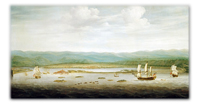
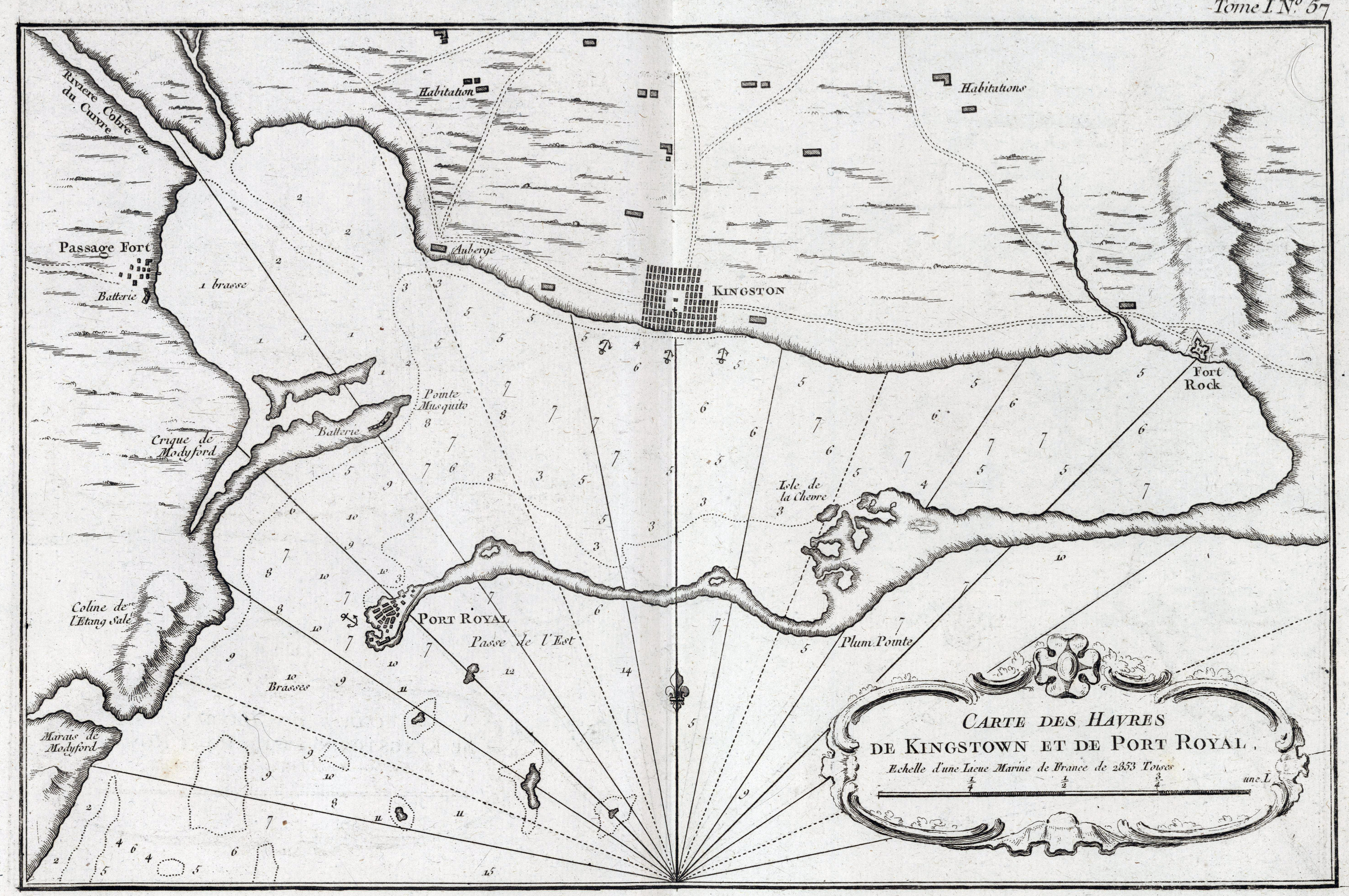
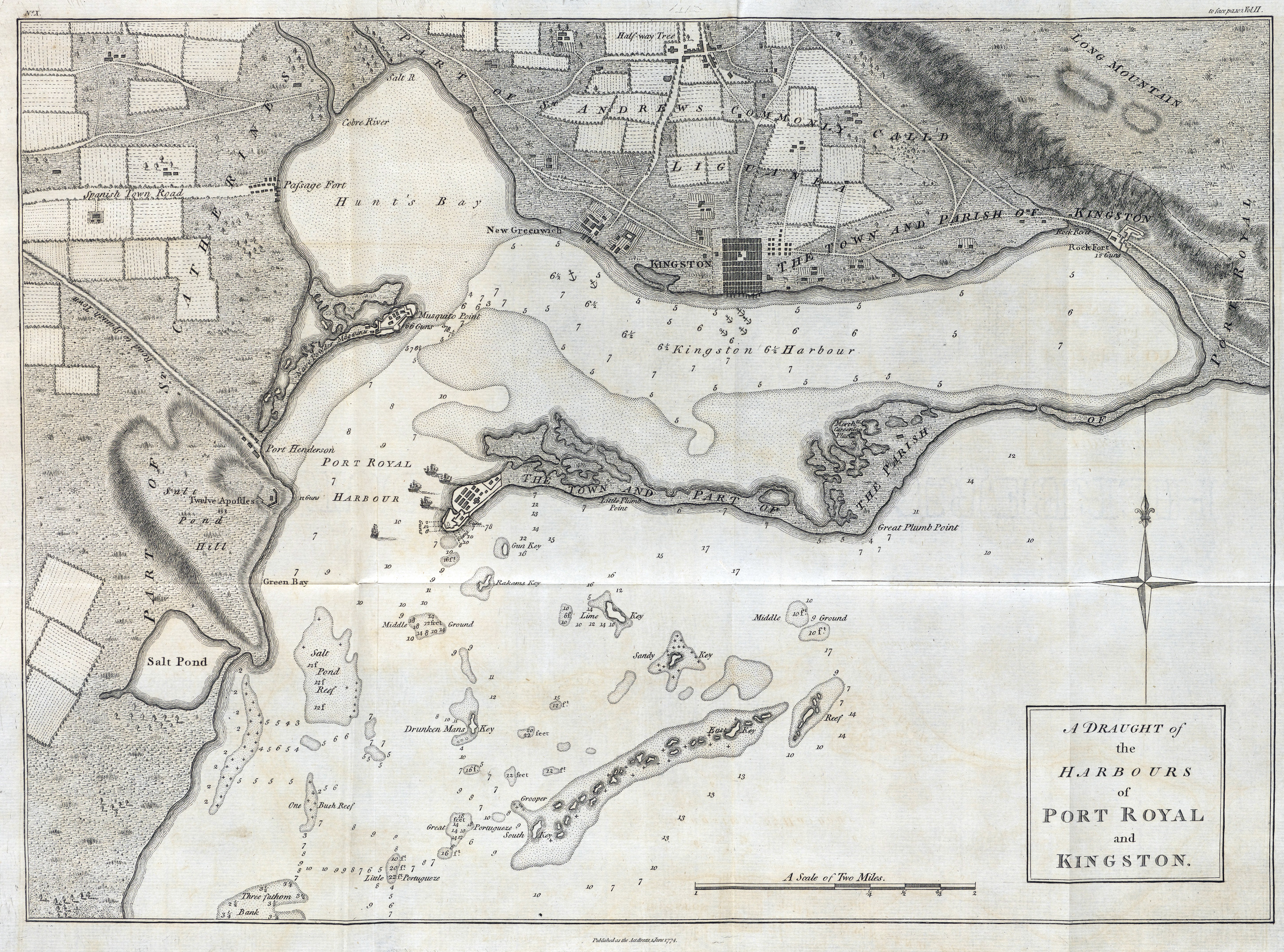
The importance of naval supremacy was quickly identified as being the key to success for the Jamaican outpost. Kingston Harbour was expanded rapidly. A fort was hurriedly constructed and fitted with guns to guard the anchorage behind the long sandy spit there. It was initially called Fort Cromwell but this would be changed to Fort Charles in due course. The small island on the spit rapidly expanded as traders sought the protection of the anchorage and the new opportunities for feeding and provisioning the new colony. Even if much of the wealth of the new colony was conditional upon the ravaging of Spanish possessions and ships in the area. Soon this port, better known by its post-1660 name of Port Royal, would be the most important English port in the Western Caribbean. Its strategic position helped ensure that despite the ravages of disease, resources and personnel would still be diverted to the new colony.
Meanwhile a small Spanish force continued to resist the English invasion from the interior of the island based in and around the inland town of Guatibacoa. The Spanish there attempted to ally themselves with the Maroons but disease and lack of supplies hampered their attempts to consistently coordinate attacks against the English. A Spanish force was sent from Cuba in 1657 to coordinate with the resisters but the English under Edward D'Oyley learned of the Spanish attempts to land men and equipment and intercepted and defeated them at Ocho Rios in the north of the island. A second attempt by the Spanish in 1658 was again defeated by Edward D'Oyley but this time at Rio Nuevo. The island was militarily secured for the first time. There would still be Maroons raiding and attacking from the interior for decades to come, but from this point on they would have to rely on their own resources and receive no help from the outside world.
Despite his victories against the Spanish, governor Edward D'Oyley was concerned for the long term viability of the colony in such a hostile region. One solution he came up with was to invite anti-Spanish pirates and privateers to establish themselves in Jamaica without fear of prosecution or retribution. He invited pirate groups like the largely Huguenot 'Brethren of the Coast' to operate out of Port Royal and issued them with letters of Marque to harry and raid Spanish ships as long as they left English ships alone. So began the long association between pirates and Jamaica as the authorities turned to desperate measures to help secure their isolated outpost.
The English Commonwealth only lasted until 1660 - but its brief foray into imperial expansion marked a fundamental shift in England's attitude to Empire. It may have appeared to have achieved little in its five brief years of imperial adventure but its tiny toehold would be consolidated and expanded upon by the Restoration governments that followed. England was no longer just nibbling at the successes of other imperial powers, it was prepared to take on those powers and supplant them if possible - as they had shown in Jamaica.
|
|
Restoration Jamaica
|
|
News of the fall of the Commonwealth and the Restoration of the monarchy did not reach Jamaica until 1661. This news was followed by a number of high profile Parliamentarians landing on the island who thought it best to leave England upon the return of the King. However, the new Royalist authorities identified that it was best to keep the successful Edward D'Oyley, despite his own Parliamentarian history, in charge of the young colony. There were concerns by many Jamaican settlers that Charles II might be sympathetic to Spanish calls for a return of the possessions seized by Oliver Cromwell and the Commonwealth. However, Charles quickly assured them that he had no intention of returning any Caribbean islands to the Spanish. Furthermore, he formalised the relationship between the planters and the English government and encouraged economic activity of the colonies. Navigation Acts were passed which gave a monopoly to English colonies to sell tobacco, cotton and sugar to England. These Navigation Acts formed the fundamental basis of the colonial economy for the next two centuries and gave planters a guaranteed market in which they could not be undercut by foreign producers. Additionally, planters were reissued with land deeds and in 1662 the King was prepared to issue a proclamation giving Jamaica's non-slave population the rights of English citizens, including the right to make their own laws. By 1664 a House of Assembly was established to advise the crown-appointed governor and help run the colony.
The Jamaican economy was dangerously dependent upon the income of buccaneers and privateers. Chancers and adventurers preferred the small chance of a large prize than to toil in the fields and plantations of the hot and humid colony. The population of Port Royal increased whilst the hoped for planters in the interior had not yet even recovered the amount of cultivation achieved by their Spanish predecessors. Governor D'Oyley complained that few were interested in the 'dull, tedious way of planting'. Governor D'Oyley began to regret inviting the buccaneers to the colony as he identified that even when they did bring a prize ship into harbour it merely encouraged more planters to chance their hand at piracy and the only real beneficiaries of the money seemed to be the alehouses and prostitutes of Port Royal. Even spectacular successes like the 1663 sacking of Campeche on the Spanish Main just resulted in prices inflating on the island and fewer people willing to work. The sheer quantity of spanish treasure taken and circulating in the Jamaican economy meant that the colony soon adopted the Spanish currency as its legal tender.
1665 saw England add Holland and France to its list of enemies as the Second Anglo-Dutch war broke out. There were now additional strategic concerns that any of these three European powers might raid Jamaica or attack her ships. However, it also meant that there were more targets for Jamaican privateers and buccaneers. There were raids against St. Augustine in Florida, Grenada in Nicaragua, Porto Bello and most spectacularly of all against Panama in 1671. This decade saw the rise to prominence of
Sir Henry Morgan who led the last two expeditions mentioned. The English were not to have it all their way in the Caribbean, but the notorious reputation of Jamaica meant that she was not attacked or seized by any of the European rival powers.
The Royal African Company was reformed in 1672 and was given a monopoly of the slave trade to and from the English colonies. It was from this time that Jamaica became one of the greatest slave markets and destinations in the world. The sugar-industry was developing during this period with the first pot of sugar being sent to London in 1673. The problem with sugar was that the cane required very heavy labour in very uncomfortable conditions to extract the necessary syrup. Native labour was in short supply and unwilling to do the hard work required. Experiments were attempted with indentured labour from England but the physical constitution of these Europeans was not up to the task. Slavery provided the solution to the planters' problem. Strong workers who were used to the physically demanding geography were imported from Africa. These slaves were denied the luxury of refusing the work. They were forced, with incredible brutality, to do the menial but harsh work. As the demand for sugar in Europe seemed insatiable, more and more plantations were established and more slaves were imported to fulfil the labour requirements.
Jamaica began its transition to a planter economy with the arrival of Governor
Sir Thomas Modyford in 1664. Unlike previous governors, Modyford was an established aristocrat with a huge household who had already had experience growing sugar in Barbados. He brought over 1,000 slaves with him and encouraged 800 planters to follow him as he sought to turn Jamaica into a similarly profitable sugar island. Modyford was to be governor for seven years giving him time to bring many of his ideas to fruition. He still dabbled in buccaneering - seeing that it provided a defence for the island at little cost and at times some considerable profit. He would oversee a period of massive land distribution as he sought to reward followers and encourage planters to establish themselves. His skill and experience in the sugar industry was also invaluable as he encouraged the slow process of clearing and preparing land for sugar cultivation. His high handed tactics did not endear him to the existing planter class who resented his rewarding of favourites, family members and the newly arrived. The Assembly and Modyford would clash over running the colony and he would seek their advice less and less. In the end, the lure of privateering and buccaneering would be his undoing. Peace between England and Spain was formalised in 1670 with the signing of the Treaty of Madrid. This Treaty formally recognised England's control of Jamaica for the first time. So it was deeply embarrassing when the authorities discovered that an attack on the Spanish settlement of Panama in 1671 was planned and authorised by Modyford from Jamaica. This was a clear breach of the Treaty provisions. Modyford was recalled to England and imprisoned in the Tower of London until 1674.
1678 saw Charles II attempt to rein in some of the more liberal powers bestowed in the 1660s on Jamaica. He was now more confident in his position of King back in England. The new plan was that the island was to pay a fixed income back to England and that the right of proposing laws was to be granted to the governor and his council with the Assembly only being allowed to veto those proposals. Fortified with exiled Parliamentarians and their sons, the Assembly refused to make such drastic concessions and lose their hard won powers. This political impasse between the Assembly in Jamaica and the Crown of England would actually endure for a further half century.
Meanwhile, the new governor, Sir Thomas Lynch, was given instructions to ensure that privateers and buccaneers were no longer welcome in Port Royal and set about the arduous task of evicting them. Henry Morgan was arrested but on return to England found that he had become something of a swashbuckling hero and was actually knighted by Charles II and later returned to Jamaica as Lieutenant Governor. However before that could happen the sitting Governor Lynch attempted to convince the privateers to convert to planting. Not all of these mariners were convinced and many relocated to Bermuda and set themselves up as out and out pirates - raiding ships of any nationality including the English. 1685 saw the final nail in Jamaica's privateers' coffin as the first English naval squadron arrived in Port Royal for permanent patrol and defence in the region. The problem had ostensibly been evicted from Jamaica but not from the Caribbean.
The late Seventeenth Century saw a sustained expansion in the economic activity of the island with the profits from sugar supplanting the traditional crops of tobacco and cotton. The American colonies were expanding and were able to compete effectively in the production of tobacco and cotton, but did not have the climatic ability to grow sugar cane like Caribbean b islands like Jamaica could. However, ever larger numbers of African slaves were imported to facilitate the expansion of these sugar plantations. Between 1673 and 1694 there were no less than six sizeable slave revolts on the island and runaways constantly escaped to the mountains to join the Maroons. In 1678 a plantation only five miles from Spanish Town was taken over by its slaves who then attempted to encourage other slave plantations to rise up. The authorities responded with savagery and called out the militia to crush such risings. However, the unnerved authorities put in measures to attempt to prevent the small white population being overwhelmed by the slave population. In the 1680s laws were passed by the Assembly to mandate slave plantations to have at least one white servant for every five slaves or to pay a fine. Unfortunately for the authorities, plantations owners found it more economic to pay the fine than to hire white servants. European settlers were just becoming less interested in Jamaica as a destination. There was more land to be found in the American colonies, Jamaica still had its reputation for debauchery and piracy, its mortality rates from disease deterred others as did the stories of slave uprisings and the savage reprisals. All in all, Jamaica was finding it hard to find willing immigrants. Slaves, on the other hand, had no say in the matter and continued to be brought ashore in ever increasing numbers.
Jamaica's reputation for brutality and harshness became a self-fulfilling prophecy as the number of slaves increased vis-a-vis the white population. The fact that it was a relatively large island compared to the other West Indian colonies meant that it was not wholly brought under control. Indeed, the Maroons of the interior added a dimension of fear and suspicion to Jamaica's authorities and planters alike. Their response was to severely and savagely punish any slave infractions; beatings, whipping, amputations and displaying of mutilated corpses were all intended to instil fear and obedience into the slave population.
The arrival of a Catholic king back in England as James II replaced his brother in 1685 saw an insurrection that sought to put the Duke of Monmouth on the throne. This was put down relatively easily, but the infamous assizes that followed the uprising saw many of the participants exiled to Jamaica as indentured slaves for the unusually long period of 10 years. Fortunately for many of these transportees, their sentences were to be cut short and pardoned due to political events back in England.
|
|
Jamaica after the Glorious Revolution
|
|
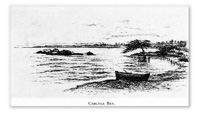
1688 once again saw a change in the crown of England as William of Orange came to the throne at the expense of James II. Almost immediately this set forth a new chain of wars that involved England and her overseas possessions. The Nine Years War or the War of the Grand Alliance saw England fighting with Holland against the rising Catholic power of France. France would displace Spain as England's primary enemy in the coming century and a half. This was felt on the island of Jamaica in 1694 when the French landed men on the North and East coastlines of Jamaica intending to hurt the economic capabilities of England to wage war. The operations were commanded by Admiral Du Casse. The culmination of these raids was when 1500 Frenchmen landed in Carlisle Bay in Clarendon parish and started attacking local plantations and seizing slaves. The local militia was called out to meet the raiding force and, together with slaves, helped repulse the French who fled in their ships, but taking some 2000 captured slaves and having destroyed over 4 dozen sugar estates and plantations.
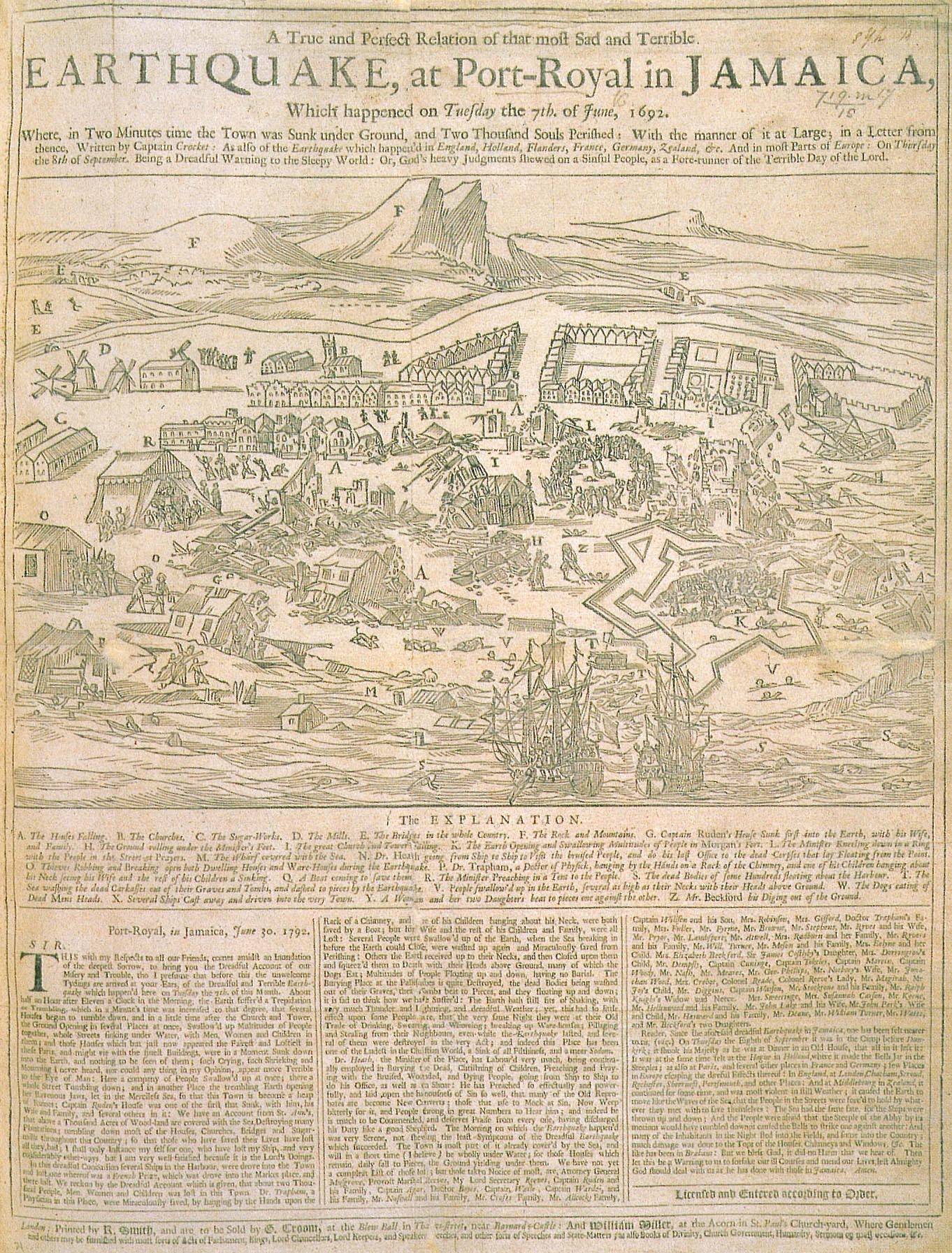
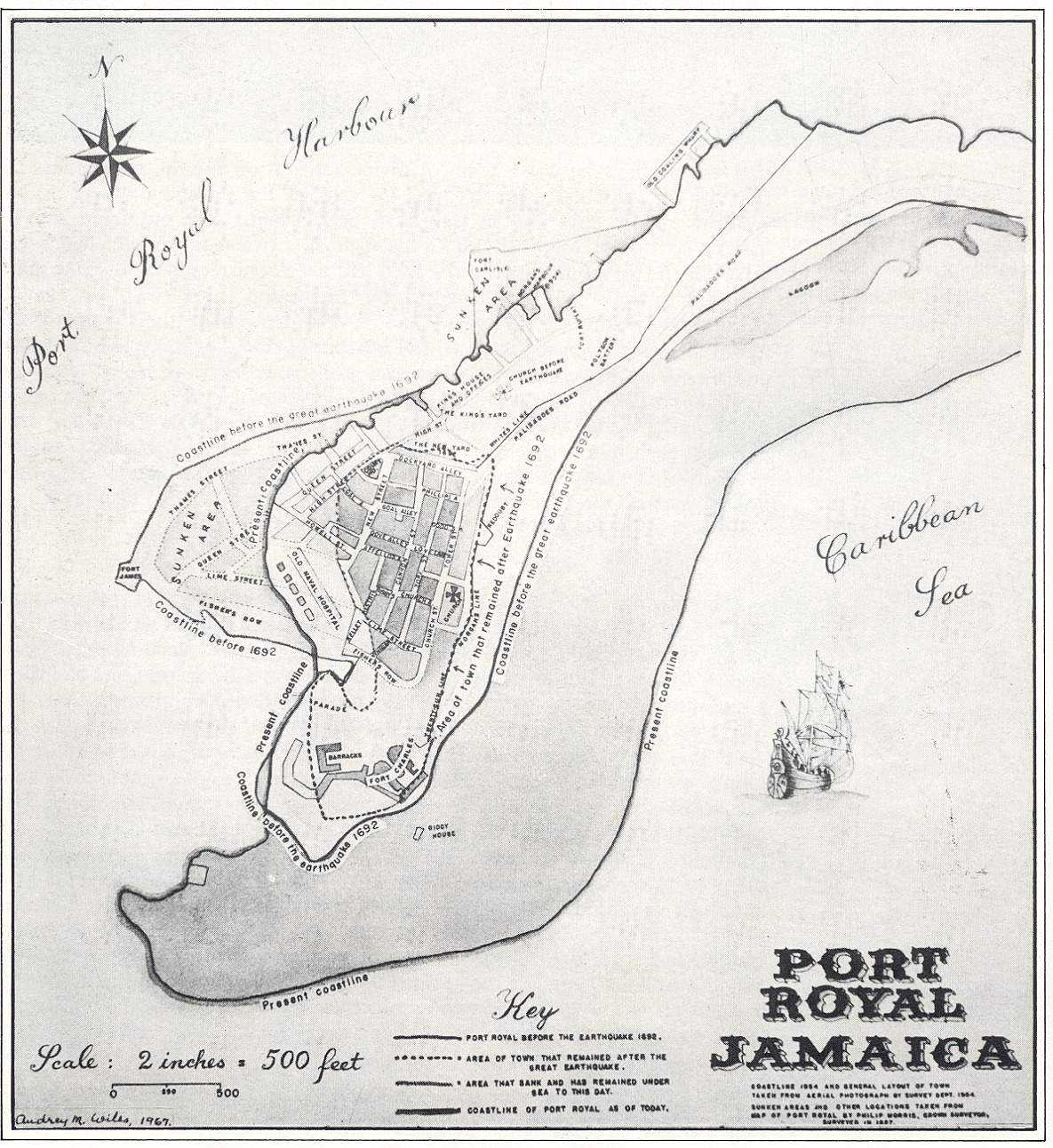
The real tragedy to hit Jamaica in these years, however, was the 1692 earthquake which struck Port Royal and utterly destroying the settlement. Indeed, two-thrids of the settlement built on the sandy spit sank immediately into the sea. 90% of the town was under water thanks also to a resulting tsunami. The settlement was so utterly destroyed that the seat of government was relocated to the old Spanish capital now renamed Spanishtown 6 miles into the interior. Attempts to rebuild Port Royal were thwarted by a serious fire in 1703 and a hurricane in 1722. Eventually, Kingston on the landward side of the lagoon would replace Port Royal as the principal port and later the administrative capital. Many pious Christians throughout the Empire believed that the earthquake was divine judgement for the years of piracy, alcoholism and debauchery which had gone on in the settlement over the previous half century.
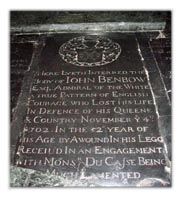
The new century saw a new war with France. The War of the Spanish succession once again pitted empire against empire. Admiral Benbow was despatched to the Jamaica Station to guard the Western Caribbean from a large French fleet (once again under the command of Du Casse.) After a hard battle lasting five days (and where Admiral Benbow lost a leg) his own captains implored the Admiral to break off and retire. On returning to Port Royal, the two leading captains were shot by Benbow for undermining his command and neglect of duties. Admiral Benbow himself died of his wounds and was buried in Kingston.
|
|
Hanoverian Jamaica
|
|
Sugar continued its inexorable rise as the fashion to drink coffee, tea and eat cakes and biscuits took off back in Britain. By 1700, the West Indian islands were selling fifty times as much sugar as they were back in 1660. Indeed, these small islands exported more in value than all the American colonies combined. More profits for the planters allowed them to fund the necessary investment to bring more of the island under cultivation and to bring in more slaves to undertake the back-breaking work.
The Crown of England was still smarting from having the expense of defending the island whilst deriving little material benefit from the vast profits emanating from it. The Hanoverian kings were viewed more sympathetically than the Stuart line by the island's planters. Although it still took many more years to iron out a compromise whereby the Assembly agreed to pay out an annual 8,000 pound to the British Treasury and for the king to provide Royal Assent to any of their laws in return for the defence of the island and their continued legal privileges. This gave the planters the rights to continue their harsh treatment of slaves and runaways and continued use of the militia to put down rebellions safe in the knowledge that the armed forces of Britain could also be called upon to put down internal or external threats to the island.
The threats were very real in the Eighteenth Century. Externally, France was providing real economic and military competition throughout the Caribbean. Internally, the Maroons were as big a threat as they had ever been and there numbers were constantly being refreshed by runaways who had a destination that was achievable.
The Maroons were principally concentrated in two main clusters: One on the Western side along the border of the Trelawny and St James' parishes in the mountains dividing the two. The main settlement there was known as Cudjoe's Town after the main leader of this group. The other cluster was to the East in the mountains above Kingston. Their base was known as Nanny Town, supposedly named after a black woman with supernatural powers who could catch British bullets in her hands.
The Western Maroons under Cudjoe's leadership avoided contact with the authorities as much as possible. Cudjoe himself went to great lengths to stop his followers from attacking plantations and stealing from the planters so that no provocation could be given for retaliation. Indeed, he spent a lot of his energy expelling rowdy members and keeping tight control of his followers. The Eastern Maroons were far more willing to take action against nearby plantations - especially towards the relatively isolated northern St George parish. The authorities sent out retributive expeditions against these Maroons but their knowledge of the land and network of informants amongst the slaves made it very difficult for the local militia to achieve and notable successes. Indeed, they tended to be the victims of ambushes, guerilla warfare and wandering through harsh jungled mountains to little effect.
In 1731, the governor requested formal aid from the British army to deal with the Maroons once and for all. Two regiments of foot were sent out from Gibraltar in May. Working alongside the militia, they were able to launch a successful attack on the main Nanny town settlement. They seized the town for three days, but their isolated position meant that supplies were not getting through and they had to withdraw. Guerilla fighting continued for another two and a half years before the regular army dragged artillery pieces up the mountains to destroy Nanny town once and for all. Its inhabitants fled once again into the mountains - many heading East to join with Cudjoe's band of Maroons.
The authorities, mindful of the role played by the regular British army, sought to continue to utilise their availability and turned their attention on Cudjoe's hitherto quiet Maroons. Another five years of bitter guerilla warfare ensued with endless ambushes, disease and hostile geography to contend with. Eventually, both sides agreed to a cessation of hostilities. The peace treaty granted Cudjoe and his men formal freedom and were given 1,500 acres to grow their own provisions. They were not permitted to grow sugar, however, so that they could not compete with the planters. In return, Cudjoe agreed to build and maintain roads to his settlements. The idea behind this was to allow quick and easy access for the British forces to sack his settlements in the future should there be a resumption of hostilities. Cudjoe also agreed to return any runaway slaves and that they would help the British if Jamaica were invaded by a foreign power. In many ways, this was a remarkable admission by the British that they could not defeat the Maroons and so had to come to an accommodation with them in an attempt to remove them as a threat, internally as a destination for escaped slaves and externally as a potential ally for invading armies.
The harsh realities of a slave economy continued throughout the Eighteenth Century. And although the Maroon threat had been temporarily neutralised, the threat from the large number of slaves still continued. The most severe threat from this quarter came in 1760 in what was known as Tacky's Rebellion. On April 7th of that year, more than a hundred slaves left their plantation to raid the arsenal in Port Maria on the Northern coast. Using these captured arms they swept through the surrounding plantations; releasing slaves and killing Europeans. Soon they were over 1,000 in number and their success was encouraging other slaves to rise up on their plantations. Many of these slaves cited the concessions given to Cudjoe as an inspiration and wished that they be granted freedom on similar terms. Fortunately for the authorities, Cudjoe remained loyal and even sent men to support the authorities to restore law and order. Ironically, it was one of Cudjoe's Maroons who tracked down and killed Tacky. Without leadership, the uprising faltered, although it took over a year to completely restore the situation. Over 60 Europeans had been killed in the uprisings and so once again the authorities felt compelled to exact harsh retributive justice. Over 100 slaves were publicly tortured and executed. Hundreds more slaves were transported to the even harsher conditions of Honduras. New laws were passed by the Assembly to further restrict the movements of slaves around the plantations and the islands. The circle of violence continued to send Jamaica into a downward spiral of suspicion and hatred as it effectively turned itself into a gigantic prison.
|
|
The Period of Revolutionary Wars
|
|
The American War of Independence proved to be a particularly tough time for Jamaica. Firstly, America was becoming an increasingly important market in its own right and to be deprived of access to the growing urban centres of New England was problematic. Secondly, new taxes were implemented to pay for the war back in Britain, notably a tax on sugar. However, a more pressing concern was the fate of the West Indies after the French and Spanish joined the American Revolutionaries. Smaller islands in the West Indies were picked off as the over-stretched Royal Navy struggled to contain the widening conflict. Jamaica itself was only saved from invasion when Admiral Rodney intercepted a French fleet under Admiral de Grasse in the Straits Passage off Dominica in 1782. The French were decisively defeated with Rodney even capturing the French flagship Ville de Paris. This late victory helped allow the British to negotiate far better peace terms than had been anticipated. Although she lost her American colonies, she was able to retain her most important sugar islands in the Caribbean. Thus Jamaica, amongst others, was saved for the Empire by the Royal Navy.
Britain's Navigation Acts made it illegal for Jamaica to trade with the newly formed America. Some naval commanders turned a blind eye to contraband trade with the North Americans. One exception was a young Horatio Nelson who was in the Jamaica squadron from 1777 to 1782 and remained in the West Indies until 1787. He made himself particularly unpopular enforcing the law on ships coming in and out of Jamaica. Smuggling returned as a major industry as merchants sought to avoid the new taxes and to trade with North America.
Less than a decade later, the French Revolution spilled into the Caribbean with unexpected results. The Declaration of the Rights of Man in 1789 also had the effect of inspiring a massive slave rebellion on the French colony of Saint-Domingue. Britain tried to intervene on the side of the monarchists, but the Republicans on the island freed the slaves and led a war against a combined British and Spanish invasion force. Whilst British forces were tied up fighting in what would become known as Haiti, slaves and Maroons alike were inspired by the new Revolutionary ideas spreading across the Atlantic.
The Second Maroon War began in 1794. The trigger in this case was the Maroons believing that the agreed Peace Treaty was not being honoured and that their lands were being encroached upon by planters. Thinking that the British authorities were busy dealing with War with Revolutionary France, the Maroons struck. However, the Royal Navy was able to quickly divert troops heading for Saint Domingue and bring them to Jamaica instead. These were augmented by vicious hunting hounds from Cuba which were used to flush out hiding Maroons in yet another savage guerilla war on the island. This time the British were less than magnanimous in this period of revolutionary fervour. Over 600 Maroons were exiled to Nova Scotia and later to Sierra Leone as the Maroons were extinguished once and for all.
For the next five years, thousands of British troops passed into the Caribbean as the war for the economically important sugar islands intensified. The British intervention in Saint Domingue backfired as the slaves found inspired leadership under Toussaint L'Ouverture. After years of fighting, the British finally agreed to withdraw from Saint Domingue in 1798 with the condition that Toussaint L'Ouverture would make no overtures to insurrection to British slaves nor could he invade Jamaica.
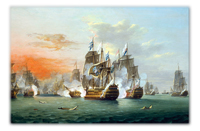
The Royal Navy gradually asserted its ascendency over the French throughout the Caribbean. The last threat to Jamaica came in 1805/6 when a French fleet was sent to blockade Jamaica and disrupt the shipping lanes of the Caribbean. The British sent a fleet under Admiral Duckworth to intercept and destroy this disruptive French presence in the region. He encountered them off Saint Domingo on February 6th, 1806. He scored a decisive victory and brought much of the French fleet into Kingston harbour as prize ships. Once again the Royal Navy had secured Jamaica.
The almost constant period of warfare from the 1780s to the 1800s saw a profound shift in the economy of Jamaica. Concerned at the dangers of the Caribbean being a constant battleground, many of the planters returned to Britain with their families and attempted to control their plantations as absentee landlords. Apart from reducing the European to slave population ratio even further, these planters outsourced the running of their plantations to locally based attorneys and managers. These often ran multiple plantations on a commission basis. These attorneys were in a position to abuse their positions in an attempt to maximise their profit. The treatment of slaves, which was already diabolical, could be made even worse as foremen were ordered to force their charges to work even harder. The attorneys could also manipulate the books and steal from the absentee landlords who had little way of knowing what was going on so many thousands of miles away. It did not help that war with France further strained communications and saw the island economy further isolated.
A surprising shock to the economy came in 1807 when the British Parliament banned the Trade in slaves. This was ostensibly brought in as a war measure to give the Royal Navy an opportunity to search ships for contraband slaves. The effect on the Jamaican economy in the short term was to raise the price of slaves as replacements could not just be shipped over from Africa.
The price of sugar also began to fall, firstly as overseas markets were cut off by Napoleon's continental system preventing British ships with trading with much of Europe. Also the French, cut off from their own sugar cane producing islands, turned to the production of sugar beet. This would have profound long term consequences as the crop slowly spread through Europe in the first half of the Nineteenth Century. Although not as pure as sugar cane, the fact that it could be grown on marginal lands in Northern Europe meant that it would eventually replace sugar cane as the primary source for sugar production over the course of the Nineteenth Century.
For a century and a half, Jamaica was an economic powerhouse, even if its economy was built on the brutality of slavery. By the end of the Napoleonic Wars, however, its future was increasingly uncertain. Britain may have won the war, but the market for the sugar islands was changing and the financial ability and will of the planters to defend the Jamaican economic model was under threat. Jamaica was finding that dependence upon a single cash crop was an increasingly serious liability.
|
|
The Ending of the Slave Economy
|
|
Within seven years of the end of the Napoleonic War, the price of sugar had fallen by half. West Indies sugar still had preferential duties and still benefitted from the Navigation Acts. However the decline in the power of the Jamaican economy was palpable in the post-Napoleonic War period.
Christianity was also going to play an important role in the future of the island. Firstly as non-conformist churches in particular enouraged slaves to come to church and taught many to read and write. The more articulate the slaves became the more they could lobby for improved conditions or petition for more rights. These were also amplified by Christians back in Britain who were inspired by the abolition of the slave trade to attempt to campaign for the abolition of slavery itself. They organised boycotts of West Indian sugar and produce and encouraged consumers to buy sugar from non-slave sources - even if the prices were higher - paradoxically thanks to the imperial preferences given to the West Indian producers. Lobbying intensified as non-conformist Christians in Jamaica fed information and compelling testimony back to churches in Britain. Petitions were set up, letters written to MPs and the newspapers.
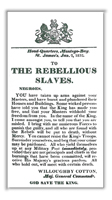
Expectations were raised amongst those slaves who could read newspapers for themselves and glean the parliamentary fights back in London. This led to a premature rising in 1831 dubbed the Baptist War. Over 60,000 slaves rose up led by a Baptist preacher by the name of Samuel Sharpe from Montego Bay. For the last time, British troops were called out to put down the rebellion. Many planters blamed the non-conformist churches for encouraging slaves to dare to believe that they may gain their freedom. In the immediate aftermath nine Baptist churches and six Methodist churches were burned to the ground. Five Baptist preachers, including William Knibb, were imprisoned. Approximately 300 slaves were executed by the authorities.
These harsh reactions to the insurrection could no longer be ignored back in Britain. Improved communications, particularly helped by the churches, relayed the horrors back quicker and made them more widely disseminated than ever before. The brutality of the institution of slavery was laid before the British public in the press and through the pulpits. The attacks on churches and on Christians were felt to be particularly horrific. Fortified by victory in the Great Reform Act of 1832, the newly elected Whig government introduced a bill for the Abolition of Slavery as early as 1833. Several concessions were made in order to speed the law through both House of Parliament as quickly as possible. The most important concession was that slave owners would be compensated but that slaves would not. Furthermore, a system of unpaid 'apprenticeship' was to replace slavery. Slaves were not granted immediate freedom but would have to work for a period of up to six years without pay. Officially, slavery was abolished in August 1834. However, disatisfaction of the terms of the apprentice system meant that it also collapsed and was abolished four years later in August 1838.
The hoped for free market did not immediately come to the rescue of Jamaica's economy. Scarred by years of slavery, the newly freed workers turned their back on sugar plantations and sought small holdings of their own or went to the towns to look for a living. Sugarcane continued its inexorable decline in value. Many planters sold up and left the island for good, taking much needed money for investment with them.
|
|
Using Science and Technology to Search for New Economic Opportunities
|
|
The final nails in the coffin of the sugar cane industry came in 1846 when Britain passed the Sugar Duties Act and with the ending of the Navigation Acts in 1849. The laissez faire economic doctrine was becoming all powerful back in Britain and the cossetted and protected old imperial industries, such as the sugar industry, were the main casualties. Britain embarked on a policy of removing protective barriers and buying the cheapest goods from the cheapest sources. Jamaica would have to diversify and seek new sources of income.
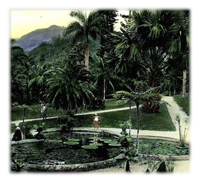
Clouded by its reputation for savagery and slavery, Jamaica was not completely cut off from the Age of Enlightenment and the Scientific Revolution of the late Eighteenth and Nineteenth Centuries. Indeed, even as Jamaica was rocked by the American Revolution, its Assembly had designated the creation of the Bath Botanical Garden to facilitate research into new medicinal and cash crops. The famous 'Mutiny on the Bounty' was occasioned by the attempt to bring breadfruit and Plantain from Tahiti to Jamaica to see if it could be grown and used as an alternative food source for the slaves and workers. Captain Bligh was later given a specially adapted ship, HMS Providence, and was able to successfully bring the crops to the island where they were planted in the Bath Botanical Gardens. One of the ships captured by Admiral Rodney in his defeat of the French at the Straits Passage off Dominica was filled with exotic plants like mangoes, cinnamon, oriental ebony and pandanus which were all also planted and seeded in Bath. A steady flow of other plants arrived from around the Empire and the wider world; sago palms, camphor, litchi, tea, trees producing dyes, resin or cabinet woods.
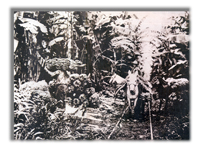
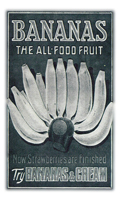
A series of floods in the Nineteenth Century saw the creation of a larger Botanical Garden in Castleton. Kew Gardens in London sent over 400 specimens to the gardens which received over 100 inches of rainfall a year in the wooded hills in the centre of the island. New crops and plants could be tried out in this different climate zone. Teak trees were brought from Burma, figs and resinous guncardies from India, mouse palms from British Guiana, but the most important crop which thrived here was the banana tree. This was to prove to be the most important replacement cash crop for sugar cane throughout the West Indies.
Another Botanical Garden was established higher up yet at Cinchona in the Blue Mountains. This remote outstation was to experiment with the cultivation of the tree bark, Cinchona, which gave the garden its name. Cinchona was used to make quinine which could be used as a prophylactic for malaria. Cinchona Gardens also experimented in growing Assam teas as these were from the hillsides of the Himalayas. Kew gardens even sent out a gardener to attempt to grow common European vegetables and flowers in the hope that a market garden economy could be created to provide fresh food to Kingston and the local population.
Jamaica was effectively part of a larger Imperial project whereby experts, plants and markets were identified and the necessary ingredients were moved around to try and match the most appropriate production centres with the most appropriate markets. Britain's Empire could also provide the means to industrialise and distribute these products thanks to the benefits of the Industrial Revolution and the power of the Royal Navy. Steamships and trains helped shrink the distances between producers and consumers. Industrially produced goods could facilitate the cultivation, storage and preparation of goods. Refrigeration and canning industries were transforming the way that goods could be stored and distributed and significantly prolonged there longevity.
The Jamaican Assembly approved the construction of the first train line from Kingston to Angels in 1843. This first rail line was an attempt to help out the sugar industry and linked sugar estates to Spanish Town and on to the port of Kingston. However, the continued decline in the sugar industry could not be arrested by this one train track and the abolition of the Sugar Duties Act in 1846 helped condemn the industry just as the train line got going. The next large investment in the train system was not until the 1880s and 1890s when the Assembly attempted to support the new growing banana and citrus industries. A far more significant rail infrastructure linked the north coast to the interior to Kingston. Jamaica was redirecting its imperial economy and using the latest technology to facilitate that transition.
|
|
The Creation of the Crown Colony of Jamaica
|
|
In the 1860s, Jamaica's fortunes were very much at a nadir. The sugar industry had all but collapsed and the replacement banana and citrus industries were yet to be developed. The raging American Civil War had disrupted trade in the region and led to rampant inflation. Emancipation was in living memory for most of the population. Freed slaves enviously eyed the land on the increasingly vacant and abandoned plantations. Still reluctant to work on the plantations, the weather and land made it relatively easy for ex-slaves to eke out enough food from the land at a subsistence level if nothing else. The Assembly may have been elected, but the property qualifications required were so restrictive that less than one person in two hundred had the right to vote. Racial tensions were as strong as ever and the well to do planters, agents and attorneys had little in common with the plight of the ex-slaves. The Assembly had the right to impose taxes and because the rich were so powerful, they tended to place the burden of taxation onto indirect taxes that fell disproportionately on the poor. The Colonial Office was in the process of reforming colonial assemblies throughout the Empire and Jamaica's was identified as being a particularly problematic one. It was for this reason that they brought in Edward John Eyre as a Governor to attempt to reform the Jamaican Assembly. It's timing could have been better.
The black population sought leadership from the non-conformist churches which had its allies back in Victorian Britain also. The Native Baptist Church provided two high profile critics of imperial rule George William Gordon and Paul Bogle who knew each well. Eyre and Gordon clashed early in their relationship over the state of the gaols and Eyre had Gordon stripped of his magistracy. Bogle set up something of a paramilitary organisation at his farm in Stony Gut, 20 miles from Morant Bay.
In this racial tinderbox, a team of black policemen were sent to Stony Gut to arrest Bogle and disband his followers. Bogle's men defended themselves and beat up the policemen. Two days later, Bogle's agitated men set off for Morant Bay with the aim of destroying the Court House there. Local militia were employed to guard the Court House but an ineffective volley of fire did little to disperse Bogle's men. The Court House was set alight and the magistrates who were in session desperately attempted to escape. They were hunted down in the streets and by the end of the day 17 white men had been killed (including most of the magistrates) and 31 injured. Bogle's men went on to free the convicts from the jail. However, there was no widespread looting and no women or children were harmed. The ecstatic rebels retreated back to Stony Gut in high spirits.
When knews spread to the rest of the white community in Jamaica they were horrified. Racially outnumbered they recalled the slaughter of the planters that had occurred in Haiti when the black population had seized power there. Eyre was petitioned to do something about the insurrection and he retaliated almost immediately with a firm hand. He declared Martial Law throughout the effected county of Surrey excepting Kingston itself. He mobilised the 600 strong regular British army soldiers on the island and called on the Royal Navy to provide ships and personnel. He even mobilised 300 descendents of the Maroons.
The soldiers were largely made up of veterans of the Indian Mutiny. As such, their tolerance for rebellion was low and their propensity to violence high. They took savage retribution killing and flogging throughout the parish. Courts martial were set up in Morant Bay where 439 men were sentenced to death and 600 were flogged. Many of those executed were symbolically hung from the remains of the burnt down Court House. A thousand black homes were punitively destroyed believing that even if the inhabitants did not participate in the attack, they were likely to have been sympathetic with it. Paul Bogle was hanged from the yardarm of the waiting Royal Naval ship HMS Wolverine. Stony Gut was razed to the ground.
Governor Eyre assumed that George William Gordon was the mastermind behind Bogle's actions. Gordon duly handed himself over to the authorities but in Kingston. This placed Eyre in something of a quandary as there was no Martial Law in operation in Kingston and a trial would be a long drawn out affair with an uncertain outcome. Eyre decided to cut a fateful corner. He took Gordon from Kingston to Morant Bay on HMS Wolverine to face a courts martial. He was charged with High Treason and after a six hour trial was sentenced to death. He was hanged from the Court House an hour later.
The Assembly, in a mixture of fear, relief and thankfulness, voted itself out of existence and handed Eyre the direct colonial government that he had worked for. His decisive action had appeared to stamp out the possibility of a wider insurrection and the local white population felt in his gratitude. However, the local adulation was not repeated across the Atlantic. News of the ferocious methods employed by British soldiers and sailors hit the headlines. Non-conformists were horrified that pastors of the church could be executed in such a brutal manner. The ratio of 1400 lives taken in retribution for 17 lives seemed disproportionate to many. The extra-judicial means by which Gordon's execution had been engineered particularly outraged those who believed in the sanctity of the British judicial system. In en era of increased literacy and pronounced religious sentiments, a Commission of Inquiry was demanded and delivered. It found that althoguh he had been prompt and vigorous in putting down the rebellion, he his use of martial law was excessive and condemned the severity of his punishments. He was dismissed with immediate effect.
Eyre's return to England did not see an immediate end to his public humiliation. Private prosecutions were made that dragged on for years with the ins and outs of his actions in Jamaica covering acres of pressprint for years to come. The private prosecutions petered out due to a lack of clarity in his constitutional powers. He retired in disgrace and never held public office again. However, his period of governorship had seen a profound reorganising of Jamaica's constitutional arrangements with Britain. Jamaica was now a directly ruled colony for the first time in nearly two centuries.
|
|
Directly Ruled Jamaica
|
|
One of the prime concerns for directly ruled colonies was that they should be self sufficient and not be a burden on the home nation. Therefore, despite the relative poverty of the majority of the population, taxation was maintained at relatively high levels compared to other colonies in the region. Furthermore, changes in the way the army was organised meant that regular British Army troops were not to be stationed overseas except to guard a few vital naval bases or for specific campaigns. This meant that Jamaica had to pay for its own militia to guard itself. The Royal Navy still operated out of Kingston, but with the relative decline in the importance of the West Indies strategically and economically, these visits were less frequent than they had been.
1868 saw the first fruit shipment take place from Port Antonio, this would provide a new direction for the economy of the island. To help facilitate the new opportunities of growing crops like bananas and citrus fruits, the authorities increased infrastructural spending. They also felt a need to do something about providing a workforce for these new plantations. For many poor blacks, working on plantations was still identified with the worst ravages of slavery. So an alternative workforce began to be imported into the island in the form of indentured labour from Asia and particularly from India. Over 36,000 workers were brought to the island before the outbreak of World War One. The contracts were supposedly voluntary and the workers had intended to return home upon completion of their contracts. In reality though, the conditions were very tough, the pay was low and many forewent their homeward ticket in return for gratuities. It is estimated that up to two thirds of the indentured labourers remained in Jamaica and never returned home.
A particularly sad consignment of Chinese workers were brought to Jamaica out of pity during the construction of the Panama Trans-Continental Railway. 800 had originally been indentured in slave like conditions in the harsh, malarial swamps of Panama. Denied Opium for the many addicts and being treated abominably by rival Irish and American workers, the Chinese began committing suicide on an unprecedented scale and in a number of bizarre ways. Out of pity, the remaining 350 were brought to Jamaica to settle with the Chinese community in Kingston. In return, Jamaicans of African descent travelled to Panama to work on the construction of the railway and both de Lesseps Canal scheme and the later American scheme. Indeed Jamaican labour was to be particularly highly prized as their constitution and work ethic were well suited to the conditions.
Bananas and citrus fruit never found the high values that sugar had once enjoyed and although it could provide a regular income, the profits were tight and the investment required to start production was high. Plantations were returning, but usually in the form of limited companies rather than the aristocratic concerns. Plantations had to merge to survive and seek economies of scale.
Sugar's long demise continued as European countries introduced subsidies to encourage the growing of sugar beet. The American market dwindled after 1898 after Cuba was given preferential access.
The Secretary of State for the Colonies, Joseph Chamberlain, was so concerned at the plight of the West Indian economies as a whole he set up a Royal Commission in 1896 specifically to examine the economic crisis there. One of its recommendations was to confront the European powers over their sugar beet subsidies, but a diplomatically isolated Britain found it hard going getting these removed although perseverance saw them begin to be removed from 1903 onwards.
These measures were too late to stop the outbreak of serious rioting in Montego Bay in 1902. Militia had to be called out to restore law and order after the two day long riot on the streets.
Attempts at establishing unions was one way that workers sought to protect their incomes. 1898 saw the creation of the Artisan's Union. Within a decade cigar makers and printers had also formed their own unions. Class consciousness and international labour rights spread throughout the world in the 1890s and early 1900s. However, these movements were distrusted by the rulers, authorities and police who believed that they were disruptive forces likely to challenge the status quo. High profile members were monitored and labour unrest was dealt with harshly in the coming years. However, these new unions would provide the kernel of leadership and identity that would produce a generation of Jamaicans who would later lead the island to independence. However the economic and political skies would darken before the rights of workers and Jamaicans in general could improve.
Other poor workers wondered aloud if Jamaica might not have a brighter future if attached to the growing regional power of the United States. The 1898 Spanish American War had seen a new confidence in American colonial expansion. With its large black population and close regional ties, many Jamaicans felt that union with America might make for new opportunities, especially as Cuba appeared to be thriving with new investment in the wake of its independence from Spain. In fact, suspicion at American designs on the island led to another governor losing his job. In 1907 Kingston suffered from another terrible earthquake. Almost every building in the capital and in surrounding towns were destroyed or seriously damaged. The Americans tried to supply relief with the despatch of three warships to aid the island and landed US marines to help restore order and provide relief. The governor requested that these American forces be withdrawn immediately. The incident caused a diplomatic stir between the two governments, and led to governor Swettenham's resignation shortly after. However, it revealed a suspicion of increasing powerlessness for the forces of authority on the island and the growing concern at American intentions in the region and how these might be interpreted by Jamaicans.
World War One saw Jamaica officially pledge its loyalty to the Empire. 'Jamaica itself donated '50,000 worth of sugar to Britain and set aside '10,000 of its own budget to defend the island. Pressure was placed on the British Government to allow West Indians to volunteer and participate in frontline action.'The Jamaican Volunteer Defence Force, the Jamaican Constabulary Force and the Jamaica Militia artillery were all tasked with protecting the island during the conflict. A War Contingent Committee was established in 1915 to raise funds for 200 Jamaicans who wished to serve abroad but could not afford the cost of travel. The Kingston Women's Fund Committee also organised fundraising activities for Jamaican volunteers. Some 10,280 Jamaicans served in the'British West Indies Regiment mostly seeing action in Africa.
An alternative challenge to imperial rule from the class based labour movements was provided in the early Twentieth Century from race based groups. These were created partly in reaction to the spreading of Social Darwinian ideas of racial superiority and inferiority that were reaching their apex of intellectual and political influence. Additionally, black West Indians were responding to African American thinkers like Booker T. Washington who was attempting to inspire black Americans to rely on themselves and even to emigrate to Africa to form their own societies. These ideas influenced West Indians like Dr Albert Thorne and Marcus Garvey. They promoted ideas on black capability and self worth but encouraged Jamaicans to divorce themselves from the prevailing political structures and develop their own separate communities. Marcus Garvey founded the Universal Negro Improvement Association in Jamaica in 1914. Two years later he moved to America and set up the Black Star Line in 1919 to provide a means to facilitate emigration to Africa. This enterprise failed and Marcus Garvey was accused by nervous American authorities of mail fraud. He was deported back to Jamaica in 1927 after being pardoned by the American President. These racially based self-help communities and societies were about to be washed away by the same storms that would also undermine the prevailing economic system by the Wall Street Crash of 1929 and the ensuing Great Depression. Although the new assault on Jamaica's economic system would allow for the labour movements to return in importance.
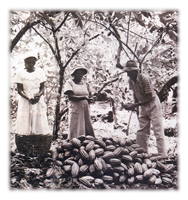
Sugar had been declining in value for many years. Jamaica had actually done better than many other West Indian islands at diversifying away from sugar cane to other agricultural products like bananas, logwood, cattle and cocoa. However, the 1930s saw a collapse in value across the board of every commodity. Regardless of the crop, plantation owners and their workers suffered. The towns were also affected as workers could not afford to buy products on their shrinking wages if they were fortunate enough to still be in employment. The economy which was already weak was in freefall as the international depression blew its own hurricane of devastation through the island's economy.
The traditional 'light touch' ideas of British colonial rule were challenged as never before. Governors had hitherto been asked to balance the books and maintain law and order and do little else. As Keynesian ideas of economic stimulation began to take hold back in Britain, commentators like W. M. Macmillan who visited the region in the 1930s argued in Warning from the West Indies that the British government should treat islands like Jamaica just as if they were an economically deprived region of Britain. He argued that Britain should build hospitals, homes and schools to regenerate the economy and develop the island.
The British authorities were even struggling to maintain law and order as labour based riots and strikes took hold culminating in large scale riots in 1938. Once again, labour organisations played a pivotal role and in the midst of the turmoil the Bustamante Industrial Trade Union was founded by Alexander Bustamante. Jamaican middle classes were also concerned at the turmoil which saw Norman Manley form The People's National Party (PNP) to agitate for more rights for Jamaicans and in sympathy with the workers and strikers. The authorities were also mindful of the increasing social and economic power of America which was deepening its anti-imperial rhetoric during its period of isolationism during the interwar years. They were concerned at how harsh reaction to British control would be viewed in America in a period in which Britain was courting American public opinion in the expectation that she would be needed as an ally during World War Two. So, the British set up a Royal Commission to the British West Indies to provide solutions to the economic under-development of the region. The Commission took 15 months and was chaired by Lord Moyne. It did not publish its findings until December 1939 by which time Britain was at war. However, if anything, being at war helped provide further impetus to the measures called for by the Commission to develop the economy and improve the welfare provision for the islanders. Britain was keen to impress the Americans and reward the islands for their loyalty as they provided soldiers, sailors and airmen to the conflict.
Political dividends came to fruition in September 1940 when a still technically neutral United States swapped fifty lend-lease ships for bases throughout the Caribbean - including an airfield and port facilities in Jamaica. The American salso agreed to use these bases to help monitor the Caribbean and West Atlantic for U-boat activity. The Americans were also granted commercial access to Britain's colonies, thus laying the foundations for increased economic contact between American and Jamaica in the years ahead. The deal helped attach America to the Allied war effort but it also meant that Americans were now more involved in Caribbean affairs than ever before. This was manifested by a joint British American Commission in 1942 designed to ensure that development of the region continued apace despite the difficulties of wartime scarcity of resources and manpower. The culmination of this scrutiny was the Colonial Development and Welfare Act of 1945 which saw a substantial boost to the money available to the Caribbean colonies for development work. It may not have arrived in time for World War Two, but it did arrive in time for the Cold War.
Hand in hand with these economic concessions went political advances. Lord Moyne's Commission had recommended that colonies should strive towards granting universal suffrage but put no timetable in place. However, as the war unfolded, Britain found itself being more generous than previously on granting rights to the inhabitants of its various colonies as a way of shoring up loyalty, for propaganda purposes and to reduce American anti-imperial criticisms. 1944 saw the introduction of universal suffrage for the first time. Previously, the franchise was dependent upon a property or tax threshold which naturally disenfranchised the poorest sections of Jamaican society.
Jamaican political movements were evolving during the wartime years to take advantage of the new expansion of the vote in 1944. Alexander Bustamante had been detained as a possible security threat in 1940 given his recent role in Trade Union activity and in the strikes and riots of 1938. However, on his release in 1942 he split from the more middle class PNP and in the following year formed the Jamaica Labour Party. This undercut the PNP's popularity with the poorest parts of Jamaican Society and in the first election by universal suffrage in 1944, the PNP won a mere 4 seats to the Labour Party's 23 in the 32 seat assembly. The vast majority of the gentry who stood as candidates were beaten.
In the post-war period, Americans toned down their anti-imperialist criticisms in the face of the increasing appeal of Communism across the world as the Cold War unfolded. The British had demonstrated that their Caribbean colonies were evolving towards more responsive self-government.
Jamaica in the late 1940s and 1950s was also able to resume its nascent tourism industry which had been disrupted by World War Two. Indeed, with the increasing ability of planes to cover longer distances in shorter times gave a fundamental boost to Jamaica as a tourist destination. It had long attracted cruise liners to its ports, but jet travel would allow Americans and increasingly Europeans to visit the island and enjoy its climate and beaches. At first, only the well to do tourist could afford to visit the island, the era of mass tourism would lie further into the future but investments in the tourist economy began in earnest during this period often using funds unlocked from the Colonial Development and Welfare Act.
The 1950s saw a major experiment in the constitutional arrangements of many of its remaining colonies through the formation of larger Federations. The idea was sold as a way of replicating the relative success of Federal/Provincial systems like that of Australia, South Africa and Canada. Indeed, Norman Manley, when he became PNP's first chief minister in 1955, advocated for the creation of the Federation of the West Indies encompassing a dozen British Caribbean colonies in a single political entity. However, almost immediately many of the participants, from all colonies, believed that the system was evolving to prolong British control and to delay the day of independence for the countries. There were also concerns at freedom of movement throughout the Federation's members and the financing of the Federal Government. It did not help that many of the Federation's members were in direct competition with one another over attracting tourists, investment or in selling their produce. So, it was increasingly difficult to agree on common fiscal, customs and tax policies to such a diverse array of colonies with their own priorities and histories. Alexander Bustamante almost immediately began to lobby for Jamaica's exit. Norman Manley, as Chief Minister, took the unprecedented step of calling for a referendum on the subject; Jamaica's first ever referendum. 54% of Jamaica's population voted against the Federation in 1961. When the island officially left the Federation in 1962 it dealt a death blow to the Federation which effectively collapsed.
Norman Manley then undertook the negotiations and preparations towards independence. However, he was still associated with the failed Federation scheme, despite calling the referendum that saw its collapse. His PNP lost heavily to Alexander Bustamante's JLP in April of 1962. This meant that it was to be Alexander Bustamante who would guide the island to its independence on August 6th 1962 and become its first prime minister. The island had been a British colony for over 300 years. Queen Elizabeth was to remain as head of state and the island has remained an active member of the Commonwealth.
|
|
|
|
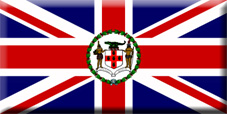
| Imperial Flag
|
|
Port Royal Earthquake Effects Map
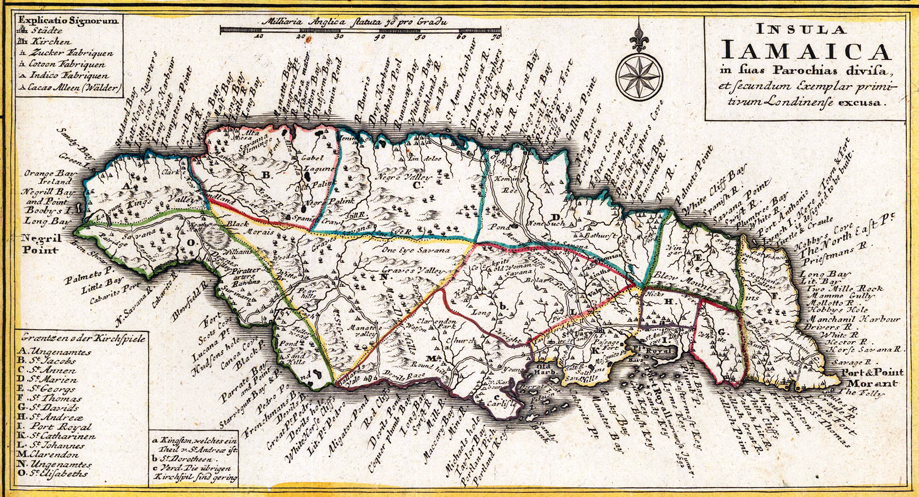
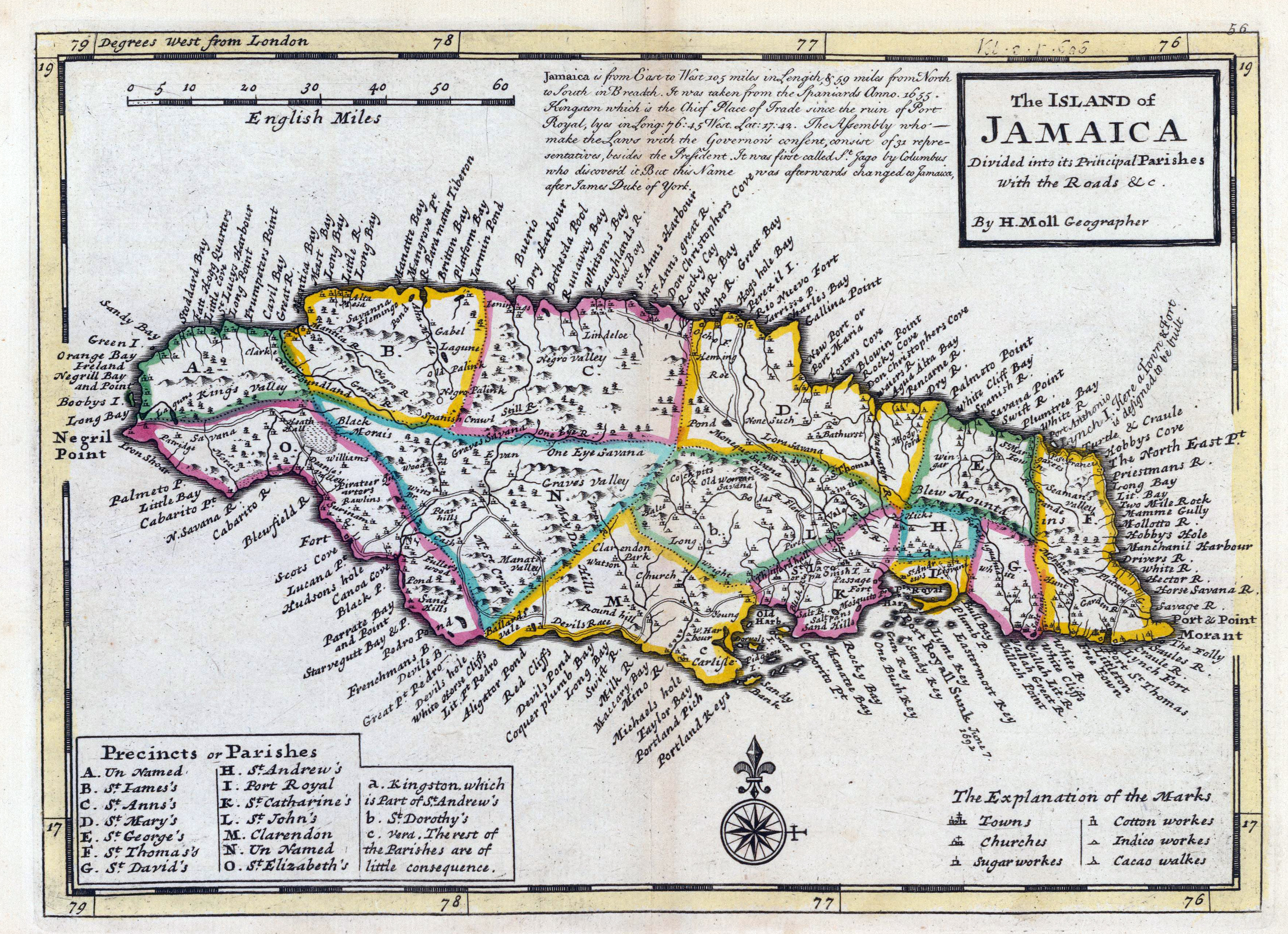
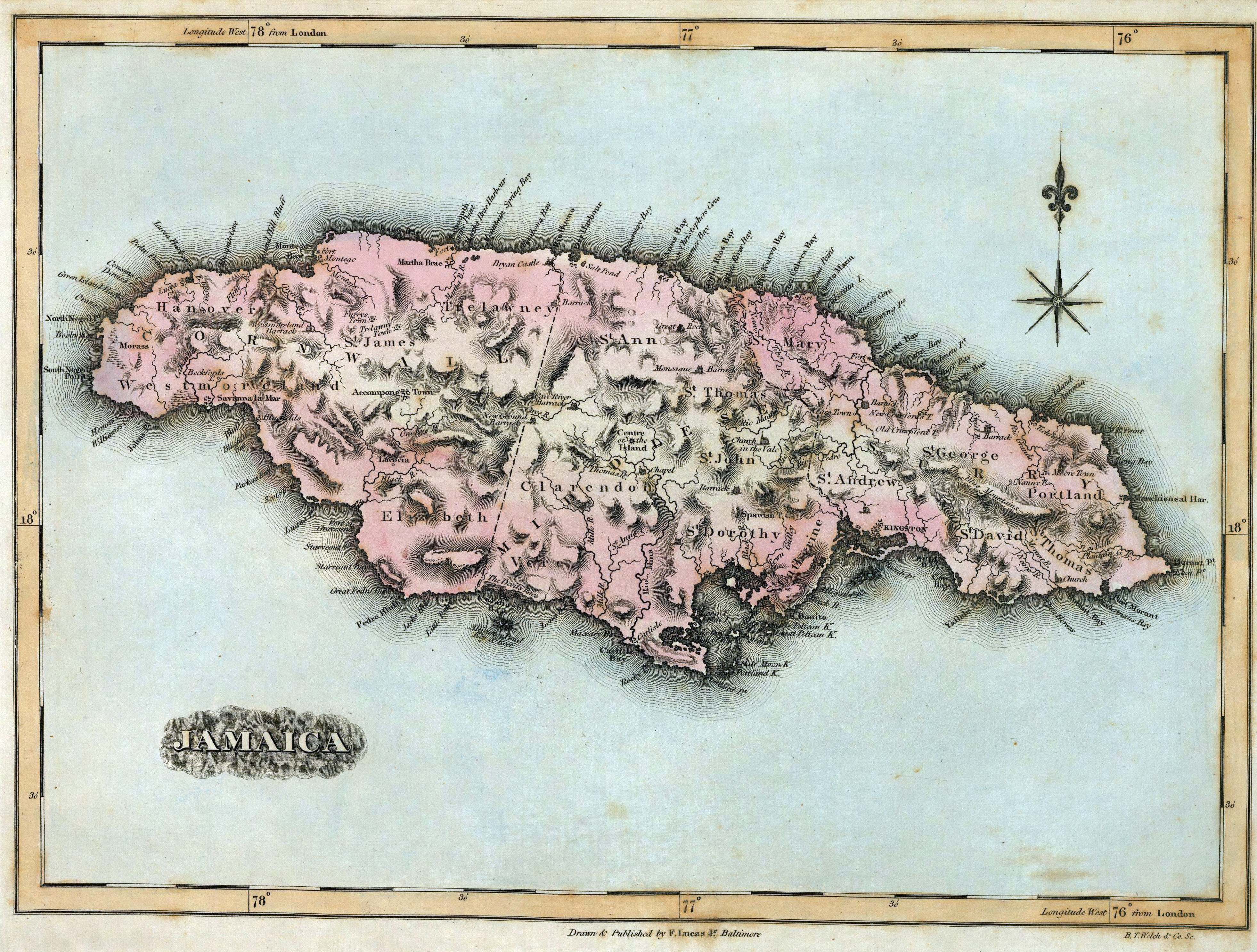
1700 Map of Jamaica
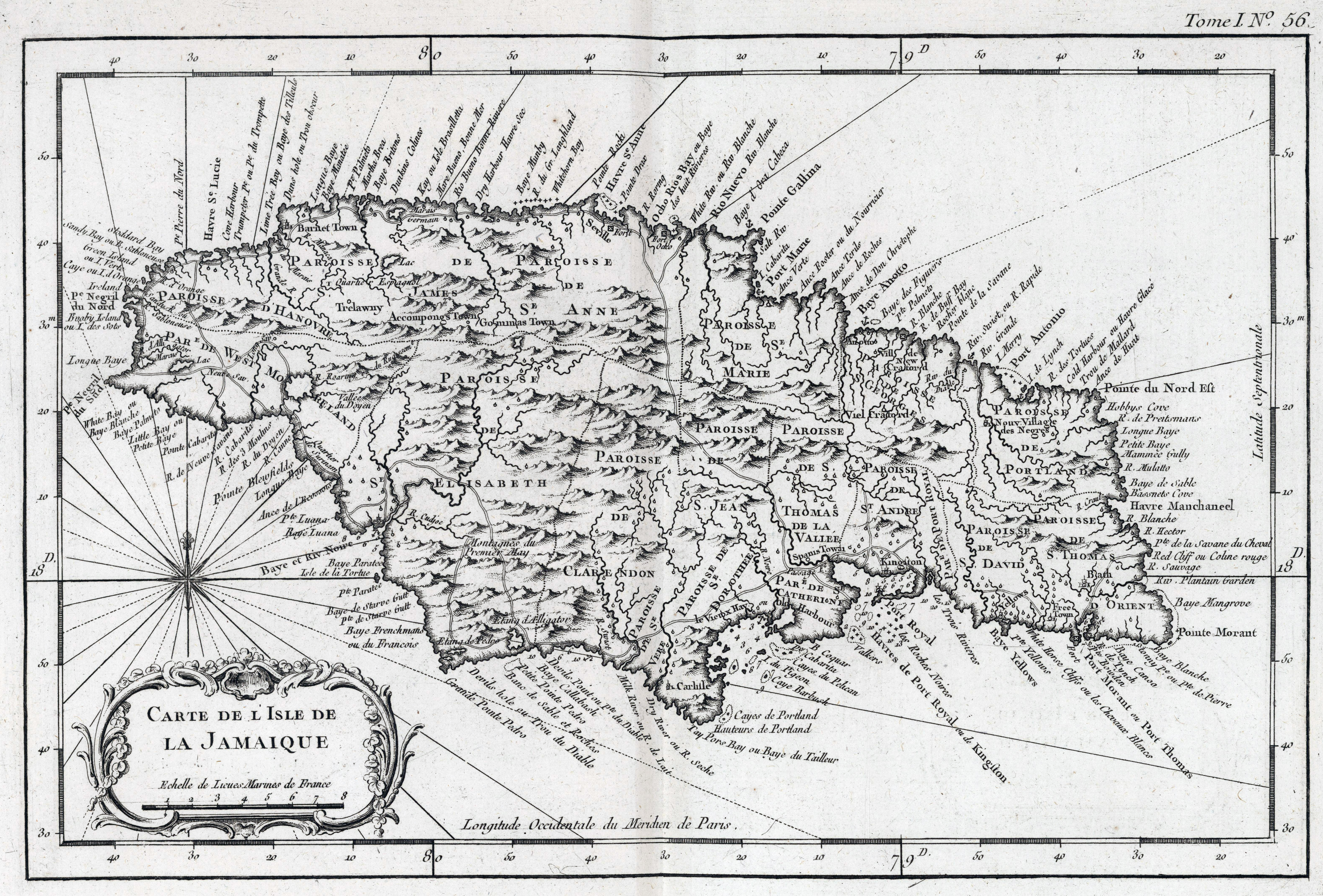
1730 Map of Jamaica
1731 Map of Jamaica
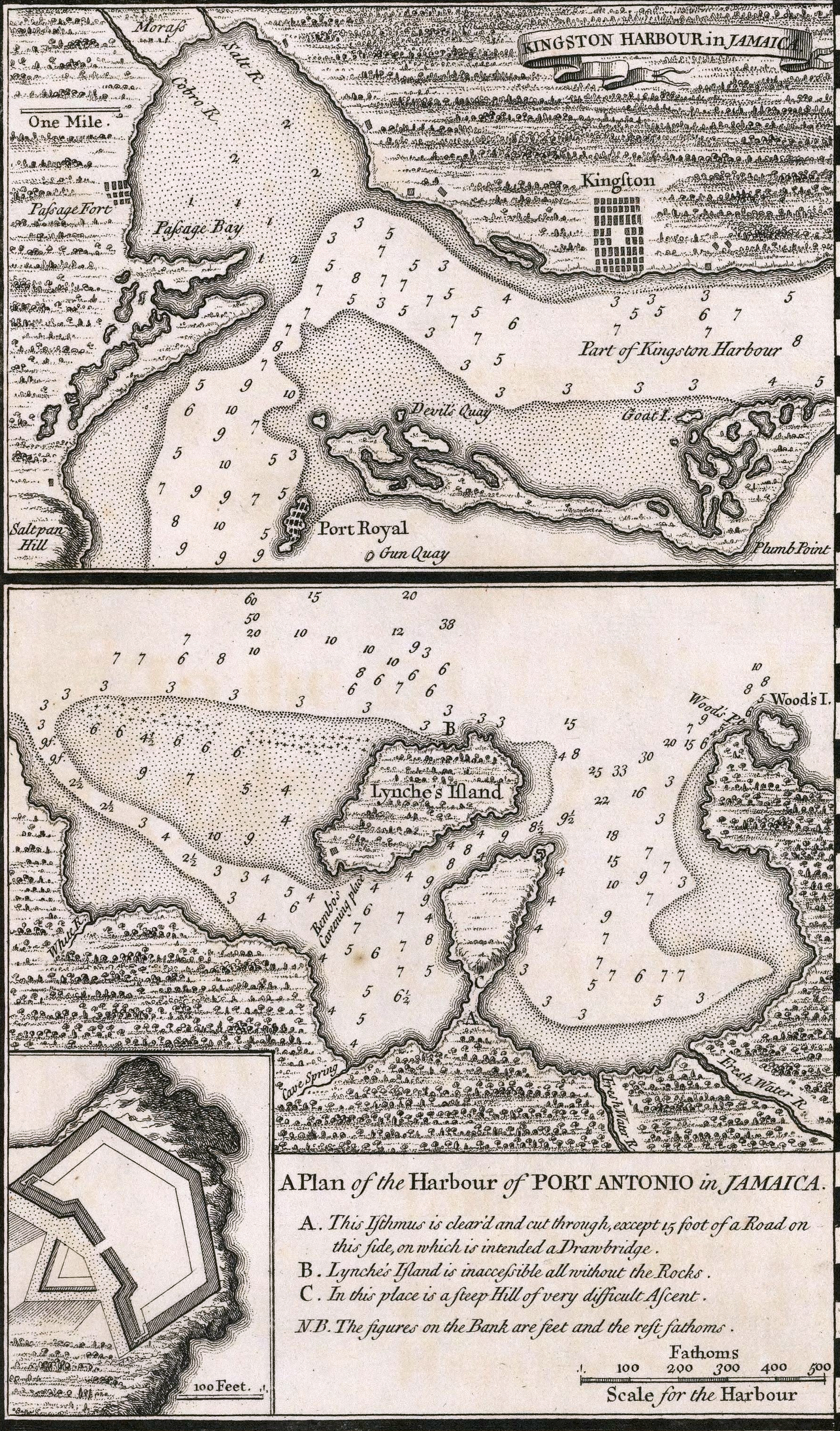
1733 Map of Kingston and Port Antonio
1736 Map of Jamaica
1747 Map of Jamaica
1755 Map of Jamaica
1764 Map of Jamaica
1764 Map of Kingston and Port Royal
1774 Map of Port Royal
1774 Map of West Indies
1775 Map of Jamaica
1780 Map of Jamaica
1794 Map of Jamaica
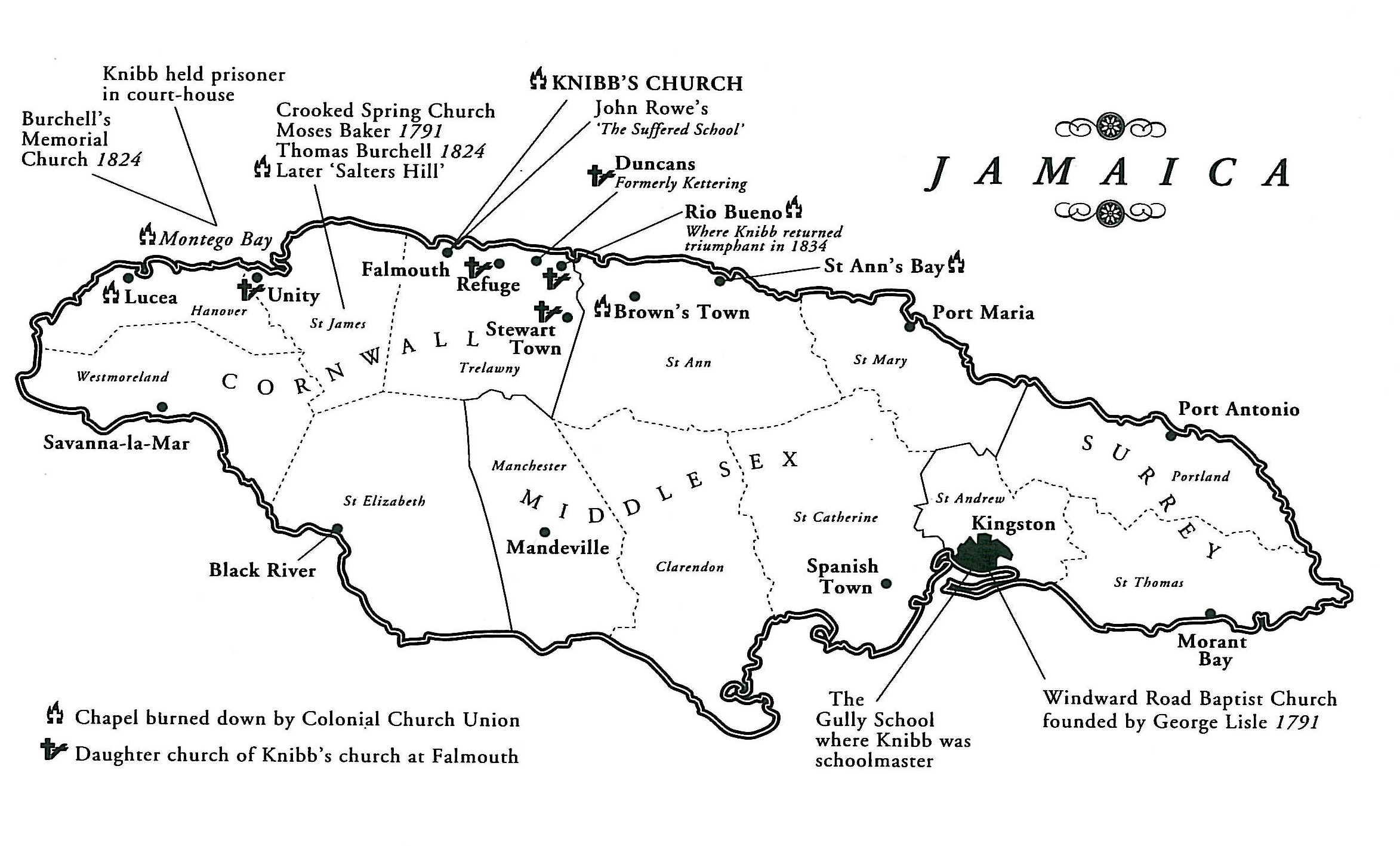
William Knibb & Slavery Resistance Map

1817 Map of Jamaica
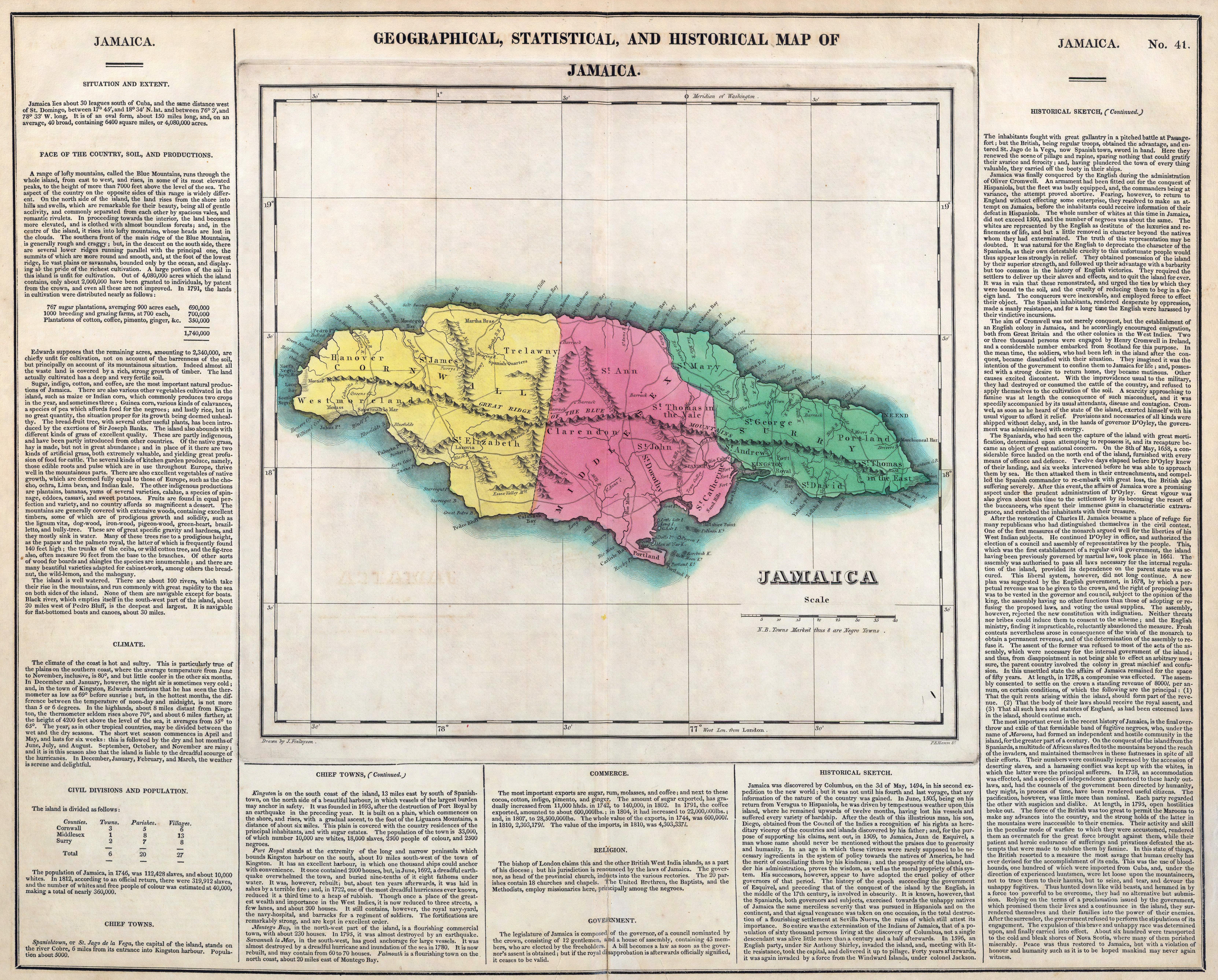
1822 Map of Jamaica
1823 Map of Jamaica
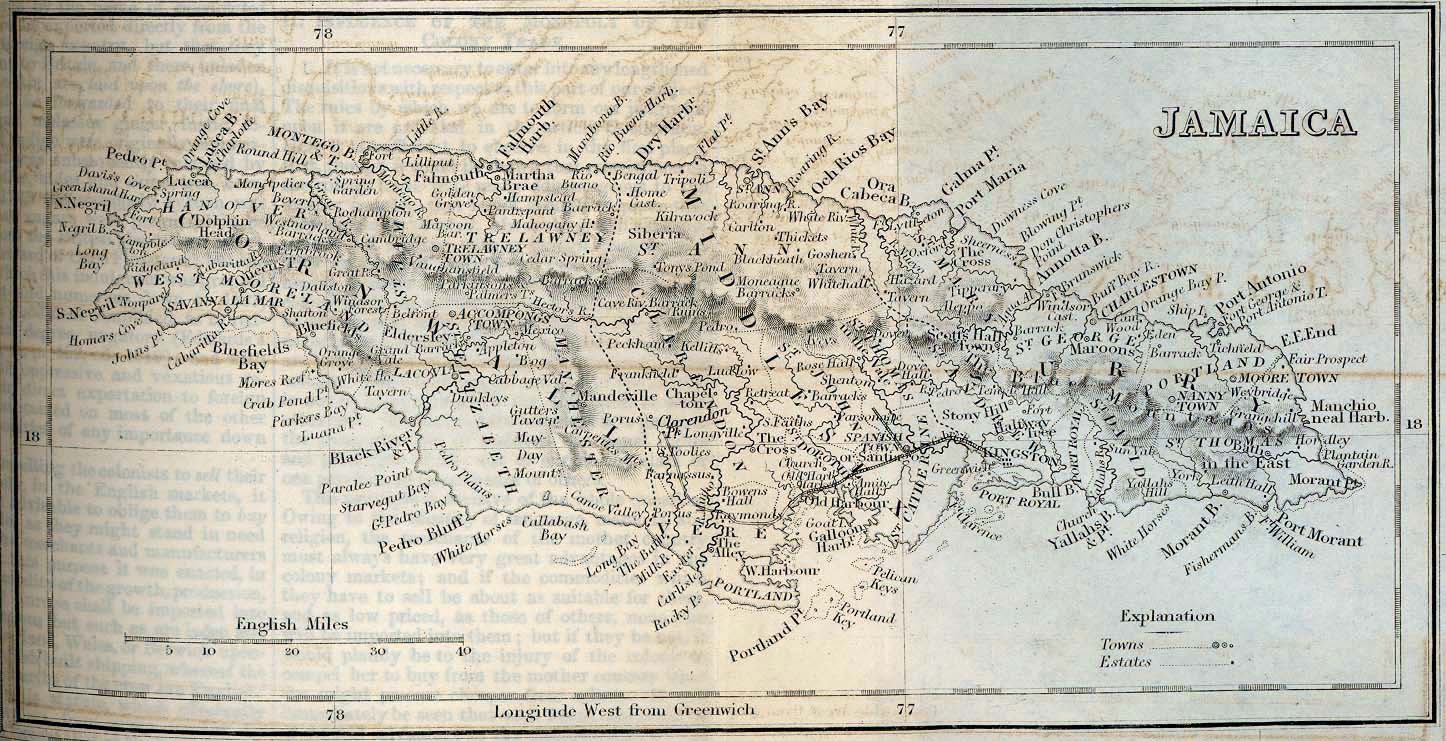
1835 Map of Jamaica
1844 Map of Jamaica
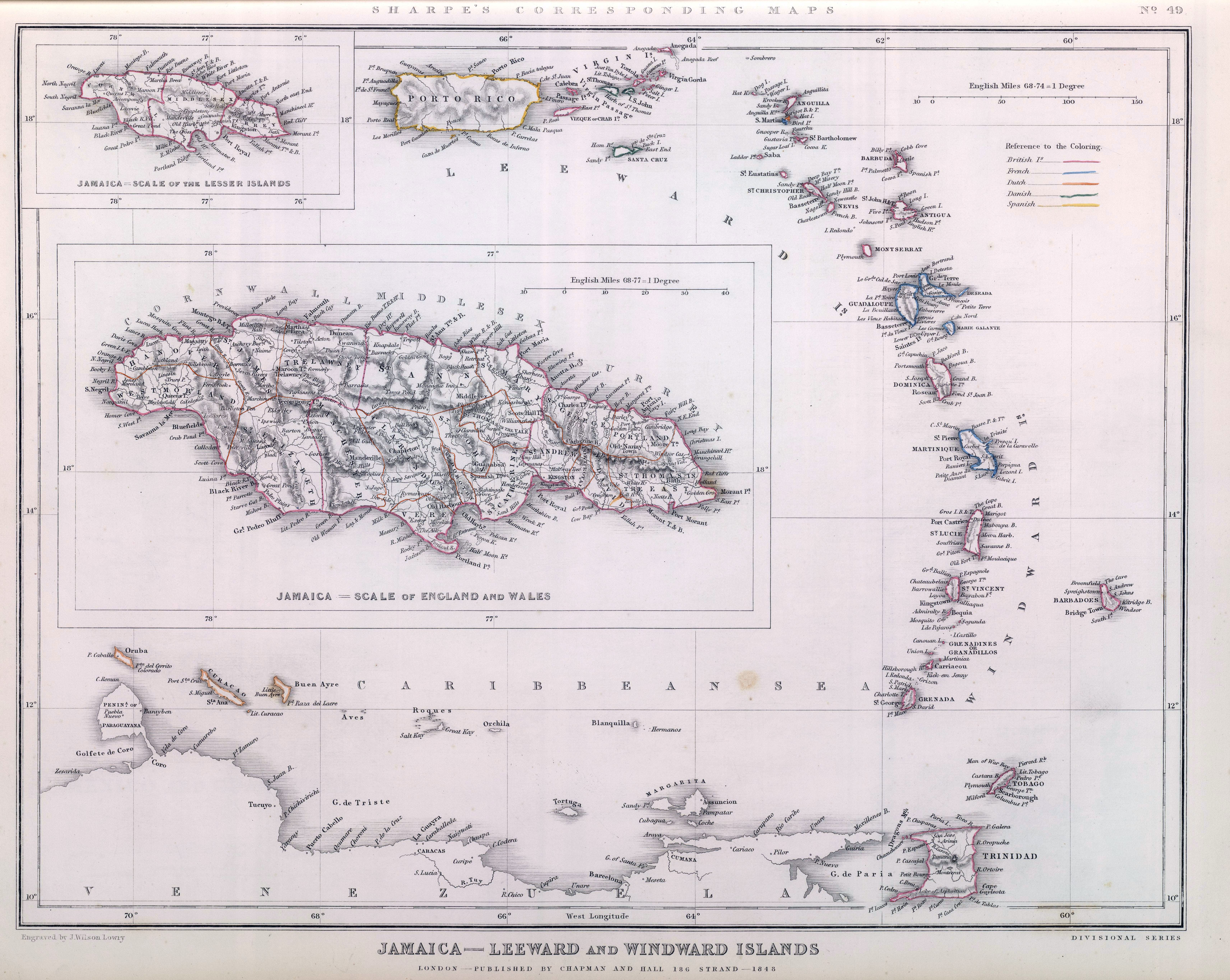
Jamaica 1848 Map
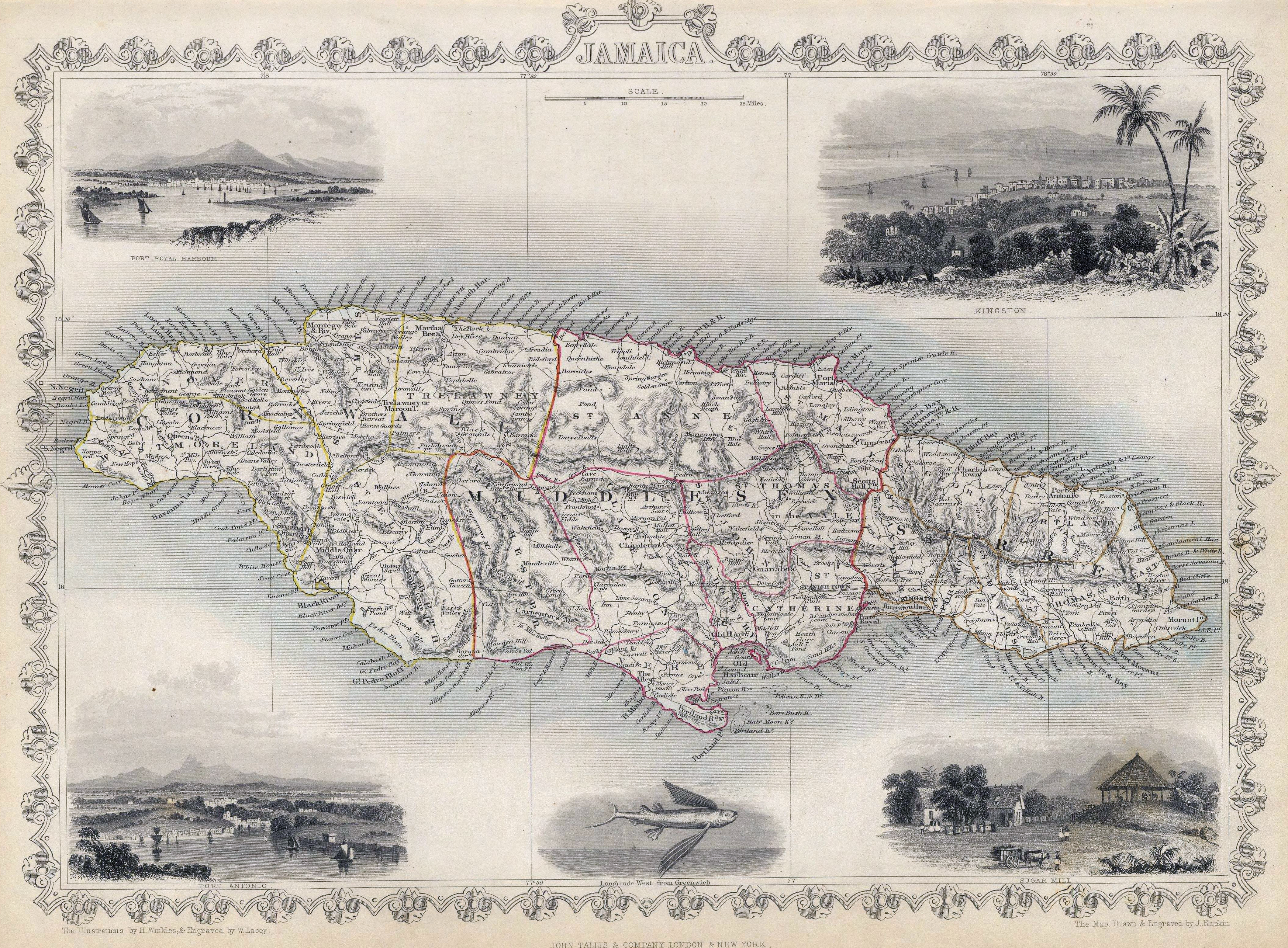
Jamaica 1851 Map
Jamaica 1853 Map
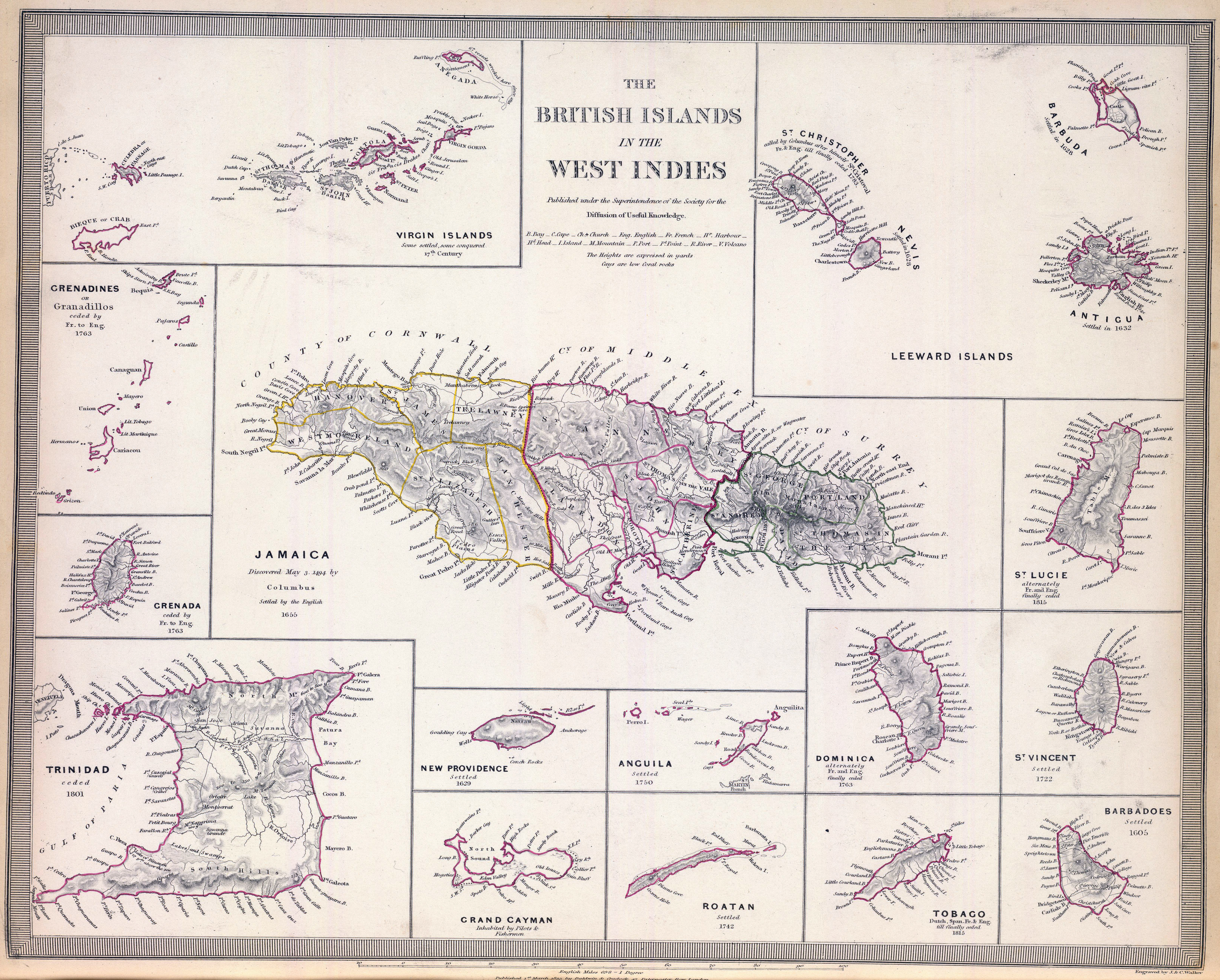
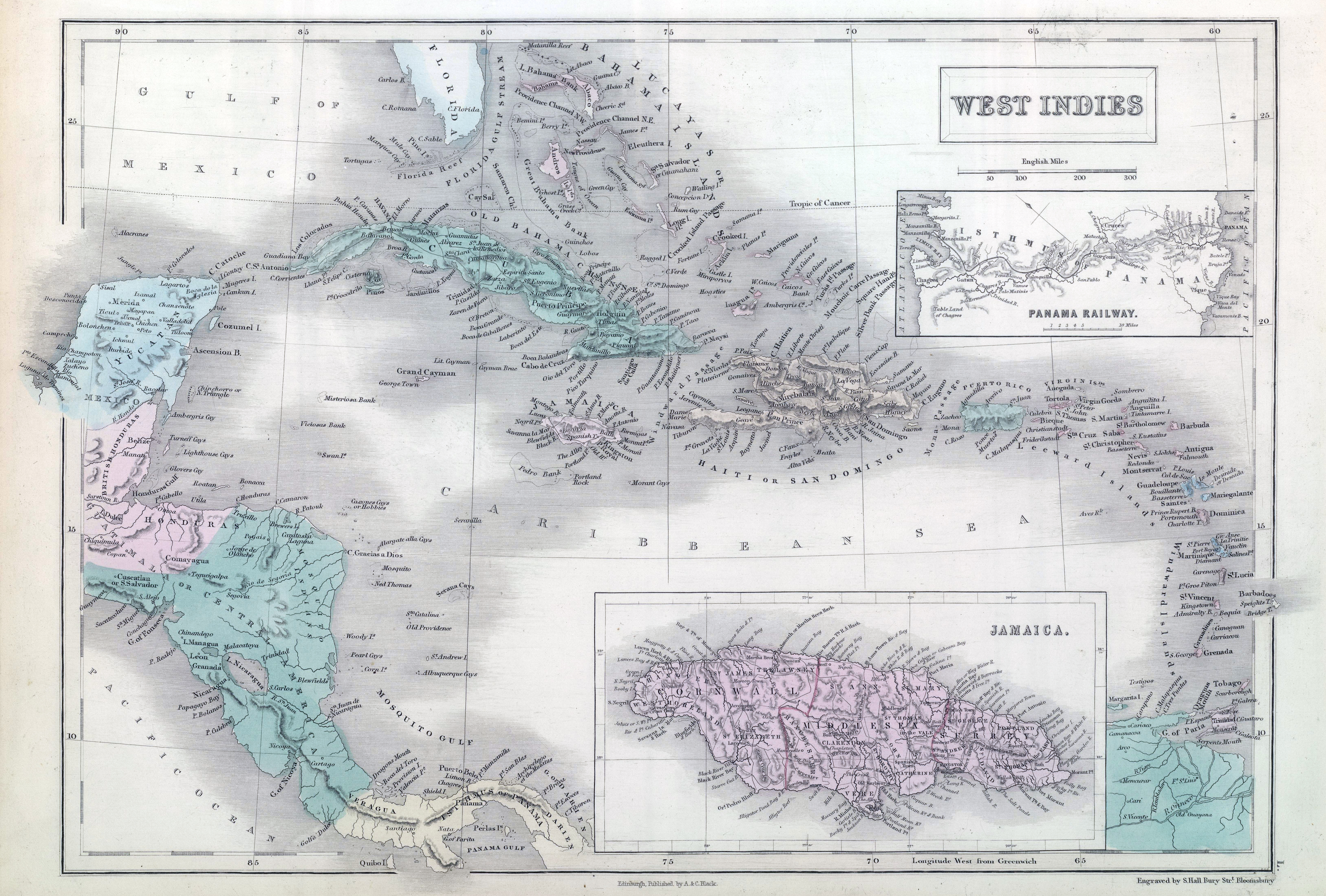
1855 Map of West Indies
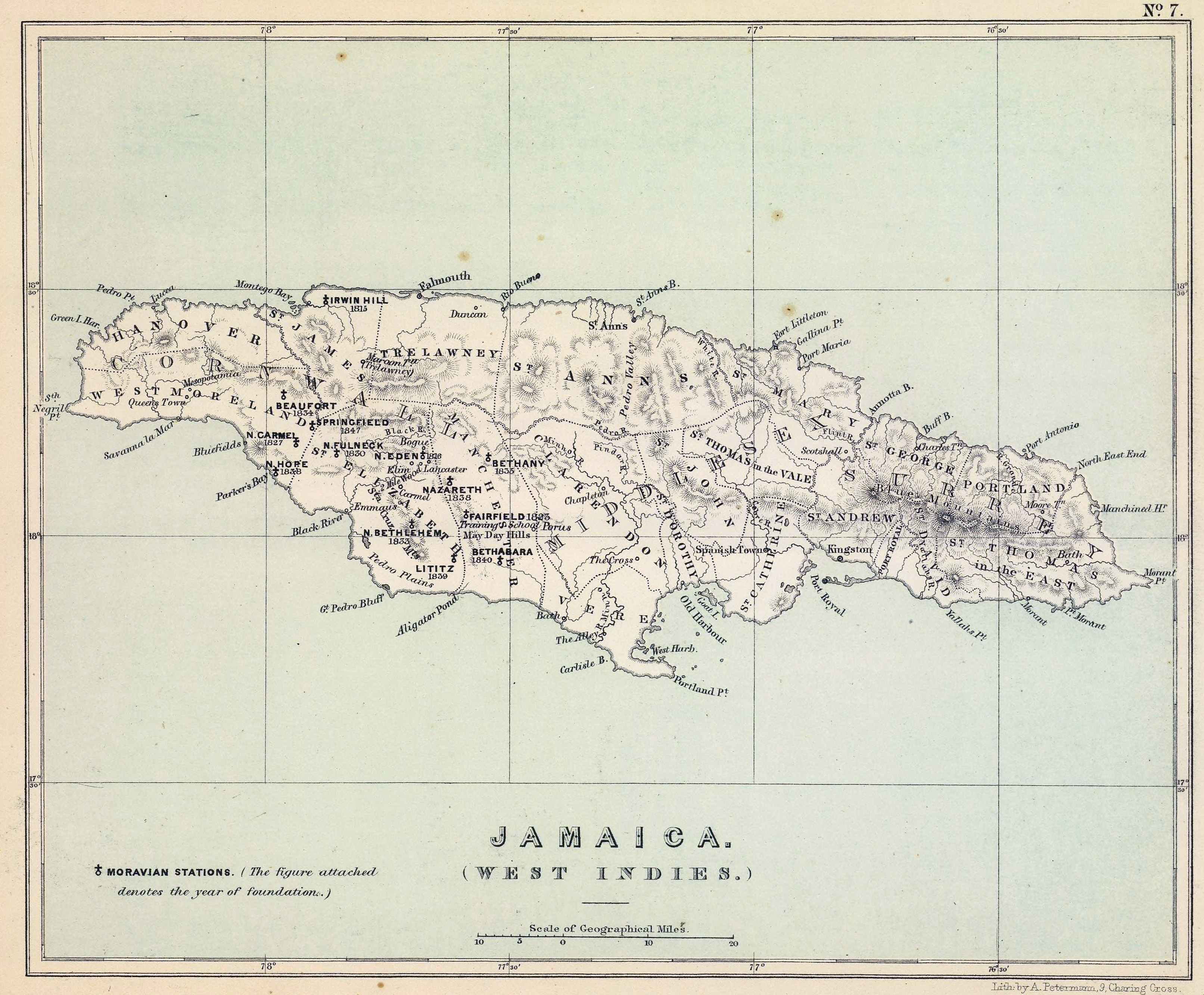
Jamaica 1882 Map

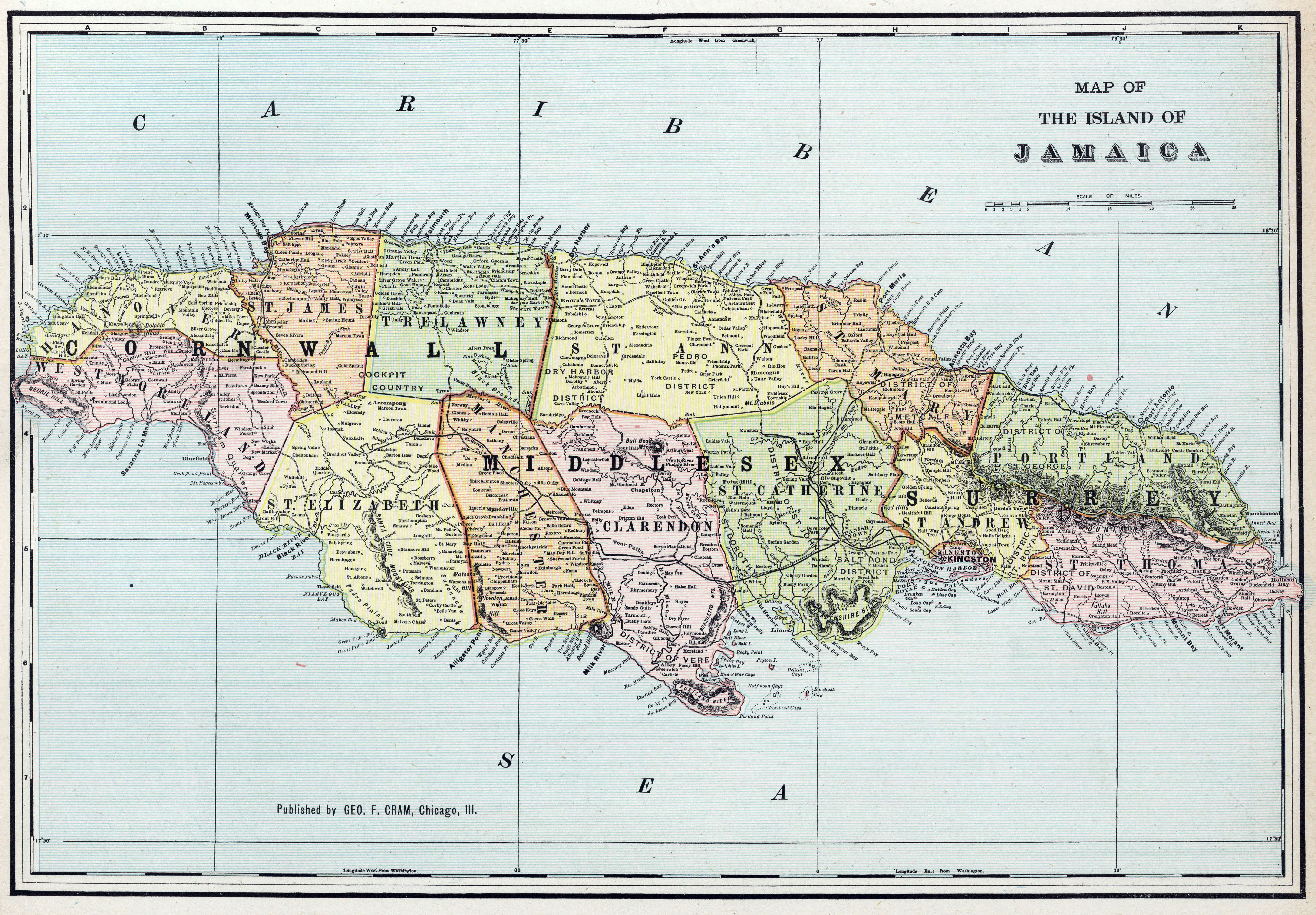
Jamaica 1892 Map
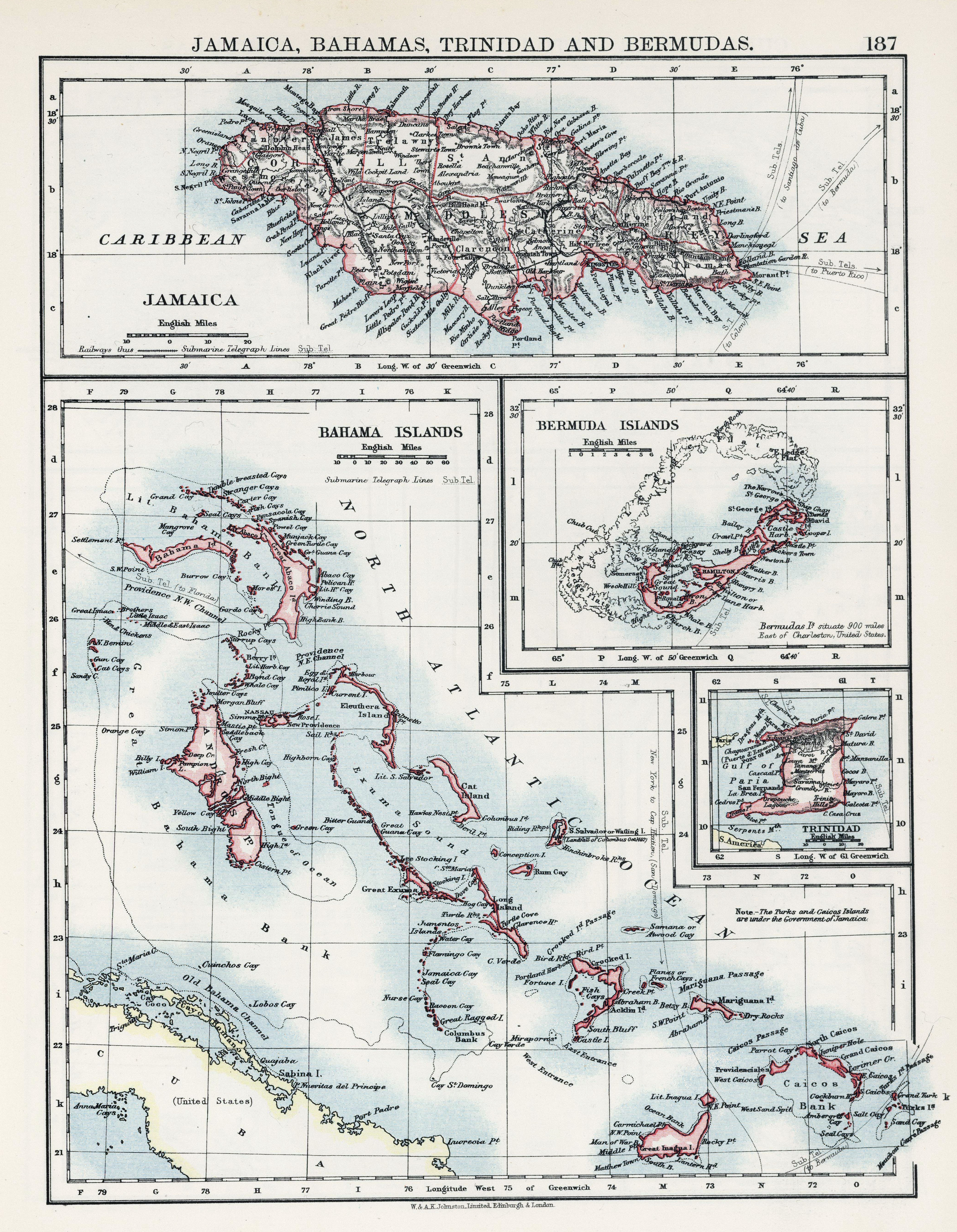
Jamaica 1901 Map
1906 Map of Jamaica
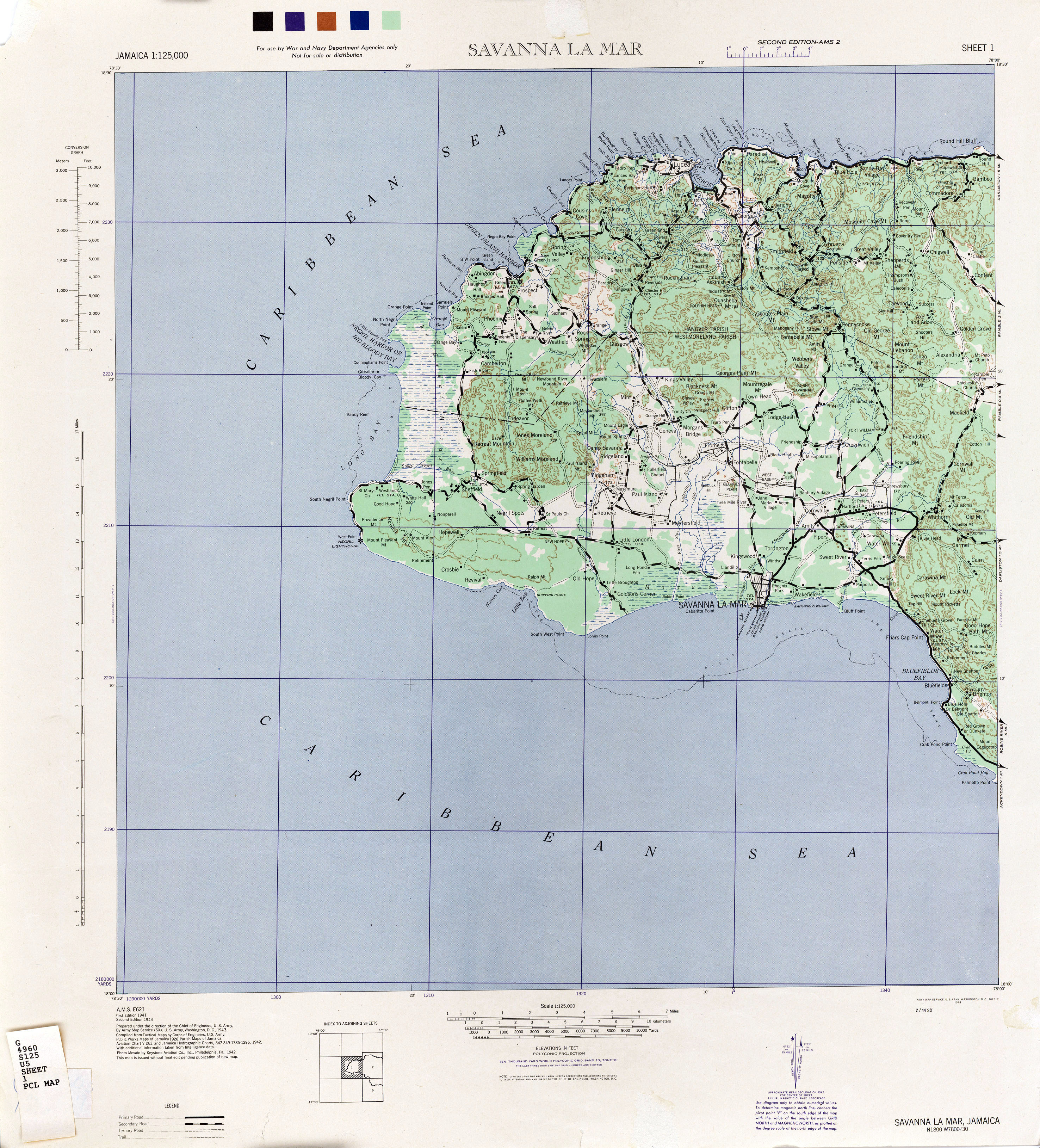
1944 Map of Savanna la Mar
1944 Map of Montego Bay
1944 Map of St Ann's Bay
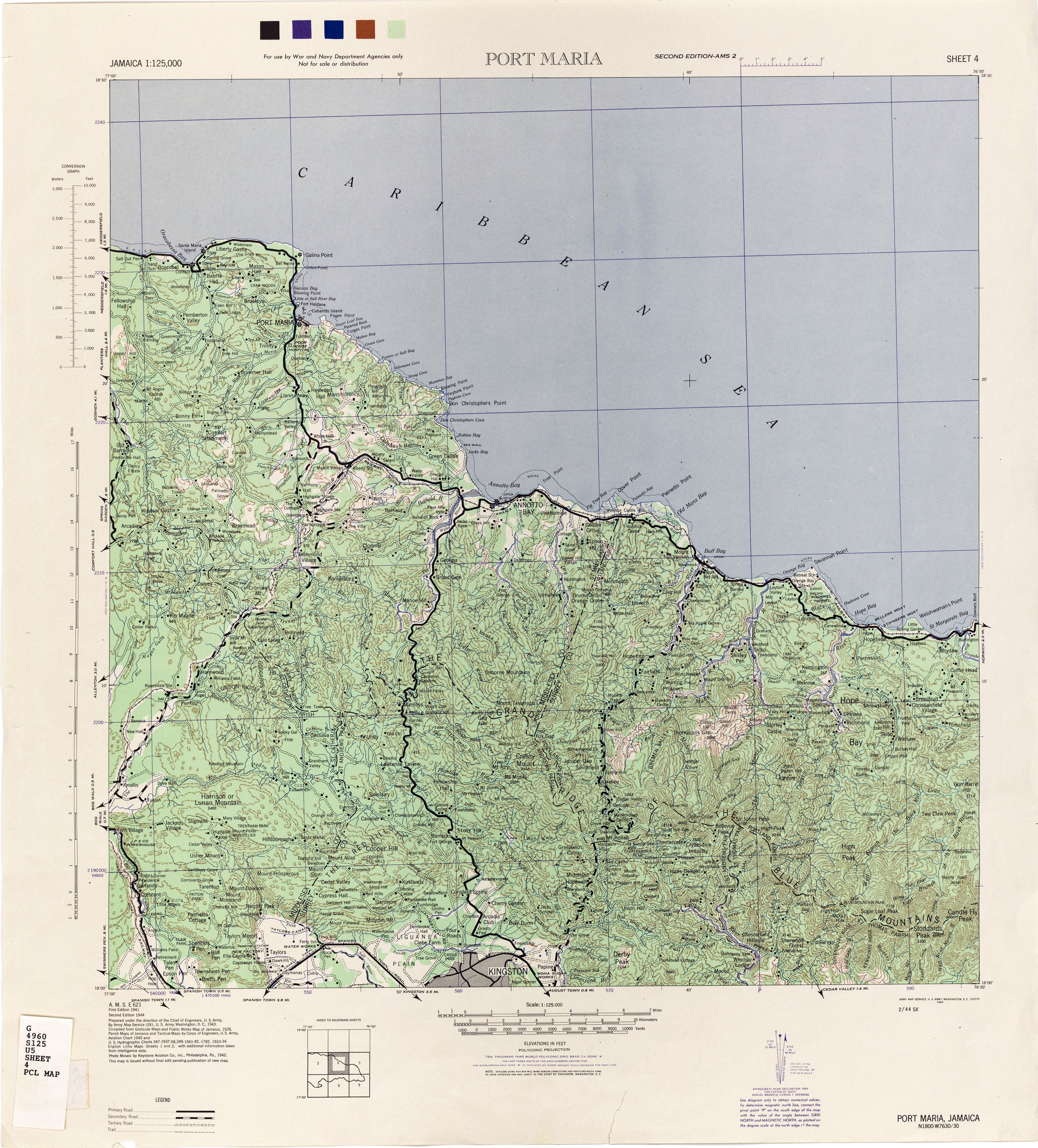
1944 Map of Port Maria
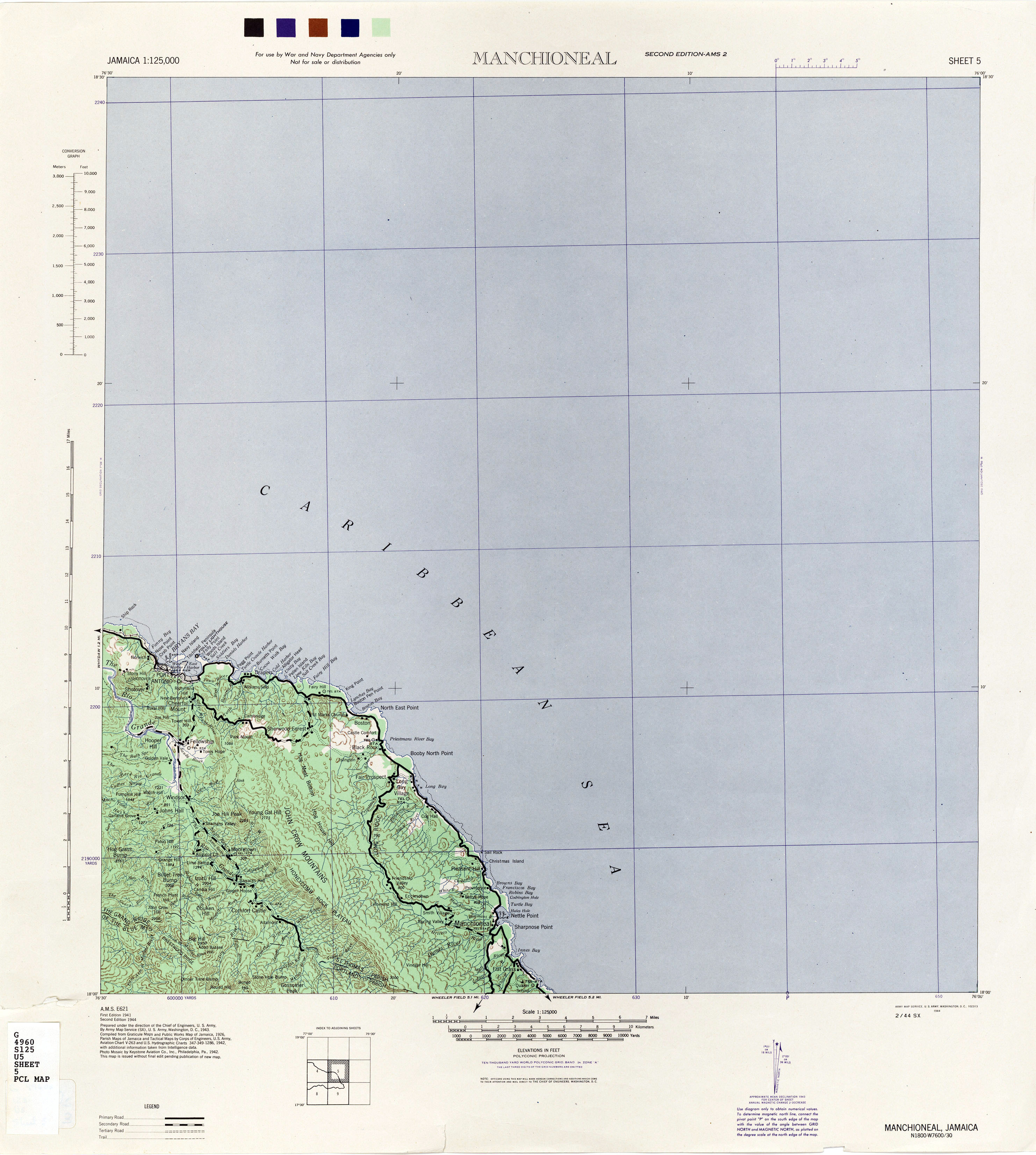
1944 Map of Manchioneal
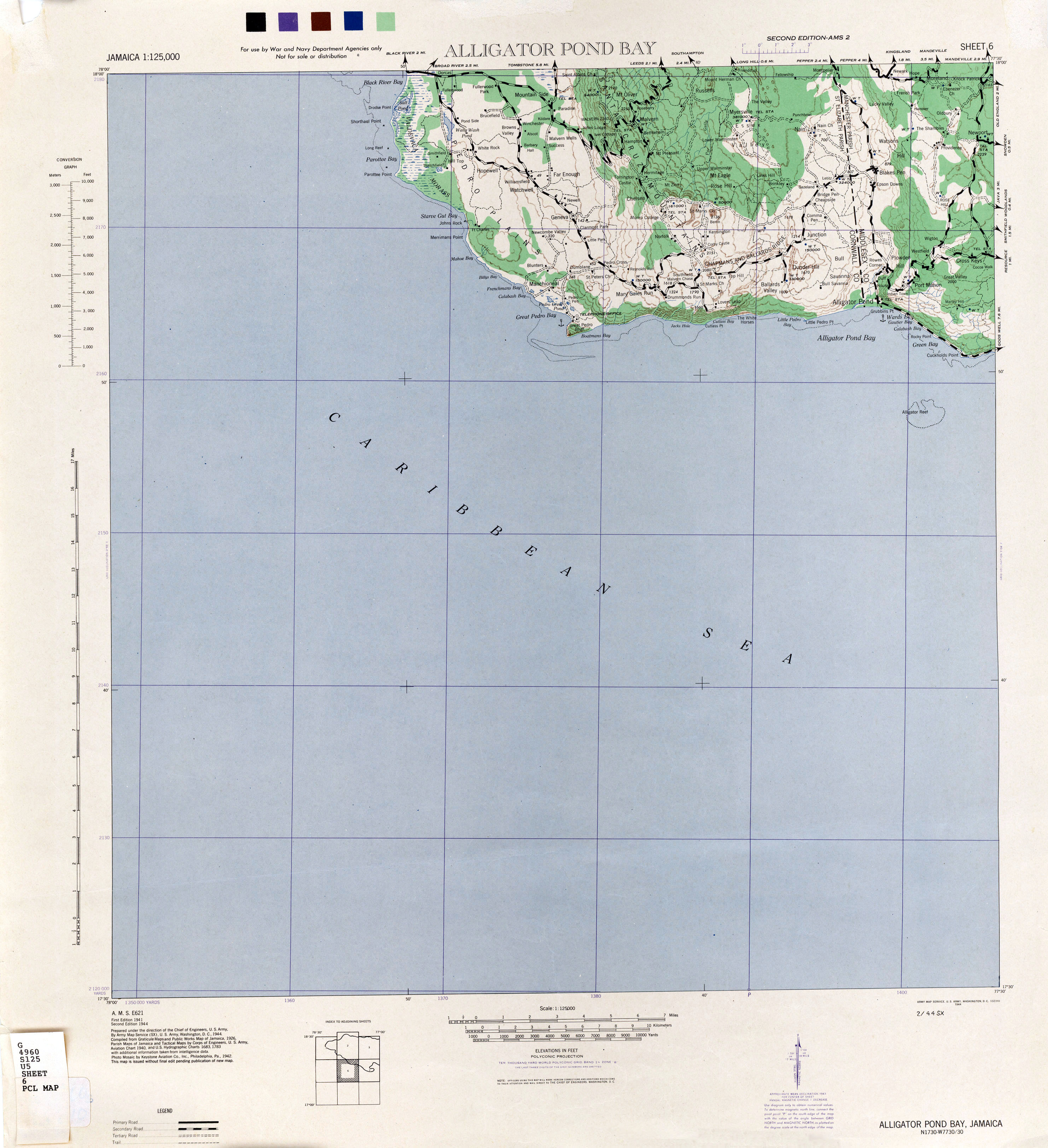
1944 Map of Alligator Pond Bay
1944 Map of Four Paths
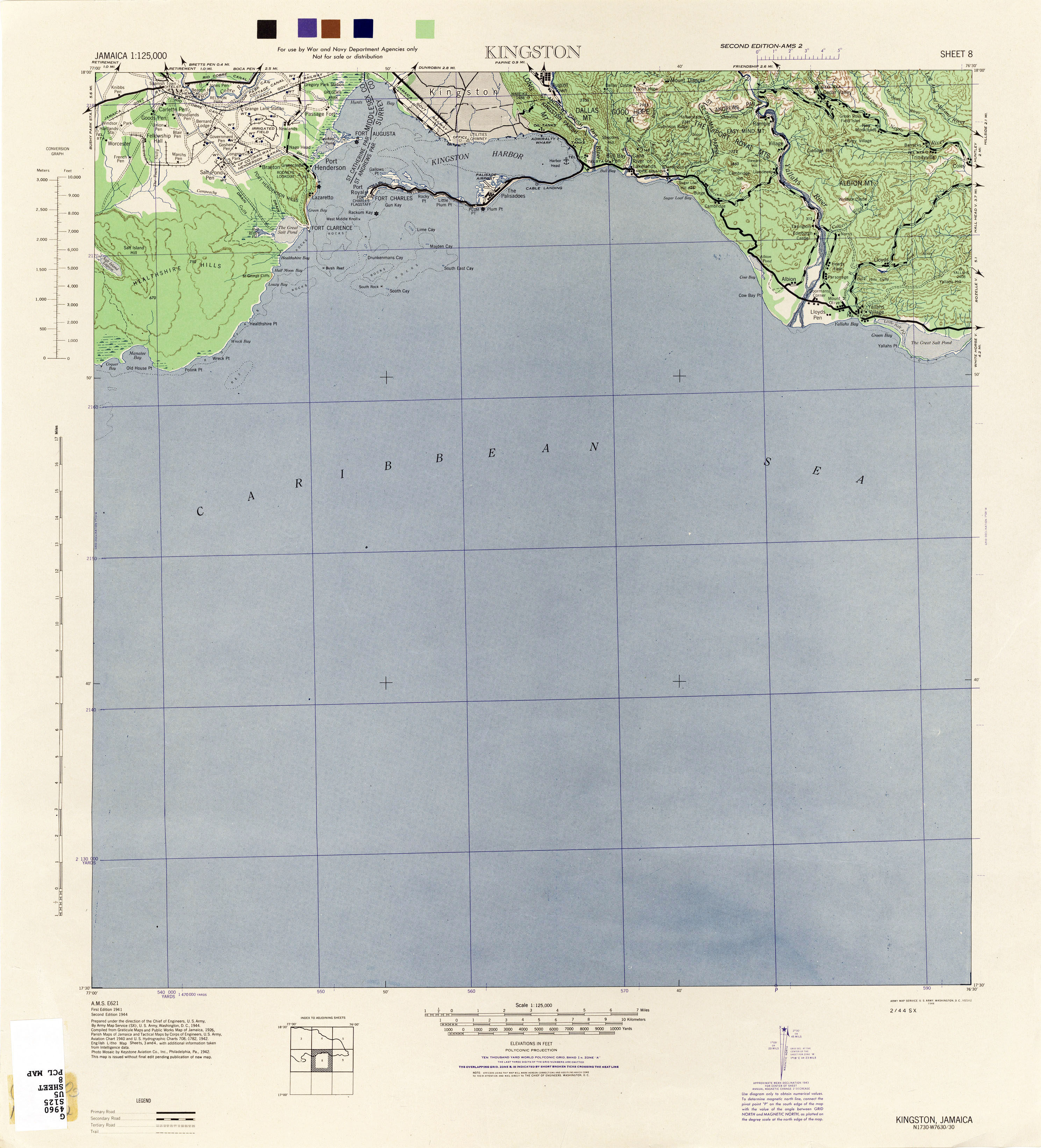
1944 Map of Kingston
1944 Map of Port Morant
1962 Map of Kingston
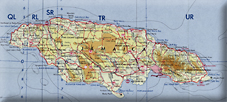
1971 Map of Jamaica
|
|
|
National Archive Jamaica Images
|
| Administrators
|
| 1655 - 1962
|
| Significant Individuals
|
| 1655 - 1962
|
| Articles
|
Reckoning With The Force: Stories of the Jamaica Constabulary Force in the 1950s
David Godfrey gives an overview of what it was like to be a policeman, Superintendant and ultimately Head of Special Branch in Jamaica during the decade leading up to independence.
|
| Audio
|
Witness: Jamaica
A BBC audio program about the slave revolt in Jamaica in 1832
Marcus Garvey
A BBC Great Lives program about the life of Marcus Garvey
|
|
|
| Montego Bay to Williamsfield, 1913
|
| Timeline of Jamaican History |
| 1494 | Columbus discovers Jamaica |
| 1509 | Claimed by Spain |
| 1596 | Sir Anthony Shirley plunders St Jago de la Vega |
| 1635 | Colonel Jackson raids Jamaica |
| 1654 | 'Western Design' formulated |
| 1655 | Penn and Venables attack and seize island |
| 1656 | 1600 settlers arrive from Nevis |
| 1657 | D'Oyley defeats Spanish at Ocho Rio |
| 1658 | D'Oyley defeats Spanish at Rio Nuevo |
| 1660 | Restoration of Monarchy in England |
| 1660 | Navigation Act |
| 1661 | D'Oyley reappointed as governor by Charles II |
| 1662 | Proclamation that all born in Jamaica to English subjects should be citizens of England |
| 1662 | Militia formed |
| 1663 | Lands granted to Maroons |
| 1663 | Jamaica fleet sacks Campeche |
| 1664 | House of Assembly meets first time at St Jago de la Vega |
| 1664 | Island divided into 7 parishes |
| 1665 | Royal African Company's first factor arrives |
| 1665 | The New Royal African Company created |
| 1668 | Spanish currency made legal tender |
| 1670 | Spain officially cedes Jamaica to England |
| 1670 | Island divided into 12 parishes |
| 1670 | Governor Modyford relieved after sending privateers against Spanish vessels after treaty signed |
| 1672 | First Deficiency Law statinging that 1 white man = 10 negroes |
| 1672 | First Hurricane recorded |
| 1672 | Royal African Company reformed |
| 1673 | Population recorded as 17,272 |
| 1674 | Henry Morgan Governor |
| 1675 | 1200 Surinam settlers arrive and begin sugar planting |
| 1675 | 35 slaves executed for conspiracy to rebel |
| 1678 | A 'slave mutiny' reported and martial law enforced |
| 1683 | Henry Morgan suspended from Council and all commands |
| 1683 | A Post Office formed |
| 1685 | Slave rebellion suppressed |
| 1685 | Monmouth rebels sent to Jamaica for 10 year term |
| 1689 | First Assiento Company to supply Spanish with Jamaican slaves |
| 1690 | Slave revolt |
| 1692 | Port Royal Earthquake |
| 1694 | French raid Jamaica, defeated at Carlisle Bay |
| 1695 | St Domingo attacked from Jamaica |
| 1696 | French fleet threatens Jamaica |
| 1698 | Population 47, 465 - of which c40,000 are slaves |
| 1699 | Jamaica prohibited with trading with Scots at Darien |
| 1728 | Political Settlement between Crown and Assembly of Jamaica |
| 1731 - 39 | First Maroon War |
| 1746 | Slave rebellion |
| 1760 | Tacky's Slave Rebellion |
| 1795 - 96 | Second Maroon War |
| 1807 | Slave trade abolished |
| 1831 | The Baptists' War - slave revolt |
| 1833 | Slavery abolished |
| 1838 | Apprenticeships abolished |
| 1846 | Preferential sugar tariffs ended |
| 1849 | Navigation Acts Repealed |
| 1865 | Morant Bay Rebellion |
| 1870 | Banana cultivation encouraged as sugar cane declines |
| 1884 | New constitution |
| 1896 | Royal Commission on the Economic Crisis in the West Indies |
| 1898 | Artisan's Union formed |
| 1919 | Riots and Labour Unrest |
| 1938 | Riots and strikes over racial policies and unemployment |
| 1938 | People's National Party founded by Norman Manley |
| 1938/9 | Royal Commission |
| 1942 | Anglo-American Commission |
| 1944 | New constitution with universal suffrage |
| 1958 | Joins Federation of the West Indies. |
| 1961 | Leaves Federation of the West Indies |
| 1962 | Independence |
|
| Further Reading
|
The Story of the Jamaican People
by Hazel Bennett and Philip Sherlock
The History of Jamaica
by Clinton Black
Lasting Legacy: A Story of British Colonialism
by Kenneth Blackburne
Description of the Island of Jamaica
by Richard Blome
The Development of Creole Society in Jamaica 1770 - 1820
by Edward Braithwaite
The Annals of Jamaica
by George Bridges
The Civil and Natural History of Jamaica
by Patrick Browne
Searching for the Invisible Man - Slaves and Plantation Life in Jamaica
by Michael Craton
Historic Jamaica
by Frank Cundall
Jamaica's Part in the Great War
by Frank Cundall
The History, Civil and Commercial, of the British Colonies in the West Indies
by Bryan Edwards
A Start in Freedom
by Hugh Foot
Reckoning With The Force: Stories of the Jamaica Constabulary Force in the 1950s
by David Godfrey
Via Ports: from Hong Kong to Hong Kong
by Sir Alexander Grantham
The Far Horizon: Portrait of a Colonial Judge
by Sir William Brandford Griffith
Far Away Cows: Veterinary Vignettes from the Third World
by Patrick Guilbride
In Miserable Slavery Thomas Thistlewood in Jamaica 1750 - 86
by Douglas Hall
Too much to Tell
by Molly Huggins
Memoir of William Knibb
by John Hinton
A New and Exact Account of Jamaica
by Charles Leslie
Journal of a Residence among the Negroes in the West Indies
by Matthew Lewis
The History of Jamaica
by Edward Long
Missionary Triumph over Slavery: William Knibb and Jamaican Emancipation
by Peter Masters
Royal Government and Political Conflict in Jamaica, 1729-83 (Royal Commonwealth Society)
by George Metcalfe
Jamaica in Slavery and Freedom
by Kathleen Monteith
The Sugar Barons
by Matthew Parker
The Sociology of Slavery: An Analysis of the Origins, Development and Structure of Negro Slave Society in Jamaica
by Orlando Patterson
Old Sinister: A Memoir of Sir Arthur Richards
by Richard Peel
An History of the Jamaica
by Robert Renny
It's Been a Pleasure
by Sandys Sherwood
A View of the Past and Present State of the Island of Jamaica
by John Stewart
Times Remembered in Africa and the Caribbean
by Sir John Stow
The Western Design: An Account of Cromwell's Expedition to the Caribbean
by S Taylor
Slaves and Missionaries: The Disintegration of Jamaican Slave Society, 1787-1834
by M Turner
A Trip to Jamaica: With a True Character of the People and Island
by Edward Ward
Revels in Jamaica
by Richardson Wright
|
>
|