|
Initial Contacts with the British
|
Kuwait's initial contacts with the British were primarily through contact with the English East India Company. This company was somewhat of an Eighteenth century Multinational corporation with interests stretching from the British Isles to the Orient. Kuwait happened to lie between the East India Company's primary centre of production (India) and her main market (Britain and Europe). There were three main routes that the company used to communicate and transport goods between these two destinations: The Cape of Good Hope provided the longest route, but had the advantage of being an all-sea route. This meant that ships could do the journey in one go and was ideal for moving heavy and bulky cargoes and goods. The Red Sea and the Persian Gulf offered the other two rival routes. They both had the advantage of being more direct, but the disadvantage of having no continuous stretch of water. Ships would have to unload their cargo or passengers and they would have to proceed overland to the Mediterrenean sea and reembark on a ship lying in wait. This procedure made it difficult to transport goods, but was still faster for passengers and, more importantly, for messengers to carry vital communications and information between India and Britain.
Kuwait, was in the fortuitious position of having one of the only decent deep water ports in the Northern Gulf and so could accomodate any British ships wishing to dock and alight its passsengers. It's primary competition in the eighteenth and Nineteenth Century was the Ottoman run port of Basra. There was a great deal of commercial and political rivarly between these two ports to supplant one another and gain control over the overland caravan routes.
|
|
Establishment of Formal Relations
|
|
Kuwait became a protectorate of the British Empire in 1899. It entered into this association in order to help itself withstand any resurgent aggression from the Ottoman empire to its north. It had already avoided direct subjagation by aiding an 1871 Ottoman expedition down to Al Hasa. However, the Ottomans were seeking, and receiving, diplomatic and economic help from the Germans. The most visible manifestation of this fact was the planned Berlin - Baghdad railway. In fact, the Germans even pencilled in Kuwait as being the terminus for this project. So, Kuwait feared Ottoman expansion, whilst Britain feared being displaced by the Germans. It was therefore in both their interests to come to a formal, protective agreement. This was also a period of heightened European tensions with Britain being forced into a much more isolationist position and having to shore up its position throughout the Persian Gulf and into the wider world.
|
|
Administration
|
|
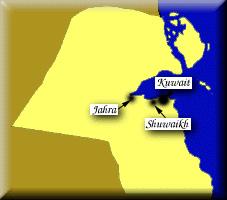
With the signing of a formal agreement between the two countries, it didn't take the British long to make the most out of their dominant position. Within a few years the first British political agent took up a permanent post in Kuwait, with a view to influencing the Sheikh into advancing British interests in the area. The Royal Navy were quick to turn Shuwaikh port into a British coaling station. A telegraphic line was passed through Kuwait in 1913. And, in a move that was not fully appreciated by any of the participants at the time, Britain was given a monopoly over the exploration and production of oil reserves in Kuwait.
As the 1920's approached it was clear that the Arabian peninsular was increasingly descending into very unpleasant power struggles. In addition, Kuwait was not only the primary British backed power in the gulf region. It had also been given a League of Nations mandate to rule over Transjordan and Iraq. This meant that any local rivalries would often pit one British backed government against another and could mean that Britain was not always acting in the best interests of the individual Sheikhs and rulers.
|
|
Role within the Empire
|
|
Kuwait was always a rather minor player within the British Empire. The ambivalence towards any greater idea of imperial well being could easily be detected amongst Kuwaiti leaders: They made it very clear that they were a protectorate of Britain only as a way to forestall inclusion into any Ottoman expansion in the area. Indeed, this was most clearly demonstrated by Sheikh Jaber II almost hostile neutrality towards Britain during the Great War. Even at the ceremonial level, Kuwaiti leaders had minimal contact with any British officials outside of Kuwait itself. Kuwait's leaders always made it clear that inclusion in the Empire was nothing other than a act of real-politik.
|
|
Economics of Empire
|
|
Unfortunately for Britain, Kuwait's oil was never fully exploited during the years of the Empire. Oil had been discovered, and British oil companies had even been granted a monopoly over its exploration and extraction. Yet, it was only in the final decade before handover that oil began to return any kind of profit to these companies and to Kuwait itself.
Before oil, the major revenue source for the Kuwaiti emirs was through Shuwaikh port and the fact that Kuwait was one of the terminals for the Caravan routes travelling between the Persian Gulf and the Mediterrenean Sea. Taxes and levies would be applied to raise money from these two economic activities. Kuwait was more of a strategic partner for Britain rather than an economic one.
|
|
Withdrawal from Empire
|
|
Britain's withdrawal from Kuwait was a swift, unannounced one. Although with hindsight, it was a fairly inevitable consequence of Britain's humiliation over the Suez crisis. The late 1950's and early 1960's was the period that Britain's withdrawal from empire was in full flight.
Sheikh Abdullah as-Sabah, was persuaded
to create a model welfare state for all his
citizens as part of a process to negotiate for his full independence
from Britain by 1961. However, no sooner
had he done so, than a new revolutionary
government in Iraq, under General Abdul
Karim Kassem, claimed Kuwait as part
of Iraqi territory and advanced its tanks and soldiers towards the sheikhdom. Sheikh
Abdullah's appeals to other Arab states for help went unheeded and
he was forced to invoke the defence agreement with Britain. The
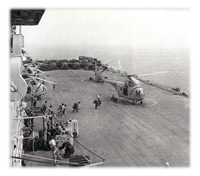
commando carrier, H.M.S. Bulwark,
landed Marines in July to serve notice on
General Kassem that Kuwait and British
oil were not for the taking.
The ending of formal ties was a fairly amicable affair, and economic and strategic links have been maintained right up until the present day.
|
|
|
| Maps of Kuwait
|
|
1913 Map of Kuwait
1660 Map of the Middle East
1765 Map of the Middle East
|
| Imperial era flag of Kuwait
|

|
| Images of Imperial Kuwait
|
|
|
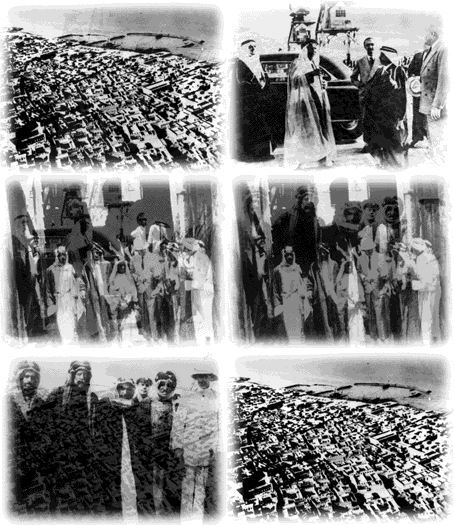
Historic Kuwait Images
|
| Articles
|
Britain's Arabian Oil Empire
David Holden gives an account of how Britain's involvement in the Middle East mutated from a Nineteenth Century concern about security of maritime trade routes and the defence of India into a Twentieth Century preoccupation of guarding the flow of oil and attempts to contain rising nationalist aspirations in the region.
|
| Timeline
|
|
1793
|
First English East India company factory established
|
|
1795
|
English East India company factory leaves Kuwait and returns to Basra
|
|
1841
|
Kuwait signs Maritime Treaty with Britain
|
|
1871
|
Kuwait aids Ottoman expedition into Arabia
|
|
1899
|
Kuwait enters into a Kuwait signs Protectorate Agreement with Britain
|
|
1904
|
First British political resident appointed to Kuwait
|
|
1911
|
British lay Telegraphic wire
|
|
1913
|
British granted monopoly on oil exploration and exploitation
|
|
1920
|
Kuwait resists Ikhwan siege of Al-Jahra
|
|
1934
|
Kuwait Oil Company was established by the Anglo-Persian Oil Company
|
|
1938
|
Oil discovered in Burgan Field
|
|
1946
|
First commercial exploitation of Kuwaiti Oil
|
|
1961
|
Kuwaiti Independence declared
|
|
|
British Politial Agents
|
|
1904 - 1961
|
|
Rulers of Kuwait
|
Sabah I
1752 - 1764
|
Abd Allah I
1764 - 1815
|
Jabir I
1815 - 1859
|
Sabah II
1859 - 1866
|
Abd Allah II
1866 - 1892
|
Muhammad
1892 - 1896
|
Mubarak
1896 -1915
|
Jabir II
1915 - 1917
|
Salim
1917 - 1921
|
Ahmad
1921 - 1950
|
Abd Allah III
1950 - 1965
|
|
Suggested Reading
|
The Modern History of Kuwait
by Ahmad Abu-Hakima
The Ottoman Gulf
by Frederick Anscombe
Shadows on the Sand: The Memoirs of Sir Gawain Bell
by Sir Gawain Bell
|
|