|
The Pacific Ocean
|
|
The Pacific Ocean covers nearly a third of the world's surface and is truly awesome in size and scope. Notwithstanding the remarkable achievements of the various peoples of the Pacific in physically traversing the enormous bodies of water to the majority of the available islands and inhabiting them, European knowledge of the location and extent of the Ocean was non-existent until the Renaissance period. They knew of the existence of the Indian Ocean and knew that their were 'Spice Islands' to the East but had no further understanding or knowledge of what was literally 'the other side of the world'. It did not help that Greek cartographers and mathematicians had greatly underestimated the size of the world by about a third (coincidentally the size of the Pacific Region). They therefore had no reason to suppose that such a vast Ocean with its widely disparate island chains existed. Of course, they did not even know of the existence of the Americas themselves until after Columbus set sail in 1492 on behalf of the Spanish Crown. It was this Spanish interest that provided the initial European interest and impetus to explore what lay beyond the known world.
|
|
The Spanish Period
|
|
The name 'Pacific' was coined by Magellan who had struggled manfully through the complex and forbidding waterways of Tierra del Fuego before emerging into the more peaceful (which is what Pacific means) waters of the Southern Oceans. Its existence was confirmed just seven years prior by Balboa from Darien in Panama, who referred to it as the 'Southern Seas'. The Spanish had been keen to find out their own route to the Indies to compete with the Portuguese who had already established their own route around the Cape of Good Hope in South Africa and across the Indian Ocean. Columbus and Magellan were searching for alternative routes to the rich spices and exotic products of the Orient only to have found the Americas providing a significant barrier en route. It was Magellan who established that a journey could be completed around the base of South America, but the winds, geography and currents were too treacherous to turn it into a viable trading route.
Magellan became the first European to traverse the Pacific Ocean but his calculations and its enormous size came close to defeating his feat. He had been working under the assumption that the ocean was far smaller than it actually proved to be (thanks to the calculations of the Ancient Greeks). His 'Pacific' Ocean came close to devouring all his supplies and water before he finally made landfall at Guam and then the Philippines. It was here that Magellan was killed by a local ruler and the expedition hobbled back to Spain with just one ship from the original five making the world's first successful circumnavigation.
The Spanish had proved the principle that the Indies could be reached from the Americas although the maritime route around the base of South America was too hazardous for the ships of the era. The Spanish therefore settled on the idea of crossing the Pacific from their newly developing ports and colonies in Mexico and Panama. They sought to discover the dominant trade winds and currents to allow them to viably trade with the Orient using the extensive silver and gold they were acquiring in South America to buy even more exotic goods to trade back to the Americas and thence on to Europe. In 1564, they sent an expedition to form colonies on Cebu and Manila in the Philippines to act as trading conduits.
The Spanish undertook some of the earliest European exploration of the Pacific in their attempt to find new resources, local partners and trading routes. They were particularly interested in discovering if a giant continent existed to the south of the ocean. This 'Terra Australis Incognita' had been predicted by the Ancient Greeks as having had to exist in order to 'balance' the weight of the planet. In 1567 Pedro Sarmiento de Gamboa convinced the Spanish to send him on an expedition to discover the missing continent with Alvara de Mendana. The mariners were disappointed to miss many of the islands of the region before alighting on a small atoll in the (later named) Ellice group of islands. They then went on to discover the far larger and populated Solomon Islands. The bequeathed name was perhaps a fanciful attempt by these early explorers to connect the islands and their resources with the fabled lands of Ophir from the bible. The motivation for the exploration was still to enrich the mariners and their sponsors. He was convinced that the great continent lay just beyond the Solomon Islands. But his chief pilot had placed the islands on his map over 1,000 miles short of their true position. When Mendana returned to the South Pacific 28 years after his first voyage, not only did the dreamed-of continent still elude him, but he couldn't even find the very islands he had discovered in the first place. It was nearly two centuries before they were again identified and properly charted.
In fact it was the return of Alvaro de Mendana and his pilot Pedro de Quiros in 1595 which illustrated the dangers of the European appearance to the native inhabitants of the islands. Oftentimes, the sailors and local islanders interacted calmly and with more bemusement than hostility. However, in July 1595 a serious misunderstanding between the Spanish sailors and the inhabitants of an island in the Marquesas saw over 200 locals slaughtered by the superior weaponary of the Europeans. 'We did not understand them,' Quiros wrote, 'and to this may be attributed the evil things that happened, which might have been avoided, if there had been someone to make us understand each other.' This clash in cultures was possibly ignited by the local inhabitants rowing out to meet the foreigners to trade coconuts and breadfruit but being misinterpreted by the jumpy Spanish sailors as an assault. It was not to be the last massacre in Pacific colonial history.
The seemingly inexhaustible quantity of silver treasure ships of the Spanish lured English mariners into the Pacific for the first time to see if they could discover for themselves the source of the wealth. Sir Francis Drake had seen the Pacific from the Panama Isthmus in 1573 and vowed to get a ship on what appeared to be a Spanish controlled ocean. Just four years later, he was given the chance and the ships to carry out the enterprise. He was to be the first person since Magellan to sail a ship around the base of Southern America as he sought to raid Spanish possessions and embark on his own explorative mission to discover if he could find a North West Passage from the Pacific Ocean as all attempts to discover it from the Atlantic Ocean had hitherto failed. He was also given permission to establish colonies and trading relationships and to disrupt the existing Portuguese and Spanish monopolies of trade with the Indies. His small fleet of ships was whittled down to just one ship which emerged through the Magellan Straits. His first targets were the Spanish ports and treasure ships which were as yet unaware of his hostile presence on their ocean. He was more than successful in seizing enough gold and silver to satisfy his crew and sponsors at home. Drake then headed north in search of the elusive North-West Passage and even claimed a new colony called 'Nova Albion' on the West Coast of America. Unlike Magellan, Drake anticipated that the Pacific was a vast ocean and took appropriate stores to ensure he got his crew across safely. On crossing the Pacific, he entered into the area of Portuguese control and the fabled Spice Islands. Using some of his stolen treasure, he purchased a huge cargo of cloves from a Sultan who was keen to sell to a non-Portuguese customer and thereby thwart the Portuguese trade monopoly. His eventual return to Plymouth was greeted with much fanfare and whetted the appetite of other English mariners keen to emulate his commercial and raiding successes. Fellow English mariner Thomas Cavendish quickly followed up his exploits with his own circumnavigation from 1586 to 1588. Once again, he followed the route through the Straits of Magellan and across the Pacific before calling in to the Moluccas, the Philippines and Java.
Unfortunately for the English, they were not to find it as easy to follow up on these early successes. Cavendish himself died in another attempt to get through the Straits of Magellan in 1591. Other English mariners also found that the Spanish were becoming more aggressive in defending themselves and making it more difficult for the English to sail with impunity against their possessions. Richard Hawkins was captured whilst attempting to force his way into the Pacific in 1594.
But there was still one more flourish of exploration on behalf of the Spanish Crown as Mendana's pilot, Pedro
Fernandez de Quiros, returned to the Southern Seas in 1605/6. Taking a more
southerly direction than he had previously taken,
he came upon the New Hebrides. He wrongly concluded
that the land must be the looked for
continent, and ceremoniously took
possession of the entire region as far south as the Pole, naming it Australia del Espiritu Santo. The two ships of his expedition became separated allowing the other ship, under the command of Torres, to sail south to the 21 degree latitude before turning back north. His intention had been to follow the relatively familiar route along the north of New Guinea but hostile winds prevented him from rounding the eastern most cape and forced him along the south of what he was soon to discover was an island. He charted the southern coast and claimed it all for the Spanish Crown even managing to negotiate the treacherous (Torres) Straits which later bore his name. These remarkable voyages were kept a secret from their rival maritime nations and so it would take more than a century before the Torres Straits were formally named in his honour. But suspicion of the motives and abilities of rival European powers was well justified at this time as the remarkable arrival of the Dutch into the region would confirm.
|
|
The Dutch Period
|
|
In the Seventeenth Century it would be the Dutch who would become the dominant maritime power in the Asia Pacific region. Holland had formally ceded from Spain in 1581 amidst a period of long running and acrimonious sectarian violence and warfare. The protestant Dutch were soon to become more interested in making money than gaining converts and set about establishing legal and commercial systems which allowed for a remarkable period of economic advancement which went hand in hand with maritime prowess and vigour. The main vehicle for Dutch activity in this part of the world was to be the Dutch East India Company which was established in 1602. It quickly took the established Portuguese routes to Asia via Africa by aggressively challenging them for their forts, trade routes and undermining their commercial deals with native producers. Portugal had technically united with Spain during this period, so any challenge to Portuguese primacy was also a challenge to Spain's power in the region.
It should be restated that the Dutch East India Company access route was via the Indian Ocean using the old Portuguese routes. They were primarily interested in the products of the Spice Islands and fought off challenges from the English East India Company with a series of vigorous wars culminating in a massacre of English traders at Amboina in 1623. The Dutch lack of religious pretensions made them more politically acceptable to local rulers than the proselytising Catholic powers and enabled them to set up trading factories throughout the region including even in Taiwan and Japan. The more successful the company became in bringing back the riches of the orient to Europe, the more money it could invest in ships and technology to maintain their advantage over any challengers to their trading dominance. Success begat success.
Whilst challenging and consolidating their hold on access to the spice islands of the East Indies, they became aware of the existence of Australia which they renamed New Holland between 1606 and 1627. Various ships came into contact with the Northern and Western coast of the new land which was deemed to be particularly barren and economically unimportant to the company due to the harsh desert conditions and lack of water sources. Of course, its discovery reopened the prospect of the existence of the enormous southern continent predicted by so many contemporaries and something to which the Dutch East India Company would later turn its attention towards.
Meanwhile, it was a rival Dutch company that undertook some of the most important exploration of the Pacific islands during the Seventeenth Century. Not wishing to disrupt the existing monopoly priviliges given to the Dutch East India Company, the Dutch government gave permission to Isaac le Maire to attempt to establish a new route to the Spice Islands via the Americas, much as the Spanish had attempted in the previous century. In 1615, an expedition under Willem Cornelius Schouten and Isaac's son Jakob le Maire was despatched. Their first target was to see if there was a more simpler route to the Pacific south of the already known Magellan Straits. Effectively, they wished to discover if Tierra del Fuego was part of a southern continent or an island itself. The expedition confirmed that Tierra del Fuego could be rounded and named it Cape Hoorn (later anglicised to Horn) in honour of their departure port in Holland. They then travelled into the Pacific landing at the islands of Juan Fernandez before attempting the crossing of the ocean. As they continued the journey they came across numerous as yet uncharted islands and met with native peoples before arriving at what was later named New Ireland and thought (wrongly) to be New Guinea. They sailed along the northern coast of New Guinea to get to Ternate in the Moluccas. Unfortunately for them, the Dutch East India Company men at Ternate were not interested in the finer subtleties of a remarkable journey of exploration in an attempt to establish a new trade route and promptly arrested the surviving crew and impounded their ship. Legal action eventually saw le Maire gain compensation, but essentially it was realised that the route discovered was just too long and too arduous to be economically viable to challenge the more direct and established routes of the Dutch East India Company through the Indian Ocean. Furthermore, none of the islands discovered en route across the Pacific seemed to offer the exotic foods or spices which were in demand back in Europe. This Cape Horn route was not pursued by traders but it did catch the attention of various military sailors who realised its strategic value in connecting the Atlantic to the Pacific.
Meanwhile, a Dutch East India Company official, van Diemen, inspired a concerted attempt to establish if New Holland (Australia) was indeed the fabled southern continent or just an island. Abel Tasman was tasked with leading an expedition in 1642 which set sail from Mauritius. They sailed due east and missed much of Australia before sighting land in what was called Van Diemen's land (later Tasmania). They failed to establish that this was in fact a small island itself and rather than travelling north they continued their journey eastwards ostensibly to see if they could find favourable winds and currents to establish a new maritime route to Chile and Cape Horn and perhaps revive this as a viable trading route. However, in travelling in this direction they discovered what became known as New Zealand (after Zeeland in Holland) and came into contact with the formidable Maoris for the first time. He failed to establish that they were in fact two distinct islands separated by a channel before sailing north to the Tonga islands and Fiji islands and then heading back towards Batavia via New Guinea. He had proved that Australia must be an island as he had sailed clear around it, and yet he did not know fully how large or significant an island it was. It should also be pointed out that his discoveries were kept as a commercial secret by the Dutch East India Company and not shared with other rival powers or mapmakers. Mariners in France and Britain were kept in the dark for many more years yet. The Dutch East India Company was interested only in protecting its existing trading routes or promoting new ones. They did not wish to give information to anyone else that might help them to challenge or undermine Dutch power in the Indies and so Tasman's voyages were not fully appreciated for many more years to come.
The Dutch East India Company had convinced itself that there was little commercial value in trading across the Pacific and continued to trade spices and goods using the old Portuguese routes for the rest of the century. But profits were on the wane for a number of reasons; ships got larger and so more product was arriving in Europe, political and economic turmoil back in Europe, diversification of spice production and the entrance of two new maritime challengers to the Dutch dominated trade in the Eighteenth Century: Britain and France.
|
|
The British and French Period
|
|
Inspired by the romanticised exploits of England's sailor pirates like Sir Francis Drake and Thomas Cavendish, the end of the seventeenth and early eighteenth centuries saw a new wave of English pirate mariners cum explorers out to enrich themselves at the expense of others. The most important of these was the English mariner William Dampier. He first set sail on the Pacific Ocean after having participated in Henry Morgan's notorious second sacking and capturing of Panama in 1680 and was immediately reminded of Drake's exploits on the relatively unguarded ocean. He returned to the Pacific in 1684 in a stolen Danish vessel renamed Bachelor's Delight along with Edward Davis. The pirates joined forces with the Cygnet under Charles Swan on whose ship Dampier crossed the Pacific from Mexico to Guam then went on to the Philippines and then down to the coast of New Holland where it appears that William Dampier was the first Englishman to set foot on Australia but was unimpressed with the harsh climate and the native peoples who he described as being the miserablest people in the world. His remarkable journey continued on the Swan to the Indian Ocean where he jumped ship and canoed across the ocean with seven comrades only eventually returning home in 1691. He wrote up his remarkable adventures in his Voyage Round the World. This book
won him the respect of the government
minister responsible for trade and plantations
and the attention of various Admiralty
officials. So much so that he was given a command of his own vessel to return to the South Seas in 1699 on the first
exploring expedition ever to be organised
and equipped by the Admiralty - although they hardly went overboard on the quality of the ship and resources supplied.
Dampier rounded the Cape of Good Hope in the old and rotting Roebuck and crossed the Indian Ocean to reach the western shore
of Australia. The bleak coastline did little to convince the crew that they had discovered any conceivable source of wealth or profit and so they sailed northward by way of Timor, round the western and
then northern coast of New Guinea,
to discover and christen New Britain to which he believed New Ireland (also named by him) was attached. The strait between New Guinea and New Britain was later named Dampier Strait in his honour. He set sail for home due to the terrible condition of his rotting ship. They only just made it to Ascension Island in the Atlantic Ocean when the ship gave out altogether and sank. They had to wait for a passing ship to take them back the rest of the way to Britain. Despite the hostile lands he had encountered, Dampier compiled a brilliant and compelling
account Voyages and Descriptions of what he had seen of Australia
which stimulated new interest in the
nature and potential of all the lands in
the South Pacific. The involvement of the Admiralty also presaged a more activist policy in the projection of Britain's maritime power which only increased as the Eighteenth Century progressed.
Dampier returned to the Pacific twice more in two further expeditions (1703 - 07) and (1708 - 11). This last voyage saw his ship round the Horn and rescue Alexander Selkirk from the Juan Fernandez group where he had been marooned for four years. It was the exploits of Alexander Selkirk which inspired Daniel Defoe to write Robinson Crusoe and start a remarkable flourishing in romanticised writings about the South Seas and idealised island life. (Indeed, Dampier himself along with his remarkable exploits were something of an inspiration for Jonathan Swift in his Gulliver's Travels if in something of a satirical vein.) Dampier continued on with his voyage and raided Spanish outposts and captured 14 Spanish ships as his old privateering nature reasserted itself and his explorative drive and rationale came full circle.
Notwithstanding the romantic, literary interest being engendered, economic enquiry tailed off in the 1720s and 1730 due to the 'South Sea Bubble' financial collapse and scandal. It did not help that France underwent its own Mississippi crisis shortly after. Suddenly, dreams of traders and explorers making a quick fortune were brought to earth with a resounding thump. Finance for risky, overseas ventures dried up as investors licked their wounds and turned inwards. Interest was only going to be re-engendered by the strategic necessities brought about by war.
The next British move into the Pacific was not until the 1740s by which time she was at war with Spain and France in the War of Austrian Succession. George Anson was sent on a daring expedition to the Pacific to harry Spanish forces, garrisons and disrupt the all important Manila to Mexico treasure ships. This four year long expedition pioneered the concept of ship to ship re-victualling and power projection on a truly global scale. Anson's expedition had a torrid time rounding the Horn managing to lose one ship and see two ships having to turn back. His remaining squadron of three ships made it into the Pacific and managed to intercept a Manila galleon carrying a fortune in silver and treasure. However, the expedition returned to England with less than half the original complement of sailors, the vast majority of whom died from scurvy which especially plagued these long expeditions and circumnavigations. However, his account of the expedition in A Voyage Round the World continued to inspire a new generation of interest into the South Seas. It helped that Anson himself had been promoted to the rank of Admiral and was now at the heart of the decision making process to gain more accurate maritime information for the Royal Navy. Indeed, the French went one step further by creating a dedicated hydrological survey section to supervise the publication of charts. The British did not go that far but pushed for improved chart making and navigational skills amongst its officer class. The later beneficiaries of this policy would include famous explorers like Cook, Furneaux and Vancouver.
Plans to undertake an expedition to the Pacific in the late 1740s to study the feasibility of establishing a base for further exploration of the Pacific in places like the Falkland Islands or the Juan Fernandez were put in motion. 'Trade and navigation' was to become the primary motive of Admiralty expeditions from this point onwards. They wished to discover shipping routes, prevailing winds and currents and hopefully new lands with which to trade or extract resources from. It was only cancelled at the very last minute due to the end of the war with Spain as the War of Austrian Succession finally came to an end. Keen not to antagonise the Spanish at this delicate point in time, the British agreed to cancel the expedition and temporarily agreed to the Spanish primacy in the Eastern Pacific - at least for the time being.
One of the less fortunate members of the Anson expedition had been John Byron who was shipwrecked on some islands off the coast of Chile. The then 17 year old began a remarkable four and a half year epic quest to return home which included living a year with the natives on the islands he was shipwrecked on; A journey through South America and his treatment by various tribes; Capture by Spaniards; and then forced shipment to France. His remarkable tale was told in Narrative of the Hon. John Byron. Nineteen years later, Byron returned to the South Seas at the head of a secret mission as the captain of the Dolphin and accompanied by the Tamar with a a young Philip Carteret as first Lieutenant. Exploration of the Pacific restarted after the end of the Seven Years War against France. That war had been something of a showcase of the global nature of contemporary war which raged across the continents and oceans. Upon its conclusion, the French had decided to turn their attention to the Pacific with ambitions of rebuilding an empire to rival and surpass its lost one along the St. Lawrence River in Canada. Likewise, Britain felt that it needed a better understanding of the shipping routes and resources of the Pacific region in order to wage any future war. Besides, the size of Britain's Royal Navy had mushroomed during the Seven Years War and there was now a surplus of ships and trained men to undertake the arduous ambitions of the Admiralty.
Byron's primary task was to see if the Falkland Islands would provide a suitable anchorage and victualling base from which to use as a base to round the Horn and explore the South Pacific and search for the, as yet, elusive southern continent. Unbeknownst to Byron and the Admiralty, the French were thinking along the same lines and had sent their own expedition under Louis Antoine de Bougainville to establish their own base in the islands for exactly the same purpose. Bougainville also had similar plans to enter the Pacific on a voyage of discovery. As for Byron, he continued his journey into the Pacific but followed the same trade winds as his Spanish predecessors and so seemed to have missed the majority of the major islands as he traversed the ocean - although he did beget the name Byron Island to one of the Gilbert chain. Despite not being able to find a southern continent, he felt that one must exist and urged others to return to discover it.
The Dolphin returned to exploratory matters just a few months after Byron docked back in Britain but this time under the command of Samuel Wallis and accompanied by the Swallow under the command of Philip Carteret. The particular object of this mission was once more to discover if the elusive southern continent existed. The two ships were separated as they rounded the Horn and subsequently went on to have two differing voyages of discovery. The Dolphin found itself forced north-westerly by the winds despite attempts to head due west. Fortuitously, he was to discover the island of Tahiti which he named King George the Third Island. Once again, cultural misunderstandings and an inability to communicate fostered an initial atmosphere of hostility. It did not help that Captain Wallis was very sick and had to cede command to his juniors who were less cautious in their dealings with the locals. It took several blasts of grape and ball from the ship's cannon, and many dead and wounded amongst the Tahitians, before the local people backed away from the ship. The Dolphin remained on the island for five weeks with the sailors ultimately reaching a more favourable relationship with the islanders. Indeed it was Wallis' description of Tahiti as a tropical paradise in Hawkesworth's Voyages that truly fired European imaginations of a Pacific idyll peopled with friendly and beautiful natives in a lush paradise. Wallis' discovery of Tahiti would become strategically vital for further discoveries. It became an extremely useful base of operations for Captain Cook to explore the area in ever greater depth and detail.
Philip Carteret, meanwhile, laboured across the Pacific in his own smaller and less well suited Swallow. He chanced upon a small and isolated island which was named after the young officer who spotted it; Pitcairn. They came across another island group which he named the Queen Charlotte Islands (Santa Cruz group). Once again, cultural misunderstandings ended tragically as a small landing party fired upon some islanders who replied with arrows and spears. The ship's master would later die from his wounds. Carteret set sail and stumbled across the Solomon Islands before sailing on to New Britain and proving once and for all that New Ireland was a distinct island from New Britain. On its final leg back to Britain, the Swallow was overtaken by Bougainville's ship which itself was returning from its own circumnavigation and exploratory voyage.
Bougainville had sailed from Nantes in 1766. His first mission was to hand over the French settlement that he had recently been instrumental in establishing on the Falkland Islands to the Spanish as a gesture of diplomatic goodwill between the two governments. Just as Wallis had, Bougainville came across the island of Tahiti, although landing on the north of the island. He found it every bit as idyllic and beautiful as Wallis had. Unaware that Wallis had claimed the island for the British, he claimed it for the French. He then set sail and sighted and named various islands in the Samoa and New Hebrides groups. He then travelled westwards and, ignorant of the Dutch discoveries, would have reached the eastern coast of Australia had his ship not come across the treacherous Great Barrier Reef first. He was less than 100 miles from Australia but was completely unaware of its existence. He was forced northwards to New Guinea and missed the opportunity to add Australia to the French Empire. At the Dutch port of Batavia he learned of the voyages of Wallis and Carteret and set sail for home and in so doing became the first Frenchman to circumnavigate the world. However, his significant achievements and discoveries, and those of Wallis and Carteret, were about to be eclipsed, literally, by the voyages of Captain James Cook.
James Cook combined navigational exactitude with remarkable scientific enquiry which laid the foundations for British ascendency throughout the Pacific Ocean for the following two centuries. He undertook three remarkable voyages which combined to fill much of the missing knowledge and understanding of the Pacific region. His precision and meticulous nature combined with the cutting edge scientific equipment of the era to produce the most accurate charting of the region to date. The fact that he would die in the Pacific region also made him something of a martyr to the cause of imperial expansion in a part of the world that personified Britain's maritime vision of itself.
Cook's first expedition (1768 - 1771) on board the Endeavour was ostensibly to track the Transit of Venus from the vantage point of Tahiti in an elaborate global scheme to attempt to calculate an accurate size of the planet and of the universe itself. The journey had initially been proposed by the Royal Society but attracted the attention of the Admiralty upon the return of Wallis and the Dolphin who claimed that one of his crew had seen mountains protruding from an island to the south of Tahiti. The Admiralty therefore added the additional (and secret) mission to search for 'a continent or land of great interest' in the South Seas, i.e. search for the missing southern continent. Cook was given some advice on how to deal with the discovery of any such new continent or lands by Lord Morton the President of the Royal Society:
'I appeal for the utmost patience and forbearance with respect to the Natives of the several Lands where the Ship may touch... To have it still in the view that shedding the blood of those people is a crime of the highest nature: They are human creatures, the work of the same omnipotent Author, equally under his care with the most polished European; perhaps being less offensive, more entitled to his favour. They are the natural, and in the strict sense of the word, the legal possessors of the several Regions they inhabit. No European Nation has a right to occupy any part of their country, or settle among them without their voluntary consent'
It should be said that this advice was easier to follow in theory than in practice. With no common language and almost no knowledge of the customs and traditions of the people and lands he came across, it would prove difficult for either side to make itself clear to the other. Certainly, Cook would prove to be a far more tolerant and enlightened visitor than most previous European explorers. Although, even he would fall foul of local customs in the Pacific and would ultimately pay for such misunderstandings with his own life.
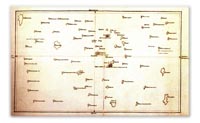
In the meantime, Cook arrived in Tahiti in April 1769 and found the island to be an enchanting place to conduct his scientific measurements and where he was aided by admirably fine and clear skies to track the transit of Venus. He visited and charted the surrounding islands which he collectively referred to as the Society Islands. It was here that the navigational skills and knowledge of the Polynesians were brought to his attention when he was shown one of their maps which charted the location of some 74 islands over a 30,000 square mile area. He used this map as the basis for his own exploration of the area and was amazed at how accurate the relative positions and distances were.
After leaving the Society Islands, he sailed southwesterly in search of a southern continent when he reached New Zealand. He confirmed that they were actually two distinct islands separated by a clear channel. His charting was remarkably accurate and still stands the test of time in most ways to the present day. Once he had sailed around the island and thus proved that it was not part of some southern super continent, he sailed westwards towards Australia. Unlike Bougainville, he sailed far enough south to avoid the Great Barrier Reef - at least at first - he would later run aground upon it after leaving Botany Bay. Hitting the east coast of Australia he chanced upon the far more hospitable climate and terrain that had hitherto escaped all previous European visits to the west and northern coasts of Australia. He immediately saw its potential as a possible colony and settlement in which to establish a base that would help the Royal Navy explore the region yet further. He commented upon the wild looking natives who appeared on the coastlines only to disappear back into the vast interior of the newly discovered lands:
'From What I have said of the natives of New Holland they may appear to be the most wretched people on earth, but in reality they are far happier than we Europeans, being wholly unacquainted not only with the superfluous, but with the necessary conveniences so much sought after in Europe; they are happy in not knowing the use of them. They live in tranquility. The Earth and the Sea of their own accord furnish them with all things necessary in life...' From James Cook's logbook.
Cook's reports would later form the kernel behind the idea of establishing a convict colony in the area in 1788. Despite running aground on the Great Barrier Reef, Cook managed to continue his journey northwards through the treacherous Torres Strait before returning home.
Cook's remarkable first journey was lauded as a landmark voyage but it had still not definitively proved that a southern continent could not exist. There were still advocates such as Alexander Dalrymple who believed that it was still there to be discovered. So plans were made to search the southern oceans once more for a continent in an expedition lasting from 1772 to 1775. The ships in use this time were to be the Resolution under his own command and that of Adventure under the command of Tobias Furneaux who himself had accompanied Wallis on his first voyage to Tahiti the decade before. The two ships were also to use a copy of John Harrison's newly invented Chronometer in order to keep accurate time and thus able to plot their longitude more accurately. The two ships sailed into the South Atlantic as they sought to travel further south than any mariner had previously sailed to date. They were amazed to see icebergs and walls of impenetrable ice before their relatively insignificant wooden ships. They had found the southern continent but it was not the huge, habitable continent that people had been expecting or hoping to find. Given the treacherous conditions they were eventually forced eastwards. The two ships were separated from one another but both successfully rendezvoused with one another in New Zealand some two months later. They then charted more of the Pacific islands including Tonga which Cook called the Friendly Islands and which were later renamed in his honour as the Cook Islands.
Furneaux was separated from Cook as they attempted to return to New Zealand once more. Whilst there, Furneaux' crew were attacked by Maoris who killed several of them. Furneaux therefore decided not to hang around and set sail to return to England by skirting the Antarctic one more time looking one last time for a landmass that they might have missed. Eventually, he contented himself that no such habitable continent existed. His return journey meant that he had become the first person to ever circumnavigate the planet in both directions.
Cook, meanwhile, returned to the Pacific where he plotted the exact positions of Easter Island and the Marquesas and conducted a more accurate charting of the New Hebrides and New Caledonia. His return across the South Pacific to the Cape Horn confirmed for once and for all that no southern continent could exist other than the barren ice-covered continent of Antarctica. The second expedition had been a success even if it had been to prove a negative.
Cook's third voyage was no less courageous. After having dealt categorically with the theory of a southern continent, they now turned their attention to the north of the Pacific. The remaining big maritime question of the era was whether a North West Passage existed connecting the Pacific to the Atlantic. Repeated attempts to discover it from the Atlantic side had ended in disaster. Cook's third voyage was, in many ways, a repeat of the mission given to Drake some two centuries earlier, to search for the passage from the Pacific side.
The third voyage (1776 to 1780) included the Resolution and the Discovery. By this time, Britain was at war with its American colonies. However, Benjamin Franklin believed that Cook's voyage was such an important scientific mission that he instructed all American vessels and their captains to resist hampering Cook's voyage in any way. Travelling around the Cape of Good Hope, they brushed Van Diemen's land before heading back to the Friendly Islands and Tahiti. They sailed north crossing the equator and coming upon an island which they named Christmas Island as it was sighted on Christmas Eve. Later, Cook would call these islands the Sandwich islands after the First Lord of the Admiralty and Cook's superior officer although they are now better known as the Hawaiian islands. He spent several happy weeks in the islands before heading north easterly to find Drake's New Albion and look for a North West Passage. They anchored in King George Sound off what would later be called Vancouver Island (indeed, Vancouver accompanied Cook on this trip as a 19 year old midshipman). They continued further north eventually passing into the Bering Strait charting the coastline as they travelled. Cook stepped ashore briefly on the Asian mainland but all he could see further to the north were treacherous ice floes and icebergs. It was clear that they could travel no further in that direction in their wooden ships. The crew were relieved to be told that they were heading back towards the Sandwich Islands.
Possibly, the Hawaiians had attached enormous religious significance to Cook's first visit to the islands - after all, he had been the first European to set foot on the relatively densely populated island. Cook's return visit in 1779 seemed to coincide with an unfortunate series of ritual coincidences. Cook arrived at the time of a festival in honour of the god Lono. The ships' slow circuit around the island seemed to mirror the slow procession undertaken by the locals on land. Then, the ships landed at the sacred harbor where the main festivities were taking place. Cook and his sailors were welcomed - if a little more reluctantly than the year before. Even Cook's departure seemed to conform to the timings of the festival and the calendar start of the period of the god Ku (the god of war). Cook may have been oblivious to all of these coincidences and should have sailed off in ignorance of the religious disruption he was causing. However, problems occurred when rough seas damaged the foremast of the Resolution, and after only a week at sea Cook felt it necessary to return to Hawaii for crucial repairs.
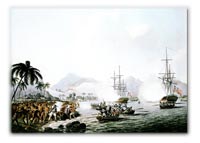
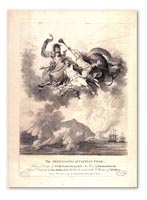
His sudden return was not welcomed at all by the Hawaiians who obviously viewed it as an ill omen. The Hawaiians greeted Cook and his men by hurling rocks as they tried to come ashore. They even stole a small cutter vessel from the Discovery. Negotiations with King Kalaniopuu for the return of the cutter collapsed when a lesser Hawaiian chief was shot and a mob of Hawaiians descended on Cook's party. The captain and his men fired on the angry Hawaiians, but they were soon overwhelmed, and only a few managed to escape to the safety of the Resolution. Captain Cook himself was killed by the mob. A few days later, the remaining crew retaliated by firing their cannons and muskets at the shore, killing some 30 Hawaiians. Cook had been one of the more culturally sensitive of explorers but even he was caught out by the complexities of island culture and religious practices which were amplified by the inability to communicate to one another clearly. His death demonstrated that the islands were not necessarily the island idyll's that contemporary artists and authors appeared to suggest. Each island had its own highly complex culture and systems which the European mariners could not hope to fully comprehend and understand in their brief forays and stays. Perhaps it was Cook's most important discovery to find that the peoples of the Pacific had their own highly complex political, cultural and religious systems. Unfortunately, it was a lesson that was not learned by all those Europeans who would subsequently visit the Pacific Islands.
It should be said that Britain and the Admiralty published accounts of Cook's journeys and voyages with remarkable speed and to a wide audience. Whereas, previous governments had been secretive of their discoveries, the Admiralty decided to publicise them widely. One reason for this was to advertise Britain's maritime prowess and their commitment to exploration and knowledge. But it was also a means of claiming prior knowledge and if not claim overt ownership prevent other rivals from claiming ownership on the basis of being the first to discover a land. If Britain could show their own knowledge and existence of the islands and lands of the Pacific, then no other nation could claim that they had discovered them.
With the death of Cook, the period of European exploration in the Pacific had been ostensibly closed. His death was quickly followed by the fall from grace and office of his prime backer, Lord Sandwich. Lord Sandwich's successors did not share his same enthusiasm for exploration. From this point onwards, European interest in the area was more concerned with identifying economic and geopolitical interests that could be uncovered or enhanced in the region. The era of exploration was about to give way to the era of exploitation.
One of the first examples of commercial activity in the region was in identifying suitable crops from the region for economic exploitation. It did not take long for the ministry of trade and plantations to ascertain if the breadfruit, long vouched for and favoured by mariners to the region, could provide a suitable source of food for the plantations of the Caribbean. Under the guidance of Kew Gardens and of Cook's old passenger scientist Joseph Banks, Captain Bligh was sent on a mission in HMS Bounty in 1787 to bring breadfruit plants from Tahiti to the Caribbean to see if they could be cultivated there successfully. His ship was ill-suited to the enterprise and the space given over to carrying the plants proved a powerful force behind the famous mutiny of his crewmen. The mutineers departed for the isolated Pitcairn Island which Carteret had charted earlier that century. Meanwhile Captain Bligh managed a remarkable feat of navigation by getting his 18 loyal crewmen to sail 3,618 miles in a small boat to the safety of the Dutch colony of Timor. A second mission in a specially designed ship was far more successful in moving the breadfruit. Whilst all this was occurring, the British were making far more long reaching plans to invest in the Pacific region by launching its first expedition in 1788 to establish a colony at Botany Bay. The arrival of European settlers, however reluctant some of them may have been, would transform the political dynamics of the region and change Britain's relationship with the region for good.
|
|
The First Fleet and the arrival of the Europeans
|
|
Throughout the seventeenth and eighteenth centuries, the British government had offloaded its unwanted criminals and vagabonds by sending them to the Caribbean or to North America. They were sent as indentured servants to serve in very harsh conditions in New England farms or in Southern or Caribbean plantations. The outbreak of the War of Independence in the Americas changed this dynamic and Britain sought an alternative outlet for its unwanted criminals. It was at this point that the Admiralty recommended Captain Cook's observations of a suitable site on the east coast of Australia at Botany Bay. This suited the Admiralty as they wished to challenge French and Dutch desires to expand their presence in the region. Besides, the Royal Navy wanted a base that could be used to provide provisions and repair ships without having to sail thousands of miles home.
Many alternative destinations had been considered, including plans to send them to Africa or to the West Indies. However, it was regarded that these areas were particularly ill-suited to the constitution of Europeans. Besides, considerable resources would have to be set aside to guard the inmates from local populations. Although far from being empty, the local aboriginal population was not regarded as being sophisticated or numerous enough to pose significant risks to the would-be colonists. Experience in North America had taught the authorities that few convicted criminals made the journey back to Britain. After having invested so much time and having established new relationships and acquired new skills few would have the means or the motivation to bother returning to Britain. It seemed as if a penal colony would serve multiple purposes to the British.
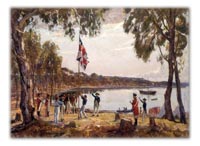
The First Fleet of two warships, six transport ships and three store ships took eight arduous months to reach its destination. Cook had selected Botany Bay as the ideal location, but the First Fleet, under the leadership of Arthur Phillip, soon identified Port Jackson and Sydney Cove as providing a far superior location and it is there that the fledgling colony established itself. Despite some early scares due to poor communications, unfamiliar environmental conditions and the erratic arrival of supply ships, the colony gradually carved out a viable niche for itself. The combination of forced labour from the convicts combined with careful planning by the authorities and the lure of good quality land for those who completed their sentences or for those guards who decided to stay on in the region all coincided to create an expanding colony. 1795 saw the first voluntary free settlers arrive. Expeditions were sent out overland and by ship to gain a better understanding of the environment and its approaches. Bass and Flinders in the Norfolk and later the Investigator charted much of the coastline. Indeed it appears that Flinders' use of the term Australia in his correspondence and accounts seems to have given the continent-sized island its definitive name.
Almost immediately, the demands of the penal colony saw requirements for the Europeans to establish other colonies nearby and expand the European footprint - invariably at the cost of the local aboriginal population. Van Diemen's Land (Tasmania) and Norfolk Island became penal destinations for the penal colony as those prisoners regarded as too dangerous or troublesome were outsourced to even harsher regimes. It also suited the Admiralty that the pines of Norfolk Island and the hardwoods of Van Diemen's land were highly suitable to facilitate repairs of their ships. The establishment of a permanent European presence in the region changed the regional dynamic once and for all. Europeans slowly but surely expanded along the coastline and into the interior of the largest of all Pacific Islands and soon began to spill over into neighbouring islands also.
|
|
Traders, Whalers and Missionaries
|
|
The new colonies sprouting up along the Australian coastline could not entirely rely on the communication links all the way back to Britain and so sought to establish trading links with closer existing island communities. It did not take long before colonist vessels were procuring pork from Tahiti, timber and flax from Maori tribes in New Zealand and fish from countless smaller islands. Soon, the Europeans recognised opportunities to trade some of the more exotic or unusual goods from the Pacific region to other markets. In particular, they realised that the notoriously fickle Chinese (who seemed to disdain most products from Europe) were highly interested in procuring sandalwood and aquatic culinary delicacies such as the sea cucumber which proliferated on the coastlines of many of the Pacific Islands. The Pacific Islands were gradually drawn into the complex trading patterns of the late eighteenth and early Nineteenth Century markets which was generally conducted by British and especially East India Company ships.
Whaling provided another economic activity in the region as demand for the oil of these animals grew exponentially in the Nineteenth Century. In 1786 an Act for the 'Encouragement of the Southern Whale Fishery' was passed in the British parliament with a view to opening up a new industry to exploit in the southern oceans so recently confirmed by Cook. Initially, these proposals were challenged by the English East India Company which believed that its right to monopoly trade in Asia was being challenged, but these legal challenges were slowly but surely over-ruled and thus opening up the way for a sustained trade. By 1790 there were fifty British whalers fitted out for the southern seas and by 1793 this number had doubled again. Whalers were soon joined by sealers who exploited fur seal pelts.
Whaling and sealing ships used various Pacific Islands or surrounding coastlines to draw fresh provisions or offload cargoes. Occasionally, the crews came ashore at the wrong place or at the wrong time as happened in 1789 when the Spanish forced a resupplying British whaler to leave the Atacama coastline of Chile as it was apparently out of bounds to non-Spanish ships. In 1790, Britain and Spain nearly came to war over the rights of fur traders in Nootka Sound in the North Pacific. Fleets were mobilised and expeditions readied before the Spanish finally backed down as their immediate neighbours France descended into a quagmire of Revolution. The resulting Nootka Sound Convention formalised the British right to enter the Pacific and trade to all areas not already occupied by the Spanish. The British had put the final nail in the coffin that contained any residual Spanish belief that the Pacific Ocean was their exclusive playground or property. George Vancouver was sent to the North-East Pacific in 1791 to reclaim the Nootka for the British (or at least to remove it from the Spanish) and to once again look for a North-West Passage or at least attempt to find navigable rivers which might be used to penetrate the North American continent from the Pacific side. Vancouver's negotiations with the Spanish were tortuous and diplomatically fraught but ended up with both sides agreeing to vacate the area around the Nootka Sound. Vancouver continued his surveying mission and felt that he had achieved something of value in determining that a North-West Passage in a temperate latitude did not exist! It can be difficult to prove a negative, but Vancouver felt that he had enough information to definitively put to rest the search for a major and easily accessible passage for ships passing from the North Atlantic to the North Pacific and vice versa.
1793/4 saw another British expedition under the command of James Colnett in the Rattler to South America to attempt to find a suitable anchorage and resupply base for British whalers in the South Pacific. After exhaustive surveying of his own, he believed that the Cocos Islands off the coast of Costa Rica provided the best location. He deliberately offloaded some pigs, goats and fruit trees onto the island in the hopes that they would form the basis of a future population for whalers and sailors needing resupply. Unfortunately, his timing was not great, the growing conflict in Europe thanks to the French Revolutionary and Napoleonic Wars saw this suggestion quietly filed in the 'to do' list. Although whalers in the Nineteenth Century certainly returned to the island and used it as Colnett had intended.
The surge in surveying work by the Royal Navy in the late Eighteenth Century provided the maps and charts for whalers, sealers, traders and missionaries to access the region and help them achieve their respective objectives. Having accurate charts did not guarantee a peaceful welcome by local populations. Whalers and sealers could come ashore and find a less than hospitable welcome from local populations as happened in 1809 when the crew of the Boyd were slaughtered and eaten in the Bay of Islands in New Zealand by a hostile Maori tribe. Maoris had grown suspicious of foreign ships coming ashore and seizing locals to act as guides or as replacement crew. The British governor in Sydney attempted to assert control and protection over New Zealand, but the distances made governance all but reactionary to events and disturbances. It should be remembered that the whaling industry in the Southern Seas had technically been a monopoly of the East India Company as far as the British were concerned. However, this monopoly was ended with restrictions being placed on the EIC in the wake of the Hastings trial in the 1780s back in London. This meant that from the 1790s the seas south of Australia and around New Zealand were opened up to other whalers but were again disrupted somewhat by the outbreak of the Revolutionary and Napoleonic wars. However, by the 1820s, whalers were regularly calling in on the Maori and by 1827 whalers had set up their first shore whaling station in New Zealand at Te Awaiti in the Marlborough Sounds. Within a decade, a further 80 whaling stations had been established on New Zealand. The economics opportunities of Empire were reaching the furthest ends of the earth - at least as far as the British were concerned. You could hardly get any further from Britain than the seas south of New Zealand!
The increased trade and traffic saw a gradual expansion of European presence throughout many of the islands to act as facilitators or middlemen to speed up the procurement of goods or supplies for passing ships or for the growing European settlements in Australia. By the 1850s, there were some 2,000 Europeans (many of them ex- or even escaped convicts) living amongst the various islands - although they were still dwarfed by the more than 4 million native population. But their presence was beginning to adjust the power relationships on many of the islands as more canny rulers or challengers realised that the Europeans had access to superior technology which could and did change the balance of power in political or tribal struggles. The key product they were interested in procuring was that of the musket. King Pomare I of Tahiti wrote a letter to King George III in 1801 where he asked 'I wish your excellency to present me with a few firearms, whereby my authority may be maintained and the peace of my kingdom preserved.' This particular request was honoured which allowed Pomare I to indeed maintain and even extend his control over the islands. Over time, there was such a proliferation of firearms due to the ready supply of traders to provide them, that it became difficult for any one faction to gain an overwhelming advantage over other factions. Muskets and guns just became a normal part of life and politics and were often incorporated into religious and cultural festivals to illustrate power and authority.
The toxic combination of ex-convicts, unruly seamen (many of whom had jumped ship), existing tribal tensions, increased supply of money due to expanding trade opportunities and the proliferation of muskets and guns meant that the region was full of tensions and possibilities for misunderstandings and violence. Given that many in Europe had assumed that the Pacific offered something of a glimpse into paradise, the region's descent towards hell alarmed many Christians back home. Efforts were put into place to send missionaries to the islands to save the islanders from the worst excesses of European culture but also to save their souls by converting them to Christianity. This missionary zeal coincided with the remarkable Evangelical revival back in Britain which saw non-conformist churches in particular multiply and extend their influence. In 1797, the non-conformist London Missionary Society sent its first mission to Tahiti, Tonga and the Marquesas on the missionary ship Duff with no fewer than 29 missionaries (and five wives). The Anglican Church Missionary Society responded by sending its first mission to the Maoris in New Zealand in 1814. French Catholic missionaries joined the fray as the Christianisation of much of the region began in earnest. Missionaries were often welcomed by local rulers as they were regarded as more trustworthy advocates and intermediaries when dealing with the more unscrupulous traders, whalers or mariners. Missionaries also brought their own skills in medicine, education and western construction techniques that were often appreciated by local rulers and peoples. For example, Pomare II received guns and a 50 tonne ship from missionaries which enabled him to subdue the whole island of Tahiti - in return for his Christianisation! Missionary willingness to teach literacy also helped the local people to better able trade equitably and to understand contracts and financial dealings. However, missionaries often disapproved of local customs when it came to issues of sexuality, nudity and infanticide. They also could clash with locals who wished to purchase alcohol or firearms from passing traders. A new dynamic had been introduced to the region with long lasting consequences for the cultures of the region. In some ways, Christianity was added like a veneer on to existing tribal customs and traditions and was not as disruptive to island cultures as it was to other tribal cultures and societies it came into contact with in the Nineteenth Century. Christianity was also wielded as a means to unite disparate tribal identities and in some cases actually helped formulate meaningful political units and kingdoms in some of the archipelagos.
Missionary life was not without its own hazards. In addition to diseases like malaria in the Melanesian islands, confused tribal relationships could see the missionaries drawn into civil wars and conflicts. In 1839, the LMS missionary John Williams was killed in the New Hebrides. Others were attacked or decided to retreat especially from the more ethnically diverse and divided Melanesian islands.
The arrival of the Europeans brought its own unseen dangers and disasters to the native peoples of the region. European diseases spread through Aboriginal, Maori and Island cultures with an alarming rapidity. Europeans had been hardened over the centuries through exposure to an alarming array of diseases and most had built up a resilience to the harshest of them over the generations. The virgin populations of the isolated islands of the Pacific had no such protection and many communities were devastated by a battery of appalling diseases. This often had a bewildering and destabilising effect on local populations and cultures who could not grasp the reason for their misfortune. Missionary attempts to build hospitals and care for the sick could confuse the situation as they seemed to offer the only viable solution whilst possibly being the source of the problem in the first place. Missionaries also claimed that if they could not save the mortal bodies of the sick and dying then at least they could save their immortal souls. Invariably, some of the desperate converted to Christianity on their deathbeds in the hope of an eternal afterlife.
The arrival of the Europeans offered new opportunities but also brought new threats and dangers. It was not always appreciated by the local people just how much Europeans were changing the Pacific region, but it was being changed radically nonetheless by their arrival and interaction. Some of them were motivated by trade and economic opportunity, some had been brought to the region against their will but some had come to try and mitigate the worst excesses of the European economic model but still ended up disrupting or distorting existing cultural and political balances nonetheless. The subsequent generation of Europeans would do more than just change existing tribal models, they would oversee the transplantation and movement of entire communities in their quest for economic advancement.
|
|
New Zealand
|
|
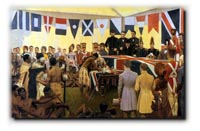
New Zealand was a large landmass with a powerful if fractured society of Maoris who demonstrated considerable ferocity and sophistication. Traders, whalers and missionaries were all wary of antagonising the local population for fear of reprisals or exacting retribution. British attempts at extending protection and an eye from their colony in Australia were proving to be forlorn, far too distant and reactive to be of practical use. Its formal inclusion into the Empire in 1840 was very much against the Free Trading grain of Britain's domestic political scene of the era. Its inclusion into the empire was more a reaction to perceived French interest in the islands in the 1830s and also due to inter-tribal friction between competing Maori clans and chiefs. The British attempted to extend protection over British traders, whalers, missionaries and, increasingly, settlers who were arriving on the shores of New Zealand during the 1830s. It was felt that the temperate climate of New Zealand was a perfect one for British settlers to deal with and it was hoped that they could grow crops and raise livestock similar to those back in Britain. There were various schemes put in place from the 1830s onwards to encourage emigration to the islands and establish new European communities in a land that seemed climatically less hostile than that of much of Australia. The British government decided to take a more interventionist course of action in an attempt to provide a peaceful and orderly space for the population. It should be said that the Europeans were the ones who were to benefit the most from these motives, as Maoris were forced to share their lands and sovereignty or make room for the incoming Europeans. The crucial document that sought to regulate the competing demands of settlers, missionaries, traders, Maoris and the British government was the Treaty of Waitangi signed in 1840. The document was unusually enlightened in the context of imperialism in the 19th century. It basically set out that the Maori Chiefs would agree to British sovereignty in return for a guarantee of Maori possession of their lands and that they were to receive all the same rights and privileges as British subjects. Although the document was often overlooked and ignored by the Europeans in later years, the text was very clear and set up an agreement between equals. Land disputes, a disastrous population collapse for the Maoris, increased immigration and later wars undermined much of the text of the Treaty but its basis and importance has recently resurfaced and allowed the document to return to the fore of New Zealand's constitutional pre-eminence.
At the time of the signing of the Treaty, the European population in New Zealand was about 2,000 as opposed to 90,000 Maoris. Conflict, disease and mass immigration changed the balance rapidly. By 1858, the Europeans already outnumbered Maoris, (58,000 to 56,000). By the end of the century, there were over 700,000 Europeans compared to just 42,000 Maori. These demographical shifts inevitably conferred greater political advantages to the Europeans and undermined the powerbase of the native Maori and ended up transforming New Zealand into an overwhelmingly European colony. When combined with the increased European settlement in Australia, the European presence in the Pacific region reached a tipping point. The European settlers of New Zealand and Australia were to become powerful players in the region over the next century and a half and even beyond the point that Britain withdrew from its empire and retreated back to Europe. They were to be aided by significant advances in the technological breakthroughs of the late Nineteenth Century; steamships, railways, telegraphy and refrigeration were set to combine to allow even remote outposts of Empire in the South Pacific to fully engage with the developing global economy. It suddenly became economical to raise sheep or cattle in the Pacific region and get the wool, meat or dairy products to markets on the other side of the world. This set up a virtuous circle of investment, whereby money was invested back into the farms, plantations and infrastructure of the region to boost productivity yet further which in turn encouraged yet further waves of immigrants to try their hands in the new colonies. This positive cycle tended to benefit the European settlers the most, but at least some of the opportunities and money did trickle down to local and native populations also.
|
|
Planters, Plantations and Blackbirders
|
|
There was an increased interest in tropical products for sale back in Europe as the Nineteenth Century progressed. Improved technology in the fields of shipping, refrigeration and canning provided new opportunities for economic opportunities in the Pacific. The first product to be commercially grown on a large scale was Copra on Samoa in 1857. Copra could be turned into vegetable oil which was very much in demand as the urban populations of Europe exploded. Another economic spur was the American Civil War from 1860 to 1865 which disrupted the Southern plantation economy which had been producing vast quantities of cotton along with sugar cane and rice. As the prices of these commodities rose during these war years, European planters eagerly settled into Northern Queensland, Samoa, Fiji, Tonga, New Caledonia and the New Hebrides to attempt to grow these crops on the industrial scale required for the European markets. Cocoa, coffee and tea were also added into the plantation mix as they sought to find the best product for the available island locations.
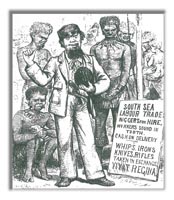
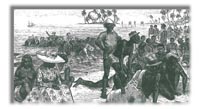
These colonies required labour and on an enormous scale. Local peoples often had little interest or lacked the appropriate skills set to offer the would-be plantation owners and so they felt forced to try alternative models to gain a suitable workforce. One such model was known as black-birding. This was where islanders were tricked or abducted into signing incomprehensible contracts and being taken to different islands to work virtually in slave-like conditions. It could be a way for a tribal chief to offload troublesome members or rivals to his authority and power - although it could also be a convenient way of generating revenue. The expanding European presence in Australia saw sugar plantations in places like Queensland desperate for labour. The local aboriginal population had little desire to provide the necessary labour and had the option of retreating into the vast outback. An alternative source of labour was from the islands of the South Pacific. As the Pacific Islands slowly embraced the global economic models and cash economy provided by the European presences, some islanders genuinely wished to have a job to generate their own income. Others were less than willing to go along but were tricked or obliged by members of their tribe or family into going to work in the plantations on the Australian mainland or the larger Pacific Islands like Fiji. The Colonial Sugar Refining Company of Sydney first brought labourers to Fiji from surrounding Pacific islands in 1864. In total some 90,000 islanders moved into the plantations of Fiji and Queensland. However, the pool of labour to draw upon - whether willing or unwilling - in the Pacific Islands was a small and finite one. It did not help unscrupulous planters that the British government, after intensive lobbying by missionary groups, passed the Pacific Islanders Protection Act in 1872 to mitigate the worst excesses of abduction and blackbirding and instructed the Royal Navy to oversee its implementation. Besides, much larger pools of labour existed on the mainland continent of Asia.
This other model to provide labour to the region was to hire indentured servants from the enormous labour pools found in India and China. Contracts were signed by workers to come out to the various Pacific Islands to work for fixed periods of time (generally 5 years) in return for passage, accommodation and a wage. Middlemen often took the majority of the money and the workers often had to do back breaking work for low pay in very harsh conditions. Tens of thousands of such migrant workers arrived on a variety of islands in the latter half of the Nineteenth Century. These population migrations often had a far more significant and longer lasting political effect on the host island nations than the arrival of Europeans in very limited numbers produced. In some cases, the native populations became a minority within their own islands. The growing plantation system certainly enriched those with access to land, labour and technology - generally the Europeans. It allowed a planter class to grow ever more powerful despite their small numbers. Furthermore, many planters converted their increasing economic power into political power. They consolidated their own positions by bribing authority figures, refusing to abide to local laws or to pay local taxes and by forming their own private armies to defend themselves from local native political actions. They often appealed over the heads of local rulers to European powers directly to protect or preserve their assets and economic activity. Local rulers could be equally frustrated at the intransigence and fickleness of these increasingly powerful economic players and often made their own requests to European powers to intervene and reign in the intransigent planters. These disputes helped open the door to formal European control of many of the local islands as planters and rulers alike shopped around for the most profitable political leverage from the various imperial actors on the stage. As the economic stakes rose, so did the political and strategic stakes and the formal partition of much of the Pacific region into imperial zones of control began in earnest.
|
|
Phosphates and Fertilisers
|
|
One of the more unexpected economic opportunities in the region was the extraction of phosphates and other minerals for use as fertilisers in farming. Australia had huge quantities of land, but the soil was generally of very poor quality. The solution to this problem was to bring phosphate based fertilisers to compensate for the poor condition of the land. Ocean Island sold a 999 year concession to the Pacific Phosphate Company to extract phosphates from the island. The Pacific Phosphate Company also gained the right to extract phosphates from the German held colony of Nauru.
This economic plundering of the Phosphate isles was an environmental and cultural disaster for the inhabitants. The rights were sold cheaply and no thought was given to the welfare of the existing populations at all. Indentured labour was brought in to extract the minerals and little heed was paid to the devastating consequences of the mining process. The islands were virtually hollowed out by these western concerns who reinvested next to nothing back into the communities that they were uprooting and displacing. They were left as desolate, almost moonlike, shells of what they had once been.
|
|
The Era of Formal Colonisation
|
|
Up until the 1870s, Britain had attempted to exert its influence throughout the region without taking formal possession of the Pacific Islands. Thus the costs of administration and obligations for defence were kept to an absolute minimum. The exceptions, as we have seen, were in Australia and New Zealand. Otherwise, British policy had been to encourage and strengthen the authority of indigenous rulers and use the Royal Navy to keep the peace and maintain the freedom of movement on the seas. It is something of a paradox that many of the requests for formal annexation and colonisation throughout the Pacific came from colonists themselves, all be it the ones in New Zealand and Australia. In many ways, these colonies feared the arrival of other European or non-European actors in the Pacific more than the British government did (from the remoteness of London). Australian and New Zealand politicians, missionaries and traders lobbied for extensions of their own colonial spheres of influence ever deeper into the Pacific region. They feared that if the British did not stake a claim then other powers would and they might be more resistant or hostile to their anglo-centric version of their European culture and economic model. Their physical distance from Europe heightened their feeling of isolation and made them want to be more pro-active in proclaiming an Anglicised sphere of influence in the region.
In 1870, Britain announced the formal withdrawal of its troops from New Zealand and Australia. This was partly a cost cutting exercise but it had the effect of worrying the settlers and made them even more inclined to take the initiative in what they saw as being the defence of their region. The Royal Navy was still earmarked to defend the region and its presence was if anything increased in the following years, but this did little to put the colonists' minds at ease. Persistent requests were made to annex islands like Samoa, the Kermadecs, Tonga, the Cook Islands and Rapa. New Zealand even offered to undertake the administration of these islands on Britain's behalf.
After Australia and New Zealand, Fiji was the most important economic island in the region. Its rulers were concerned at the growing power of planters and the ever growing number of migrant workers arriving. They requested British protection as a way of controlling Europeans on their own island and in fact received a fairly generous settlement. Britain agreed to respect and protect Fijian owned lands and extended the King of Fiji's remit over the surrounding islands whilst providing him with the security and protection of the British government and Royal Navy.
The next attempt at formalising British political power in the region was the creation of the Western Pacific High Commission in 1877 to cover a variety of British interests scattered across a number of island chains. This experimental colonial polity only lasted until 1885 when it was over-ruled at the Berlin Congress which laid down that only effective occupation could be used as a basis for recognising colonies - it was not enough just to claim them.
In fact it was German interest in the area that really accelerated the colonisation process. Bismarck had identified colonies as a way of antagonising British and French relations and becoming a factor in European diplomacy. The French took the bait and stepped up their own territorial demands. Even the USA and Japan were to join in with the island grab as the Scramble for Africa gave way to the Scramble for the Pacific. It was German interest in the region that was the real catalyst for Britain formalising much of its interests and control in the region. In particular, German claims in New Guinea saw the British finally cave in to Australian demands for a British protectorate over British New Guinea - but only under the proviso that the settlers in Australia paid for it. Similarly, New Zealand agreed to pay for the administration of the Cook Islands in 1888 to forestall German claims to them. The formal claiming of lands using the principles laid down by the Berlin Congress started a chain reaction of formal claims and formal counter-claims as the Pacific was divided up between the various Empires of the world.
Colonial rivalry did spill over into a proxy conflict in the Samoan Islands during the 1880s. Germany made aggressive moves to further its economic interest in the islands. It was actually the USA which responded by laying claims to other islands in the chain and encouraging resistance to German ambitions. The British felt compelled to send their own military resources to the island to defend their own economic interests. There followed an eight year long, low intensity conflict as the rival European powers funded and armed their respective proxies. This crisis came to a critical juncture in March 1889 when all three colonial contenders sent warships into Apia harbour, and a larger-scale war seemed imminent. It was only avoided after a massive storm on 15 March 1889 damaged or destroyed the warships, ending the military conflict. An attempted coup a decade later saw the three imperial rivals join forces and send landing parties and shelling rebel positions. The swift and decisive intervention ended the rebellion. The diplomatic fallout of the crisis saw the rival powers carve out clear lines of control as the chain was divided into clearly delineated zones. The Americans had only recently joined the imperial game thanks to acquiring the Philippines and Hawaii the year previously. A potential flashpoint was defused for the time being but it meant that Samoa had been divided very oddly and to the convenience of the imperial powers rather than to any logical, local solution.
|
|
The Early Twentieth Century
|
|
The beginning of the 20th Century saw the British locked in a conflict in Southern Africa and feeling peculiarly diplomatically isolated. Australia and New Zealand both provided soldiers and support to the mother country for the Boer War marking a turning point in the relationship between Britain and her colonies; they were now providing men and material rather receiving them! This helped convince the British that some of the more developed colonies were ready for increased powers and responsibilities.
It was in this context that Australia's own federation came about in 1901. It was really imposed from above by the British government, with little initial enthusiasm from the colonists. It was fundamentally an administrative convenience to encourage Australians to take more responsibility (and hence more of the monetary burden) for their own affairs, defence, infrastructure and investment. Until this point, each of the individual colonies had their own distinctive cultures, organisation and administration. Railways were linked to ports to facilitate trade back with Europe and not to rival Australian regions. In fact, it was not until 1995 that a common railway gauge was imposed on the rail network. Some Australians actually feared that Federation was a way for Britain to cut Australia adrift and force it to fend for itself in a hostile region which was increasingly hosting the arrival of other rival Empires and powers. Far from making Australia feel secure and on the road to nationhood, the federation made Australia feel even more vulnerable to hostile attention from these other powers. The relatively small population in an enormous landmass further heightened their feelings of regional precariousness. Their defensiveness was immediately made apparent by the introduction of severe immigration restrictions to non-whites effectively codifying a 'White Australia Policy'. This policy would prove to have profound effects on the course of Australia's relations with her regional neighbours and Asian rivals over the coming century.
Further outsourcing of imperial responsibilities (and burdens) by the British to Australia and New Zealand continued into the new century. Britain formally handed the Cook Islands and Niue to New Zealand to administer in 1901 and formally handed over British New Guinea to Australia in 1906 - renaming it Papua Territory. Rising tensions with Germany in the first decade of war made it more appropriate that regional defence was coordinated from the closer centres of Sydney and Wellington rather than from London.
The new international realignments saw some interesting imperial developments in the Pacific. Having felt diplomatically isolated at the time of the Boer War and in return for their help in putting down the Boxer Rebellion the British turned to the Japanese for their first alliance of the new century. This Anglo-Japanese Alliance concerned the Australians and New Zealanders who were suspicious of Japanese ambitions in the Pacific and were unsettled by the fact that it gave the Royal Navy an excuse to draw down its naval commitments in the region and pull ships back closer to home as European tensions seemed to rise yet further. The Australians responded by creating their own Royal Australian Navy but given the size of her landmass and surrounding seas still relied heavily on the implied reinforcement of Royal Naval ships if ever directly threatened. Australia and New Zealand also introduced their own compulsory military training programmes as they created their own militia armies to help guard themselves if necessary.
The next interesting diplomatic development was the Entente Cordiale with what had been one of Britain's most vehement imperial rivals; France. Concerns at growing German militarism in Europe trumped imperial rivalries as Britain, France and even Russia came closer together. This new Entente had one interesting imperial result in the Pacific as Britain and France decided to jointly run the New Hebrides as an Anglo-French Condominium. This was a novel imperial development which saw the British and French share sovereignty - and hence costs! It was a model that interested internationalists who saw within it a more collaborative and less exploitative model of imperialism. Some of these ideas were contemplated by the League of Nations for their mandates in the wake of World War One, but they were quickly dropped for the administrative convenience of single power ownership.
The focus of Britain's Pacific Islands presence was undoubtedly Fiji which was also used as the High Commission for the entire Western Pacific. It provided the umbrella authority for the patchwork of residents and advisers required in the vastly scattered island chains under British control or protection.
|
|
World War One
|
|
The outbreak of War in August 1914 was both anticipated and a huge shock at the same time. Tension had been evident for a long time, but the actual start of the conflict still struck many by surprise. Britain quickly delegated its responsibilities in the region to her ally Japan north of the Equator and to Australia and New Zealand to the south. Japan hoovered up German possessions in Micronesia, the Marianas, the Carolines, the Marshall Islands and on the mainland of China. New Zealand forces captured the German portion of the colony of Samoa with a sizeable force of over 1400 troops whilst Australian forces took German New Guinea with some 2000 soldiers of her own. Nauru was also seized by the Australians from the Germans despite the fact that it was largely populated and controlled by the British Pacific Phosphate Company anyway.
The Imperial German Navy offered a different magnitude of threat from that of the isolated and vulnerable island colonies. Unable to support or protect these outlying colonies, the German Navy attempted to return to Europe through the Pacific Ocean attacking islands and radio stations as they went. They were intercepted off the coast of Chile at the Battle of Coronel. However, the Germans were able to destroy the Royal Naval squadron and continue their journey down to Cape Horn. The German fleet was only finally dealt with at the Battle of the Falklands as a full complement of British battleships came to bear down on the German fleet. This left just one major cruiser left, SMS Emden which acted as a highly successful raider off the coast of South East Asia and the Indian Ocean. It was the first major naval success of the fledgeling Royal Australian Navy to destroy this German vessel at the Battle of Cocos and so effectively remove any German threat from the region for the remainder of the war.
This did not end the Australian and New Zealand contribution to the war by any means. They both sent considerable numbers of soldiers to fight in the Middle East, Africa and Western Europe. Indeed, the ANZAC forces became one of the most highly respected formations in the British Empire forces and the Australian General Monash was one of the most effective commanders who did much to help bring about the successful conclusion of the Allied offensives in 1918. In gratitude, Britain insisted that Australia and New Zealand be fully represented at the Treaty of Versailles (despite not being sovereign nations) and were given their share of the supposed spoils of victory.
The capturing of the German colonies and islands expanded yet further British and in particular Australian and New Zealand control in the Pacific region. However, there was to be one further clash between the settler colonies and the mother country as Britain insisted that Japan be allowed to keep the territories she seized north of the equator much to the chagrin of the Australians and New Zealanders. Both Australia and New Zealand were given control of the German colonies that they had seized south of the equator as League of Nations' Mandates. This formalised at the international level the concept of colonies owning colonies! New Zealand received Western Samoa whilst Australia was entrusted with northern New Guinea, the Bismarck Archipelago and the Northern Solomons. Nauru was to be governed by Australia but the proceeds of the phosphate rich economy were to be shared with Britain and New Zealand.
|
|
The Interwar years
|
|
Despite Britain's good relations with Japan before and during World War One, she was forced to reconsider her alliance with her thanks to a combination of Canadian, Australian, New Zealand and American pressure. They were all suspicious of the territorial ambitions of this new and dynamic regional power. Britain was less concerned but felt compelled to dissolve the alliance as part of the Washington Naval Conference on disarmament. Once again, one of Britain's pre-eminent concerns was on saving money and reducing her defence commitments in the wake of World War One. Britain agreed to reduce the size of her navy in the ratio of 5:5:3 (Britain, USA, Japan). This may have appeared to assuage those concerned at a future arms race, but few foresaw the consequences of this policy for the balance of power in the Pacific. The British had worldwide commitments for her navy to tend to. Even the USA had two oceans to divide her ships between. Meanwhile the Japanese, despite the lower ratio - could concentrate all her ships within the Pacific region - which she duly set out to do. The Japanese were also offended at being dropped by the British Empire at the direction of the Americans and felt that a crude form of racism was at work by the Anglo-saxon powers - which the white only policy in Australia only seemed to confirm. The German threat had been removed from the Pacific only for the new threat of Japan to take her place!
British defence commitments to Asia-Pacific were concentrated on building up the naval base in Singapore so that a Royal Navy fleet could be rushed to the region in the event of a threat. New Zealand helped subsidise the building of the base in Singapore directly whilst Australia decided to build ships for its own navy. Both investments were seriously curtailed thanks to the effects of the Wall Street Crash and the following Great Depression. The Empire somewhat turned in on itself in response to other nations hiding behind tariff barriers. The sheer size of the Empire meant that an internal trade was feasible, but the overall decline in value and particularly the collapse in commodity prices hit the overwhelmingly agrarian economies hard. The 1930s were to be very tough economically and led to defensive cutbacks which would later have strategically important consequences.
Politically, Australia and New Zealand were granted considerable powers of independence with the Statute of Westminster in 1931. Again, this was an idea of Britain's to save yet more money for itself. Furthermore, Australia and New Zealand both appeared reluctant to pick up the additional powers granted to them for fear of being further abandoned by Britain. Australia did not actually adopt the statute until 1942 and New Zealand delayed it until as late as 1947!
|
|
World War Two
|
|
The Second World War started as an overwhelmingly European affair as Britain and France went to war over Germany's invasion of Poland. There were no longer any German colonies in the Pacific, so the war did not at first seem to spill over into the Pacific. The Fall of France in 1940 shifted the strategic balance decisively against Britain. It also meant that French colonies in Asia-Pacific were drawn into pledging allegiance to the fascist Vichy France or the Free French government. New Hebrides, possibly due to the Anglo-French Condominium, became the very first French overseas territory to declare for de Gaulle and his Free French regime. Events were more complicated in New Caledonia as the Australians felt it necessary to despatch ships there in order to help place a Free French administration in place of a Vichy claimed one. A referendum was held in Tahiti as to which side to support. the result was a massive majority (5564 to 18) to support the Free French regime.
The Invasion of France had brought Italy into the war which expanded the front into North Africa also. Australian and New Zealand forces were sent to help defend the Suez Canal and keep the communication lines open to the all important naval base at Singapore. Many of their best formations were sent to the Middle East to help with the real war going on there. Lesser formations were sent to Malaya and South East Asia as the threat there was regarded as being more nominal. Churchill warned the Australians and New Zealanders that with the loss of the French fleet and the addition of the Italian fleet to the German one meant that it was less likely that a significant naval force could be spared to help defend the Pacific dominions. They were asked to step up their diplomatic representations in America to help lobby for American support and aid in the event of a Pacific War unfolding whilst the British were tied down in Europe and the Middle East.
The Japanese attack on Pearl Harbour, Hong Kong, the Philippines and Malaya made these diplomatic overtures moot. The Americans were thrust into the war anyhow. However, even their resources could not be deployed immediately and their decision to concentrate their forces on defeating Nazism first further sidelined the Asia-Pacific theatre. Further humiliation for the British Empire ensued as Malaya fell meekly with Commonwealth formations being consistently outmatched by the previously underestimated Japanese forces. But the biggest blow was the loss of Singapore in February 1942. This sent shockwaves throughout the region and particularly in Australia which soon came within range of Japanese naval and aerial forces. The nightmare scenario seemed to be unfolding as Darwin was attacked and Japanese troops reached New Guinea and the Solomon Islands. The Australians pulled back all their troop commitments from the Middle East and even redirected a division en route to Burma to return directly home. Australia, which had historically provided so much in men, material and talent to the British Imperial forces over the previous half century withdrew almost completely from the imperial war effort from everywhere but the Pacific and her own island. As mentioned before, it was only in October of 1942 that Australia finally signed the Statute of Westminster in order to clarify its rights to take control of its own destiny and particularly its defence.
It was the swift arrival of American forces in Guadalcanal and even Australia itself together with ships meeting a Japanese fleet at the Battle of the Coral Sea that slowed down the Japanese juggernaut. The arrival of the Americans would profoundly change the strategic balance of the Pacific Region. With Britain battling for survival in Europe, it was only obvious that the Australians and New Zealanders turn to America for supplies and aid. Huge numbers of American soldiers, sailors and airmen also transformed the economies and infrastructure of many of the Pacific Islands as airbases and resupply ports became critical in the strategically unfolding Pacific War. The Island hopping campaigns of the US Marines divested the Japanese from many of their colonies or else bypassed them altogether to suffer a lingering and paralysing isolation. Even the ending of the war, by two atomic bombs being dropped on Hiroshima and Nagasaki signalled a changed world order and one in which the British Empire was to be greatly diminished in terms of influence and power in the region.
|
|
The Post-War Period
|
|
The Americans expressed an interest in remaining in the region through the ongoing maintenance of some of the bases that they had established throughout the region. However, the Australians sought to tie down the Americans to a defence commitment in return for the use of these bases. The Cold War had not yet started in earnest and the Americans were reluctant to enter into entangling new alliances in the immediate aftermath of the war and so declined the Australian invitation.
As the Cold War unfolded, both New Zealand and Australia felt it necessary to contribute toward British attempts at holding back the Communist insurgency in Malaya and to help defend Hong Kong from the newly Communist China. The spread of communism throughout Asia became an increasingly pre-eminent concern for the Australians and New Zealanders. They both contributed forces to the Commonwealth Division which fought in Korea and finally entered into a defensive ANZUS agreement in 1951 with the US as a Pacific variant on NATO in the North Atlantic.
The British humiliation over the Suez Crisis in 1956 presaged yet another retrenchment by Britain - despite diplomatic and military support from Australia and New Zealand. It no longer seemed strategically important for Britain to own so many bases beyond the Indian Ocean if she no longer controlled the Suez Canal. Wilson's Labour government confirmed the strategic shift when it announced its 'withdrawal from East of Suez' in 1968. Indeed, the Australians and New Zealanders both left contingents of their own in Singapore and Malaysia long after the British had left - only leaving them in 1989.
|
|
Decolonisation
|
|
The Decolonisation process arrived late in the Pacific. The British were convinced that a certain size and level of development was necessary before full independence should be conferred. She had delayed independence in Africa on the basis of developmental status - but they at least had large populations and markets available to them. The Pacific Islands appeared to be too small, too fractured (thanks to the various imperial divisions) and too under-developed to be granted their independence - or at least that was what was argued by the decision makers back in Europe. Indeed, the Pacific was pretty much the very last part of the Empire to have been dismantled.
It must be said that not all islanders welcomed the prospect of independence. Many in Fiji for instance were happy to use imperial rule to continue protect their way of life from the large Indian population. Many islanders were happy with their links to New Zealand or Australia and were wary that independence would deny them employment and residency access to these regionally powerful economies. Many islands and archipelago were so ethnically diverse or fractured that national consciousness was a meaningless concept in many cases. Tribal, cultural or linguistic allegiances were more important for many than physical proximity. For these reasons and more, decolonisation took a much more leisurely pace before achieving any critical mass.
The first colony to achieve its independence in the region was Western Samoa. The New Zealand sponsored colony has been one of the very few in the region to have demonstrated any substantial anti-colonial movements in the 1930s and 1940s. From the late 1940s, the New Zealand government carefully introduced democratic reforms and encouraged local participation in constitutional institutions. The 110,000 population was felt by many back in London to be too small to sustain a viable state, but New Zealand pushed on with its reforms regardless so that by 1962 it was granted independence. New Zealand continued to take responsibility for the defence and foreign affairs of the new state - at least for a while. Interestingly, neighbouring American Samoa remained resolutely under US control with no concessions towards independent institutions or local administration. American Samoa is still under full American control and governance.
The far smaller Cook Islands took a different path from Western Samoa. They were offered four options in a referendum in 1962: Full independence, integration with New Zealand, Federation with other islands or self-government in association with New Zealand. The islanders chose the last option - Self-government in Free Association with their former colonial master. This allowed Cook Islanders to retain their access and rights of entry to New Zealand but gave them effective control of their daily affairs. Niue took a similar decision in 1974 after their own referendum.
Not all islands took advantage of the offer of increased self-government. Tokelau has failed to achieve the necessary 2/3rds majority in two constitutional referenda. It therefore remains a non-self-governing territory of New Zealand.
Australia had taken the leading role in the tripartite ruled Nauru in the post-war period. Given the environmental degradation of the island, moving the population was seriously considered by inhabitants and rulers alike. Various schemes at relocation fell through before the 6,000 local population requested for independence alongside ownership of the Phosphate concerns. This double request was honoured in 1968. Concerns that the tiny nation would struggle in its viability were set aside after the 1973 oil price shock which considerably increased the price of the Phosphates mined on the island.
The Australian controlled Papua and New Guinea Territories posed difficulties of an entirely different order to those of the small and isolated Pacific Islands. The territories had large and diverse populations with little infrastructure and challenging geographical conditions. In many ways, it was one of the least developed parts of the world. The Australians amalgamated their two colonies in 1949 to form a single administrative unit. However, this did little to change the essentially fractured tribes and population of the new, enlarged territory.
Development took central stage in the 1960s, but local constitutional arrangements were slow to be put in place. The more anti-colonial Australian Labour government of 1972 sped up the process towards independence which was finally granted in 1975. However, Australia had had to commit to underwriting 40% of the budget of the new nation and secessionist tensions almost immediately came to the fore upon independence. The most serious of these was in the New Guinea Solomon Islands. National cohesiveness was found to be difficult to transplant on to societies that had never been united except thanks to colonial administration.
The British run colony of Fiji seemed to be the most economically and developed of the Pacific Island nations. And yet the problems of disunity were to undermine and weaken moves towards independence in the post-war period. In 1946, the Indian Population outnumbered the Fiji population; 46% to 45%. The Indian population tended to dominate the commercial life of the island, whilst the Fijian population predominated in the military and governmental administration. Both communities had the ability to undermine or sabotage any constitutional or economic viability for a newly independent nation. It was regarded as an 'intractable problem'. Invitations to consider independence were declined by both communities who each feared that the other might become paramount in post-colonial context and sought to keep Britain involved as an independent broker to protect them from the other community. However, the British were reluctant to continue its financial and defence obligations indefinitely into the future and so introduced a racially balanced legislative council (14 Fijians, 12 Indians and 10 Europeans all to be elected). This led to the formation of a Fijian-European alliance of sorts which later requested Independence. This was granted in 1970. A complex constitutional arrangement was formulated to attempt to ensure a racial political balance was maintained after the British left; 22 Fijian representatives, 22 Indian representatives and 10 European ones. European over-representation was deliberate in order to attempt to provide a fulcrum between the two competing communities. When Fijian representation fragmented in 1987 allowing a united Indian block to come to the fore, the Fijian military backlashed with a coup. This led to the erosion of Indian political representation and rights in the island and Fijian political paramountcy has been in place ever since despite repeated condemnation from the Commonwealth and other international organisations.
The Gilbert and Ellice islands presented a whole series of more complex issues. They had largely been linked together for the sake of administrative simplicity for the British. Many of the islands had been occupied and ravaged during World War Two by the Japanese, some of the islands were claimed by America, some of them had been mined to exhaustion and one, Christmas Island, was being used as a base for British atomic tests. Divisions between the Ellice Islanders and Gilbert Islanders were particularly pronounced. This eventually led to the islands being divided into two distinct nations; Tuvalu (primarily the Ellice Islands) became independent in 1978, Kiribati (primarily the Gilbert Islands) became independent in 1979 after a delay to resolve various sovereignty claims by the United States.
The Solomon Islands had been the most physically ravaged of the Pacific Islands during World War Two and so had their own economic development problems in the post-war period. They also had considerable ethnic and tribal tensions and differences much like New Guinea. The restoration of British rule in the post-war period was resented by some on the islands and led to a rebellion calling for a return to traditional values and forms of government. The rebellion was put down with force and many were jailed by the authorities before it petered out in 1949. The suspicion caused by this uprising saw constitutional institutions slow to be introduced by the British and even slower to be accepted by the Solomon Islanders. It was not until the 1970s that forms of self-government were in place and independence was not granted until 1978. The underlying secessionist and tribal antagonisms lay dormant for a few post-colonial years before fully exploding in 2000 and leading to an Australian led military and police intervention on the island in order to restore law and order. There has been continued political instability and ethnic tensions and strife ever since. In many ways, the Solomon Islands are another example of how difficult it has been to grant nationhood on peoples who had never been united.
The New Hebrides posed its own decolonisation problems as the Anglo-French condominium exacerbated the political difficulties in coming to a united solution. Within the European population, French settlers outnumbered British ones on a 6 to 1 ratio and had also imported substantial numbers of Vietnamese labourers to work on their plantations. However, most of the local population were English speaking protestants with their own suspicions of French control and her unwillingness to disengage in her other Pacific colonies. The big sticking point was land reform. The local population wished to see the large European plantations reallocated. Most of these plantations were owned by French settlers who did not wish to hand over their land and economic livelihoods without adequate compensation. The French and British finally managed to unify their respective legal and land systems in 1975 and allowed elections to an Assembly. Moves towards independence were accelerated, but once again secessionist demands reared their heads and the so-called 'Coconut War' broke out in 1980 in an attempt to undermine the forthcoming independence and create a separate Espiritu Santo. Troops were despatched from nearby Papua New Guinea with support from Australia to restore order and allow the newly independent Vanuatu to take its place as a nation. However, political instability has continued to plague the island down to the present day.
Britain continued to draw down its political, military and economic support to the region as it retuned its economy to Europe with its entrance into the EEC in 1973. Australia and New Zealand had to refocus their own economies in response to Britain's changing economic direction. Concessions were made to allow New Zealand and Australia access to Britain's markets within the EEC but not on the same preferential basis as they had enjoyed before. Both nations sought new markets in the Middle East enjoying its own commodity boom from the 1970s onwards and then to Asia as their economies boomed from the 1980s onwards. The White Australia Policy was one of the most important casualties of this regional shift as Australians realised that they should harness the advantages of their location rather than attempt to override it. The people of Australia and New Zealand had forged powerful national identities of their own and no longer felt the requirement to rely solely on their British political and cultural heritage and connections.
Britain still has responsibility for the tiny Pitcairn Island with its population of less than 40. It is regarded as just being too small and too isolated to be able to function as anything other than a dependent territory. It is the last vestige of Britain's imperial presence in the region stretching back over the prior two centuries and beyond.
Britain may have all but left the region in any meaningful political capacity, but its influence and legacy still lives on. English is by far the most spoken language of the region and is something of a lingua franca - often even within states with competing linguistic traditions. Christianity has flourished in the region more successfully than any missionary could have dared dreamed of at the start of the Nineteenth Century. Christianity may have been adapted to suit the local cultural requirements but it provides sustained common cultural reference points and values which have extended across the region and back to Europe and the Americas. The Commonwealth finds many of its most vocal advocates and members within the Pacific region. The informal ties and diplomatic avenues opened up by the Commonwealth give a voice to what can be very tiny nation states that are otherwise often overlooked in the world's political institutions and discourse. One of the most significant ethnic minorities in the region are those of European settler descent - this is almost entirely due to the success of the Australian and New Zealand settler colonies - but their continued existence and influence is clear throughout the region. Indeed the cultural and social legacy that remains in the region owes much to its connections with the British Empire; legal systems, military organisation, sporting interests, etc... all have their antecedents with their connections with Britain. It was Britain's maritime prowess that allowed it to become pre-eminent in the Pacific region but few could have foreseen the long term consequences of those Royal Naval sailors coming ashore over two centuries ago in helping to transform the region and tying it into the global economy and trade routes so comprehensively.
|
|
|
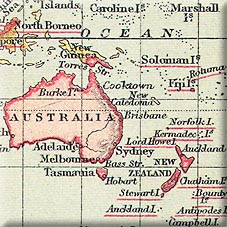 |
| Pacific Maps
|
| Films
|

|
First Contact by Bob Connolly and Robin Anderson
|
| Audio
|
BBC's In Our Time:
Voyages of James Cook
|
| Colonies
|
Ashmore and Cartier Islands
Australia
Baker Island
Bonin Islands
British New Guinea
Christmas Island
Cocos Islands
Cook Islands
Ellice Islands
Fiji
Gilbert Islands
Hawaii
Howland Island
Jarvis Island
Lord Howe Island
Nauru
New Hebridies
New Zealand
Norfolk Island
North Borneo
Ocean Island
Palmyra Atoll
Philippines
Pitcairn
Queensland
Samoa
Sarawak
Solomon Islands
South Australia
Tasmania
Tokelau
Tonga
Victoria
Western Australia
Western Samoa
|
| Historiography
|
Historiography of the Pacific Islands
|
| Timeline of Pacific History
|
| 50,000 BC
|
Aborigines arrive in Australia
|
| 3000 BC - 1000 AD
|
A series of migrations sees most habitable islands of the Pacific region populated by seafarers
|
| 950 - 1350 AD
|
New Zealand populated by Maori from Polynesia
|
| 1492
|
Colombus arrives in Americas bringing Europeans closer to Pacific region
|
| 1513
|
Balboa spots Pacific from Darien in Panama
|
| 1564
|
Spanish send expedition to Philippines to establish trading colonies
|
| 1568
|
Solomon Islands discovered by Spanish
|
| 1573
|
Drake becomes first Englishman to view Pacific Ocean from Panama
|
| 1577 - 1580
|
Drake's Circumnavigation of the World Voyage
|
| 1586 - 1588
|
Thomas Cavendish's Circumnavigation of the World Voyage
|
| 1594
|
Richard Hawkins captured by Spanish for entering Pacific
|
| 1595
|
Spanish clash with locals in Marquesas
|
| 1602
|
Dutch East India Company formed
|
| 1606
|
de Quiros discovers New Hebrides, Willem Janszoon of the Dutch East India Company spots Australia
|
| 1684 - 1691
|
William Dampier arrives in Pacific
|
| 1699 - 1701
|
Admiralty sponsors Dampier's return to the Pacific
|
| 1703 - 07
|
Dampier's third Expedtion
|
| 1708 - 11
|
Dampier's fourth Expedtion
|
| 1722
|
Jacob Roggeveen discovers Easter Island
|
| 1764 - 1766
|
Byron and Carteret explore Pacific
|
| 1766 - 1769
|
Carteret and Wallis explore Pacific including Tahiti
|
| 1766 - 1769
|
Bougainville crosses Pacific and lands in Tahiti
|
| 1768 - 1771
|
Cook's First Expedition
|
| 1772 - 1775
|
Cook's Second Expedition
|
| 1776 - 1780
|
Cook's Third Expedition
|
| 1779
|
Death of Cook in Hawaii
|
| 1788
|
First Fleet brings first European settlers to region
|
| 1790
|
Nootka Sound Convention between Spain and Britain
|
| 1791 - 1795
|
Vancouver Expedition to search for North-West Passage
|
| 1793 - 1794
|
Colnett Expedition to South Pacific
|
| 1795
|
First voluntary settlers arrive in Australia
|
| 1797
|
London Missionary Society sends first missionaries to Pacific
|
| 1798 - 1799
|
Bass and Flinders explore and chart Tasmania
|
| 1801 - 1803
|
Flinders explores and chart Australian coastline
|
| 1827
|
First whaling station in New Zealand at Te Awaiti
|
| 1840
|
Treaty of Waitangi
|
| 1870
|
Britain announces withdrawal of troops from Australia and New Zealand
|
| 1872
|
Pacific Islanders Protection Act
|
| 1874
|
Fiji becomes formal British colony
|
| 1877
|
Western Pacific High Commission formed
|
| 1884
|
Germany New Guinea signals start of formal European annexations throughout Pacific region
|
| 1898
|
America gains Hawaii and Philippines launching its Pacific presence
|
| 1899
|
Tripartite Convention over Samoa
|
| 1901
|
Cook Islands and Niue awarded to New Zealand for administration
|
| 1906
|
British New Guinea handed over to Australia for administration
|
| 1914 - 1918
|
World War One
|
| 1919
|
Australia and New Zealand granted League of Nations mandates in Pacific Region
|
| 1921 - 1922
|
Washington Naval Conference
|
| 1931
|
Statute of Westminster
|
| 1939 - 1945
|
World War Two
|
| 1942
|
Fall of Singapore
|
| 1945
|
Atomic bombs dropped on Japan
|
| 1947 - 1949
|
Rebellion to British colonial rule in Solomon Islands
|
| 1949
|
Australia combines Papua and New Guinea Territories
|
| 1951
|
ANZUS Pact signed
|
| 1962
|
Western Samoa gains Independence, Cook Islands Referendum
|
| 1968
|
Wilson announcement of withdrawal from East of Suez, Nauru gains independence
|
| 1970
|
Fiji granted independence
|
| 1973
|
Britain joins EEC
|
| 1975
|
Papua New Guinea given Independence by Australia
|
| 1978
|
Solomon Islands granted independence
|
| 1980
|
Coconut War on New Hebrides whilst independence declared
|
|
| Further Reading
|
A Voyage Round the World
by George Anson
Possessing the Pacific Land, Settlers, and Indigenous People from Australia to Alaska
by Stuart Banner
Atlas of the British Empire
By Christopher A. Bayly (1989)
A Voyage to the South Sea for the Conveying of the Bread-fruit Tree to the West Indies, Including the Narrative of the Mutiny.
by William Bligh
A Chronological History of the Voyages and Discoveries of the South Seas
by James Burney
Narrative of the Hon. John Byron
by John Byron
A Voyage to the South Pole and Round the World Performed in His Majesty's Ships The Resolution and The Adventure in 1772, 1773, 1774 and 1775
by James Cook and Tobias Furneaux
Asia-Pacific: A History of Empire and Conflict
by Thomas Crump
The Penguin Historical Atlas of the British Empire (Penguin Reference)
By Nigel Dalziel (2006)
Voyage Round the World
By William Dampier
Voyages and Descriptions
By William Dampier
The Devil's Mariner: William Dampier, Pirate and Explorer
by Anton Gill
Robert Louis Stevenson in the Pacific: Travel, Empire, and the Author's Profession
by Roslyn Jolly
Tales from Paradise: Memories of the British in the South Pacific
by June Knox-Mawer
Are you Coming or Going: My Sixty Years on the Run
by Ronald Knox-Mawer
A Case of Bananas and other South Sea Trials
by Ronald Knox-Mawer
Tales from a Palm Court
by Ronald Knox-Mawer
Cities and Men: An Autobiography
by Sir Harry Luke
Winding up the British Empire in the Pacific Islands
by McIntyre, W. David
The German Empire and Britain's Pacific Dominions, 1871-1919: Essays on the Role of Australia and New Zealand in World Politics in the Age of Imperialism by John Anthony Moses by John Anthony Moses
Atlas of British Overseas Expansion
By A. N. Porter (1994)
A Pirate Of Exquisite Mind: The Life Of William Dampier
by Diana Preston
Building A Life
by Geoffrey R Price
Far-Fetched Facts: The Literature of Travel and the Idea of the South Seas
by Neil Rennie
I Have The Honour To Be
by Tom Russell
Aphrodite's Island: The European Discovery of Tahiti
by Anne Salmond (2009)
William Bligh in the South Seas
by Anne Salmond
British Imperial Strategies in the Pacific (Pacific World: Lands, Peoples and History of the Pacific, 1500-1900)
by Jane Samson (2003)
Australia's Empire (Oxford History of the British Empire Companion Series)
by Deryck Schreuder (2010)
Intimate Strangers: Friendship, Exchange and Pacific Encounters (Critical Perspectives on Empire)
by Vanessa Smith
King George’s Keys
by Sir Robert Stanley
Germany's Asia-Pacific Empire: Colonialism and Naval Policy, 1885-1914
by Charles Stephenson
A Pacific Bibliography
by C. Taylor
Islanders: The Pacific in the Age of Empire
by Nicholas Thomas (2010)
The British Territories in the Pacific (in The Historiography of the British Empire - Commonwealth)
by John Ward (ed by Robin Winks)
|
|