OIB


Topic Powerpoints Key Terms Historiography Useful Textbooks Useful Websites Videos Further Reading News Feeds
Cold War Cold War (ppt)

OIB Cold War Handbook (pdf)

Superpower

Iron Curtain

Containment

Peaceful Co-Existence

Arms race

Detente

Second Cold War

Nuclear disarmament

Cold War Historiography The Cold War
A Very Short Introduction
Amazon

Cold War in Europe and Asia
Heinemann
Amazon

History Learning Site

Cold War Museum

BBC The Cold War


This is the first part of a series on the Cold War - you need to follow the rest on Youtube itself.
The Cold War
by John Gaddis
Amazon

Cold War: For Forty-five Years the World Held Its Breath
by Jeremey Isaacs
Amazon

Cold War Studies

Militarization in Cold War Taipei

During the 1950s, American economic assistance to the KMT regime equaled about 6% of Taiwan’s GNP and nearly 40% of its gross investment. Military aid was even more substantial. By 1957, 10,000 Americans were present in Taiwan in “an official capacity,” most of them in the capital city, Taipei. America, the world’s most powerful nation, [...]

COLD WAR STUDY APP: COLD WAR 101

Exciting news! Our first iPhone Study APP, Cold War 101, is now for sale in the iTunes Store. * Cold War 101 lets you learn about the Cold War while you’re on the go! * Ever wished you had an easy and FUN way to learn about Cold War History and Politics? Are you a [...]

POST COLD WAR CUBA: RELIGION

Many of you are aware that Pope Benedict XVI arrived in Cuba recently.  His visit marks the 400th anniversary of Cuba’s patron saint, El Virgen del Cobre, and marks thawing relations between the church and the still communist state. During the beginning  years of the revolution, the church struggled in Cuba. Many clergy were deported [...]

THE SOVIETIZATION OF CUBA

After Cuba implemented the Soviet-directed System for Economic Planning and Management (SDPE) in 1975, Cuban scholars and Cold War ideologues began talking about the Sovietization of Cuba. Many interpreted the adoption of SDPE as a signal that Havana’s fate would now be dependent on the imperatives of Soviet central planning. In its most ideal form, [...]

A REAL SPY CASE

  This is a guest post by Lee McCaslin, Author of Secrets of the Cold War: US Army Europe’s Intelligence and Counterintelligence Activities Against the Soviets During the Cold War. Names, units, and locations have been changed to protect classified information. GENERAL I knew spies were causing grave harm to USAREUR (US Army in Europe) [...]

IRAN 1960: KENNEDY PUSHES LAND REFORM

In 1960, the Kennedy administration came to office determined to shift the shah’s preoccupation from military security to economic progress. The Americans were even willing to limit American aid as leverage. In Iran, American influence was clearly reflected in the shah’s decision to inaugurate land reform. It seemed as if the US was successfully dictating [...]

MOSCOW RULES

I’ve just finished reading the Daniel Silva thriller Moscow Rules (Gabriel Allon). It stars Gabriel Allon as an Israeli spy and assassin enmeshed in the intrigue of post Cold War Russia with its corruption, drug culture, and illicit arms traffickers. What I didn’t know until the book ended was that the term “Moscow Rules” relates [...]

HAVANA 1970 REDUX

By the beginning of the 1970s, Soviet advisors were a common sight on the streets of Havana. Carmelo Mesa-Lago estimates the in the summer of 1971 there were approximately 3,000 Soviet technicians and military advisors in Cuba. They were  particularly visible in the Vedado section of  the city around the University of Havana. By 1973, 1500 [...]

TWEETING THE COLD WAR: @coldwarstudies

Cold War Studies is now tweeting the Cold War. I hope you’ll follow us: @coldwarstudies. I have to admit that I borrowed the idea from a New York Times article called The Tweets of War: What’s Past is Postable. Not everyone has time to read a blog post, but it’s easy to take just a [...]

COLD WAR TAIWAN’S MILITARY-INDUSTRIAL COMPLEX

Public enterprises — linked to the KMT Party and the military — were particularly important in Taipei’s post WWII development. Public enterprises accounted for a larger proportion of total investment in Taiwan than in 80% to 90% of other noncommunist countries. According to Robert Wade: Their continued role owes much to the importance attached to [...]
Colonialism Empire in Asia.ppt

Empire in Africa.ppt

Decolonisation.ppt

Assimilation

Indirect Rule

White Settler Colony

Colonial War

National Independence Movements

Metropolitan Weakness

Reasons for Development of Empire

Decolonization and the End of Empire

The British Empire, 1815-1914
Access to History
Amazon

Empire
A Very Short Introduction
Amazon

British Imperialism 1750-1970
Cambridge Perspectives in History
Amazon

End of Empires: European Decolonisation 1919 - 1980
Access to History
Amazon

The End of the British Empire: The Historical Debate
Making Contemporary Britain
Amazon

The BBC provides a good overview of the Start of Empire and the End of Empire

There is also my British Empire site which has a bit of information for you to use.

French Empire from 1871 to 1914 Lecture

Scramble for Africa An interesting Vodcast on the Scramble for Africa


This is the first part of a series - you can follow the rest on Youtube.
The Rise and Fall of the British Empire
Lawrence James
Amazon

The French Overseas Empire
Frederick Quinn
Amazon

Empire: How Britain Made the Modern World
Niall Ferguson
Amazon

Empire: The British Imperial Experience from 1765 to the Present
Denis Judd
Amazon

Britain 1945 - 1991 Post War British Politics 1945 to 1991 (ppt)

OIB Post War British Politics Handbook (pdf)

Welfare state

Consensus politics

Keynesian economics

Affluent society

The age of austerity

Permissive society

Thatcherism

European integration

Multiculturalism

Industrial relations

The Historiography of Post-War Britain Britain 1945-2007
Access to History
Amazon

Britain 1929-98
Heinemann Advanced History
Amazon

The Making of Modern Britain It has good sections on the Welfare State, End of Empire and Thatcherism

BBC British History Timeline

This is the first part of a series - you can follow the rest on Youtube. A History of Modern Britain
by Andrew Marr
Amazon

Britain Since 1945: The People's Peace
by Kenneth Morgan
Amazon

The National Archives Podcast Series

Medieval queens in The National Archives

Dr Jessica Nelson explores the role of the queen in medieval England, using records held at The National Archives.

Selling history: the role of the past at Fortnum and Mason

Dr Andrea Tanner, keeper of the company memory at Fortnum and Mason, discusses the role of the past in ensuring sustainability and growth.

Digging for diamonds: hidden histories at The National Archives

This talk focuses on the histories that are harder to find at The National Archives, exploring the issues and problems involved and the work being done to resolve them.

An introduction to the first tranche of colonial administration records released at The National Archives

Following the release of the first tranche of records on 18 April, Principal Records Specialist Dr Edward Hampshire discusses the origins of the ‘migrated archives’ and explains how to get the most out of your research.

United Kingdom Archives Discovery forum 2012 keynote talk

Keynote talk from the UKAD 2012 forum, delivered by Bill Thompson from the BBC.

When sport meets the law

This talk uses records of the law courts and government departments to describe the uneasy relationship between sport and the law, covering various sports including football, cricket, golf and horse racing.

Business Archives: new initiatives and developments

This podcast looks at the background to company archives and the recent development of national strategies to promote business archives more widely.

'There is no aspect of government activity on which the State Papers may not throw light': the papers of the secretaries of state 1509-1782

This talk gives an overview of state papers and the State Papers Office, and looks at what resources are available for research.

Digitised newspapers as sources for family history

This talk gives listeners a demonstration, using practical examples, of the recently launched British Newspapers Archive (BNA).

Finding your family in Canada

Researching in Canada is vastly different than researching in the UK. This talk gives an overview of record keeping in Canada, how the records are organised, and where to find them.
Fifth Republic Post War France (ppt)

From the 4th to 5th Republc (doc)

The 5th Republc (doc)

Gaullism

Cohabitation

Constitution of the Fifth Republic

May 1968

Decentralisation

Trente glorieuses

Historiography of Fifth Republic

Modern France
A Very Short Introduction
Amazon

Charles De Gaulle overview

Britannica artile on Fifth Republic

This is the first part of a series - you can follow the rest on Youtube.

Also worth watching are Play Time and Mon Oncle Jacques Tati to show the change in France in the 30 Glorieuses.

La Vie en bleu: France and the French since 1900
by Rod Kedward
Amazon

France Since 1945
by Robert Gildea
Amazon

The Fifth French Republic
by Nicholas Atkin
Amazon

Charles de Gaulle and the France He Saved
by Jonathan Fenby
Amazon

Globalisation Globalisation (ppt) The History of the City(ppt)

Globalisation

Trade bloc

North/South divide

Transnational corporation (TNC)

Foreign direct investment (FDI)

Sustainable development

Global city

Global shift / New International Division of Labour (NIDL)

Models Globalisation
Access to History
Amazon

Globalisation
A Very Short Introduction
Amazon

Tate Exhibition: Global Cities

Foreign Policy: Global Cities Index

BBC World Service Report on Globalisation

BBC Bitesize

BBC Special Report on Globalisation


Globalisation is Good


Globalisation is Bad

No-nonsense Guide to Globalization
by Wayne Ellwood
Amazon

Major Economic Powers MEDCs including Japan, USA, EU and China (ppt) Core/periphery

Megalopolis

Counter-urbanisation

Deindustrialisation

More economically developed country (MEDC)

Ageing population

Special economic zone (SEZ)

Newly industrialised country (NIC)

Economic migration

Core-Periphery Model

Cumulative Causation

Lee's model of push pull factors

The European Union
A Very Short Introduction
Amazon

Modern Japan
A Very Short Introduction
Amazon

Modern China
A Very Short Introduction
Amazon

Visualising Economics

Gapminder for USA

No-Nonsense Guide to International Migration
by Peter Stalker
Amazon

A European Life
by Michael Tracy
Amazon

The Economist: Indicators

UNFAIR TRADE

The worldwide steel and metals industry was the subject of the biggest number of anti-dumping investigations initiated by members of the World Trade Organisation last year. A report by Rowe & Maw, a corporate-law firm, records 95 cases involving steel and metals—more than a third of the year’s total. Of these cases, 37 were started by America, in an attempt to protect its ailing steel industry from foreign competition. The steel business has entered a period of restructuring amid a wave of consolidation by the world’s biggest producers. Steel accounted for 80% of America’s anti-dumping investigations in 2000, and American companies are clamouring for even more cases this year. In relative terms, the paper and wood industries showed the biggest drop in anti-dumping activity over the past year: 25 cases were begun in 1999, but just eight got going in 2000. Investigations involving textiles and related products also fell sharply, from 37 to 16.

TRADE, EXCHANGE RATES AND BUDGETS

In February, the European Union’s current account jumped into surplus for the first time in five months; the 12-month deficit shrank by nearly 10% compared with January. Hurt by weak data from purchasing managers, the euro shed 0.9% against the American dollar. But the greenback fell by 3.0% against the Australian dollar. In trade-weighted terms, the yen rose by 0.2%.

STOCKMARKETS

The Nasdaq Composite index rose by 7.8%, boosted by an unexpected first-quarter rebound in the American economy. Tokyo reached its highest level of the year after opinion polls showed firm support for Japan’s new prime minister, Junichiro Koizumi.

MONEY AND INTEREST RATES

Growth rates of both broad- and narrow-money supply in Australia continued to rise in March, to 14.1% and 7.5%, respectively. Danish money supply contracted again in March.

CURRENCY PROJECTIONS

Quarterly forecasts from J.P. Morgan Chase suggest that the euro will strengthen a little against the American dollar over the next quarter, and then stay at the same level into next spring. The currency has weakened a little over the past three months. The exchange rates for sterling and Swiss francs are also expected to remain broadly stable over the next year. The Swedish krona is expected to appreciate in the next three months and to hit still loftier highs by April 2002. The yen is expected to weaken against the dollar, before regaining a little ground by next April. On an opposite course, the Brazilian real will strengthen a little this summer, before softening over the following nine months. The Mexican peso is predicted to experience a 10% fall against the dollar over the next year.

MONEY AND INTEREST RATES

Interest rates eased in many euro area markets. Britain’s broad-money growth slowed to 8.4% in the 12 months to March, down from a revised 9.4% in February; Canadian broad-money growth slowed for the third month running, to 5.6%.

TRADE, EXCHANGE RATES AND BUDGETS

The visible-trade deficit in the euro area, which now includes Greece, narrowed to $9.7 billion in the year to February. In the same period Britain’s visible-trade deficit shrank to $43.3 billion, and Italy’s trade surplus remained at $1.6 billion. The dollar fell by 1.7% in trade-weighted terms, and the euro gained 1.8%.

STOCKMARKETS

Further weakness in high-tech and telecom shares, as well as concerns about corporate profits, pushed the S&P 500 and the FTSE 100 down by 0.8% and 1.1% respectively. Political uncertainty in Japan made investors cautious, but the Nikkei still gained 1.4%.

LABOUR TAXES

Tax wedges measure the share of labour costs attributable to income taxes and social-security contributions less cash benefits. In the past three years, they have fallen in most OECD countries. The biggest declines have occurred in Ireland and Australia, where the wedge for a one-earner family with two children fell from 14.5% to 7.7%. The Czech Republic also trimmed its wedge substantially from 31.2% to 24.8%. However, Japan and South Korea have moved in the opposite direction as their governments have tried to spend their way out of economic crises. The tax wedge has risen in both countries by about a third.

MONEY AND INTEREST RATES

In a surprise move between scheduled meetings, America’s Federal Reserve cut the federal-funds rate by 50 basis points to 4.5%. It was the fourth cut this year and brought its target for interest rates to the lowest level for 6 1/2 years.

Development Development (ppt)

Inside Brazil (pdf)

Rio de Janiero Case Study (pdf)

The global South

Less economically developed country (LEDC)

Development indicators

Development strategies

Demographic transition model (DTM)

Development

Underdevelopment

Urbanisation

Megacity

Demographic Transition Model

BBC Demographic Transition Model

Development
Access to History
Amazon

Population
Access to History
Amazon

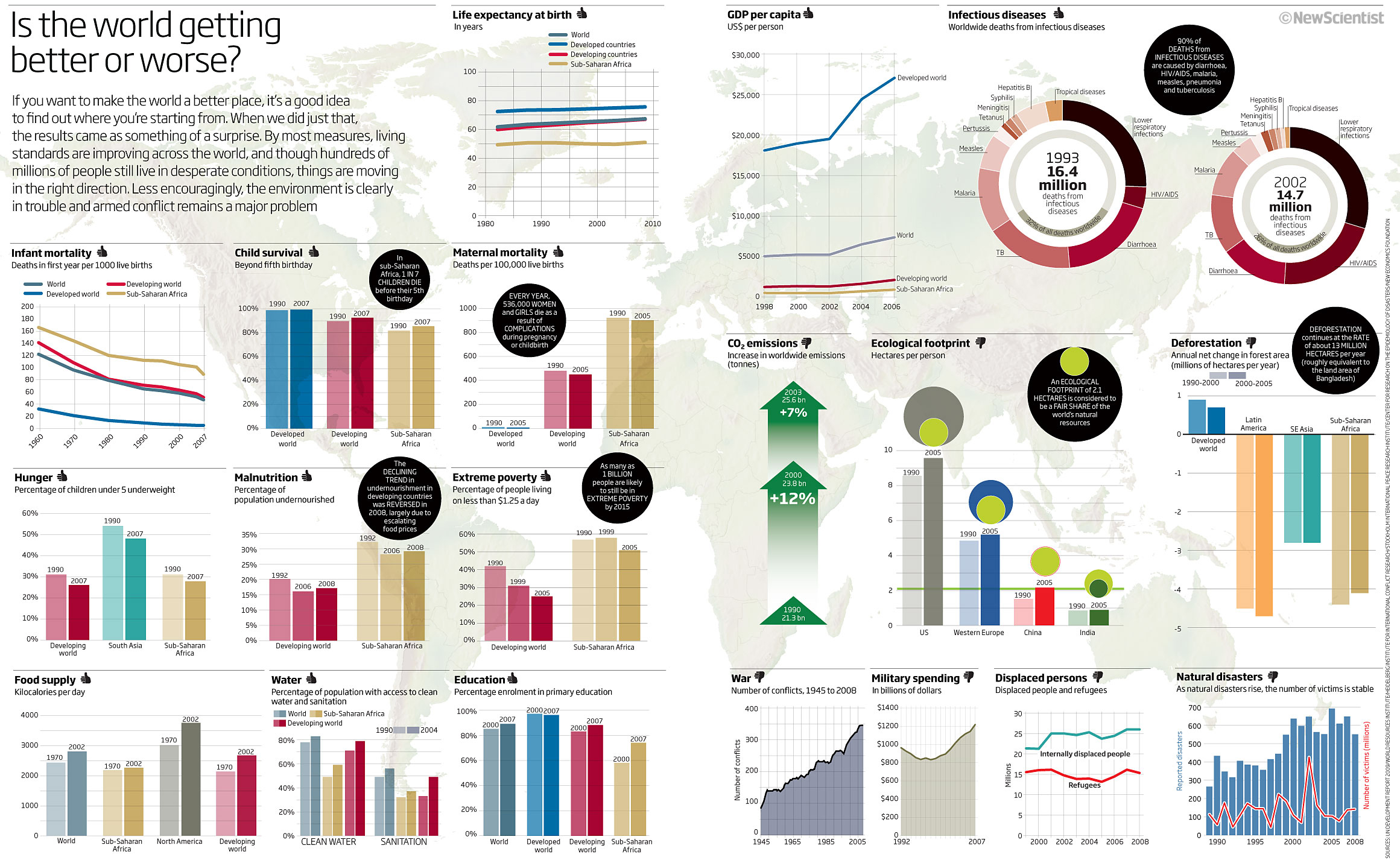
Is the World Getting Better

Hans Rosling's Gapminder

World of 100

One World

UN Human Development Trends/TD>

No-nonsense Guide to International Development
by Maggie Black
Amazon

No-nonsense Guide to Poverty
by Jeremy Seabrook
Amazon

Global Issues

World military spending exceeds $1.6 trillion, continuing high trend despite economic conditions

After a decline following the end of the Cold War, recent years — including during the global financial crisis from 2008 — have seen military spending increase

In recent years, global military expenditure has increased again and is now comparable to Cold War levels. Recent data shows global spending at over $1.6 trillion, despite the global economic conditions. It is still a 1.3% increase since 2008 when the financial crisis began, for example.

For some nations, they can increase their spending as they grow economically. For others, there are geopolitical interests at stake.

The highest military spender is the US accounting for 41% of the world’s spending, more than the next top 14 countries combined, and more than all its potential enemies, combined. But this represents a slight decline over previous years as other nations, especially China, increases spending and the US begins to very slightly feel budgetary pressures on its military spending.

This update includes updated figures, graphs and charts exploring this further.

Read full article: World Military Spending

Foreign aid: first decline in years, though still close to highest levels ever, but still way below promised amounts

The OECD (Organisation for Economic Co-operation and Development) recently published new preliminary figures for aid in 2011.

It showed official development assistance (ODA) aid from wealthy governments had increased to $133.5 billion in 2011 (at constant 2010 prices). This is roughly 0.31% of GNI (Gross National Income) of the donor nations. But this was also a drop of nearly 3% from the previous year. It was to be expected that the effects of the financial crisis would eventually affect aid. In some respects, the decline is not as bad as it could have been given the conditions in many donor countries.

Net ODA in dollars: the US provided the most in dollar terms. As a percent of their GNI, Sweden provided the most

Yet, over 40 years ago nations promised to reach 0.7% of their GNI by the mid-1970s. While each year the amount of aid falls quite short of that 0.7% target (less than half of that target), the quality and effectiveness of that aid is often questionable, sometimes benefiting the donor more than the recipient due to the types of conditions attached to this aid.

This update includes a number of new and updated charts and graphs.

Read full article: Foreign Aid for Development Assistance

Foreign aid: shortfall since 1970 over $4 trillion; greater than aid given

40 years ago, rich country governments agreed to give 0.7% of their GNI (Gross National Income) as official aid to poor countries for development assistance.

The average aid delivered each year has actually been between 0.2 to 0.4%. The shortfall has therefore accumulated to $4.37 trillion dollars at 2010 prices, while total aid delivered in that same time frame has reached $3.19 trillion.

Year after year, the accumulated shortfall increases at almost a steady rate

This update includes updated charts and graphs that look into this further.

Read full article: Official global foreign aid shortfall: $4 trillion

Climate change and carbon emissions trading

Flexibility mechanisms were defined in the Kyoto Protocol as different ways to achieve emissions reduction as part of the effort to address climate change issues. These fall into the following categories: Emissions Trading, Joint Implementation and Clean Development Mechanism.

However, these have been highly controversial as they were mainly included on strong US insistence and to keep the US in the treaty (even though the US eventually pulled out). Some of the mechanisms face criticism for not actually leading to a reduction in emissions, for example.

The updates to this article includes a couple of videos summarizing some concerns about cap and trade.

Cartoon Depicts politics in global warming negotiations where an emissions-producing Uncle Sam (representing the rich nations, including the US) is twisting the arms of a poor person (representing poor nations) to sell emissions quotas at dirt cheap prices

Image ©: Centre for Science and Environment

Read full article: Climate Change Flexibility Mechanisms

As climate change increases developing countries face brunt

New data from NASA shows the planet continues to warm. At the same time, a Climate Risk Index shows that since 1991, developing countries have been most affected by climate related impacts. While Canada withdrew from the Kyoto Protocol stating it did not want to burden taxpayers with an additional $14 bn (Canadian), many economists have noted that the economic costs of inaction far outweight costs associated with action.

The updates to this article include expansion of the above issues as well as new videos and graphs and charts.

Read full article: Climate Change and Global Warming Introduction

New video from NASA shows increasing global temperatures since 1880

NASA’s Goddard Institute for Space Studies (GISS) monitors global surface temperatures on an ongoing basis. Their analysis shows temperatures around the globe in 2011 compared to the average global temperature from the mid-20th century. The comparison shows how Earth continues to experience warmer temperatures than several decades ago.

Global temperatures have warmed significantly since 1880, the beginning of what scientists call the “modern record.” At this time, the coverage provided by weather stations allowed for essentially global temperature data. As greenhouse gas emissions from energy production, industry and vehicles have increased, temperatures have climbed, most notably since the late 1970s. In this animation of temperature data from 1880-2011, reds indicate temperatures higher than the average during a baseline period of 1951-1980, while blues indicate lower temperatures than the baseline average.

Click on the image to see the video:

Video

Read full article: Global Temperature Anomaly, 1880 - 2011

Media and advertising: manipulating photos of people; going too far?

It has long been known that advertisers will “photoshop” (slang for editing photos to touch up or airbrush out imperfections) photos to make the subject more attractive. But many have pointed out that this subtle manipulation often goes too far. Young people, girls in particular, are bombarded with images of how they are supposed to look, contributing to many social and health problems as a result.

The American National Advertising Division (the US advertising industry’s self-regulating watchdog) for example, recently moved to ban the misleading use of photoshopping and enhanced post-production in cosmetics adverts as it could be too misleading. In the UK some adverts have been banned because the effects of airbrushing has resulted in very misleading cosmetic adverts. France has even considered legislation to explicitly identify retouched images.

Some will claim it is up to parents to teach their children how to recognize these things, but parents cannot often win against an army of professional psychologists, marketers and others all focused on pushing their own images onto children, when studies also say that children are not old enough tell the difference between commercial and other content.

This page has been updated to add a section about this issue with further links, videos and examples.

Read full article: Media and Advertising

Media in the US: lax campaign financing bad for democracy but good for media companies

US campaign financing rules have been relaxed even further in recent years, making a worrying problem about the state of American democracy worse (because those with money have even more ability to try and buy votes or influence policy).

Media coverage of this issue, though it may pop up from time to time, seems quite limited. Perhaps because it is estimated that television stations this year could make as much as eight billion dollars from political campaigns.

The state of US mainstream media has unfortunately been lamentable for many years, and after the issues around hurricane Katrina, it was thought that the media would be rejuvenated. Unfortunately it does not seem that way.

This page has been updated with further information about campaign financing issues and how limits in the US have been lifted making the problem worse. Also added were notes on US press freedom, and an info graphic on media ownership concentration.

Read full article: Media in the United States

Climate change: historic emissions still matter

China, India and other emerging economies are often the focus points for climate change negotiations. Many rich nation politicians and their media often point to their rising emissions as proof that they urgently need to be bound to emission reduction targets in the same way rich nations are.

But what is often easily forgotten or omitted is that greenhouse gases can stay in the atmosphere for a very long time. In other words, historic emissions matter.

Historical data show that the majority of greenhouse emissions have been by rich nations, known as "Annex I" countries in climate negotiation speak:

Apart from China and India, the remainder of the top 10 historical greenhouse gas emitters have been from Annex I countries.

This is why 2 decades ago the climate negotiations started by understanding there were "common but differentiated principles" and why "Annex I" countries were initially given target emissions while the rest were to be given space to grow given the urgent need for poverty alleviation and development.

Furthermore, climate negotiations frameworks have always said developing nations need to avoid a polluting path to industrialization, so they can’t just use historic emissions injustice as an excuse not to do anything. At the same time, the dirty path to development was also the cheap and easy path which developing countries need to avoid, so it was also agreed that the Annex I countries should help developing countries in various ways. Needless to say much of this has not really happened.

These and additional charts have been added based on updated data up to 2008 on historical carbon emissions plus estimated emissions for 2009 and 2010.

Read full article: Climate Justice and Equity

COP17 - Durban Climate Conference

An overview of the Climate Change Conference (also known as COP 17), held in Durban, South Africa in December 2011.

Predictably and sadly, the same issues have resurfaced: lack of media coverage, West stalling on doing anything trying to blame India and China instead, lack of funding, disagreement on how to address it, etc.

Geopolitical threats (real and imaginary) quickly focus a lot of political will and money is easily found to mobilize military forces when needed.

The economy also takes center stage as the current pressing issue, while climate change is easily deferred, in the hopes that the West can let China and India pick up the burden of addressing emissions even though they have not contributed to the historical build up of emissions that have started the recent changes in the climate.

This page is an overview of the Durban conference.

Read full article: COP17 - Durban Climate Conference

The British option of the OIB (Option Internationale Du Baccalaureat) or otherwise known as 'The International Option of the French Baccalaureat' should not be confused with the International Baccalaaureat. The French government, in collaboration with Cambridge University, run an exam system that is conducted entirely in English although the majority of the candidates sit the examination in France. This page gives information on the History and Geography component of the British Section of the OIB exam. There are seven topics (see above) taught to what might be regarded as an A-Level standard. The students have to take a four hour written examination and a 15 minute oral examination. Further information can be found at ASIBA, CIEP and a handbook is available from Cambridge


Armed Forces | Art and Culture | Articles | Biographies | Discussion | Glossary | Home | Library | Links | Map Room | Media and Advertising | Science and Technology | Search | Student Zone | Timelines | TV & Film | Wargames | British Empire Store


by Stephen Luscombe