
|
|
|

 |
The History, Civil and Commercial of the British Colonies in the West Indies by Bryan Edwards London, 1793 Edwards was an early writer who criticised the tyranny of the British Parliament in its treatment of the liberties of English gentlemen in Jamaica. He assumed that it was similar treatment that had led to the colonists in the 13 colonies demanding their own liberty. He represents a strand of early historiography that emphasised the ancient rights and liberties of the settler communities of British subjects overseas.
|
 |
An Historical Survey of the Foreign Affairs of Great Britain With a View to Explaining the Causes and Disasters of the Late and Present Wars. by G. F. Leckie London, 1808 Leckie represents a type of Napoleonic-era writer who believed that the expansion of British territorial influence was as a result of the enlightenment and industry of the British people and was therefore something to be welcomed. Whigs and Tories alike held Britain's experience up as a mirror to the chaos and disorder unleashed by the French Revolutionary and Napoleonic Wars.
|
 |
An Inquiry into the Colonial Policy of the European Powers by Henry Brougham London, 1803 Brougham represents a far more sceptical strain of Napoleonic era writers. These were not necessarily hostile to empire but did think that overseas settlement would lead (once again) to the settlers seeking to separate from the centre and create self-governing communities. They were critical of acquisitions of territory through conquest and subjagation of other peoples on the grounds that it gave undue power to the executive and therefore threatened English liberties back at home.
|
 |
A Treatise on the Wealth, Power and Resources of The British Empire in Every Quarter of the World, Including the East Indies by P. Colquhoun London, 1815, (2 vols) Colquhuoun was a Utilitarian writing at the end of the Napoleonic Wars. He basically believed that colonies had been run badly before, but that good governance could benefit the rulers and the ruled alike.
|
 |
Freedom and Independence for the Golden Lands of Australia: The Right of the Colonies, and the Interest of Britain and of the World by John Duncan Lang London, 1852 Lang represents one of the early examples of patriotic histories from the settler colonies. As Imperial garrisons were being recalled from the colonies in the 1840s and 1850s, settlers naturally felt suspicious of the commitment of the metropolitan cenre and promoted the efforts of the settlers and pioneers themselves. Lang is an example of an early nationalist historian of what would become the Dominions.
|
 |
A Translation of the Seir Mutaqherin or a View of Modern Times by Seid Gholam Hossain-Khan Tabatabai Calcutta, 1789 Tabatabai represents an early Persian critic of British Imperial expansion into India. Tabatabai criticised the corruption and divisions of the local rulers which gave the British their opportunity. But he also attacked the greed and violence of the British as they established themsleves and the 'drain of wealth' that they were systematically implementing from the sub-continent.
|
 |
The Founding of the Second British Empire 1763 - 1793 by Vincent T. Harlow London, 1952 - 64, (2 vols) Vincent Harlow traced the Second Empire from 1763 rather than the more common 1783 of his era. He believed that the American Experience convinced the British than an Empire of expanding trade was better than one of settlement or territorial control. Britain's ability to survive Napoleon's blockade and of Britain's reluctance to retain many of the Spanish and French colonies hoovered up at the end of the war was further proof to him of this shift in emphasis.
|
 |
Reappraisals in British Imperial History by Ronald Hyam and Ged Martin London, 1975 Hyam and Martin represent a strain of historians who saw continuity from the First to Second Empires. Basically, they believed that the American and French Revolutions - followed by the Napoleonic Wars - were basically an aberration and that the post 1815 period resumed where the mid-Eighteenth Century left off.
|
 |
The Expansion of England: Two Courses of Lectures by J. R. Seeley London, 1883 With a cautionary nod to what happened to the 13 colonies, Seeley cautioned about racial matters and characteristics within the Second Empire. This was, after all, the period of Darwin and scientific explanations and categorisations. Seeley felt that 'the future of the planet' depended on the racial similarities of Britain and America and that many of the problems of the 19th Century Empire - Canada, the Great Trek, the Indian Mutiny - all had racial or anthropoligical underpinnings. More than just influencing historiography, Seeley's writings influenced imperial policy through people like Cecil Rhodes and Joseph Chamberlain.
|
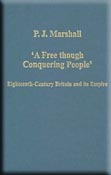 |
A Free Though Conquering People: Britain and Asia in the Eighteenth Century by P. J. Marshall London, 1981 P. J. Marshall argued that Britain could be both a 'free' and a 'conquering' people post-1783. He argued that the British adjusted their conceptions of empire from one based on freedom and the domination of the seas, to one which involved the exercise of autocratic rule. He believed that territorial empire became a more acceptable ideology as governmental apparatus and international economic realities matured towards the end of the Eighteenth Century as a response to the contrasting successes in the Americas and India. Examples of this change in policy included the creation of the Colonial Office and of the state sponsoring of various scientific endeavours such as James Cook and Joseph Banks.
|
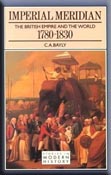 |
Imperial Meridian: The British Empire and the World 1780 - 1830 by C. A. Bayly London, 1989 C. A. Bayly emphasises the increasing autocratic nature of the Second Empire compared to the First. He cites the increased autocratic powers of the colonial Governors. He gives examples verging on despotism such as Somerset in the Cape, Maitland in the Mediterranean and Lord Hastings and Amherst in India. He believes that these were not evidence of a more enlightened empire but of a more ruthless one.
|
|
The Fall of the Old Colonial System: A Study in British Free Trade, 1770 - 1870 by R. L. Schuyler London, 1945 Schuyler wrote that the 1850s and 60s was the key period of transition which would see an end to the 'old colonial system' with the withdrawal of garrisons from the settler colonies, new communications technologies, the advocacy of Free Trade and the settling of the Canadian constitutional and border issue in the aftermath of the American Civil War. He wrote that the years from 1861 to 1867 were 'the critical period in British imperial history'.
|
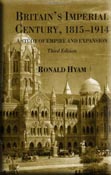 |
Britain's Imperial Century: 1815 to 1914: A Study of Empire and Expansion by Ronald Hyam London, 1976 In his book, amongst other topics, Hyam wondered why there were so many rebellions to British rule clustered around the 1850s and 1860s. He explained it as the delayed consequenes of the severe pressures placed on the Imperial system and colonies due to the effects of the 'Age of Reform'. This is when missionaries, liberals, free traders, utilitarians were all trying to bend the institution to what were thought to be nobler goals but could often be seen as cultural insenstivity and meddling in existing societies.
|
 |
Studies in the Development of Capitalism by Maurice Dobb London, 1947 Dobb was an orthodox Marxist who belived that the reason for the British expansion of empire between 1783 and 1860 was primarily due to the economic forces unleashed by the Industrial Revolution.
|
 |
Trade and Empire in Western India, 1783 - 1806 by Pamela Nightingale Cambridge, 1970 Pamela Nightingale was another Marxist historian. She documented how the British extended their occupation and power in Western India due to private British traders applying pressure on the East India Company whilst seeking supplies and access to raw cotton and spices. Basically, she was assigning economic motives for the spread of Empire.
|
 |
Reluctant Empire: British Empire on the South African Frontier 1834 - 54 by John S. Galbraith Berkeley, 1963 Galbraith is an example of a historian who ascribed Imperial expansion due to constant attempts at having to settle the 'turbulent frontier'. The idea was that native enemies provided the impetus to pull the Imperial forces ever onwards as the British continually sought security for their existing settlements and commitments.
|
 |
British Imperialism by P. J. Cain and A. G. Hopkins London, 1993 (2 vols) Cain and Hopkins have offered a more sophisticated economic explanation asserting that in the early stages, 'gentlemanly capitalism' such as East India Bonds, shipping, insurance and official salaries provdided the incentive for Imperial expansion but that this gave way to the export of capital and the search for markets of raw materials. This second phase, lasting up until the 1860s, utilised railway and infrastructure loans or the funding of indigenous rulers in return for access to raw materials or trading concessions. This Imperial enterprise model changed as British economic imperatives changed and the role of the 'City' and finances were pivotal.
|
 |
Africa and the Victorians: The Official Mind of Imperialism by Ronald Robinson and John Gallagher with Alice Denny London, 1961 Robinson and Gallagher beleived that the 'official mind' back in London kept on taking colonies and intervening due to 'crisis in the periphery'. The government was vigilant in protecting India, settler colonies and key communications routes which led them to respond to threats and developments that threatened those interests. British intervention in Africa was largely explained in this way - Egypt, Sudan, Southern and Central Africa. What makes their thesis interesting is that when they were writing in the late 1950s and early 1960s, similar problems were effecting Britain due to decolonisation and the Cold War: Suez, Aden, Cyprus, etc...
|
 |
Subaltern Studies: Writings on South Asian History and Society by Ranajit Guha New Delhi, 1982 - 96 (9 vols) This collection of writings looks at the 'history from below' angle. Basically, to what extent did the local peoples, in this case in India, acquiesce, resist or otherwise shape the imperial processes. It emphasises the poor, marginalised and downtrodden sections of society - although still manages to discuss leaders emerging from these groups. These kinds of theories helped fill the vacuum for Marxist historians in the post-Cold War and were particularly popular in the non-settler ex-colonies and ex-slaving colonies.
|
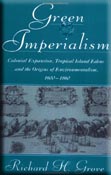 |
Green Imperialism: Colonial Expansion, Tropical Island Edens and the origins of Environmentalism, 1600 - 1860 by Richard Grove Cambridge, 1995 Grove represents an example of a group of historians who examined the control and contest for resources as a defining reason for imperial expansion. It is a kind of post-Marxist struggle for resources as rulers, settlers and local populations all attempted to gain access and control sources of land, timber, raw materials and wildlife in order to sustain themselves economically. As science became more sophisticated, administrators started to protect certain areas - which often put them into conflict with settlers and/or local populations. These theories became popular in the 1990s as environmental degradation and dispersal of scarce resources resurfaced as a contemporary issue.
|
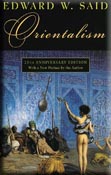 |
Orientalism by Edward Said London, 1978 Said provided an influential and controversial challenge to traditional imperial theories in the 1980s and 1990s as he claimed that almost all European knowledge of other peoples was generated simply by their own needs of conquest. Essentially it is how the West saw the East. He believed that they had a romanticised image of the societies that they were conquering which was fundamentally false and was created primarily to justify the imperial processes.
|
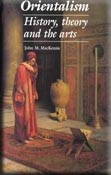 |
Orientalism: History Theory and the Arts by John M. MacKenzie Manchester, 1995 Leading the fightback against Edward Said, John MacKenzie believed that some Europeans were genuinely inspired and moved by art and culture that they came into contact with. He believed that it was overly simplistic to label entire cultural attitudes in a binary fashion. And that different individuals responded to host cultures in different ways in different territories.
|
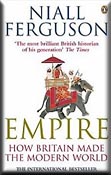 |
Empire: How Britain Made the Modern World by Niall Ferguson London, 2003 Niall Ferguson might be seen as the neo-con of Imperial writers. He offered a view of an early stage of globalisation (or Anglobalisation as he says) whereby the Empire far from being an overwhelmingly negative force brought forward an international system of Free Trade and technology transfers that were to transform the empire and indeed the world's economy. He doesn't completely ignore the negatives explains that the empire went through certain stages of development. Essentially he offers something of a Whiggish interpretation that explains a process towards betterment for all. Reviewed in full here
|
 |
Economics and Empire: The Periphery and the Imperial Economy by B. R, Tomlinson Oxford, 1999 Tomlinson believes that the economic benefits of the empire were not shared by the majority and certainly not by the poorest. If anyone was able to profit from the Empire it was the European settlers and usually at the cost of the local populations. 'British rule did not leave a substantial legacy of wealth, health or happiness to the majority of the subjects of the Commonwealth.'
|
|
|
|
|
|

|
|
|
|
|
Armed Forces | Art and Culture | Articles | Biographies | Colonies | Discussion | Glossary | Home | Library | Links | Map Room | Sources and Media | Science and Technology | Search | Student Zone | Timelines | TV & Film | Wargames
