|
Guarding India's Borders
|
|
With Britain's ever increasing power and influence in India, it was only a matter of time before she became concerned at protecting the Jewel in the Crown's borders and access routes. Burma provided one such area of concern for nervous British administrators in India. Additionally, the more powerful and confident the Burmese nation became, the more the British agonised over its power and capabilities. Burma became an example of mission creep for the British. They had conquered Bengal, but wanted to ensure its security and so felt compelled to deal with threats to their position there. Burma provided one such hypothetical threat and so was dealt with accordingly by the British East India Company.
|
|
The First Burmese War 1824 - 1826
|
|
In 1824, during the First Anglo-Burmese
War, Maha Bandula,
Burma's greatest general, wanted
to see for himself one of the enemy's
"shells" which were throwing his
army into such a panic. The opportunity
soon came when one fell, but did not
explode, near where he stood.
A party of Burmese soldiers - observing
that the missile was obviously a dud by
the way its long fuse sputtered and
smoked - picked it up and started towards
their chief, who eagerly waved
them on. Fortunately for Bandula, they
were still some distance away when the
burning fuse reached its conclusion and
brought the bomb-carriers to theirs. A
man renowned for his courage, Bandula
was said to have been unnerved for the
rest of the day.
The story may be apocryphal, but it
reflects some truths about the collision
of British and Burmese civilizations.
Before Burma began to fall to the British
early in the 19th Century, it was a highly
organized state, the most powerful
monarchy in South-East Asia. It had 2,000
years of tradition behind it, a written
language rich in ancient literature, and a
firmly established Buddhist religion.
Against this ancient country the British
depioyed the technological wonders of
19th-Century warfare. When the smoke
cleared, Burma's independence had been
destroyed, a slow process which took
three wars and a little over 60 years from
1824 to 1886.
Before Britain colonised it, Burma was
itself an expansionist nation. It was, in
fact, Burma's conquest of Arakan and
Assam in the late 18th and early 19th
Centuries that brought Burma to the
borders of India and thus face to face
with the British Empire.
Relations between the two powers
had been brittle from the time of their
initial 16th-Century contacts.
The first Englishman to visit Burma
was Ralph Fitch, who arrived in Pegu
(Lower Burma) in 1587. Rangoon was
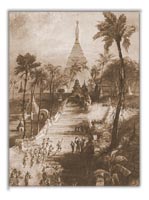
then a mere fishing village, but the Shwe
Dagon Pagoda, the country's greatest
Buddhist temple, "all gilded from the
foote to the toppe," impressed him as
"of a wonderful bignesse" and "the
fairest place... that is in the world."
Fitch's tales of the country's own riches and the caravans that brought from
China "great store of mastic [the resin
used for varnish], gold, silver and many
other things of China work" began to
awaken British commercial interest.
However, it was not until 1619 that
the East India Company established
trading stations at Syriam, Prome, Ava,
and Bhamo and started to deal in Burmese
oil, timber and ivory. In the middle
of the 17th Century all "European barbarians"
- which included Portuguese
and Dutch traders as well as the English were
for a brief period thrown out of
the country by the Burmese.
In 1755 a leader from Ava (Upper
Burma) named Alaungpaya overthrew
the Pegu dynasty in the south, which
had long ruled the country, and laid the
foundations of modern Burma. The King
now considered himself "the Lord of
Earth and Air."
In his own country, the King of Ava
was answerable to none, free to make and
break agreements at will - an attitude
which made for a relationship of bewildering
unpredictability.
A Captain Baker took Alaungpaya
gifts of gunpowder, a few muskets, a
gilt looking-glass and some lavender
water, and offered him British support.
It was refused.
Yet two years after this rebuff, in
1757, Alaungpaya reopened the discussion
with a letter addressed to George II
written on gold leaf studded with rubies,
and containing an invitation to his court.
To the English representative who came
in response he gave 24 ears of maize, 18
oranges, five cucumbers and two grants
of land for trading factories. Two years
after that, in 1759, the British merchants
at one of these stations, on the island of
Negrais, were sitting down to breakfast
with the local Burmese Governor when
he gave a signal that brought a band of
his soldiers rushing into the room. They
killed the eight Englishmen present
and more than 100 of the Indian employees,
who manned the station.
Alaungpaya's justification for this outrage
was that he had discovered the
British were conspiring with Peguan
rebels to overthrow him. When he died
in 1760, his successor again invited
British traders into Burma. Once more
the traders came in, but they continued to complain of harassment as Burmese
and British interests increasingly came
into conflict through the remainder of
the century.
In 1795, as Burma consolidated her
hold on Arakan and Assam, 5,000 Burmese
troops invaded British territory in
pursuit of Arakanese rebels who had
taken refuge there. The Governor-General,
Sir John Shore, meekly surrendered
the fugitives. In the years that followed,
there were repeated crises over fugitives,
smuggling and boundaries. War finally
came when a King named Bagyidaw
ascended to the throne of Ava in 1819.
A low, flat, almost worthless island
called Shapuree, in the mouth of the
river that separated Burmese territory
from that of the Company, became the
testing ground for conflicting claims. In
September, 1823, the King of Ava, claiming
that the island had been his property
since time immemorial, sent 1,000 soldiers
to evict the 12 Company sepoys who
occupied it. The Burmese evacuated the
island as soon as they had taken possession,
and the British moved back in,
only to leave again, this time driven
away by sleeping sickness.
The fact that nobody actually wanted
to stay on Shapuree made no difference.
When Lord Amherst, the GovernorGeneral,
made a conciliatory move, the
Burmese threatened to invade Bengal.
Later, when the Burmese were in a mood
to make the island neutral ground, the
British refused. Finally, on March 5,
1824, Amherst declared war on Burma.
At home, the news of so remote a
conflict was barely noticed. In
India, however, British soldiers
were thrilled. "Never shall I
forget the shouts of joy with
which we welcomed the intelligence of a
war with the Burmese," wrote Ensign
F .B. Doveton. "Here would be glory for
a young soldier, perhaps even an opportunity
to sustain a flesh wound, in the
easiest possible manner."
The Burmese were also out in their
reckoning. Their commander, Maha Bandula,
included in his expeditionary baggage
a pair of golden fetters with which.
to secure Lord Amherst, once he had
captured the Governor-General.
Bandula at first seemed on the verge of making good his promise. His army
of 60,000 crossed the border and at
Ramu, in May, 1824, almost annihilated
a smaller British force. Dread
and terror spread among the merchants
of Calcutta, who feared they were next.
Bandula's army soon turned round and
marched back into Burma, however, and
for a very good reason - the southern
parts of Burma had been invaded by the
British. Lord Amherst had wisely seen
that the Company should not fight this
war in the difficult hill-country of the
border areas, but should strike at the
heart of Burma, the Irrawaddy River
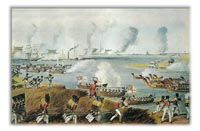
Valley. On May 10, 1824, Sir Archibald
Campbell with 11,OOO British and sepoy
soldiers arrived off Rangoon in a fleet of
warships. The next day 6,000 men went
ashore, found the city abandoned, and
went on the rampage.
"By night-time the greater part of the
European force in the town were intoxicated,"
wrote an officer of the Madras
Regiment, "and in this state they went
rambling from house to house with
lighted torches.... The conflagration
was certainly a magnificent sight."
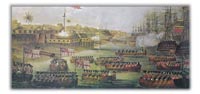
The British bivouacked in and around
Burma's holiest shrine, the Shwe Dagon
Pagoda, raising their flag on its lofty,
gilded spire. The Burmese, meanwhile,
hastily threw up a ring of bamboo forts
to hem in the invader. "Stockades sprang
up like mushrooms in every direction,"
wrote Doveton, "so that, look which way
we would, there was ever a pleasing
variety from which to pick and choose
whenever our general wished to relieve
the monotony of the cantonment by the
excitement of a sortie."
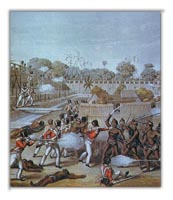
The first of these palisades which Sir
Archibald attacked was called Zwegyon.
The rains had begun and British gunpowder
was wet, so the Company's
soldiers used bayonets.
The British next moved on the biggest
stockade, Kemmendine (the soldiers
called it jocularly, "Come an' dine") ,
defended by 20,000 Burmese. On June 3,
a combined naval and military attack
collapsed rather ignominiously. The British
reached the stockade's high walls
only to discover they had left their scaling-ladders behind, and during their retreat
suffered battering fire both from their
own ships in the river and from their reserve units to the rear, who thought
they were the enemy trying to break
through. On June II they tried again this
time remembering their ladders and
were victorious.
With seasonal rains turning the delta
into an impassable mire, Campbell could
not advance. Most of his force went down
to the coast where they spent the next
three months conquering Burma's maritime
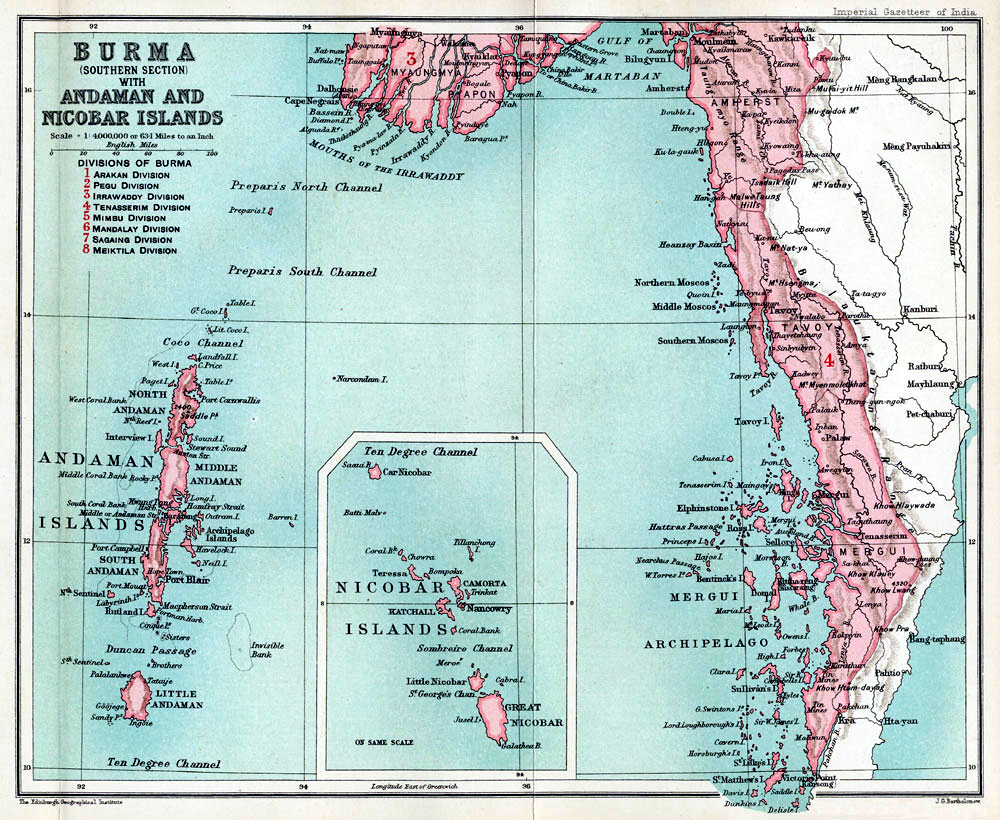
provinces, capturing Yeh, Tavoy,
Mergui and Tenasserim.
While all this was happening, Maha
Bandula, far to the north, undertook an
epic march. Having heard of the landing
at Rangoon, he turned his 60,000 soldiers
from Bengal and drove them over the
hills of Arakan, a difficult route at the
best of times. He did it during the rains,
when the flooding streams, leeches and
malaria-bearing mosquito turned the
jungle into a waterlogged nightmare.
By November, when the rainy
season ended, Bandula and the
Burmese were again threatening the British at Rangoon. The
British soldiers may have
genuinely welcomed action as an alternative
to the punishment the climate was
imposing on them. In six months, 1,200
Europeans and many Indians had already
died, mainly from disease.
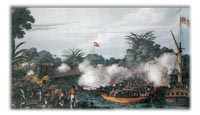
On the night of November 30 the British, now defending Kemmendine, saw
the sky up-river begin to glow. Soon a
vast fleet of Ioo-foot-Iong fire rafts
appeared, floating towards the British
ships. "The scene before us was a grand
and imposing spectacle; the whole jungle
was illuminated, the Golden Pagoda at
Rangoon, and everything around us, was
as clearly discernible as' at noonday,"
wrote a British Officer. Behind the fire
rafts, which British sailors were busily
fending off, swarmed boatloads of Burmese
warriors. They were joined by
others from the jungle in an attack on
Kemmendine, but the outnumbered British
repulsed them.
On December 3, Bandula failed to take
Kemmendine again, and the following
day he was repulsed once more. His
troops now lay in a wide semicircle
around Rangoon. On December 5, Campbell
surprised him with a sudden sally
against the Burmese left wing. It was so great a rout that some British found time
for larking. At the height of the battle a
sergeant grabbed a riderless, exotically
caparisoned, Burmese pony and mounted
it, shouting to his comrades, "Here comes
Bandoolah!"
Campbell estimated that 5,000 Burmese
were killed or wounded that day.
Bandula managed to rally 20,000 men
at Kokine, up the river, behind what
Sir Archibald called "the most formidable,
entrenched and stockaded works
I ever saw," but they were soon dislodged
by a British force of only 1,300
men who were assisted in equal parts by
superior artillery and unquestionably
magnificent courage.
Bandula fell back to Danubyu, 50
miles up-river. Campbell pursued him,
marching with 2,500 men by land, and
sending another 1,300 in all the riverboats
available. This latter unit reached
Danubyu first, and its commander, a
Brigadier-General named Cotton,
cheekily demanded the surrender of
Bandula's army, about ten times as
numerous as his own. "We are each
fighting for his country," Bandula replied,
"and you will find me as steady in
defending mine as you in maintaining
the honour of yours."
Campbell arrived and the attack began
with an all-night artillery, mortar and
rocket barrage on April I, 1825. The
British were still in their trenches the
next day when it was learned the enemy
had evacuated the stockade. Bandula,
while in conference with some of his
officers, had been killed by that former
object of his curiosity, a British mortar
shell. Although his brother tried to
assume command, the death of their
great general was too demoralizing for
the Burmese soldiers. They fled.
Campbell advanced up the river to
Prome, but could not continue to Ava
because the rains came again. Meanwhile,
British forces had been making progress
elsewhere in the large country. They
conquered Assam in January, 1825, and
supported a local Prince, Gambhir Singh,
who threw the Burmese out of Mampur.
By the end of April, Arakan was under
British control. The Burmese hastily
accepted a one-month armistice to discuss
a treaty, but rejected British terms.
Fighting resumed when the rains ended.
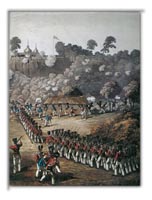
At Prome the Burmese tried the
same tactics they had used at
Rangoon, building stockades
round the British position.
On December I, 1825, Campbell's
men struck at one of these forts,
Napadee. When the fighting ended, it
was discovered that among the defenders
were three beautiful and apparently highranking
Burmese girls, two of whom
were killed in the attack. The British
went on, clearing out stockade after
stockade, until the enemy again sued
for peace on December 5.
They balked at the British terms,
which required surrendering much of
their territory. "The question is not how
much you will cede to us," a general on
Campbell's staff remarked gravely, "but
how much we shall return to you." A
draft treaty was signed on January 3,
1826, and the Burmese were given until
January 18 to have it approved.
When that da:te passed with no ratification,
Campbell resumed his march. He
was 45 miles from Ava, at a town called
Yandabo, when two European missionaries,
who had been released from a Burmese
prison for the purpose, arrived with
a treaty and 250,000s pound in gold and silver
as a down payment on the indemnity
demanded by the British.
Under the Treaty of Yandabo, which
ended the First Anglo-Burmese War on
February 24, 1826, the English got the
provinces of Assam, Arakan, Manipur and
Tenasserim. In addition, Ava promised
to accept a British Resident and pay an
indemnity of 1,000,000 pounds. The war had
cost Great Britain about 13,000,000 pounds.
Forty thousand men had been employed
in it, of whom 15,000 died, mainly from
disease. The British left Rangoon when
the second instalment of the indemnity
was paid in 1827, a move that enabled
King Bagyidaw to save face - he let it be
known that the exhausted English had
begged for peace, but since they did not
have enough money to leave he had
magnanimously paid their fares home.
|
|
An Uneasy Peace
|
|
The British Resident sent to the court
of Ava in the aftermath of the First Burmese War was Henry Burney, brother of
novelist Fanny Burney. He found Bagyidaw
as proud and uncooperative as ever.
When the King, who was steadily going
insane, was overthrown by his hot-headed
brother, Tharrawaddy Min, in 1837, Burney was even more frustrated in his
attempts to increase trade and get special
concessions. Tharrawaddy completely
disavowed the 1826 Treaty (although he
made it clear he would not try to recapture
the lost territories) and, as a
monarch, refused to deal with the representative
of a mere Governor-General.
Burney left Ava in disgust and urged his
superiors to launch a new war.
The East India Company declined to
do so - yet. In 1846, Tharrawaddy also
began to show signs of insanity and was
ousted by his son, Pagan Min. Pagan's
favourite sport was cock-fighting, but
he was not averse to a little Britishbaiting
on the side. His Governor of
Rangoon, Maung Ok, seemed to regard
the English merchants now established
in that port as a source of supplementary
income to be extracted by any available means. In 1850, Maung Ok compelled a
certain Mr. Potter to pay 16,000 rupees
for permission to launch a ship. Pdtter
complained to Lord Dalhousie, the new
Governor-General of India who had just
finished fighting the Second Sikh War.
The following summer the Governor of
Rangoon falsely charged the masters of
two British vessels with murder and made
them pay '920 for their freedom. They
asked the government of India for compensation.
It was over this amount that
the Second Anglo-Burmese War began.
With the Sikhs subdued Dalhousie had
troops to spare and he decided that the
Burmese must be brought to heel.
The war, like most colonial wars,
aroused little interest in London. One
of the few Englishmen who objected to
it, the politician Richard Cobden, said
later he could find no one, in or out of Parliament, who had read the two Parliamentary
papers relating to the conflict.
It would have made little difference. The
reports suppressed critical evidence, even
that of Lord Dalhousie, to justify the war.
Dalhousie sent a Commodore Lambert
to Rangoon to investigate the case of the
two captains. "It is to be distinctly
understood," Dalhousie told Lambert,
"that no act of hostility is to be committed
at present." When Lambert
reached Rangoon he was inundated with
complaints from British businessmen.
"Many of them," Dalhousie said later,
in a statement not included in the Parliamentary
papers on the war"are of old
date, none are accompanied with proof,
none were preferred at the time, not until
the appearance of the squadron suggested
an opportunity for deriving some profit
from the occasion."
One notable complaint was from a Mr.
Crisp, who, perceiving that a war between
his own countrymen and the Burmese
was in the wind, had imported a
shipload of arms and sold them to tl1e
Governor of Rangoon. As Maung Ok
had not paid for the guns, Crisp was now
asking the government of India for
41,490 rupees in compensation. The claim
was rejected.
Commodore Lambert, whom Dalhousie
later called "combustible," and
of whom he wrote, "If I had the gift
of prophecy I would not have employed
Lambert to negotiated," did not waste
time investigating the validity of the
complaints. Within a day of arriving he
sent an ultimatum to the King of Ava,
demanding that he recall his Governor.
Perhaps not surprisingly with a British
squadron in his major harbour, Pagan
acquiesced. When Dalhousie heard that a
new Burmese Governor had been appointed,
he thought the crisis was over.
He did not realize just how "combustible"
Commodore Lambert was. On
January 5, 1852, a deputation of senior
British officers tried to call on the new
Governor without a formally arranged
appointment. They were told that he was
asleep. Lambert immediately took several
hundred British residents on board
his ships, and, when night fell, seized a
vessel belonging to the King of Ava. He
informed the King that he was "obliged"
to do so "in consequence of the insults offered by the Governor of Rangoon."
The Governor tried to reopen negotiations.
Lambert said he would receive
him on his frigate . The Governor suggested
Lambert should come to him.
Lambert refused. The Governor said that
if the British attempted to take away the
King's ship, he would have to fight. Lambert
replied that if so much as a pistol
was fired he would level the riverside
forts of Rangoon to the ground.
And that, on January 10, was what
happened. Two ships, H.M.S. Hermes
and H.M.S. Fox, started down the river
with the Burmese vessel in tow. Shots
were fired from the shore, and the two
ships answered with devastating effect.
Lambert wrote to his headquarters the
same day: "I am confident the Government
of India will see it was unavoidable
and necessary to vindicate the honour of
the British flag."
When he got word the next day that
the Governor was ready to comply with
all British demands, Lambert did not
bother answering him. It would be war.
"So all that fat is in the fire," Dalhousie
sighed when he heard the news.
Dalhousie admitted that his emissary
had acted "in disobedience of his orders,"
but once fighting had begun he fell back
on the familiar need to assert the Company's
authority. "We can't afford,". he
said, "to be shown to the door apywhere
in the East." Not ready for a full-scale
campaign, he stalled by sending Pagan
Min an insulting ultimatum in which the
compensation demanded was raised from 920 pounds to 100,000 pounds. On April I, 1852, he
declared war on Burma.
|
|
The Second Burmese War 1852
|
|
General Sir Henry Godwin, with
about 8,000 men, easily took
Martaban. after a furious
cannonading ofthefort on April
12. When the British ships
opened fire on Rangoon the next day,
some Burmese soldiers tried to escape the
bombardment by jumping into the river"as if resolved," wrote an English officer,
"on becoming targets for practice."
On April 14, Godwin's men swept some
20,000 Burmese from their main redoubt,
the Shwe Dagon Pagoda, and the enemy
continued to provide entertainment for
the British. Recalling the scene, Colonel
Williarn F.B. Laurie who took part in the action, wrote: "It was amusing to see
them chevied through the bushes, across
the plain where the artillery was drawn
up, by the European soldiers. Crack!
crack! crack! - away they ran, as if a
legion of evil spirits were after them."
Naval guns did "fearful " to
Rangoon. That night the city once more
blazed in the darkness, "observing which
formed amusement for the weary who
could not sleep."
In May, Godwin with Boo men - and his
powerful guns - overcame 7,000 Burmese
at Bassein, 60 miles up the river. By
June almost the whole province of Pegu Lower
Burma - was occupied. "But the
beasts don't give in," groused Dalhousie.
"There is no symptom of submission and
I now give up all hope of it." Prome fell
to the invaders in October but still,
Dalhousie complained, the Burmese
would not recognize"their actual inferiority
to the British power."/I>The Burmese
simply refused to answer the peace
proposals, which entailed cession of Pegu.
Patience at an end, Dalhousie annexed
Lower Burma on December 20, IB52, by
simply proclaiming that it was "henceforth
a portion of the British Territories
in the East," and told its people to "submit
to the authority of the British
Government, whose power they had
seen to be irresistible and whose rule was
marked by justice and beneficence."
Two days later he ' had white pillars
erected six miles north of the town of
Meeday and informed the King of Ava
that, from now on, that was its boundary.
Early in IB53 Pagan was overthrown
by his brother, Mindon Min, who then
tried to negotiate with the British. He
was told they would be happy to have a
peace treaty, but would not return Pegu.
Dalhousie's proclamation was "irrevocable."
Mindon, in the light of the recent
campaign, understandably desired peace
with the British, and ordered his people
not to challenge the new frontier, but he
could not accept the proposed1treaty. The
war ended without a formal document
being signed.
The Times, which was wont to pass
judgment on wars in those days the way
a theatre critic might now review plays,
pronounced it "generally inglorious."
One report put British dead at about
3,000. It had cost 1,000,000 pounds more than 1,000 times the amount of the claim
which began it. By cutting off Burma
from the sea - "She could now reach the
world only by the sufferance of the British,"
said a Burmese writer - the war
markedly reduced that nation's ability to
challenge British supremacy in South-East
Asia, or even to sustain its own
independence, which, economically
speaking, was being rapidly eroded by
the influx of British goods from India.
|
|
Another Uneasy Peace!
|
|
Despite some guerrilla resistance, Pegu
was soon organized as a province of India.
On the grounds that the Burmese were
unreliable. uneducated, and lazy - though
their patronizing critics never failed to
credit them for being "good-humoured"
- the new British overlords imported
Sikhs for policemen. Bengali clerks for the
lower ranks of the civil service, and
Madras coolies for labourers. The Britishowned
Irrawaddy Flotilla Cornpany began
running steamers up the, river in 1864.
The submarine telegraph cable reached
Rangoon in 1870 and a railway to Prome
.opened in 1877. Lower Burma was becoming
British Burma.
Under King Mindon, a peaceful and
popular monarch, Upper Burma was also
undergoing changes. He built a new
capital just east of Ava at Mandalay,
brought in the telegraph, and encouraged
education and religion. He even paid for
the restoration of the Shwe Dagon
Pagoda now in British territory, which
had been damaged in the two wars.
Possession of Lower Burma tended
to whet rather than satisfy
the appetites of British businessmen.
They kept glancing hungrily
at Ava. An official report lamented
the embargo on exporting opium to
Upper Burma. "The use of the drug is
more or less forbidden by the Ava
Government to its subjects. The people
of that kingdom. however, are probably
quite as willing to consume opium as
the people of China or India... "It
appears possible that a considerable
addition to the opium revenue might
accrue were the present restrictions on the export to be removed."
The merchants were lured less by
Upper Burma itself than by what lay
beyond it - south-western China. The Nanking Treaty of 1842 had forcibly
prized open China to trade, and British
merchants were eager to press the products
of Yorkshire and Lancashire into
the hands of millions of new Chinese
customers. Commercial circles in Britain
saw Burma as a potential bridge between
India and the Chinese province of Yunnan;
as matters stood, it was an obstacle.
In 1862, Mindon agreed to British
traders travelling to Bhamo, where they
could meet caravans from China. The
Indian government wanted a clause in
this treaty which would exclude
foreigners, other than the British from
this route, but the British negotiators.
knowing the King would refu se, did not
propose it. By another treaty, in 1867,
Mindon permitted the Irrawaddy Flotilla
Company to run steamers to Bhamo and
allowed a British party to explore possible
railway routes leading to China.
Mindon became nervous as the British
pressed for wqr-e and more concessions,
especially when he learned British agents
were dealing secretly with anti-Ava rebels
from Burma's Shan states. To underline
his position as monarch of a sovereign
nation, he decided to send an embassy
directly to Queen Victoria. The bypassed
government of India was incensed, and
Mindon was warned his envoys would not
be allowed to talk business in London.
but only make a ceremonial visit.
The British Press made every attempt
to belittle the Burmese envoys during
their tour of Europe. In Paris, the British
Ambassador tried to jockey himself into
the position of introducing them to the
French, as if they were his proteges. The
Burmese managed to avoid his unwel- .
come embrace, and retained their dignity :
commercial agreements were signed with
Italy and France allowing for the exchange of diplomats and trade contacts.
The British government actually objected
to Italy about the warmth of the
welcome the Burmese received in Rome.
When they were given the Italian Cross
of Commander, The Times correspondent
reported petulantly: "I am pretty sure
they all went to bed last night with their
crosses carefully stowed away under their
pillows after the manner of good and
deserving children with new playthings."
In England the delegation was coolly
received by the government, but its
members were well fed by chambers of
commerce in almost every leading city.
Mindon died in 1878. Since the throne
of Ava usually changed hands in a coup,
the natural death of a reigning monarch
posed unusual problems of succession.
Mindon had 53 queens, 48 sons and 62
daughters. One of his chief queens was
Hsinbyumashin, the daughter of the late King Bagyidaw and his wife, Menu,
reputed to be a sorceress. Hsinbyumashin
was even more of a Lady Macbeth
than her mother had been.
She had three daughters who were
supayas, princesses held in reserve to
marry whichever of their half-brothers
should eventually reach the throne, a
provision designed to keep the dynasty
"pure." Hsinbyumashin picked I9-yearold
Thibaw, one of Mindon's younger
sons who happened to be in love with her
eldest girl, as her choice for King. With
the help of some powerful politicians, she
locked up or drove from the country
princes who might be rival claimants to
the throne. Her oldest daughter took
refuge in a nunnery rather than marry
Thibaw, but he wed the other two
supayas and was crowned.
By a practice repeated many times in
Burmese history, but which had been ignored in recent years, a new King
secured his position with a "massacre of
the kinsmen. " Thibaw's power-crazy
mother-in-law re-established the tradition
and in January, 1879, some 80 courtiers,
including IS of Thibaw's half-brothers
and four of his half-sisters, met grisly
ends in the palace at Mandalay. When
word of the killings reached the outside
world, indignation and threats of coercion
induced Thibaw to promise that he would
never repeat such a massacre.
Thibaw did not have a happy home
life. After a baby son died of smallpox,
his chief wife bore only daughters. He
tried to satisfy his disappointed manhood
by collecting a harem, but as often as not
an executioner in the hire of his motherin-
law would call on one of his new
girls the morning after Thibaw did.
The British were as offended by his
foreign policy as by the barbarism with
which his rule was associated. Thibaw
began granting monopoly concessions,
and not always to British companies. An
old custom of the Court of Ava gave the
British an opportunity to show their
displeasure. They suddenly decided, after
years of conforming to the rule, that it
was "humiliating" to remove their shoes
before approaching the King. Diplomatic
relations virtually ended in October of
1879 when the British Charge d'Affaires
stormed out of Mandalay with other
British residents in tow. Thibaw, surprised,
sent gifts to the Viceroy of India
and asked him to continue the "grand
friendship."
He followed this appeal with envoys,
whom the British detained at the border
for eight months. insisting that the Burmese
accept the terms of a proposed new
treaty before arriving in Calcutta to discuss
it. The mission returned to Ava
when, on their last attempt to communicate
with the Viceroy, the local British
officer rejected their letter as unacceptable
and did not keep a copy.
Like his father, Thibaw tried to reduce
the English threat by agreements with
other European powers. Although the
commercial treaty he signed with the
French in 1885 had no political or military
clauses, his flirtation with France only
hardened animosity in London. "We
should now get any pretext to annex or make Burmah into a protected state,"
said Sir Owen Burne, assistant to Lord
Randolph Churchill, who was then
Secretary of State for India.
Certainly British merchants thought
so. The chambers of commerce of many
English cities joined that of Rangoon
in clamouring for annexation. Lord Dufferin,
the Viceroy, admitted that "an
independent Burmese kingdom" was the
"most serious obstacle to development
of the Irrawaddy trade," but nevertheless
he contended that annexation did
"not appear to us to be justified."
The Chief Commissioner of
British Burma was more
specific: "If King Thibaw's
Government transgressed British
frontiers, invaded British allies,
maltreated British subjects, broke
treaties, continued to commit massacres,
rejected British projects and refused
redress, matters would be different. But
things have not come to any such pass."
Such scruples were soon overcome.
The Bombay-Burma Corporation was
fined '230,000 by Thibaw for defrauding
the Burmese government as to the value
of timber exported from the country.
The fine was obviously excessive, although
the charge may have been genuine.
Anyway, it was the issue Lord Dufferin
needed. Simultaneously, he moved 10,000
troops to Rangoon and sent an ultimatum
to Thibaw. It required the King not only
to settle the matter of the fine, accept a
British agent in Ava, and facilitate
British trade with China, but also to
"regulate" all of Burma's foreign relations
"in accordance with our advice."
Thibaw said that he would take care
of the company's complaint and accept
an agent on the old terms, but would
submit to Germany, France and Italy
the question of whether Britain should
control his foreign policy. That, obviously,
was not good enough On November II,
1885, the troops in Rangoon boarded a
flotilla of river steamers for Mandalay.
|
|
The Third Burmese War 1885
|
|
The Third Anglo-Burmese War was,
according to one Briton, "not a war at all
- merely a street row." The Burmese,
thinking it would never happen, were not
prepared for it. Thibaw's army was scattered
all over the country. Some resistance
was met and quickly put down at Myingyan. Shortly afterwards General
Sir Harry Prendergast, the expedition's
commander, received a message saying
that Thibaw would now comply with all
points of the ultimatum, and requesting
an armistice.
Prendergast said it was "out of his
power" to grant an armistice. He promised
to spare the King's life if his troops were
allowed to enter Mandalay unopposed.
Thibaw agreed. A fortnight after leaving
Rangoon, the British occupied the capital
of Burma. There they were disappointed
to find only '60,000 to confiscate from
the King's fabled treasury.
The royal family was rounded up, the
queens being detained overnight in the
palace gardens in a summer-house which
later became the bar of the Mandalay
Gymkhana Club. The next day they were
deported. Thibaw lived on well into the
20th Century, dying in exile during the
First World War in a seaside villa to the
south of Bombay.
Prendergast, bearing China trade in
mind, pushed on to Bhamo, along the way
terrifying Burmese villagers by flashing
them with electric searchlights fixed to
the roofs of the steamers. Lord Randolph
Churchill ordered Lord Dufferin to proclaim
annexation on January I, 1886, as
"a New Year's present to the Queen."
There was talk about putting a puppet
King on the throne of Ava, but when
bufferin visited Mandalay in February
the ruling nobles refused him an official
welcome. Openly defiant, at first they
would not attend his ceremonies. When
compelled to do so they grabbed all the
front seats for their low-ranking servants,
forcing British notables to sit at the rear.
Lady Dufferin was cross because Burmese
women snubbed the nice little
reception she had laid on as a gesture of
reconciliation. Dufferin abolished .the
council of ruling nobles and made Burma
part of British India. But the Burmese
Army refused to surrender and melted
into the jungles to carry on guerrilla
warfare. To make matters worse hundreds
of Burmese joined them and together
they roamed the country as
"dacoits" or bandits, whose marauding
disrupted everyday life and prevented
orderly administration.
|
|
Pacification and Imperial Integration
|
|
Faced with a massive task of pacification
the British tended to regard anybody who fought them as a dacoit. Included in
this proscribed group were followers of
royal princes, local chieftains who resisted
foreign domination, and educated patriots
who slipped out of Mandalay to fight in
the mountains.
Dacoits twice set fire to occupied
Mandalay in 1886, destroying a third of
the city. There were enough of them in the
hills and forests to require 32,000 British
troops and 8,500 military policemen in
Upper Burma within a year of occupation.
One thousand dacoits were brought into
Mandalay and branded with a mark that
would "save the formality of a trial when
arrested a second time."
The British could not understand the
dacoits. A naval brigade captured 12 of
them and decided to make the punishment
"exemplary" by shooting them one
at a time instead of altogether. The first
shot took off the top half of a dacoit's
skull "as one decapitates an eggshell
with a breakfast knife." At this his comrades
laughed uproariously, and continued
laughing as they were similarly
dispatched, one by one, thoroughly disconcerting
their British executioners.
There was organized resistance in the
remote Shan states and Chin hills, and
new guerrilla activity broke out in Lower
Burma. Large-scale operations against
the insurgents were rejected in favour of a
network of small British outposts, each
one dealing quickly and effectively village
burning was a common technique
of reprisal- to put down the trouble in its
area. By 1891, Burma was largely pacified,
although as late as 1900 more than
20,000 soldiers and military policemen
were still needed in the country, and at
least one rebel leader, Bo Cho, eluded the
conquerors until 1920.
Though many British civil administrators
thought that Burmese culture,
with its written literature, high literacy
rate, and strong Buddhist clergy, should
be preserved intact, Burma flourished
only as a British-Indian country. Rangoon
became known as "a SUburb of
Madras." Home-produced Burmese textiles,
famous for their exotic beauty,
disappeared under an avalanche of cheap
fabrics from Manchester. The British
spent generously on education, but Buddhist
literature was not taught and was
largely forgotten.
Britain made better use of Burma's
natural resources. By 1900 there were
141 factories in Lower Burma, most of
them rice-mills. A ruby-mining concession
in Upper Burma, granted soon after
annexation, was by 1901 paying 17l per
cent to its British shareholders. Rice
became big business; just before the
Second World War, two-fifths of the
world's rice exports were produced in
Burmese fields.
This was not entirely beneficial to the
Burmese. In 1892 and 1893 a combine of
millers and exporters managed to drive
down the price paid for rice at the paddy
by a third, which greatly increased their
profits but did not help the peasants
much. The government broke the cartel
only when other businessmen angrily
pointed out that, as Burmese farmers
without money could not purchase British-
made products, imports were falling
off drastically.
Even after that the Burmese farmer did
not fare well. Caught up in a sophisticated
and unfamiliar economic system
which required him to pay taxes and buy
supplies before his crop came in, he fell
into the hands of Indian moneylenders
backed by British banks and rice-dealers.
They took much of his profit, and, eventually,
his land. By 1936 half the arable land
in Burma was owned by banks, brokers
and mortgagees.
Though imperial rule brought with it a
general respite from the wars that had
long plagued Burma, the period was
marked by a tremendous increase in the
number of violent crimes. Between 1900
and 1930, the number of murders doubled,
while the incidents involving dacoits
actually tripled. Some efforts were made
to curb this frightening outbreak of
disorder, but they had little effect. For
the root causes of Burma's violence lay in
the breakdown of the Burmese social and
political system in the wake of annexation.
Not until 1937, when Burma was
separated administratively from India
and given a certain measure of self-government, did the country recover its
sense of nationhood.
|
|
|
|