|
Initial Contacts with the British
|
|
The Portugese were actually the first European power to come into contact with India when Vasco de Gama sailed into Calicut in 1498. After that date, Portugese ships would frequently return to Europe laden with spices and commodities that would fetch fabulous prices. Other European powers looked enviously at this stream of exotica coming from the Orient. Portugal managed to hold on to its preeminent position largely in part to the Treaty of Tordesillas of 1494. This treaty had been created to divide the New Worlds between the Catholic countries of Portugal and Spain. In effect they had carved up these New Worlds with Spain receiving a monopoly of power in most of South America and Portugal in the Indies. Working together, the two Catholic countries were able to maintain an effective blockade of these new markets for the majority of the Sixteenth Century.
The lure of potential wealth of the East was too much for the rising Protestant powers of England and Holland. The English began to look for a Northern route to the Indies. The Treaty of Tordesillas specifically stated that Portugese and Spanish monopolies were only in effect south of the Cape Verde Islands. An English company was chartered to undertake just such an expedition. in 1553 Sir Hugh Willoughby set off to find the Northern Passage to India. Two years later the crew were found dead on the Siberian coastline. It dawned on the English that there was no northern route to the Indies. Therefore an alternative scheme was hatched. In 1554, a royal charter was granted to the Muscovy company. This company was set up to explore the possibility of trade through Russia to Persia. Although economically expensive to transport goods this way, the company did actually achieve a modicum of success and allowed some Indian products to be transported back to Northern Europe. The company actually survived until the latter stages of the Eighteenth Century.
Ships would always prove to be a more economically viable way of trading with India. And, as the English could not directly trade with India, its sailors resorted to buccaneering and piracy of the Portugese ships as they headed to Europe with their fabulously valuable cargoes. It was with the era of Drake and Cavendish looting and shooting their way around the world that the first cracks appeared in the Catholic monopoly. In fact, it was Drake's victory over the Spanish Armada in 1588 that really opened the floodgates. The Navies of the Catholic countries were no longer strong enough to ensure an effective blockade of their New Worlds. English and Dutch ships began to pass the Cape of Good Hope in increasing numbers. Both nations quickly established Chartered companies to exploit the commercial possiblities presented to them. The English East India Company was established in 1600. The EIC would lead the vanguard for British political power in India.
|
|
Establishment of Formal Relations
|
|
Initial EIC approaches to the Mughal Emperors were brushed off with disdain. This was partly due to the residual influence of Portugese Jesuit advisers who sought to frustrate Protestant England's attempts at making inroads into this part of the world. However, it was also due to the fact that the English had no products of value to the Mughals. The English at this time did not produce anything that was even remotely of interest to what was effectively an Indian superpower. This would remain the case for many years to come and would force the English to trade precious gold and silver for the spices and commodoties of India.
The breakthrough in negotiations came when the English demonstrated the one aspect that the Mughals did appreciate; raw military power. In 1612, Captain Best entered the busy harbour of Surat in his ship The Red Dragon. Four Portugese galleons and a number of Portugese frigates attempted to repel the English ship. When this one English ship dispersed the entire fleet of Portugese ships, the Indians were impressed. English stock rose and that of the Portugese fell. Although in truth, the more important fact was that by this time the English had surpassed the Portugese in terms of maritime technology and technique. The Portugese would never again seriously rival the power of the English at sea.
Captain Best's victory opened the door for King James' ambassador, Sir Thomas Roe, to attend the court of Emperor Jahangir in 1616. Sir Thomas Roe was painfully aware of the mismatch in power between the two respective powers and found negotiations with the Mughals tedious and difficult at the best of times. However, after nearly three years of haggling, he managed to gain permission for the EIC to build a factory at the port of Surat. However, this was on the condition that EIC ships escort Mughal vessels on their annual pilgrim to Mecca.
This first English toe-hold on the Indian sub-continent would prove to be vitally important as relations broke down with the Dutch. In 1623, the Dutch executed 10 English merchants for conspiracy to overthrow their fortress in Amboina in the Indies of the Spice Islands. This soured relations to such an extent that the EIC were forced to abandon their bases throughout the Indies. They were compelled to consolidate their power and fall back to Surat. At the time, this was a devastating blow for the EIC as they watched their Dutch counterparts thrive on their Spice Islands' monopoly. However, with hindsight, it allowed the English to cultivate economic and political relations with an area of the world that would ultimately dwarf the wealth and power provided by the Spice Islands.
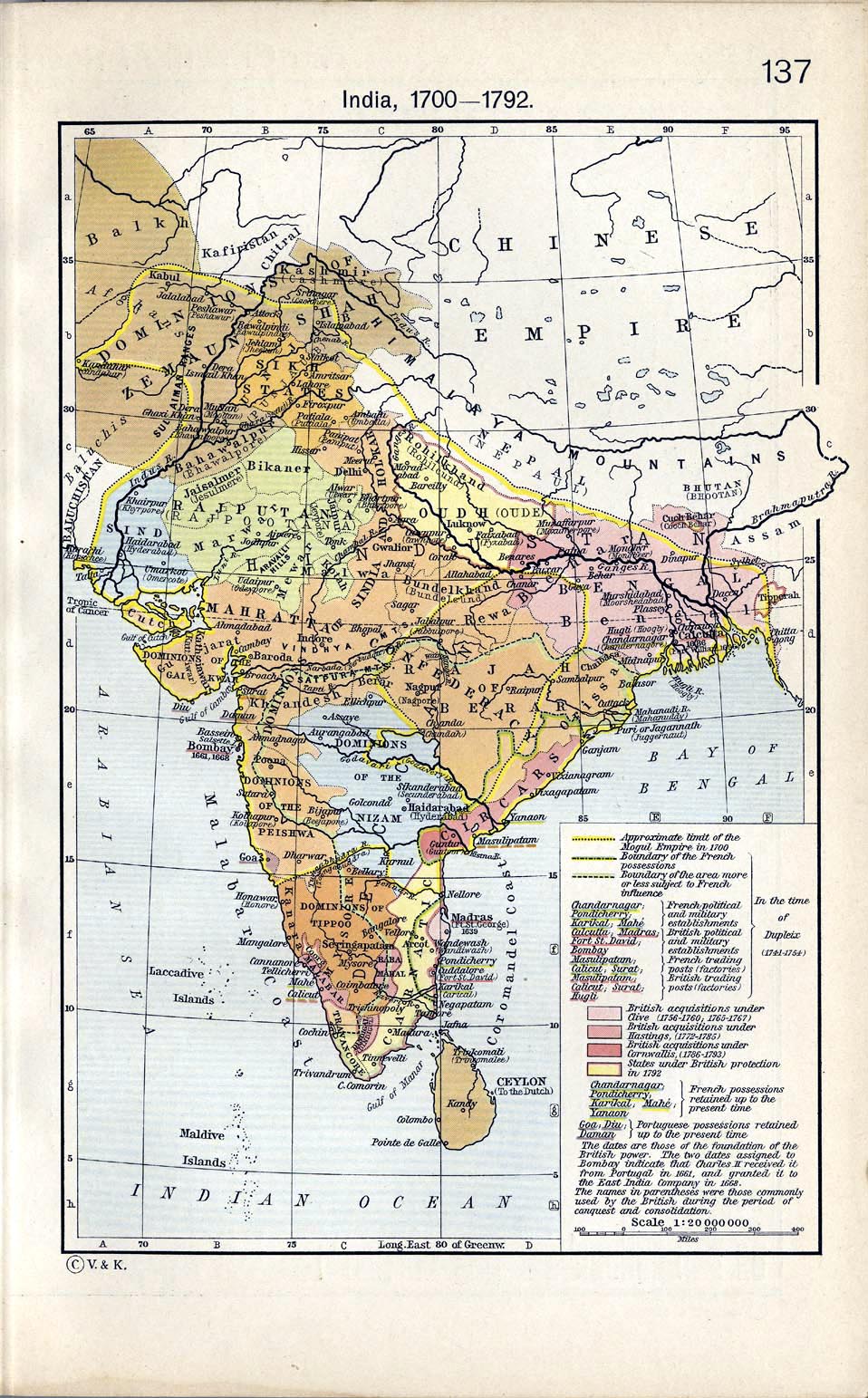
The EIC may not have appreciated the significance of these events for the Company's future, but the next century provided the EIC with an opportunity to expand and consolidate their power base in India. Factories were opened up in Madras, Bombay and Calcutta. Fairly insignificant ports at the time, these three factories would ultimately turn these trading posts into hugely important urban ports. In the following century, British power would emanate from these small enclaves to engulf most of the sub-continent.
Not everything was to be plain sailing for the EIC. To the horror of the company, Charles I granted another Charter to a rival company led by Sir William Courten. Even worse for the EIC, this rival resorted to piracy of Mughal vessels and left EIC officials to pick up the pieces. The EIC were severely punished after one such incident. This competition led to a dimunition in the value of EIC stock and there was serious discussion of withdrawing from the sub-continent altogether. It was not until the Charles I had literally lost his head and been replaced by Oliver Cromwell that the EIC saw its reckless competitor's Charter being revoked. In fact, Oliver Cromwell ushered in two reforms that would transform and revitalise what had been an ailing EIC. First of all in 1654, a treaty was drawn up with Portugal which would allow English ships to have full access to all Portugese ports in Asia. This effectively concluded any residual power behind the Treaty of Tordesillas. Secondly, Cromwell inaugurated the first permanent joint stock subscription to the EIC. This replenished the EIC coffers and would allow it to continue buying Indian commodoties with gold and silver. Fortunately for the EIC the restoration of the Crown in England did not compromise the EIC in the eyes of the new king and Charles II was content to preside over what would become a golden age of trade for the EIC.
Ideally, the EIC would have liked their commercial relationship with the sub-continent to remain just that; commercial. However, one of England's age-old rivals appeared on the scene and increasingly began to dabble in Indian politics. The French were relative late comers to the Indian sub-continent, and for most of the early part of the Eighteenth Century, they were more than content to limit their interests to commercial activity. Besides, their island bases at Mauritius and Bourbon gave the French East India Company a real competitive advantage over their English rival. That all changed with the appointment of Joseph Dupleix in Pondicherry in 1741. He would embark on meddling in Indian local affairs to a level unprecendented by any former European power. Dupleix was long familiar with the Indian ways of conducting business. He had already spent twenty years on the sub-continent as a trading merchant. Now, in a position of considerable local power, he embarked on a policy of expanding French power in India at the expense of Britain. The war of Austrian Succession gave Dupleix his excuse to summon the French fleet from Mauritius and to capture Madras from the British. This set off a chain of events that taught even Dupleix a lesson in how powerful he had actually become. The nawab of the Carnatic insisted that Dupleix hand back Madras to the Carnatic. When Dupleix refused, the Nawab sent 10,000 soldiers to forcibly retake it. Dupleix could only muster 230 French soldiers and 700 Sepoys. However, their superior firepower and discipline allowed them to defeat this huge Indian army. The result of this battle was to decisively shift the balance of power to the Europeans. In addition, Dupleix had become the effective Nawab of the Carnatic.
Had Dupleix received more direct support from France, he would almost certainly have been capable of turning India into a French concern. Fortunately for the British, the Treaty of Aix-la-Chapelle returned Madras back to the British. The French had missed their opportunity to dominate the sub-continent. As it was, the person who learnt the most from Dupleix's machinations was a young EIC writer named Robert Clive.
It did not take Clive long to put the lessons learnt from Dupleix into action. Almost immediately, he took advantage of a dispute between the Nawab of the Carnatic, Chanda Sahib - who had been installed by Dupleix, and Muhammad Ali who claimed that he was the rightful Nawab of the Carnatic. Chanda Sahib formed a vast army and marched to Trichinopoly and laid seige to Muhammad Ali's garrison. Clive, taking advantage of the situation, led a small expedition of 200 Englishmen and 300 sepoys over 100 miles to Chanda Sahib's capital of Arcot. Clive had correctly anticipated the fact that Chanda Sahib would have all but vacated his capital city in order to pursue his vendetta against Muhammad Ali. This left Arcot open for Clive's men to do as they wished. It forced Chanda Sahib to all but lift the siege of Trichonopoly and return to besiege his own capital. In fact, the Marathas also turned against the hapless Chanda Sahib and sent an army to relieve both Clive and Trichonopoly. Clive had made his reputation as a daring general and became the effective Nawab broker of the Carnatic. He duly installed Muhammad Ali as the Nawab of the Carnatic. Additional fallout from this venture was the fact that Dupleix was recalled to France. His political adventures had cost the French company dearly in financial and political terms.
The Seven Years war would provide Clive with another excuse to extend British power in India. The focus of his endeavours shifted from Madras to Fort William (Calcutta). The nawab of Bengal, Siraj-ad-Daula, learned that the British were building fortifications at Fort William in order to defend themselves from possible French attack. He ordered the British to cease building. When they refused, he gathered an army of 50,000 soldiers and descended on the small garrison of 1,000 British soldiers, many of whom escaped to nearby ships. The remainder of the garrison surrendered when realising that the powder for their antiquated guns had become damp and unusable. Siraj's victorious army gave Britain an excuse for moral outrage by what has become known as 'The Black Hole of Calcutta'. This is where a number of prisoners were placed in a room too small to hold them. The resulting deaths led to the creation of Imperial martyrs and gave British soldiers a carte blanche excuse to do whatever it took to avenge their deaths.
Clive and a fleet of warships were despatched from Madras. The warships bombarded the French base at Chandranagar whilst Clive led an attack on the French fortress at Hughli. This removed French influence from the region of Bengal. Clive then turned his attention on Siraj. Clive found a suitable replacement Nawab, Mir Jafar. He also found allies in the form of Hindu bankers who were willing to bribe Siraj's soldiers not to fight. Then on June 23rd 1757, Clive met the 50,000 army of Siraj with only 700 European soldiers and some 2,000 Sepoys. This battle has gone down in history as one of the turning points in Indian history. Although the events of the day were a little more on the squalid side. Mir Jafar defected with many of Siraj's men midway through the battle, most of Siraj's troops had been paid not to risk their life or limb. Those who did fight were overwhelmed by the ferocity of Clive's superior firepower and with the resolve of the men using it. The battle itself may not have been historic, but its results were. Clive installed Mir Jafar as ruler, he awarded himself the lion's share of the financial spoils and granted himself a substantial area of land. Not only had the EIC gained financially, but the Nawab, by granting so much land to gain his position, had denuded his treasury of funds. It was not too long before Mir Jafar stood down to be replaced by another Nawab - willing to grant yet more land for the privilege of becoming ruler.
British ascendency was confirmed in 1764 when the remnants of the Mughal emperors amassed their armies in a last attempt to rid India of the British once and for all. The remains of the Mughals were comprehensively defeated by the much smaller force of Major Hector Munro. This victory, more than Plassey, sealed the fate of the Indian continent once and for all. In fact, there was nothing to stop the British force from then marching directly to Delhi and proclaiming itself as the new Empire for India. Instead, they took the more cautious route of hiding behind whatever legitimacy the Mughal empire might have had. They agreed to pay a paltry 230,000 pounds annually to the Emperor in return for the rights to the revenue of Bengal, Bihar and Orissa in perpetuity. Of course, the EIC did not volunteer to take over the civil administration of these regions. For the EIC, this was the best of all world's; Power without Responsibility.
|
|
EIC Administration
|
|
Although power without responsibility was useful for the EIC, it was anything but for the Indians who found themselves under EIC administration. Early direct EIC rule of their provinces was characterised as a time of almost lawlessness. The revenues that EIC officials were collecting were being rapidly repatriated back to Britain - this left the Indian officials with no means to pay for their judicial system. From the British government's point of view, this was leading to an extremely bad press. And even worse than this was the fact that it was the EIC officials who were getting rich off of this system. As individuals were making fortunes for themselves, the EIC itself was in dire straits economically. The company never got to see the vast majority of the revenues collected in India. The financial problems of the EIC came to public prominence in the 1770s, when the EIC first of all defaulted on payments for use of British armed services and then was forced to ask the British government for a one million pound loan to keep the company going. Many people in Britain were incensed that so many EIC officials were coming back to Britain as incredibly wealthy individuals, but that the British government would have to bail out the company itself. The loan was reluctantly forwarded to the company in 1773 but it had strict provisions that directly involved the British government in EIC affairs for the first time - at least on a formal basis. They established a Supreme Court in Calcutta to which Indians also had recourse and which could even make appeals to the Privy Court in London. The Crown was also to appoint members to a Supreme Council which could advise the newly created post of Governor General of Bengal. Efforts were also made to stamp out official profiteering - although these measures were less successful.
The EIC had successfully used their significant presence in Westminster to avoid direct Crown rule in India. However, EIC administration was still more concerned with revenue collection than for the betterment of civil society in the sub-continent. This made perfect sense to the EIC, but sat uneasily with many of the more liberal sentiments coming out of Britain at the time. In fact, little more than a decade later, the British parliament found that it had to scrutinise EIC activities in India to an even greater extent. The result was the creation of a 'Board of Control' in 1784 whose president was a member of the Cabinet and was directly answerable to parliament. This Act still left the day to day running of the provinces to EIC officials on the ground - however it was clear that the British Government was being drawn further and further into the administrative affairs of India. In fact, the first Governor General of Bengal, Warren Hastings, resigned almost immediately when he discovered that the Board of Control had power to force any Governor General to resign.
Warren's successor, Lord Cornwallis, ushered in a period of profound reform in company rule of India. Cornwallis' honesty and integrity saw his administration remove all officials considered to be corrupt or disreputable. He professionalised and increased the salaries of the civil service in an attempt to remove temptation for corruption. He introduced revenue reforms that were designed to simplify revenue collection - but would also create an Indian gentry of sorts. This artificially created class would later become staunch defenders of the British Empire and would be instrumental in preventing the spread of rebellion in the middle of the following century. Cornwallis also reformed the military wing of the EIC by Europeanising its officer corps. This effectively barred Indians from advancement to commissioned status. This particular rule proved to be one of the more pernicious rules and one that may explain much of the snobbery and disdain that was to follow in the nineteenth and twentieth centuries. Perhaps the most important of Cornwallis' reforms were what became known as the 48 regulations. These basically formally accepted EIC responsibility for civil services and the judicial system. It may have been a peculiarly British legal system, but it was better than none at all - which had been the case for the previous four decades. These reforms would shape not only the remaining half century of EIC control of India, but much of the subsequent Raj as well.
In fact, one of the major aspects of EIC control in India is how it slowly and surely shifted from being a trading company to an administrative arm of the British Government. Trade became less and less important as tax collecting took increasing precedence within the company. Part of this transformation was the removal of the privileged monopoly rights that had been granted to the EIC way back in the Seventeenth Century. The British government passed acts in both 1813 and 1833 which effectively withdrew these privileges. However, there was an element of compensation built into these Acts and the EIC was effectively subsidised to collect taxes. The distinction between EIC rule and British rule was becoming increasingly hazy as the century wore on. It is hard to say whether this effective 'privatised imperialism' would have continued throughout the century or whether it would have naturally transferred itself to government rule anyway. This question would remain an academic one as the north of India would unexpectedly test the EIC to destruction and force the British Government to become directly involved in the subcontinent. These convulsions were what has become known as 'The Indian Mutiny.'
|
|
Second Sikh War 1848 - 49
|
|
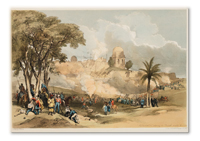
The Second Sikh War was sparked off with the murder of Mr Vans Agnew, a Political Officer, and his assistant, Lieutenant Anderson of the Bombay European Regiment. They had gone to Multan in April 1848 to install Khan Singh Man as Governor in place of Mulraj. But they were attacked and wounded by a mob, and taken to the Idgah, a building outside the city. Two days later they were mobbed again and this time killed. Mulraj was defeated by a force of irregulars under Herbert Edwardes at Kineyri, but he took refuge in the strongly defended fortress of Multan. Edwardes urged the Government in Bengal to send a large force to besiege Multan but the Commander-in-Chief Sir Hugh Gough was reluctant to send British troops into action in the heat of mid-summer. However, Major-General Sir William Whish was sent with a small column, joining up with Edwardes, and attacked the Sikh advance position on 12 Sep 1848. One section of the Sikhs, a force of 3,000 led by Sher Singh, defected to Mulraj so Whish and Edwardes withdrew 5 miles and called for reinforcements, which were sent from Bombay.
The Bombay Division 1848
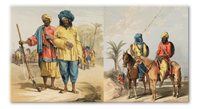
The Bombay army assembled at Rohri on the east bank of the Indus opposite Sukkur. The 4th Regiment left Karachi on 26 Oct and arrived there on 19 Nov covering 332 miles in 25 marches with only 2 days halt. Brigadier-General Henry Dundas commanded the Bombay Division and would be second in command at the siege of Multan under Major-General Whish. The Division was composed of 2 Brigades:
1st Brigade under Brigadier Capon:
60th Rifles
3rd Bombay Native Infantry
9th Bombay Native Infantry
3rd Troop Bombay Horse Artillery
Bombay Sappers and Miners
Scinde Irregular Horse
2nd Brigade under Brigadier Stalker CB
1st Bombay European Fusiliers
4th Bombay Native Infantry, Rifle Corps
19th Bombay Native Infantry
Bailey’s Battery RA
Bombay Lancers
The Division set off from Rohri by brigades, the 2nd leaving on 29 Nov, two days after the 1st. They met up with the Bengal Force on 21 Dec at Suraj Khund. Herbert Edwardes wrote in his book A Year on the Punjab Frontier 1848-49, that ‘.. they had been long looked for and our soldiers crowded out to welcome them as they arrived in Camp. They were the first troops of the Bombay Army which I had ever seen, and I beheld them with admiration.’
Sidi lal ki Bed, 27 Dec 1848
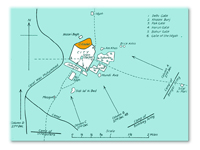
General Whish’s strategy was to make a four-pronged attack on the defended positions outside the city walls of Multan, advancing from the east and the south. The 4th Bombay Rifles were in column C with one wing of the Bombay European Fusiliers, some lancers, sappers and a light gun battery, given the task of capturing a mound called Sidi lal ki Bed. The column was led by Brigadier Henry Dundas and Major Honner. The 4th NI had a strength of 748 Indian ranks, 15 British officers and a sergeant-major. They advanced at noon on 27 Dec and formed into extended order facing the mound and a mosque to the left. After a few artillery rounds were fired at the mound, the 4th were ordered to drive the enemy from the mosque and another building where the enemy had two guns. The Fusiliers went to the right of the mound and the 4th to the left. The enemy vacated the mosque and their position on Sidi lal ki Bed, and fled to the suburbs south of the city.
The worst of the fighting took place in the streets of the suburbs. Skirmishers of the 4th on the left found themselves in a maze of buildings and up against overwhelming numbers of enemy that included cavalry. One section managed to enter the city, but did not get far. The greater part of the regimental casualties occurred in the suburbs, and they soon ran out of ammunition. The recall was sounded and they retreated under covering fire from the Fusiliers. The regiment occupied the garden at the Biji Bagh until relieved by the 19th NI, and then bivouacked for the night. They had lost 19 men killed, 19 wounded, and 18 missing, taken prisoner.
Repulse of the Sortie, 29 Dec 1848
The infantry took turns to occupy the suburbs over the next three days to cover the construction of batteries. On 29 Dec the 4th Bombay Rifles were positioned between the two mounds, Mundi Ava and Sidi lal ki Bed which was occupied by the Irregulars. The enemy sortied out of Multan on that day to attempt the recapture of Sidi lal ki Bed. The left of the 4th’s line was involved in heavy fighting which resulted in the sortie being repulsed and the loss of two riflemen killed and three wounded.
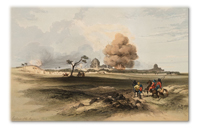
Explosion in Multan, 30 Dec 1848 The Sikhs suffered a catastrophic loss on 30 Dec when a shell from one of the artillery mortars struck the Jumma Masjid (Great Mosque), and another hit their main gunpowder magazine. The result was a terrific explosion which killed and buried nearly 1,000 people and destroyed a huge quantity of stores.
The Storming of Multan, 2 Jan 1849
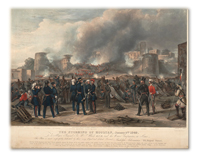
The original plan had been to attack the citadel first and leave the city of Multan until later, but General Whish now decided to secure the city first so that the stronghold of the citadel could be assaulted from all sides. By the morning of 2 Jan 1849, two breaches in the city walls were reported to be practicable. The Bengal column was ordered to storm the breach near the Delhi Gate on the east side, while the Bombay column was to storm the breach near the Khooni Burj (Bloody Bastion) on the southeast corner. The three Bombay regiments of the 2nd Brigade paraded at 1pm and marched to Mundi Ava. One company of the 4th Rifles was detailed to carry scaling ladders. At a point 200 yards from the breach they waited for the signal to assault.
The Fusiliers were the first to climb the rubble to the breach, and were held up by the defenders’ stiff resistance. The 4th Rifles were in support but Major Honner led the regiment up a mound to the right and they were able to rush to the help of the Fusiliers. The storming was made easier by covering fire from the Bombay artillery and fire from the 60th Rifles. The Fusiliers suffered heavy casualties whilst storming the breach, and also once they were inside, as the Sikhs had dug a trench and built a stockade to stop the attackers. But these obstacles, having been overcome, the enemy were pursued through the streets as far as the walls on the west side. The 4th Rifles advanced towards the Grain Market in the middle of the city. Regimental HQ was established near the Bohur Gate and they bivouacked there for the night.
The Night of the Occupation of the City, 2 - 3 Jan 1849
The capture of the city meant that prisoners could be released, including the 18 riflemen of the 4th who were captured on 27 Dec. During the night there was an attack made on the Harun Gate by a party of 30 Fusiliers and 50 of the 4th Rifles. A brass gun had been firing grapeshot at one of the guard posts set up nearby, causing casualties. The attack was successful and the gun captured. The regimental surgeon David Ritchie was involved in this attack, as he was in most of the action that day and night despite a bullet injury to his ear. The other incident that occurred that night was an explosion at the Bohur Gate where sappers were working to clear the gates. Many Indian soldiers were killed or buried alive in the blast. The city was generally a scene of horror, with dead piled up, half burned or half eaten by dogs, and the next morning the stench was appalling, and flies swarmed everywhere.
The Assault on the Citadel, 4 - 22 Jan 1849
The regiment was relieved by the 60th Rifles on 3 Jan and marched to their camp southeast of the city. The next day the 2nd Brigade moved to Hazari Bagh on the northwest of the citadel. Batteries and trenches were prepared by sappers and pioneers, for which the 4th Rifles provided protection by exchanging fire with the defenders. Eight men were wounded in this daily duty. Mulraj was holding out with around 5,000 men but their supplies were running short so peace talks were started. General Whish insisted on an unconditional surrender which was finally conceded on 22 Jan 1849. This day marked the end of the siege of Multan. The 4th Bombay Rifles had sustained casualties of 29 killed and 74 wounded. The battle honour MOOLTAN was awarded to the regiment on 8 April 1853.
Aftermath of the Siege
The bodies of Vans Agnew and Lt Anderson were retrieved and given a ceremonial funeral, and on 22 March a man was publicly executed for their murder, named as Gudhar Singh, a Mazbi Sikh. The 4th Rifles had been disappointed to be ordered to stay behind as a garrison while the rest of Whish’s force marched to Gujrat in north Punjab where the decisive battle of the Second Sikh War was fought on 21 Feb 1849. However, the infantry did not play a significant part in this ‘Battle of the Guns’. The 4th were at Multan when heavy rain in August caused the Chenab to overflow and the area became a sea of mud. They were obliged to leave their camp and stay in the citadel which was hot and unhealthy. At one time there were 500 men sick with fever. This state of affairs lasted until mid-November. They left Multan on 24 Dec and sailed down the Chenab, Sutlej and Indus, then by sea to Vingourla in the Concan. They marched to Belgaum where they were stationed for 3 years.
|
|
Mutiny
|
|
The administration of Governor General Lord Dalhousie was hailed as the apogee of Company rule. His 1848 - 1856 tenure would prove to be an uncommonly interventionist and expansionist period of EIC rule. Indeed, these would be halcyon days for the EIC before being plunged into a desperate battle for survival as a minor military mutiny spread into a full scale rebellion.
In fact, it was the increasing tendency of the EIC to intervene and expand in internal Indian affairs and princedoms that led to the rebellion in the first place. Lord Dalhousie was only following along with one of the major mid-Nineteenth Century political philosophies; that of utilitarianism. Lord Bentinck had really got the ball rolling as he tried to rein in some of the more unpalatable of Indian traditions; ritual murder (Thuggee), female infanticide, widow burning (suttee) and slavery. At the time, it seemed as if many Indians supported these aims. With hindsight, it would appear that they deeply resented tampering with traditions that went back thousands of years, however unpalatable those traditions might have been. They perceived British tampering in their social order as proof that the British wished to forcibly convert Hindus and Muslims alike to Christianity. British utilitarian reforming zeal combined with increasing Christian missionary activity helped to form this unlikely alliance of Hindu and Muslim sepoys.
Lord Dalhousie's expansionist policies also helped to foster resentment. In fact, the majority of the mutiny took place in areas of India that the EIC had barely ruled for little more than a decade. Lord Dalhousie had instituted a reform entitled 'Doctrine of Lapse'. Basically, this doctrine held that if any ruler died without a suitable heir, control of the princedom would pass to company rule. Now, not only did this doctrine attack a long held Indian tradition of adopting an heir, it also managed to offend virtually every ruling family on the sub-continent. They would all now feel vulnerable to EIC control. And rightfully so as minor and major principalities began to be picked up by the company; Jhansi, Satara, Nagpur and Oudh were all absorbed into EIC India. Again, Hindu and Muslim leaders were equally discriminated against by this policy. In fact, Dalhousie felt so confident of EIC power on the sub-continent that he even refused to accept an heir for the Mughal emperor Bahadur Shah unless the imperial title be renounced. Dabbling in Indian internal affairs had taken on dangerous proportions.
The EIC had supplied the powder for an insurrection and they also happily provided the match. The introduction of a new cartridge for the army entailed the biting off of their ends. Unfortunately, there were rumours (quite correctly at first) that these cartridges had been greased with animal fat. There was no way of telling if this fat was from a cow (offending the Hindus) or from a pig (offending the Muslims). Again, the EIC had managed to offend both sections of society. As regiment after regiment refused to use the new cartridges, discipline began to break down. Three cavalry regiments at Meerut broke out into full scale mutiny. Soon, at cantonments throughout the north of India, regiment after regiment followed suit. Any European was considered fair game as many sepoys headed towards Delhi to 'restore' Bahadur Shah to the throne of Mughal India.
The events of the mutiny are detailed elsewhere on this site. Suffice it to say that the initial atrocities were more than amply matched by the indignant British soldiers rushed to India from all corners of the Empire. The British were actually fortunate that the mutiny did not engender a deeper and more widespread rising. Many, indeed most, Indians either stood on the sidelines or actively supported the British. Most of the rebels were drawn from the company army. Rebel support was also found amongst the landowners in the recently annexed province of Oudh and from dispossessed or threatened princes. However, it never ignited support from the masses. Although, there were plenty of hangers on who were keen to take advantage of the break down in civil administration. Anarchy in large swathes of northern India was one of the main results of the mutiny.
A key plank of support for the British was from the Zamindars and the gentry artificially created by Cornwallis some half century before. A number of Indians realised that their positions and fortunes were dependent upon the continued rule of the British. The British were therefore able to contain the spread of much of the rebellion. The British were also helped by the lack of a coordinated command structure amongst the rebels. Once they had mutinied, most rebels were content to loot a little, head towards Delhi, wait a little and then go home. When attacked, the rebels defended stoutly. However, they were reluctant to attack British forces of any consequence.
Back in Britain, reaction to the slaughter of British men, women and children was hysterical. The British government was unable to resist the pressure for major political reform once order had been restored. In November 1858, the Act for the Better Government of India was passed. It replaced the EIC with direct rule from Britain. John Company had been replaced by the Raj.
|
|
Raj Administration
|
|
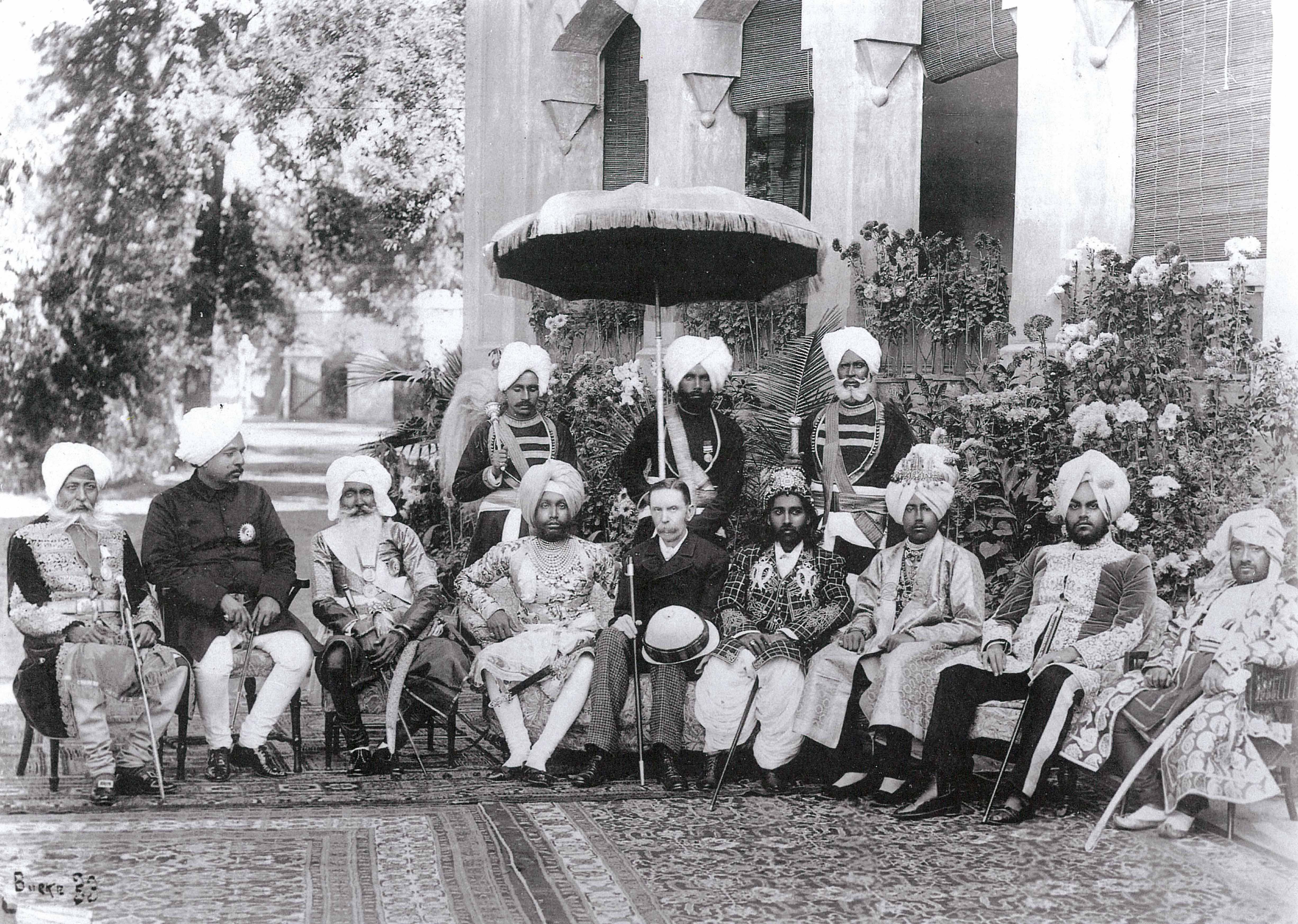
After the Indian Mutiny, the Governors-General
became known as Viceroys, to mark the transfer of power
from the East India Company to the Crown. They had won
a new grandeur; but they lost their near absolute power. By
then steamships were in use and the overseas
route to India was in full operation.
Passengers and mail went by steamship
to Alexandria and then up the Nile to
Cairo and across the desert to Suez in
closed vans, very bumpy and uncomfortable;
at Suez they embarked in a new
ship and might be in Calcutta within about
two months of leaving London. The time
for the journey was halved again when
the Suez Canal was opened in 1869. In
1870, the Red Sea submarine cable
brought the Viceroy so close to London
that he could no longer ignore even
temporarily the views of the government
in Britain. Parliament periodically reviewed
Indian affairs, always reducing a
little the independence of the Indian
government and asserting a little more
clearly their own control. But legal control
would have been no use without
physical means of asserting Parliament's
will, and the physical steps followed the
legal; step by step, distance was reduced
and control became more of a reality.
After the Mutiny, four Viceroys in succession
- Lawrence, Mayo, Northbrook
and Lytton - found their talents challenged
in particular by the problem of the
North-West Froritier. The first two were
able to operate successfully within the
limits imposed by their position, largely
because the parties in Britain did not
differ in principle. But the policies of the
parties diverged increasingly and changes
in government in England forced the
second two to resign.
Sir John Lawrence, who resolutely
refused to perform the ornamental functions
of Viceroy, was an excellent administrator,
in the same tradition as Dalhousie.
Blunt, truthful, honest, as exacting to
his subordinates as to himself, but a loyal
supporter of those who accepted his own
gospel of unremitting work, he was a commanding
rather than an endearing figure.
In foreign policy, Lawrence had always
been a "close frontier" man, believing
that to entangle ourselves in Afghanistan
would be likely to prove as calamitous
as it had been in Auckland's time. As to
the Russians, he agreed with much military Opinion that, if they should ever
attack India, it would be far better to
let them first waste their strength on the
difficult advance through the mountains.
Let the Russians, not the British, operate
a long line of communications through
tribes who counted their wealth in rifles
and looked on killing as the proper duty
of man! But this view was not universal
in India, still less in England, where there
was an anxious obsession with the Russian
advance in Asia. While the British
had advanced 1,500 miles, from Madras to
Peshawar, the Russians had moved 2,000
miles to the frontiers of Afghanistan.
A Russian advance through a hostile
Afghanistan was one thing; it would be
quite another if the Russians had such
influence in Afghanistan that they could
build up a base in Kabul and advance
on India from that.
Lawrence's policy was described, first
in mockery by his opponents, later in
praise by his friends, as one of "masterly
inactivity." His successor, Lord Mayo,
was more positive; he met the Amir, Sher
Ali, at Amballa and explained his policy. The days of annexation were past; we had
no such ambitions. But we did want a
strong Afghanistan with a stable ruler,
friendly to us and independent of Russia
- and therefore we would help the Amir
when he was in need, with money, arms,
perhaps even men. And we would use
diplomatic pressure to make Russia
respect Afghan territory. This policy was
broadly acceptable to both the British
parties: Mayo had been appointed by
Disraeli but served under Gladstone. But
his successor, Lord Northbrook, was
Gladstone's man, and his emphasis as
Viceroy was on peace, on sound administration,
on keeping expenditure below
income, preventing famine, lowering
taxes, at all of which he was quietly
successful. In 1873, the Amir, Sher Ali,
alarmed by a Russian move forward,
begged Northbrook for a closer alliance.
Northbrook, harking back to the policy
of masterly inactivity, refused. Sher Ali
therefore felt he could not afford to rebuff
Russia so firmly as before.
Meanwhile, in Europe, Disraeli was in
power and a Russian move towards the Balkans had almost led to war. The British
government felt that Russia should be
checked in Asia and proposed to move
troops up to the Afghan frontier and
demand from Sher Ali the presence of
British agents at Kandahar and Herat as
well as Kabul. Northbrook disliked imperial
chess; he demurred, remembering
his own refusal of a closer alliance and
knowing that Sher Ali would regard this
as highly provocative. The Afghans had
not forgotten Auckland's war and believed
that a British Resident at Kabul would
be an interference in their affairs and the
prelude to annexation. There was thils a
major difference of view between the
Viceroy and the home government, and
soon another arose. Northbrook's government,
in the interests of Indian trade, had Disraeli's government, in the interests of
Lancashire, demanded that they should
be taken off. Northbrook resigned..
Lord Lytton, a professional diplomat,
took his place in 1876. He entered enthusiastically
into Disraeli's views, but,
as Northbrook had foreseen, Sher Ali
could not accept a British Resident at
Kabul and retain the confidence of his
people. The Second Afghan War followed;
Sher Ali died, his son made peace on
British terms and a Resident was sent to
Kabul. But there was a popular rising and
the Resident was murdered with his
escort within six weeks of his arrival.
Once again the British found themselves
supporting an Amir whose people rejected
him as a puppet; once again, they had to bring him to India and keep him as a
pensioned exile. The aggressive policy of
Disraeli and Lytton had failed .
Disraeli went out of office in 1880, and
so sharp had been parliamentary criticism
of his Afghan policy, and Lytton's
execution of it, that Lytton had no alternative
but to resign too. Thus two Viceroys
in succession had demonstrated how
close the connection with the government
in Britain had become.
Lord Ripon, who succeeded Lytton,
was fortunate to find an Afghan chief,
Abdur Rahman, who was strong enough
to establish himself at Kabul and unite
his country once more. He kept it peaceful
for 20 years, with a subsidy from the
British but no Resident at Kabul and no
"peaceful penetration" by such means as
roads or telegraphs. In the Second Afghan
War, as in the First, the Afghans had in
the end got their way.
Ripon was a Liberal of Gladstone's
school and his administration marked the
beginning of a cautious advance towards
a more democratic system of government,
chiefly in the realm of local government.
But he suffered one serious set-back, which
underlined another limitation on the
Viceroy's power, a force that was steadily
to decline but could not wholly be ignored.
This was the opinion of Europeans, particularly
of businessmen in Calcutta. In
most of India, a sessions judge of Indian
birth was debarred from trying a European;
Ripon and his advisers regarded
this as unjust and humiliating and proposed
in a measure known as the Ilbert
Bill to abolish the distinction. There was
an outraged howl from the Calcutta
Press, which received some covert support
from the services. Ripon eventually
gave in to this clamour and modified the
bill, providing that a European could
claim trial by a jury, of whom half must
be Europeans. But this made a new distinction
on grounds of race and emphasized
the fact that Indians were not tried
by jury, but by a sessions judge, helped
by assessors whose views he could disregard
if he wished.
Nonetheless, Ripon's Viceroyalty, from
1880 to 1884, indicated to Indians that
there was a belief in Britain that free
institutions must in the end be applied
to India and it led to the formation in
1885, with some British support, of the Indian National Congress. Thus it was
the beginning of national awakening and
the effort for independence.
There had been sharp contrast between
Northbrook and Lytton, between Lytton
and Ripon. But it had been due to differences
in policy in London and underlined
the Viceroy's position as agent of the
British Cabinet. Now came a period in
which differences between the parties in
Britain were, at any rate on Indian
affairs, less acute. The terms of the three
Viceroys who led up to Lord Curzon were
correspondingly placid. Indian nationalism
grew fast; year by year Indians
became more ready to take for themselves
the kind of steps which the school
of Dalhousie had wished to thrust upon
them. There was a minor constitutional
advance; skirmishes took place on the
frontier; Upper Burma was annexed. But
in retrospect it was an uneventful period.
The great machine pounded smoothly
on its well-oiled way. Messengers brought
piles of locked boxes to Viceregal Lodge and toiled back with them to the Secretariat
next day ; the Viceregal court
observed its own peculiar protocol.
Visitors to Simla, if they belonged to the
official hierarchy or if, although outside
it, they considered themselves sufficiently
important, hired a rickshaw or rode on a
horse to Viceregal Lodge; here at the
gatehouse, under the eyes of magnificent
scarlet-coated sentries and messengers,
they wrote their names in His Excellency's
book and left cards for His Excellency's
staff ~ virtually a request for
Viceregal hospitality.
The Viceregal staff sorted the applicants
into those deserving invitations to lunch,
to dinner, to a ball or to a garden-party,
and in due course the invitations went
out. The guests would be greeted by aides-de-
camp and eventually marshalled for
His Excellency's entry. Each would be
introduced by the Aide-de-Camp in Waiting
and would bow or curtsy; then each
male would lead in his appointed partner
to his appointed place. There he would sit, scrupulously dividing his smiles and
conversation between his two neighbours
until it was time to move to sofas. Now
the most important lady who .had not
sat next to the Viceroy at dinner would
be led up to his sofa for five minutes' conversation,
after which she would be led
away and another would take her place.
And this would go on till His Excellency
escaped to his office boxes or to bed.
The Viceroy had also to show India
that he really existed and at the same
time convince himself of the reality of
the land he ruled. When he went on tour
- and this normally took up a good deal
of a Viceroy's year - he was still pursued
by files, though not in such overwhelming
bulk. The Viceregal saloons would in
these latter days carry him and his staff
swiftly and comfortably across India but
at his destination there would still be the
ceremonial receptions; there would be
experimental farms to inspect, universities
and hospitals and exhibitions to
open ; his host would also have arranged tiger-shoots, polo matches and displays
of tent-pegging. The Viceroy had to show
himself at the racecourse if he went to
a provincial capital; he must appear in
public at parades and in processions if he
went to visit an Indian prince.
Every Head of State must perform
some of these decorative functions, but
few give so much of their time as the Viceroy
was expected to give and few Heads
of State are also Prime Minister and
Minister for Foreign Affairs. It seems
possible that from the time of, say, Lord
Ripon onwards, the immense effort involved
in this exercise in public relations
was directed to the wrong audience. It
was directed to English officials, to the
businessmen of Calcutta, to the Army,
to the princes of India - but not noticeably
to the new Indian middle classes and
the products of the new universities, who
were the people of the future .
In 1899, India received the most regal of modern Viceroys, Lord Curzon. He
saw himself as the supreme embodiment
of imperial authority ; he was, like Dalhousie,
determined to reform India from
the top. His remarkable story will be told
in issue 60 of this history. But neither he,
nor the last nine Viceroys who followed
him, ending in 1948 with Lord Mountbatten,
could escape the hard reality that
by the 20th Century the Viceroy had
become virtually an extension into Asia
of the British Cabinet rather than an
absolute monarch. The Viceroy could
hardly help sharing London's insensitivity
to Indian opinion. And in fact for this
reason, it can be argued that the inactive
Viceroys were the most successful. In the
Indian system the best District Officer
was the man who was idle but alert, ready
to let his subordinates do their own work
so long as they told him what they were
doing and kept to his general line. The
Viceroy was a District Officer writ large was the same thing perhaps true of him?
|
|
British India at the turn of the Twentieth Century
|
|
It was George Curzon whose controversial viceroyship straddled the nineteenth and twentieth centuries. While Indians were taxed by the British to support the Raj, a generous 40% of these taxes were spent on the police and army. This figure contrasted with only 10% devoted to welfare, utilities, health and education. Such spending on security was perhaps necessitated by evident discontent amongst Britain's subjects. In 1871 Viceroy Mayo had been murdered by a Muslim Indian. In 1897 the Plague Commissioner, Rand, was murdered by a Hindu Brahmin. The same year brought a boycott of British institutions in Bombay, the murder of its soldiers there and the destruction of a hospital. Three years later Cawnpore suffered similar damage and deaths. Anti-British outlets were particularly evident in Bengal, north eastern India, with the formation of the Indian Association of Calcutta and revolutionary newspapers (such as Yugantar and Bangabasi).
In an attempt to stifle Bengali nationalist fervour, Viceroy Curzon partitioned the province to create a Bengali minority in (new) Bengal and a Muslim majority East Bengal. Curzon's measures to counter discontent failed. Instead, in 1906, the All India Muslim League (AIML) was formed and, more seriously, terrorist cells (samiti) were established to undermine British rule; the District Magistrate of Dacca, B.C. Allen, was murdered in 1907 and, in 1909, Sir William Wyllie of the India Office was shot dead on a London street. Bal Tilak came to form the New Party in response to the Bengal Partition; in doing so, he created a radical nationalist wing within the Indian National Congress. This Congress was an elite political forum (established in 1885) which was designed to influence, and even cooperate with, British rule. Instead, Tilak and his followers picketed government offices and boycotted British goods.
The British made some concession to Indian concerns: not only was Bengal re-united (in 1911) but 1909's Indian Councils Act allowed for the election of Indians to various law-making councils. To protect India's minorities, however, a system of reserved council seats and a separate Muslim electorate was established. In this way, the Act allotted seats to Indian Muslims on both municipal and district boards. Such a concession to India's Muslim leadership (i.e. AIML) was to be repeated in later Anglo-Indian relations. Arguably, the idea of 'separateness' exemplified a British tactic of divide and rule: it certainly promoted communalism and undermined any unified Hindu-Muslim sense of Indian nationhood.
Whether the British Raj was based on concession or repression, it would be fair to say that any Indian organization or leadership to topple British government was lacking at the turn of the Twentieth Century. Interestingly, in order to reduce the risk of a repeat mutiny, Indian soldiers were used across the wider empire: in 1882 for example, 7,000 were used to help suppress Arabi Pasha's Revolt in Egypt. The outbreak of World War I, however, was to further stretch Indian involvement and to shake the very foundations of imperialism.
|
|
India and World War One
|
|
The assassination of Austrian Archduke Ferdinand in Sarajevo would not appear to obviously impact on India. However, a system of alliances ensured that all European powers were engaged in conflict by August 1914. Consequently, Britain called upon its colonies to wage war against the Axis Powers.
It is interesting to note that the Austrian heir had been shot by Serb nationalists as an expression of resentment towards - and to throw off - imperial rule. Ironically, Britain asserted its own such rule and declared war on India's behalf! Some one and a half million Indians were thus brought into conflict - as both soldiers and supporting non-combatants. Such mobilization cost India #146 million.
In the main, India's military efforts were concentrated in the Middle East fighting the Ottoman Turks. This proved problematic on two counts: first, the Indian Army's needs were not a priority for Britain and, secondly, there was discontent amongst Indian Muslims taking up arms against the Ottoman Sultan since he also served as the Sunni Islamic leader (i.e. Caliph). With Britain focussing on war against Germany, Indian troops were left short of supplies and support; indeed, only one motorized ambulance served the Indian Army during 1914's Mesopotamia Campaign. Further to this, no nursing aid was available there until 1916 and this, no doubt, helped ensure a severe cholera outbreak which served to both reduce manpower and morale which, in turn, perhaps led to the Indian Army's ultimate defeat at Kut. Besides Mesopotamia, Indians also saw action in East Africa, Palestine and on the Western Front; over 60,000 died in support of Britain's war.
Economic Effects of the War
Britain's dependence on India continued beyond the war. Besides the cost of mobilizing its manpower (which was kept on in the Middle East), India's government took on #100 million of Britain's war debts. The tax burden imposed on Indians increased notably while war-time inflation meant food costs rose 40% and war needs ensured shortages of basic commodities (such as kerosene) for Indians. Some of the raw materials and goods sold by India during the conflict were no longer required; such reduction in exports brought recession and unemployment to the Raj. India was also hit by the post-war influenza epidemic. The epidemic killed 13 million on the sub-continent.
Interestingly, the demands of war helped to quicken India's industrial growth and helped develop new trade links with both the USA and Japan. In these ways, Anglo-Indian interdependency had been somewhat diluted.
A certain lawyer and campaigner, Mohandas Gandhi, returned to India from South Africa in 1915. He was to become Congress leader and a pivotal figure in Anglo-Indian relations. He reflected on India's war effort thus: 'The liberty-loving English will surely yield when they have seen that we have laid down our lives for them.' It was the belief of Gandhi and others that the British would hand over some measure of political control to Indians, perhaps even home rule. Such an expectation was furthered by Edwin Montagu, Secretary of State for India.
In 1917, Montagu recommended Indian involvement in government administration as well as: 'The gradual development of self-governing institutions, with a view to the progressive realization of responsible government in India.' This Montagu Declaration was compounded by the India Secretary and Viceroy Chelmsford conducting a tour of India to elicit local opinion and, in 1918, Montagu and Chelmsford produced a report suggesting reform of Indian government.
Indian anticipation of freedom from British rule was derived from the outcome of the war too. The war drove revolutionary events in Russia in 1917 and marked the end of tsarist rule. It served as an example for Indians seeking freedom from the Raj. The Bolsheviks had seemingly illustrated how the downtrodden and disenfranchised could remove and replace an imperial dynasty. Further example and encouragement were lent by the collapse of the Ottoman and Austro-Hungarian empires at the end of the war. Germany also lost its overseas colonies as part of the post-war peace settlement. Arguably, a new international order appeared to have been ushered in evidenced by the formation of the League of Nations. The creation of new nation-states across Eastern Europe and US President Wilson's Fourteen Points - urging self-government to ensure world peace - further raised Indian nationalist ambitions and expectations.
Amongst those with such aspirations were returning soldiers. While Indian combatants had enjoyed some measure of equality and camaraderie with British troops, their efforts and sacrifice stood for nothing as, again, they were treated like second class citizens in their own country.
Interestingly, not all Indians were not able to return home following the war's end in November 1918. Instead, soldiers were kept on in Mesopotamia to resist rebels, some remained on duty in the new British Mandate of Palestine while others were used in conflict against Russian Bolsheviks and against Afghans on India's northern borders. If extended service and further casualties stirred anti-British sentiment, discontent within the Indian Army had already been evident during the war itself. The Sikh Revolt (Ghadr) movement infiltrated Punjabi garrisons who turned on the British authorities over the winter of 1914-15. There were two Baluchi troop mutinies over the same period and the Indian Light Infantry also mutinied on Singapore, in 1915, murdering several officers and Britons. Murmurings of Muslim Indian discontent were evident over fighting their Ottoman co-religionists - and against their Calpih, Sultan Mehmet.
Besides pulling India into a faraway war, the Raj government imposed the Defence of India Act in March 1915. It was designed to help the British control India whilst its forces were stretched across the Western Front and elsewhere. The Act allowed for the suspension of trial by jury in cases of political dissent and for the imprisonment of agitators. If anything, such measures made Indians more receptive to nationalism; by 1918 new Home Rule Leagues boasted over 60,000 active members. The ordinarily acquiescent Congress installed the radical Bal Tilak as its leader in 1917 and successfully petitioned for the right to tax British manufactured cotton imports (in order to better protect local textile producers). Moreover, in the Lucknow Pact, Congress forged agreement with AIML to pressure the British for constitutional change i.e. to open up government to Indian involvement.
Further pressure on the Raj came in the form of Islamist advances in Bengal and the Punjab but also in the southern Malabar region where Muslim separatists sought an independent enclave. The resulting conflict of October 1921 brought 2,400 deaths. Muslim resentment had also re-surfaced with the Khilafat Movement (1919-24) which sought to protect the Caliph and the Ottoman Empire in the face of the imposition of a considerable war indemnity and the confiscation of its colonies.
The Punjab had seen particularly serious war-time rioting and violence: it was not only an effect of inflation and food shortages, nor the sedition sown by Afghan incursions, but also because of its demographic mix of Muslim, Sikh and Hindu communities who tended towards mutual mistrust. Indeed, it was an uncommonly politicized region - serving as a base for both the Ghadr and Khilafat movements, but also as a target for post-war Communist propaganda from Bolshevik Russia. In 1920 the Communist Party of India was formed and soon established a section in the Punjab led by Ghulam Hussain.
World War I effectively raised Indian expectations for some form of political collaboration, if not self-government. The war also undermined goodwill towards the Raj: it gave rise to ideologies, organizations and individuals opposed to British rule. While there was a measure of post-war constitutional reform in India, the Raj was far from being dismantled. Instead, as the New York Times recognized: 'British imperialism would be compelled to evacuate Great Britain itself before it would willingly evacuate India' (Clair Price, 10th July 1921).
|
|
The Inter-War Years
|
|
Government of India Act 1919
For all India's war efforts and for all the findings of the Chelmsford-Montagu tour, the India Act of 1919 disappointed those anticipating, or intent on, self-government. In short, the act made the following changes:
It enlarged Provincial Councils which gained control of 'transferred' policy areas including agriculture, health and education
It enlarged the imperial legislature which was divided into a Legislative Assembly and a Council of States
It ensured the Assembly and Council were made up of both elected and nominated members (including princely states and minorities such as Christians, Muslims and Anglo-Indians)
It provided for a High Commissioner in London representing India
It provided for further constitutional reform i.e. the Act covered the period 1919-29
The India Act established a dual form of Anglo-Indian government known as 'dyarchy'. The Viceroy, however, could veto any proposed legislation and the nominated members of the legislature were a means to offset any Indian parties' growing influence. Further to this, the British kept firm control of 'reserved' policy areas such as defence, foreign affairs and communications. Congress was disappointed by the India Act. Rather than move the country towards self-government, the British had used constitutional reforms as a stalling process and maintained their rule. Arguably, the act could well demonstrate British rule as an iron fist within a velvet glove. Indeed, earlier in 1919, the iron fist had been brutally demonstrated.
The Amritsar Massacre
With troops scattered across World War I's conflict zones - particularly in ex-Ottoman territories - the British were vulnerable to disorder in India. To protect the Raj, anti-terrorist laws were introduced. Despite unilateral Indian opposition, the Rowlatt Act passed through the (as yet unreformed) imperial legislature in March 1919. The act enabled the government to arrest and imprison troublemakers without trial. It marked something of a turning point in the history of the Raj - not least by lending impetus to Gandhi's campaigning.
Given the overseas absence of Tilak, Gandhi inherited the leadership of Congress and instigated protest against the new legislation. On 6th April, Gandhi called for a hartal - a day of prayer, fasting and no work - in effect a general strike. It proved to be the first nationwide protest since 1857's Mutiny. The hartals in the Punjab, however, were accompanied by violence. When two leading protest figures were arrested in the Sikh holy city of Amritsar, mass rioting followed and five Britons were killed.
General Reginald Dyer was sent to Amritsar on 11th April, by Punjab Governor Michael O'Dwyer, as the city had fallen into anarchy. General Dyer believed Amritsar had to be recovered, not least for the message it would send other riot afflicted Punjabi cities (such as Lahore) and, indeed, all India. A curfew was imposed on Amritsar i.e. all processions and political meetings were outlawed. The 13th April marked the Sikh festival of Baisakhi and 15,000 gathered for a rally in the enclosed gardens (Jallianwala Bagh) adjacent to the Golden Temple.
Despite breaking the conditions of curfew, the gathering was peaceful. Dyer, however, decided to send in troops. Over 1,600 rounds were fired on the crowd killing 379, including women and children, and injuring 1,200. He followed the shooting with the flogging of high caste Indians suspected of agitation. Dyer believed his decision at Amritsar restored authority in the Punjab and even saved the Raj.
The Non-Cooperation Movement 1920-22
Dyer's actions showed a degree of desperation to British rule and, more so, evidence of barbarism. While Dyer was eventually forced to resign, he was not prosecuted and his sympathisers in Britain raised a generous cash gift for him. Arguably, the Amritsar Massacre indicated Britain's loss of moral authority. Gandhi was quick to move against such unjust government and, in 1920, launched a non-cooperation campaign. At the core of his campaign was non-violence or satyagraha which involved boycotting British goods and institutions (such as schools and courts).
Such pacific methods ensured Indians maintained moral authority over the British. Gandhi deliberately sought to unite the nation by adopting minority or marginal groups' causes: he did so by calling a Khilafat Day hartal, by promoting women's and Untouchables' rights and (earlier) by lending support to impoverished indigo farmers. As a consequence of both the non-cooperation campaign and Gandhi's inclusivity, Congress membership grew 20-fold (to 2 million members) over 1920-21. Indeed, Congress opened a hundred additional district branches and had now become a mass movement against British rule.
The non-cooperation protest reached new levels when the Prince of Wales embarked on a royal tour of India. Gandhi called for a hartal to greet the Prince's Bombay arrival on 17th November 1921; it developed into something more than a strike however. Violence erupted across the city with extensive looting and the killing of three Indian constables.
A hartal was similarly organized to meet the royal tour at Madras on 13th January 1922; again, it turned riotous despite Gandhi's consistent calls for protest to remain non-violent. Only a month later Gandhi felt forced to call off the non-cooperation movement. He did so in response to events at Chauri Chaura. An anti-British demonstration in the town led to a clash with local police who opened fire on the crowd. On running out of ammunition, they took shelter in the police station which a mob promptly set on fire. Twenty-two Indian policemen were killed.
Gandhi not only called off national campaigning but also declared Indians unready for self-rule. He continued to promote the boycott of British goods and a focus on self-sufficiency known as swadesh. Ironically, it was at this point that Gandhi was imprisoned for two years by the government. Other Congress figures believed the disorder and violence that Gandhi despised could well have made India ungovernable and brought an end to the Raj. One such nationalist, Jawaharlal Nehru, believed that solely non-violent methods were insufficient and resented Gandhi's overly spiritual focus. Evidently, Gandhi had put moral concerns before simply seeing off the British.
1920s' Indian Disunity
Gandhi's political influence diminished not only as a result of his imprisonment but also by his later withdrawal to a Gujarat ashram. His disappearance combined with the failure of the non-cooperation campaign meant Congress membership slumped to 18,000 members by 1925. Even the boycott of all things British ceased. Civil servants maintained cooperation with the Raj and the recognized need for literacy and qualifications ensured government schools remained popular. More serious, however, was the loss of Gandhi as a force to unite Indians. Between 1923-27, the United Provinces (now Uttar Pradesh) experienced 88 inter-religious riots. Similar communal disorder in the North-West Frontier Province led to the entire Hindu population of Kohat fleeing their hometown in 1924. Those seeking an independent and exclusively Hindu India formed militant nationalist organizations such as Rashtriya Swayamsevek Sangh (in 1925) and the Hindustan Socialist Republican Association (in 1928).
The most widespread opposition to British rule in the late 1920s, however, came in response to the underwhelming provision made for the review of India's constitution as set out by 1919's India Act. In short, the Conservative government appointed seven parliamentary members, led by Sir John Simon, to determine the sub-continent's political future.
The Simon Commission
The absence of any Indian from the Simon Commission provoked outrage. A nationwide hartal and the hanging of black flags marked the Commission's arrival in February 1928. Protests took place in every city the Commission visited. The most notable proved to be that in Lahore on 30th October. When key Congress figure Lala Lajpat Rai led a popular, silent, non-violent march, the police responded by beating protestors with sticks. Rai died from the injuries he sustained.
The findings of the Commission were published in May 1930. The report proposed representative government in the provinces - yet retaining central British control - and recommended a series of conferences to promote constitutional change. Inclusive discussion, with Indian representation, was further necessitated by serious opposition to the Raj in the form of 1930's Chittagong Uprising in Bengal and Gandhi's new call to action through his Salt March.
The Salt March
A 240 mile march to Dandi on the coast of the Arabian Sea announced Gandhi's return to political campaigning in April 1930. His purpose was to 'break the salt laws of this satanic government'. Salt was crucial to Indians as a means to both preserve and flavour food. The British taxed salt sales which provided some 3% of their revenue from India. As a means of protest and, crucially, to promote swadesh, Gandhi's march culminated in taking salt from the seashore. Thousands followed Gandhi's example. The most significant action was at the salt pans north of Bombay. Over 2,000 peaceful protestors marched towards the salt deposits only to be met by police aggression. While two protestors were killed and hundreds injured at the hands of the police, not one retaliated. The scene is sharply depicted in the 1982 film 'Gandhi'.
As many as 25,000 Indians, including Gandhi and Nehru, were imprisoned for their role in the salt campaign. The episode seemed only to confirm Britain's heavy handedness and loss of any moral right to govern India.
The Roundtable Conferences 1930-32
The Roundtable Conferences were a series of three, London based, meetings designed to facilitate constitutional reform in India. They were a follow-up to both 1919's India Act and the Simon Commission.
The first conference was opened by King George V, on 12th November 1930, and was chaired by Prime Minister Ramsay MacDonald. Despite such pomp, it was fatally flawed by the absence of any Congress members - a number of whom were in jail. An Indian political federation was both proposed and supported, while the spokesman for the Untouchables, B.R. Ambedkar, demanded a separate electorate to guarantee their representation at provincial level. The proposed federation of India would be made up of the 11 British provinces and the princely states. Importantly, Indians would be involved at all levels of government.
Viceroy Irwin released Gandhi from jail in January 1931 and promised Congress involvement at the second meeting in return for an end to civil disobedience. It was Gandhi, then, who attended the Second Roundtable Conference which opened on 7th September 1931. While Gandhi was Congress' sole representative, he asserted that it alone represented all India. He rejected the idea of separate electorates or political safeguards for Muslims and other minorities. He also resisted the idea that Untouchables constituted a 'minority', insisting they were part of the Hindu community. Consequently, and unsurprisingly, Indian agreement was not forthcoming.
The Third Roundtable Conference of late 1932 was poorly attended, short-lived and unproductive. As a collective, however, the conferences provided some background and details which were reflected in 1935's Government of India Act.
The Roundtable Conferences 1930-32
India's nationalists were dissatisfied with this further India Act since they gained neither independence nor dominion status. Nevertheless, the India Act was a step towards self-rule - however distant. Specifically, it brought the vote to 35 million Indians (based on wealth criteria) and it introduced an elected Indian Assembly, albeit without influence over defence or foreign policy. The Act enabled 11 provincial assemblies to have full control over local affairs. Two new provinces (Sind and the North-West Frontier) had been created by the Act, while Burma was permitted to separate from India. Indeed, the right to secede from India was established.
The Act also provided for both legislative and provincial elections which came to be held over the winter of 1936-37. Beforehand, the British attempted to weaken Congress by nurturing the Muslim League. They did this not only by having created the two Muslim-majority provinces of Sind and North-West Frontier but, further, by acceding to their Roundtable demand for separate communal electorates.
The Congress and League manifestos were strikingly similar. They differed, however, over electorates and over India's official language: Congress urged a unified constituency and Hindi language, while AIML stood for separate constituencies and Urdu. In terms of election results, Nehru led Congress to a double victory. Congress emerged as the single largest representative in the Legislative Assembly and Council of States, and secured 40% of the total available seats across the 11 provinces. Arguably, this was far from an overwhelming victory and undermined Gandhi's notion that Congress represented all India. However, Congress won five of the provincial elections outright and was able to form a coalition ministry in a further four provinces.
If Mohammed Ali Jinnah, leader of the Muslim League, never anticipated election victory, he had expected sufficient support to ensure AIML's role in provincial government coalitions and ministries. Instead, the elections provided heavy defeat: AIML secured only 106 of 491 reserved Muslim seats. Even in the Muslim dominated Punjab, it was Fazlul Hassan's Unionist Party that secured victory and formed provincial government.
While Jinnah had proposed forming coalition with Congress in provinces without an overall majority, Congress rejected the League's offer. This proved a turning point in Indian politics and, indeed, the very future of the sub-continent. The rejection of AIML (combined with Congress favouritism towards Hindus in provincial ministries) meant the League came to pursue a separatist agenda. The scale of Congress' victory confirmed that Muslims would only ever constitute a minority group in a united India.
Pakistan Resolution
Ironically, electoral defeat served to strengthen AIML: different Muslim communities and organizations now feared Hindu dominance. Not only did Muslims turn away from Congress but Islamic scholars and moderate Punjabi Unionists alike gathered behind AIML and the leadership of Jinnah.
Arguably, the most significant result of India's provincial elections came at Lahore in 1940 when the Muslim League Conference passed the Pakistan Resolution. AIML, then, was now committed to breaking away from India to form an independent Muslim majority homeland i.e. Pakistan. The name 'Pakistan' was derived the northern provinces which AIML proposed should form the new state - the Punjab, Afghan Frontier (i.e. North-West Frontier), Kashmir, Sind and Baluchistan. The League now had a radically different manifesto to Congress. While Gandhi, in particular, opposed such separatism, outright hostility came from Master Tara Singh, a Punjabi Sikh leader, who portentously declared: 'If the Muslim League wants to establish Pakistan, they will have to pass through an ocean of Sikh blood.'
|
|
World War II
|
|
As an interesting footnote to India's elections, Congress now controlled provincial taxes. In this way, India's economic value to Britain diminished. However, with September 1939's outbreak of World War II, the Raj was to show its worth once again.
As in 1914, the Viceroy (Lord Linlithgow) declared war on India's behalf. In response, Congress issued a demand for complete independence. The best Linlithgow could propose was dominion status at some unspecified point and Indian representation on the Viceroy's Executive Council. Congress leaders refused to cooperate with the government; instead, they rejected any involvement in the war effort. Indeed, Gandhi's recommendation to Britain, facing the Nazi threat, was to: 'Allow yourself, man, woman and child, to be slaughtered, but you will refuse to owe allegiance to them' (Cited in The Times, 4th July, 1940).
On 10th November 1939, Congress representatives and ministers duly resigned across the provinces as a mark of non-cooperation. Jinnah swiftly declared a Deliverance Day in response to the resignations, i.e. India's Muslims were now freed from supposed Congress injustice. Jinnah and the League supported the government in the meantime. Arguably, such cooperation showed how Britain benefited from its bolstering of minority groups in India. On the other hand, Jinnah's approach ensured AIML came to be regarded as the natural successor to Britain to govern the Muslim majority, northern, provinces. It is no coincidence that the Pakistan Resolution quickly followed since it served as a form of pressure on, and potential solution for, the Raj. Indeed, a separate Pakistan was not far off Britain's earlier proposal for an Indian federation at the Roundtable Conferences.
The turn of 1942 brought Britain defeat at the hands of the Japanese, most notably on the key strategic island of Singapore. Prime Minister Churchill sought broad Indian backing for the war and dispatched Sir Stafford Cripps, MP, to India to gain the main parties' support. In return, Britain would give India post-war dominion status and, crucially, the right of provinces to secede from India.
Congress rejected Cripps' offer - not only because of its overt concessions to the princely states, but largely because it sanctioned the break-up of India.
Quit India Campaign
Having failed to secure suitable concessions from Britain and having withdrawn from provincial government, Congress was losing influence. In order to assert itself, Congress launched the Quit India campaign in August 1942. Despite a flurry of hartals and riots, both the Indian police and army stood firm against the rebellion. If anything, the campaign back-fired as hundreds of Congress leaders - including Gandhi and Nehru - were imprisoned and the party became utterly marginalized for the remainder of the war.
Another nationalist figure, however, S.C. Bose (or 'Netaji') was prepared to take a more direct approach to remove British rule. In 1943, Bose arrived in Tokyo in order to organize an Indian militia to fight alongside the Japanese. The Indian National Army (INA) was raised from Indian prisoners of war and was sent into combat against British forces in Burma. By and large, INA recruits lacked loyalty to the cause. They deserted in their hundreds and were defeated at the Battle of Imphal (June 1944) which effectively halted Japan's advances in Asia and proved significant in the war's eventual outcome.
India's War Contribution
Ultimately, two million Indians served in British armed forces across Asia, Africa and Europe. Besides halting Japan, Indians were particularly prominent in the liberation of Italy; indeed, 6,000 died in doing so. Overall, 87,000 Indians were killed over the course of the Second World War. Besides such sacrifice, India contributed considerable funds and resources towards the war effort. The control of grain prices and supplies (to feed troops) led to a further, and unacceptable, cost. As domestic rice supplies faltered and prices rose, as many as two million Bengalis perished in the subsequent famine.
British rule undoubtedly came at a high price for India. Again, the war raised Indian expectations but then so did recent promises of self-rule and secession. Similarly, Britain's victory in both the European and Asian theatres of war, in 1945, came at a devastating cost: it was bankrupt and utterly dependent on American loans. Further to this, Britain owed #1250 million to its largest creditor - India!
|
|
The Post-War Period
|
|
Britain's moral, economic and military grip on India had been loosened by the effects of the Second World War. Further to this, a psychological shift was evident in Britain. Winston Churchill, the celebrated war leader, and his Conservative Party were rejected in 1945's elections; instead, Clement Attlee headed a Labour government which the public had handed a clear parliamentary majority.
If anything, the war years had concentrated Britain's attention and spending overseas. The margin of Labour victory indicated how the public wanted to focus on domestic concerns. In this way, Attlee's government established the National Health Service and set about erecting council housing - not least as a means to re-build towns affected by war-time bombing. There was little appetite for further military spending or sacrifice on foreign shores: indeed, reducing the risk of both appeared the key to Britain's approach to India.
If victory against Japan and the wider Axis Powers was welcomed in India, it wasn't long before dissent at British rule re-emerged. Early 1946 brought a general strike across Bombay and mutiny amongst both the Indian police and navy. Oddly, Congress refused to encourage such disorder. Congress was fearful of anarchy jeopardizing its inheritance of government in India. To such an end, the Labour government decided to gauge the political situation in India by calling for elections across the provinces and legislature.
The election results confirmed Congress' strength yet AIML gained support and could now claim to represent the majority of Muslim opinion.
Attlee then sent a Cabinet Mission, in April 1946, to fathom India's future. Congress and the League failed to agree on the make-up of a proposed central government and on the very nature of an independent India: AIML sought separation whereas Congress sought a united country. Indeed, the newly appointed Congress President, Jawaharlal Nehru, reported to the Cabinet Mission that a Congress-led India would never permit a breakaway Pakistan. Jinnah was incensed and declared a Direct Action Day for 16th August 1946. In effect, he presented Congress with a choice: chaos or partition. The subsequent rioting and violence brought 5,000 deaths in Calcutta alone. In response, the Hindus of Bihar set upon the local minority Muslim community.
Post-war demobilization meant the British had insufficient manpower to contain such communal violence. By the end of 1946, the British had little over 10,000 troops across the entire Raj. This suggested both an unwillingness and inability to control India. Indeed, AIML had now boycotted its elected roles and, in February 1947, Louis Mountbatten replaced Lord Wavell as Viceroy. Mountbatten had a mandate to hand power over to the Indians by June 1948.
Mountbatten quickly recognized that securing all party agreement (let alone compromise) on the future of India was impossible. The Viceroy recognized that without acceding to AIML's demands for Pakistan, India would fall into a prolonged civil war. Indeed, in the spring of 1947, communal violence had already erupted in the Punjab and North-West Frontier Province. While the Muslim League directed a civil disobedience campaign against Congress at a provincial level, militant Sikhs demanded direct action against the League.
Mountbatten had no wish to preside over the violence and anarchy that had come to characterize much of post-war India. Further to this, both he and Nehru recognized that new claims for secession were emerging. Not only had Punjabi Sikhs made claims for a separate Khalistan but demands for an independent Nagastan, Pathanastan and Bengal were soon raised by other ethnic communities.
If Britain had neither the will nor manpower to avert civil war, then Congress had no desire to inherit an ever disintegrating India. Time, then, was of the essence. Nehru was prepared to accept the formation of Pakistan in the north-western and north-eastern corners of the country while, on 3rd June, Mountbatten brought forward British withdrawal to 15th August 1947.
Partition and Independence
By bringing forward the date of independence and partition by some ten months, the British now had the task of mapping out the new states of India and Pakistan. A Boundary Commission was established under the chairmanship of Cyril Radcliffe, a senior British civil servant. Its task was to separate Pakistan from India and to define the two states' borders. The Commission had five weeks to do so. The public perception was that areas with a distinct Muslim or Hindu-Sikh majority would fall into either an independent Pakistan or India; consequently, homes were abandoned as communities sought to escape the arson and violence that was used to encourage specific communal dominance in areas of the Punjab. Ironically, Britain's military withdrawal from India continued and neither Congress nor AIML would sanction the use of British troops to control civil unrest.
With such distractions over partition, Viceroy Mountbatten belatedly convened a conference with the rulers of India's princely states in July 1947. They were informed that they would have to opt into either India or Pakistan - whichever they were closer to geographically. The princes regarded this as imposed, rushed and unfair. Indeed, prior negotiations had suggested the right to secession and self-rule. Nevertheless, the princely states mostly joined India (including Kashmir, ruled by a Hindu maharajah, yet a largely Muslim province).
Ultimately, the Boundary Commission established a Pakistan made up of the provinces of Baluchistan, North West Frontier, Sind, West Punjab and East Bengal. The latter was some 1,000 miles from the rest of Pakistan and effectively became East Pakistan.
Pakistan was rather impractically divided but it also appeared to have come off second best in terms of land distribution and frontier lines. In truth, Mountbatten (and Nehru) believed Pakistan was unsustainable and likely to have to be reabsorbed into India before long.
Independence was declared in Pakistan on 14th August 1947. As Jinnah became Pakistan's Governor-General, so Nehru led India to independence on the following day. While Karachi and Delhi celebrated, the Punjab and other areas fell into further appalling violence. Partition had left 5 million Hindus in Pakistan and a greater number of Muslims in India. Estimates suggest that 10 million fled their homes to find sanctuary on the other side of the new border. One million of these refugees lost their lives as a result of the accompanying communal violence.
If the birth of independent India and Pakistan was met by a bloody baptism, it reflected both the desperation and division that British rule had contrived. Not only had viable ruling factions emerged in the early Twentieth Century but widespread, organized opposition to foreign domination had been evident since 1920's non-cooperation campaign. Arguably, if such momentum had been maintained, and Gandhi had relented in terms of non-violence, the British may have been forced to leave sooner.
The conditions that ensured Britain's withdrawal after 1945 were similarly evident following World War I. Not only was Britain economically and militarily exhausted, the public had become weary of conflict. Interestingly, the fear of Suffragette campaigning was enough to extend the vote to British women in 1918. Arguably, it was no greater step to enfranchise Indians too; indeed, had they not made equal war-time sacrifice to Britain's women?
The international climate further suggested Indian home rule was credible: not only had European empires dramatically collapsed, the Treaty of Versailles and its peace treaties strongly promoted the idea of national self-government. Britain was stretched by new League of Nations' mandate roles in the Middle East yet also needed to recover trade competitiveness and contend with domestic industrial disputes.
Ultimately, Raj rule was brutally re-asserted at Amritsar. The massacre only served to delay the inevitable as it politicized the Indian public and turned nationalist opposition into a mass movement. The British effectively deployed two tactics to maintain rule for a further generation i.e. a series of concessionary bluffs and by dividing Indian nationalism. The India Act of 1919 and its re-visitation by the Simon Commission were followed by the Roundtable Conferences which gave way to 1935's India Act. The government then hesitated before calling provincial elections. The slow drip of constitutional reform lent optimism to India's politicians yet brought them no closer to outright independence. In the meantime, Britain had successfully undermined the nationalist challenge to its rule by dividing the Indians amongst themselves by promoting political safeguards for minorities such as the Untouchables and Muslims.
World War II left Britain economically, morally and militarily bankrupt. It was in no position to hang on to a sub-continent which, again, had been dragged into conflict. Further to this, India had been explicitly promised self-rule to ensure its commitment to the war effort. Viceroy Mountbatten was quick to recognize the danger inherent in denying independence any longer. In this way, Britain's withdrawal in August 1947 can be seen as a rather cowardly cost-saving exercise: no adequate policing or resource provision was made to soften either the tragic violence or refugee crisis that brought Pakistan and India to freedom.
Twentieth Century material provided by Dr Robert Carr. He is the author of a study guide on the History of 20th Century India that includes activities and tasks. It is available from: Waterstones
|
|
|
|