


Seated left: Honorary Captain Chagar Singh, Sardar Bahadur OBI, 1st Battalion (Prince of Wales’s Own) 17th Dogra Regiment. Formerly the 37th Dogras, which served in Mesopotamia in WW1. The 17th regiment was formed in December 1922 from the 37th, 38th and 41st Dogras, each of them comprising 8 companies of Dogras. This officer wears a scarlet tunic with yellow facings. His Order of British India was 1st Class.
Dogras, from the Punjab Hills and Jammu and Kashmir, were rated most valuable soldiers. They are Hindus of Rajput origin, traditional soldiers with a record of centuries of service, courageous and with great powers of physical endurance.
Seated centre: Major T N Watson MC, 5th King Edward’s Own Probyn’s Horse. The 5th was formed in 1922 from the 11th KEO Lancers (Probyn’s Horse) and the 12th Cavalry. Major Watson was an officer in the 12th Cavalry. He wears a blue kurta lavishly decorated with gold embroidery.
Trevor Newell Watson was commissioned in August 1906 and two years later was a lieutenant in the 12th Cavalry. He served in Mesopotamia in the war where he was awarded the Military Cross. By 1919 he was acting lieutenant-colonel but reached the substantive rank of Major in August 1921. As was customary, he was appointed a Member of the Royal Victorian Order (MVO) when he commanded the King’s Indian Orderly Officers in 1925. Major Watson transferred in 1927 to command the Governor’s Bodyguard Madras, retiring in 1931.
Seated right: Honorary Lieutenant Lakhi Ram MC, Bahadur OBI IDSM, 1st Royal Battalion 9th Jat Regiment. Formerly the 6th Jat Light Infantry which comprised 8 companies of Jats, stationed at Secunderabad before the war. They served in India, France, Egypt and Mesopotamia. Lakhi Ram was one of only two Indian officers (he was a Jemadar at the time) of the 6th Jat LI to be awarded the Military Cross for bravery in France. He wears a scarlet tunic with blue facings.
Standing left: Subadar-Major Narain Singh MBE, Indian Signals Corps. The Subadar-Major (a Hindu Dogra) wears a uniform tunic identical to the Royal Engineers; scarlet with dark blue facings and gold lace. There are silver embroidered bomb badges on his collar and embroidered crown rank badges on each plaited shoulder cord. He has a leather waist-belt and (almost invisible in this photo) a leather pouch-belt on his left shoulder.
In April 1920 an Indian Army Order ruled that all Signal units of the Sappers and Miners would become a Corps in their own right, with the designation Indian Signals Corps. But in Army Orders and in the Army Lists the signals units continued to be known as the Signal Service of the Sappers and Miners. In November 1922 another Order insisted that the new designation be applied. So, by 1925, this officer officially belonged to the Indian Signals Corps but was still wearing the dress uniform of the Sappers and Miners.
He has MBE after his name, and this Order shows in the photo as a cross in his row of medals. It was unusual for an Indian officer to be appointed a Member of the Order of the British Empire. The 1925 Birthday Honours lists recipients of this Order in India but Narain Singh’s name is not on it. There were no Indian recipients of the MBE prior to 1925.
Standing right: Risaldar-Major Lakhpat Singh, 20th Lancers. This regiment was the result of amalgamation in 1922 of the 14th Murray’s Jat Lancers and the 15th Lancers (Cureton’s Multanis). As Lakhpat Singh was a Hindu Jat it is safe to assume that he served in the 14th Lancers which was a Jat Class regiment while the 15th Lancers comprised four squadrons of Muslims (Multani Pashtuns and related tribes). Murray’s Jats, as they were known, served on the NW Frontier in 1915, but the following year went to Mesopotamia. This tall Risaldar-Major wears a splendid kurta which is blue with scarlet facings and elaborate gold braiding.
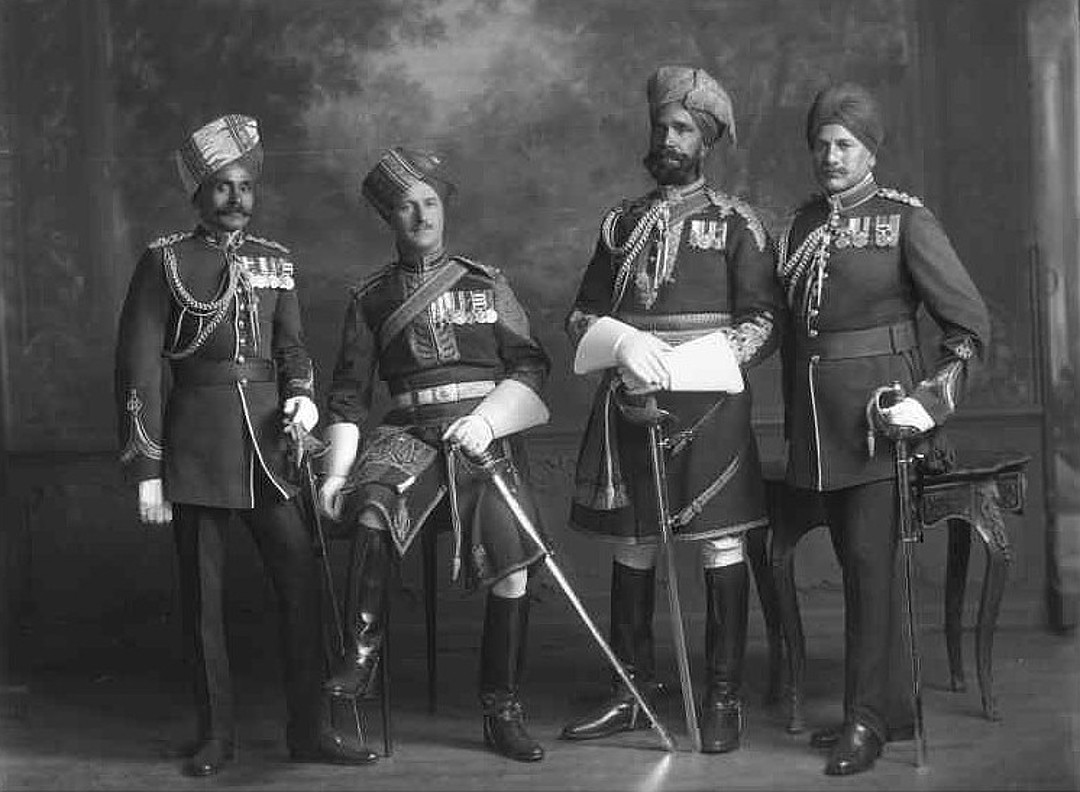
Photo at the Lafayette Studio
This photo was taken on 25 April 1925 at the Lafayette Studio, 160 New Bond Street, London. It shows four of the King’s Indian Orderly Officers who came to London in 1925. One of them is missing; Subadar-Major Narain Singh MBE, Indian Signals Corps. The four officers in the photo are, from left:
Honorary Lieutenant Lakhi Ram MC, Bahadur OBI IDSM, 1st Royal Battalion 9th Jat Regiment.
Major Trevor Newell Watson MC, 5th King Edward’s Own Probyn’s Horse.
Risaldar-Major Lakhpat Singh, 20th Lancers.
Honorary Captain Chagar Singh, Sardar Bahadur OBI, 17th Dogra Regiment.
The photo comes from the Lafayette website. However, the information they give is incorrect in that Risaldar-Major Lakhpat Singh was an officer in the 20th Lancers, not the 10th QVO Corps of Guides.