|
|
|
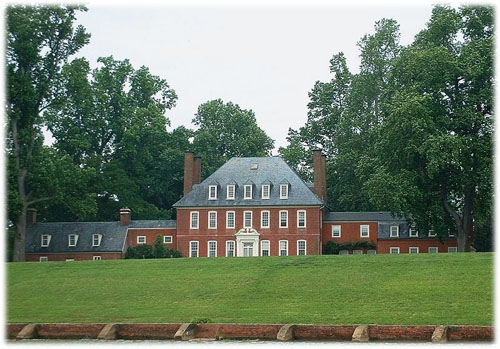
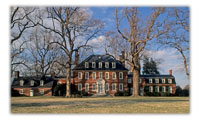
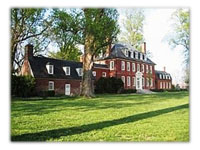
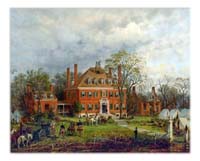
"The broad lawn that rolls down to the waters edge at Westover is shaded by
huge
trees - the yew planted by George Washington, the elms and sycamores, and the
line
of tulip poplars. They stand there before this great Georgian mansion which
has
withstood all the ravages caused by fire and wars ever since William Byrd II
built it
beside the James river 260 years ago". |
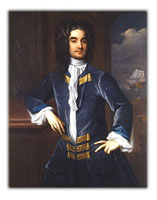
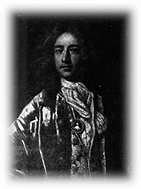
William was hardy and energetic and, like most Virginians of his time, often in the saddle. A great traveller, he was no ordinary pioneer: this was a man of culture, wide accomplishments and considerable charm, a genial host who had powerful friends on both sides of the Atlantic. He crossed that ocean ten times and "Golden Rose", the ship in which he often sailed, is in the background to Hans Hyssing's portrait of him. While William was growing up in Essex he lived with his uncle, Daniel Horsmanden, the Rector of Purleigh near Chelmsford where he met his maternal grandfather, the formidable Colonel Warham Horsmanden, who for twenty years had been a member of the ruling council in Virginia. William attended Felsted Grammar School near Braintree for nine years when Christopher Glasscock was its headmaster and then studied law at the Middle Temple. He was called to the Bar in 1695, served a short apprenticeship in Holland and visited the Court of Louis XIV. In London William was becoming known as a satirical writer and wit, and in 1696, through the good offices of his mentor Sir Robert Southwell, he was elected a Fellow of the Royal Society. His influence grew and he was appointed Virginia's colonial agent in London and was thus at the heart of the conflict between Crown and Colony that was eventually to spark into Revolution. No man had a better preparation for representing the old world in the new and vice versa.
William's nickname was the Black Swan, which is perhaps an allusion to birds that he introduced at Westover. He was a lover of books and gathered together in his new home one of the largest libraries in the colonies - over 3600 volumes - of which he was inordinately proud. It contained Bibles in Dutch, Hebrew, Greek and Latin all of which he could read - a mark of his scholarship. The east wing in which it was housed was burnt down during the American Civil War but subsequently rebuilt. He also brought over from England many portraits of his family, his friends and men who he admired.
His manuscripts are among the few early colonial literary works in existence. Best known is his 'History of the Dividing Line' (1728). Other manuscripts such as 'A Progress to the Mines' (1732) and 'A Journey to the Land of Eden ' (1733) were not published until 1841, nearly a century after his death, which is a good indication of their enduring quality. His cheerful entertaining discourse on Virginian life can be read in his diaries and copious correspondence much of which has survived. Among them are three less literary but more revealing "secret" diaries written in shorthand and discovered only sixty years ago. Together they cover nine years in the period 1709-41 and in America have been described as "one of the most complete, entertaining and informative cultural documents about 18th century life in the Old and New Worlds that we have in the English language". The middle diary has even been compared with Pepys' famous journal.
War returned again a century later when Westover was used as a headquarters during the American Civil War by General Pope and other Federal officers, and subsequently by McClellan on his retreat from Richmond. But by then the estate had passed out of the hands of the Byrd family who sold it in 1814. Westover today is still privately owned although the grounds are open to the public. Thus visitors can now enjoy something of the beauty of this famous old house with its riverside setting, and of the history of nearly three centuries that have passed since the Black Swan with all his energy, scholarship and wit flew in from England. |
Armed Forces | Art and Culture | Articles | Biographies | Colonies | Discussion | Glossary | Home | Library | Links | Map Room | Sources and Media | Science and Technology | Search | Student Zone | Timelines | TV & Film | Wargames