|
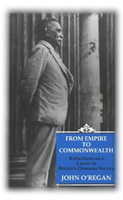
On the cover of my Memoir "From Empire To Commonwealth" is a photograph of
D. S. Senanayake proudly standing on the steps of the Parliament Building in
Colombo at the time of Ceylon's independence as the Dominion of Ceylon's first Prime
Minister. And what an appropriate image, for Ceylon had not only played a leading role
in the defeat of Japan, but under his leadership had set an example to the rest of the
Empire on the way to achieve independence by peaceful means and by encouraging
co-operation among all those concerned. This article, by one who was proud to be a
member of the Ceylon Civil Service during this period, is a short personal tribute to
Ceylon and the example it set; an example all the more poignant in view of the myriad troubles
besetting Sri Lanka subsequently.
In 1938, 3 years after joining the Ceylon Civil Service, the new Governor, Sir Andrew
Caldecott, appointed me his Private Secretary. For me what a fortunate appointment, for
he had been instructed by the Secretary of State to make recommendations for constitutional
reform and at the many meetings he held I got to know personally the leading
politicians. In 1941, after marrying Sir Andrew's daughter Joan, I went to Kandy as
Assistant Government Agent.
With the lessons of the fall of Singapore in mind, it was decided that liaison officers
should be appointed in areas where troops were stationed or military exercises held and I
was chosen as liaison officer for the Central Provinces - an interesting and rewarding
assignment as I got to know the senior military authorities. General Inskip was G.O.C.
Ceylon in 1941 and 1942 and on his departure he wrote to me expressing his gratitude
for my assistance and adding "it is certainly a great wrench leaving this island . . . The
last 9 months of my service have been the most interesting in my career and I shall
return to India with the happiest memories of Ceylon". I also got to know General Moore
who commanded the 34th Indian Division in 1942 and 1943 and who, in a letter to me in
April 1943, wrote:- "I shall never forget the friendly relations which have existed
between the civil and military at Kandy and I only hope that we shall all meet in happier
times."
 |
|
|
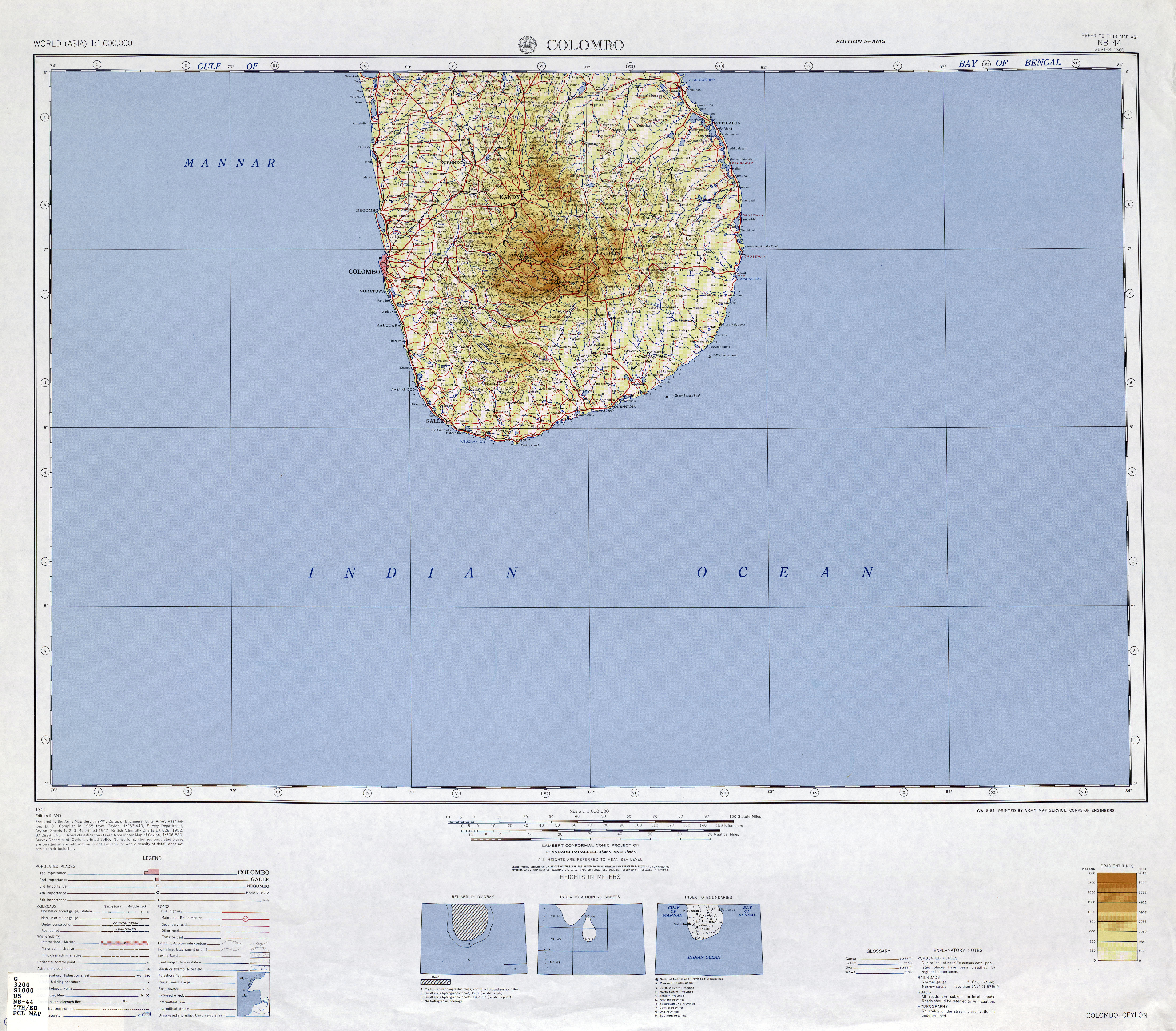
Although Ceylon was a rice producing country, large quantities of rice were regularly
imported before the War - over 500,000 tons in 1938. The Japanese invasion of Malaya
and attack on Burma and the air raids on Colombo and Trincomalee not only brought the
war unpleasantly close to Ceylon, but badly affected the rice supply to the Island. Drastic
measures therefore became necessary and the post of Civil Defence and Food
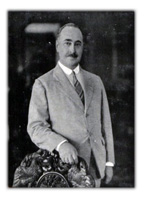
Commissioner was created, to which Sir Andrew appointed Oliver Goonetilleke:- an
excellent choice for he was a Ceylonese, an outstandingly capable civil servant and
closely in touch with and respected by the leading politicians including especially D. S.
Senanayake to whom he was responsible.
In order to distribute the limited supplies of rice available, a Food Control Scheme
was started, followed by an Internal Purchase Scheme for the compulsory purchase of
locally grown rice in which I became intensely interested, with the result that I was
transferred to Colombo as Assistant Civil Defence Commissioner and Controller,
Internal Purchase Scheme. Goonetilleke gave me full encouragement and support and
the compulsory purchase of rice rose from 9,000 tons in 1942 to 30,000 tons in 1944 - an
achievement that could not have been reached without the political backing we enjoyed.
 |
|
|
Internationally, Ceylon became best known as Lord Louis Mountbatten's Headquarters
for, with Sir Andrew Caldecott's consent, he took over King's Pavilion, Kandy, one of
the Governor's residences, when he was appointed Supreme Commander, South East
Asia Command. This proved an ideal arrangement since Mountbatten had chosen
Peradeniya, only a few miles away, as his Ceylon Headquarters.
The War had prevented early action on Sir Andrew's recommendations for constitutional
reform, but in 1943 on the recommendation of Sir Andrew, backed by Sir
Geoffrey Layton, Commander in Chief, a Commission on constitutional reform was
appointed - the Soulbury Commission. The choice of members was an excellent one - in
particular the Chairman, Lord Soulbury, whose intelligence was matched by his easy
manner illustrated by the remark in the Commission Report, and whose later appointment
as Governor-General was warmly welcomed:- 'The enlargement of liberty is always
attended by risk, but it is well to bear in mind a wise observation attributed to Aristotle,
"The only way of learning to play the flute is to play the flute".' - a saying I have kept in
my mind ever since!
Ceylon attained independence on 4 February 1948 when Sir Henry Monck-Mason
Moore was sworn in as Governor-General. There seemed little doubt that under
Senanayake's leadership Ceylon's success as the newest Dominion was assured. And so,
I believe, it would have been if he had lived. Sadly, however, he died in March 1952,
having suffered more severely from diabetes than was generally recognised - as is stated
in the biography of J.R. Jayawardene of Sri Lanka by K. M. de Silva and Howard Wriggins.
To me the example he set has remained in my memory ever since and it is a pleasure
to pay this short tribute to him and to the Ceylon of his day that he guided so well.
|