 |
|
|
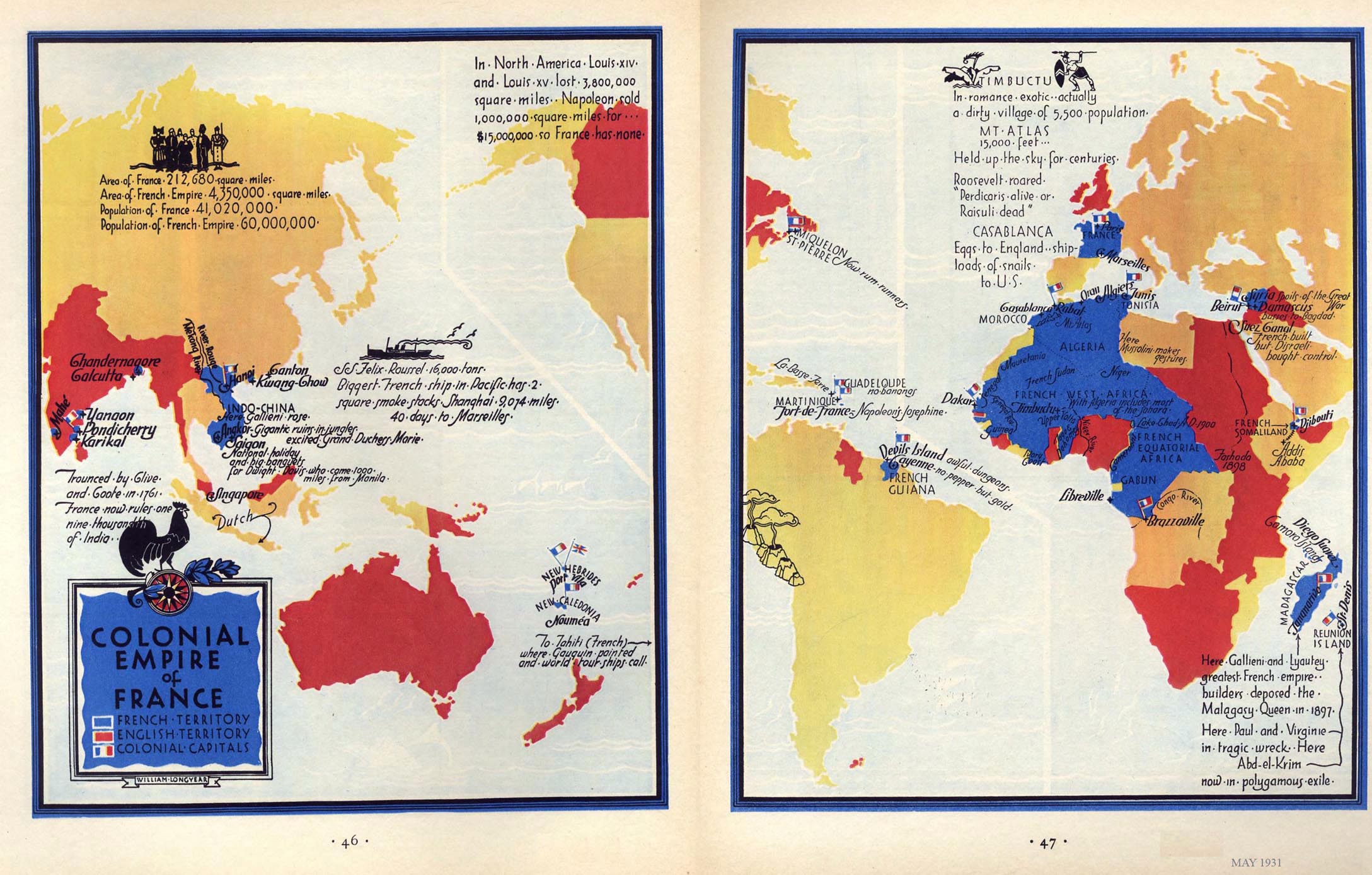
The fact that France still seemingly attracts greater trust among her former
subjects in Africa than Britain has often been commented on and never fully
explained. The difference has again been in the news with the recent French military
action in her former colonies: had the British Government
undertaken such operations one can but imagine the howls of protest that
would have arisen within Britain let alone from her former African territories.
Why the difference -- it has been said that "Britain placed its emphasis on law
under which independence is a status never to be compromised" "while France
placed its emphasis on language and culture so that the link with the metropolitan
power has never been broken". This bold statement however begs too many
questions -- for one it is not the whole truth to wit the suppression of the army
mutinies in East Africa in the early sixties. Moreover these territories owe their
creation and even their natural identity to Britain and the ties of most former
colonies with Britain are myriad, e.g. language, literature, the educational
and legal systems and on a lesser plane (but perhaps equally important) come
food, drink (especially tea) and the penchant for visiting bookshops, group
photographs and Savile Row suits.
The same links then existed though in a different form (a point to which I
will return). They were founded on mutual trust and often affection: in the
last analysis this depended on the respect of the individual inhabitant for the
individual European officer. This trust in its finest form was to be seen in
India and in particular in the Indian Army -- for as Philip Mason has pointed
out in his fine book A Matter of Honour: An Account of the Indian Army, Its Officers and Men the men would follow their officers if they
trusted them. Seemingly, they always did as for example in the Second World
War there were remarkably few defectors. I would not argue that the same degree
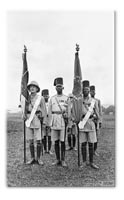
of trust existed in Africa but note should be taken of the thousands of African
troops who fought for Britain in both world wars: indeed in the First World
War a battalion of Ugandan Police took part in operations in East Africa.
The developed view today does not of course accord with this -- the empire was
an instrument of oppression and exploitation in which white men lorded it over
black men. Nothing could be further from the truth -- how would such a vast
empire have been created and administered if that had been the case. the men would follow their officers if they
trusted them. Seemingly, they always did as for example in the Second World
War there were remarkably few defectors. I would not argue that the same degree
of trust existed in Africa but note should be taken of the thousands of African
troops who fought for Britain in both world wars: indeed in the First World
War a battalion of Ugandan Police took part in operations in East Africa.
The developed view today does not of course accord with this -- the empire was
an instrument of oppression and exploitation in which white men lorded it over
black men. Nothing could be further from the truth -- how would such a vast
empire have been created and administered if that had been the case.
 |
|
|
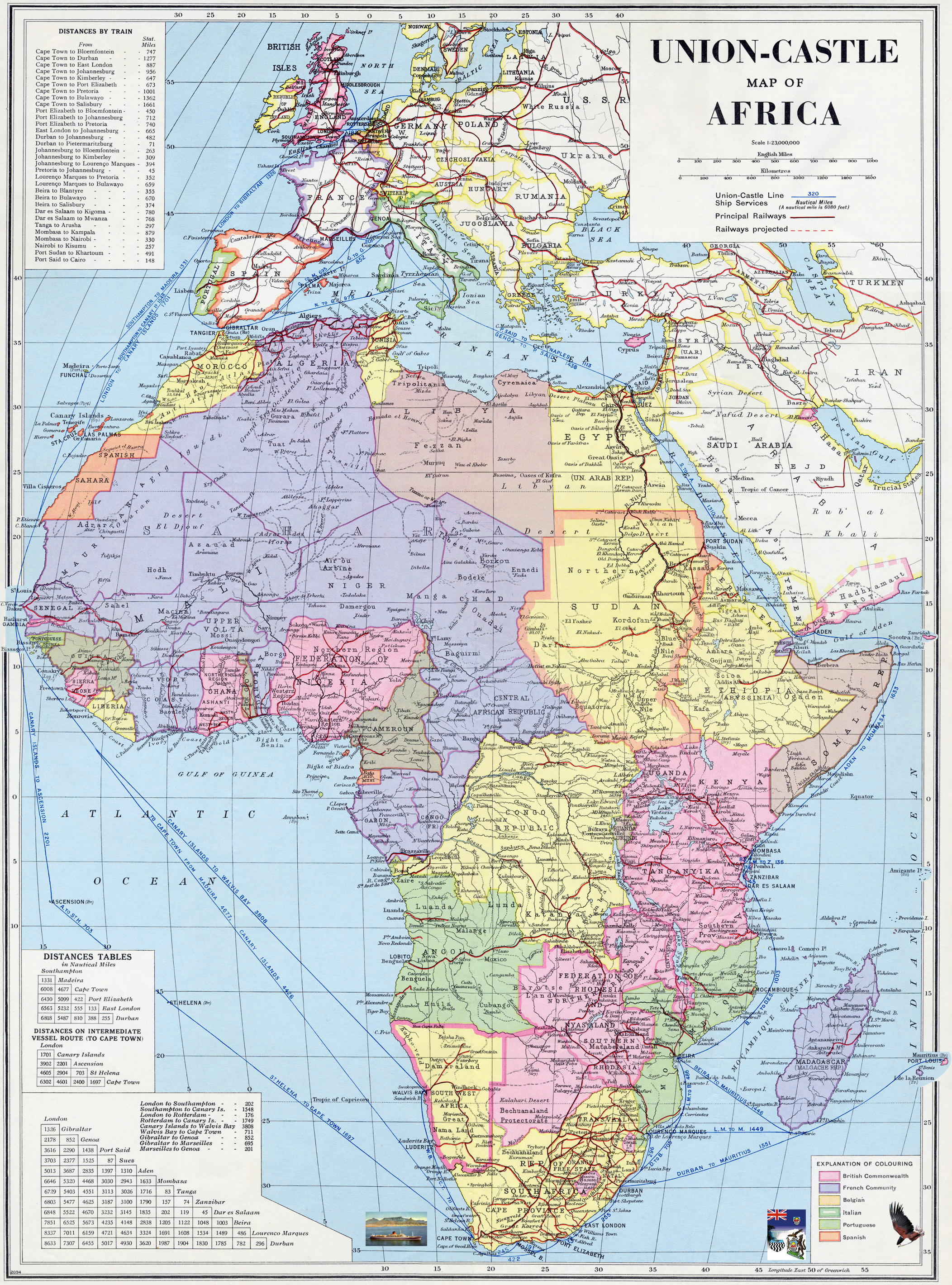
To make this point let us turn to East Africa and Uganda in particular.
In this latter country, with an area of 94,000 square miles, in 1948 there was
an African population of 5,250,000 and a European population of 6,500. By 1962
it had risen to nearly 7,000,000 Africans and some 11,000 Europeans -- at least
half of the European population would be women and children and another quarter
non-government personnel (missionaries, teachers and business men, etc.). Thus
Uganda, a country comparable in size to the United Kingdom was administered by
some two thousand civil servants and of these only a few hundred would actually
be in the command structure putting across government policy and enforcing it on
the ground. These officers maintained law and order, built roads, schools and
hospitals and strived to create a happy and prosperous country -- all in a span of 50 years.
It was not without incident of course: yet it is significant to note that at
independence on 9th October 1962 the country only had an army of one battalion
(4th Kings African Rifles -- the Uganda Rifles) and a police force of some 5,500
officers and men (5,000 other ranks, 300 inspectors and 200 officers). The
Uganda Police was of course a para-military force having little in common with
the constitution of the police in Britain: yet as well as its para-military duties
it undertook all the functions of a "normal" force. It was directed and controlled by an Inspector General assisted by his officers of whom little more than half
would have been European. This scheme of things would have been repeated
throughout Africa.
That this relationship was close is shown by the fact that a number of
individuals (African and European) made the final sacrifice; the last European to
die in the service of Uganda did so in 1960 (just two years before independence)
when a police officer was shot in North-Eastern Uganda attempting to repel armed
Turkana raiders from northern Kenya. Indeed the web of this relationship was even
more extensive for on many occasions government policy required the full and
active consent of all sections of the indigenous population -- one example of this
is connected with the Mau-Mau Emergency in Kenya. Because of the nature of this
insurrection the government decided that all Kikuyu living in Uganda must be
detained and deported to Kenya. So in 1955 in a series of dawn raids throughout
the country this operation was carried out without untoward incident. Independence
came to Uganda on 9th October 1962 and with it the time to say goodbye to its
European officials. What is of note here is that many were asked to stay on by the
new government: what better evidence is there of the trust that was placed in them.
Their final epitaph -- in the words of Sir Abubakar Tafawa Balewa, "We are grateful
to the British officers whom we have known first as masters and then as leaders
and finally as partners but always as friends".
Knowledge of all this leaves no doubt of the existence of very close ties but
in a sense they were personal: and the first reason why they were broken is that
there was no common ground in Britain. Our colonies were governed in the same
way as the French governed theirs -- a centralised administration with departmental
officers in each district responsible through a hierarchy to a head of department
in the capital. This of course is what happens in France itself with its "departments",
prefectures, prefects and prefects of police, etc. -- there was no barrier therefore
between home and overseas. But in the United Kingdom with its system of local
government the opposite was true: there was no link and no rapport between those
who served the crown at home and those who did so abroad. The French empire
was an extension of France: French officers could move from one to the other and
not notice the difference -- Britain's empire was something quite different.
This factor leads one to the second reason. There was always an ambivalent
attitude to the empire in Britain -- to the common man it hardly existed apart
from his schooldays when the areas painted red were drawn to his attention. So
few officers served abroad that few shared experiences were established with the
population at home: moreover those who served abroad were often looked down
on and their achievements denigrated. The origins of this attitude are obscure
although it has always been acknowledged that Whitehall viewed with some
suspicion those officers who had made their reputation in India. The Iron Duke
himself suffered this and in 1805 said the Horse Guards "thought very little of
anyone who had served in India. An Indian victory was not only no grounds for
confidence but it was actually a cause for suspicion". This attitude is seen again
in the Crimea in 1854. Cecil Woodham-Smith in "The Reason Why " remarks on the
caste system which kept Indian officers down as being so powerful that not one man
from the list of Indian Cavalry officers was given a command (these were the only
officers at the time who had any experience of active service). The one officer to
engage two of these men to assist him did so on a completely unofficial basis --
this was General James Scarlett of the Heavy Brigade who, with his troopers,
performed one of the great feats of cavalry against cavalry in the histroy of Europe.
This attitude extended to the Indian Civil Service and more so to the Colonial
Service in later years. Members of the latter service were of little account in
Whitehall being fit only to take charge of lesser breeds. Yet it was these men who attempted to turn the wilderness of Africa into ordered prosperous modern countries
fit in the view of the British Government to be given independence. " remarks on the
caste system which kept Indian officers down as being so powerful that not one man
from the list of Indian Cavalry officers was given a command (these were the only
officers at the time who had any experience of active service). The one officer to
engage two of these men to assist him did so on a completely unofficial basis --
this was General James Scarlett of the Heavy Brigade who, with his troopers,
performed one of the great feats of cavalry against cavalry in the histroy of Europe.
This attitude extended to the Indian Civil Service and more so to the Colonial
Service in later years. Members of the latter service were of little account in
Whitehall being fit only to take charge of lesser breeds. Yet it was these men who attempted to turn the wilderness of Africa into ordered prosperous modern countries
fit in the view of the British Government to be given independence.
In turn this leads directly to the third reason -- Britain's overseas affairs
(in their final flowering after World War I) were directed by three departments,
the Foreign Office, the India Office and the Colonial Office. Whitehall was ever on
guard to maintain its ascendancy and protect its own against any influx of
outsiders: and there were grounds for concern for a career abroad would usually
have greater responsibilities and rewards and so greater satisfaction in addition
to which these officers would dispose of greater power than would ever be
exercised by an official at home. The India Office went with the independence
of India in 1947, and the Colonial Office disappeared in the "fifties"; and so the
"battle" was finally won. But the war still went on: anyone who saw the poses,
official and social, of Whitehall officials vis-a-vis their Colonial Service counterparts
in the "fifties and sixties" would have no doubt of this. Did the vendetta still
continue in the "seventies" -- there are many who would say yes, and it was to be
seen in the Foreign Office's desire to humiliate and defeat the last colonials in
Rhodesia.
The culminating factor was an amalgam of moral and political judgement. The
empire was an embarrassment and, as Macmillan would have it, the wind had
changed direction and Britain's place in the sun would be bought by running
before it. There was no longer any desire to administer an empire and this coupled
with a loss of purpose and power resulted in its disposal and the disbandment of
the service which ran it.
From 1947 to the withdrawal from the Gulf in 1971 countries of all shapes and
sizes were given independence and treated as foreign powers. In all but the larger
and more developed countries this was to confuse the form with the content. Over
and above all this the British government and political establishments of every hue
seemed to have believed that freedom
was to be granted to all and sundry. In fact this process only prepared the ground
for future tragedy and created a collection of vacuums which the super-powers first
filled although often followed later by radicals and fundamentalists. In retrospect would not Britain (and the West) have been wiser
to retain control of more key strategic islands like Kamaran, Perim and Socotra. When events
in Britain's former empire call for action it has, unlike France, neither the means,
power nor will to act as the French do and be respected for it.
|