|
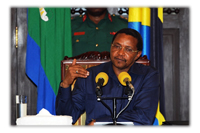
President Jakaya Kikwete of Tanzania is reported to have said in a speech at
the 50 years of Independence celebrations in December 2011.
"The colonial government had no intention of developing the country but
just wanted to exploit Its resources".
Should this go unchallenged? We administered Tanganyika as a Trust Territory
under the UN Trusteeship Council. It was drummed into us that we were preparing
the country for self-rule. Our benign, paternal respect and affection for the country
and the people was manifest and made for the good-will that exists between us to
this day. We worked conscientiously and with devotion to develop the country as
the following two examples show.
Sukumaland Development Scheme
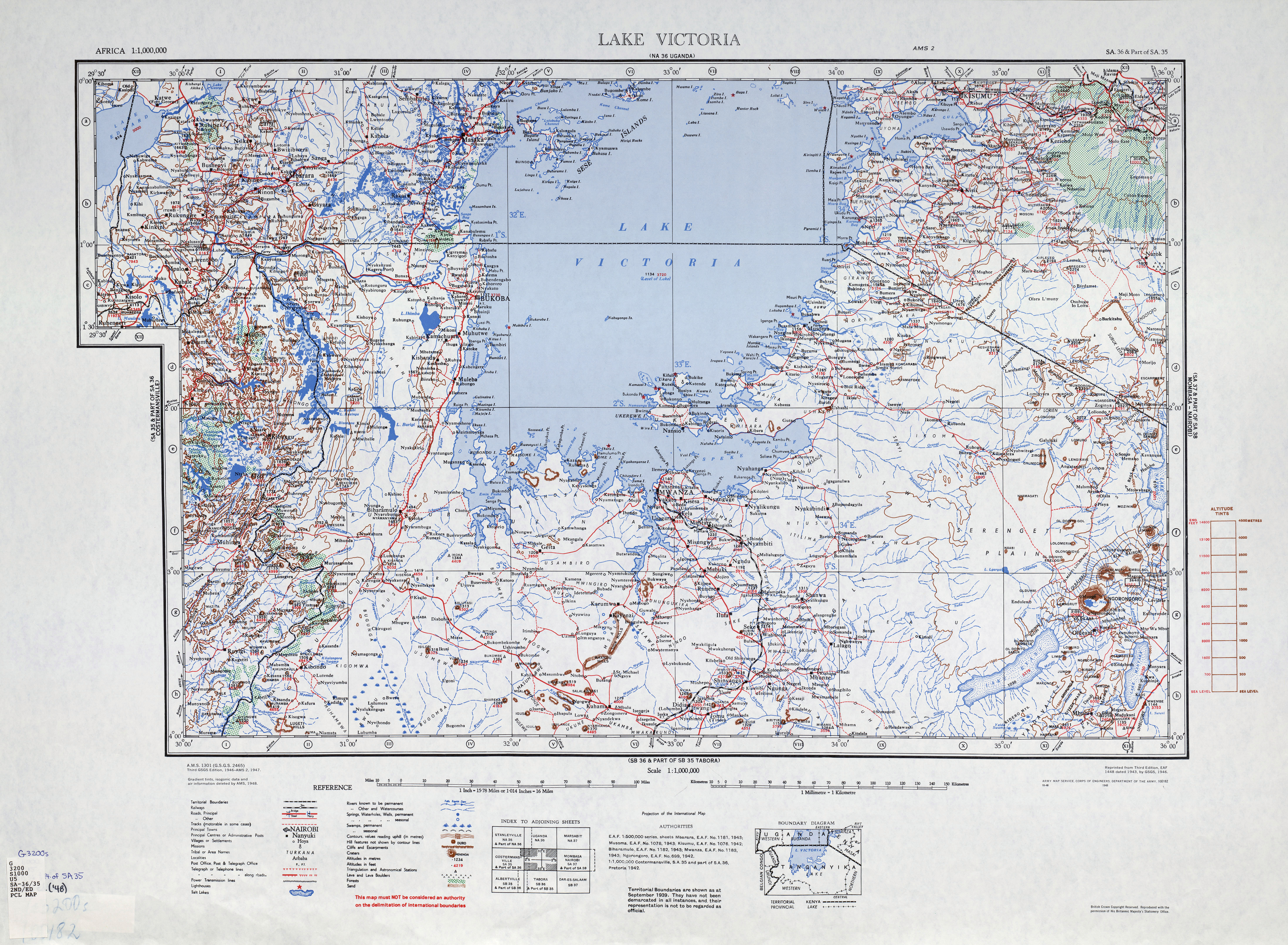
The five districts of Usukuma in Lake Province were brought together in the highly
successful Sukumaland Development Scheme which was the brain child of two
remarkable Agricultural Officers, Rounce and King, with Scottie Purves as the
Veterinary Officer. An outstanding senior District Officer, Donald Malcolm, was
the chief executive and the whole was governed by the Provincial Commissioner,
Jimmy Rowe and his Deputy, Jock Griffiths. Sukuma customary law was an all prevailing
theme guided by an anthropologist, Hans Cory.
They devised what was called the Sukumaland Equation. It assumed that on
average the Sukuma family comprised seven men, women and children, that they
cultivated 8 acres, had 32 head of livestock and occupied 40 acres on a sustained
basis. For example, in Geita District which had room for settlement from the more
crowded districts, the village headman (Mwanangwa) and the Msumba Mtale
(leader of the young men) allowed newcomers at a density of 40 acres per family
(Kaya). This prevented overcrowding, soil erosion and the denuding of woodland,
especially on the hilltops. The Federation set aside each year certain areas of
permanent grazing to rest, or fallow, allowing grasses to re-seed. These closed
off areas were called Ingitiri. We had advice from Van Rensberg, an East African
grassland expert.
 |
|
|
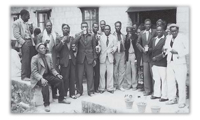
All was agreed by the democratic Federation of 52 chiefs and 104 elected
elders (Bagunane). They met in a splendid octagonal "court house" at Malya
and were led by that charismatic chief Majebere. The Federation agreed and
carried out annual development of dams for domestic water supply, bush clearing
to drive out tsetse fly and open up fresh grazing, and extensive soil conservation
measures, eg. tie-ridging on all sloping land. This was carried out during dry
weather on a tribal turnout basis under which each chief provided 100 men for ten
days to work in relays. They were rewarded by beef and beer at the end of the
dry season. There was universal support for this work and It gave this splendid
tribe an opportunity to dance and sing and celebrate with their delightful chiefs
and elders every achievement of benefit to the whole district.
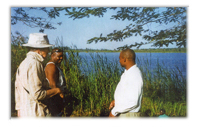
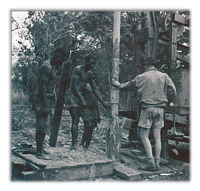
I helped make 14 dams in Geita (see Geita District photo) and one in
KIsarawe District at Lugoba close to President Kikwete's home, all on the tribal
turnout basis, without which nothing would have been done since there was
no money to pay for it. It was a privilege to serve here where the Sukumaland
Development Scheme worked so well and there may have been nothing to equal
it elsewhere in East Africa.
Bena Wattle Scheme
In 1953 Governor Sir Edward Twining saw an opportunity to develop a cash crop
for the Wabena who lived in sparsely inhabited areas of relatively infertile mountain
grassland in Njombe District, in the Southern Highlands. He asked the Colonial
Development Corporation if they would plough, harrow and seed chosen areas
with Australian black wattle (acacia mollissima wild) at cost and buy the harvested
bark in eight years time. Thus the Bena Wattle Scheme, run by a District Officer
full-time, at the end of the first five years had developed 12,000 acres out of a
target of 20,000 acres over eight years, parcelled out to the Wabena growers in
one acre plots.
 |
|
|
At the same time the DO i/c developed 12 mini tree nurseries with pines. The
seedlings, at about ten Inches in height, were sold to the Wabena and Wakinga at
cost and taken away on their heads or on bicycles. The losses might have been
high but 40 years later huge areas of Ukinga, a mountain area too high and cold
for most cash crops, was found to have been transformed into a miniature Swiss
Alpine landscape with home woodlots in every parish - the Wakinga enjoying life
as pit- sawyers selling softwood planks by the roadside.
And in his spare time the DO, hearing from Chief Solomon that a mountain
road might be made from Chimala to Matamba, undertook this during two dry
seasons on a tribal turn-out basis, resulting In a road having 49 hairpin bends and
the Watamba getting their harvest down to the main road at Chimala. The road
is called Hamsini na saba (57), simply by counting the 49 bends on the climb and
adding 8 more on the downward slope to Matamba village. The climb was from
3,000 feet to 7,000 feet at the top. Again there was no money at all.
General Development
Agricultural Officers throughout Tanganyika introduced cash crops such as cotton,
cashew, soya, castor bean and encouraged cassava and sweet potatoes as a
precaution against famine. This was backed up by the introduction of short-term
early-maturing varieties of sorghum and millet. Veterinary Officers ran cattle
markets at fair prices and helped with the sale of hides and skins. District Officers
and the Public Works Department developed roads and bridges throughout the
country but were always restrained by lack of money. There was no outside
funding in the form of aid such as has been provided in recent years.
 |
|
|
As a less visible and intangible achievement, the Administration developed
Indirect Rule on the lines of the Donald Cameron pattern in Nigeria. This worked
well and was a remarkably harmonious way of establishing law and order and
myriad local courts of justice. This was a refreshing and much admired benefit
and came as a relief from the harsh direct rule exercised by the previous German
Administration. The growth of education and medical care was steady and well
ordered, rather than spectacular, and here again the lack of outside finance
governed the pace of development.
Much of what was done in Tanganyika in less than 40 years is judged by fair
minded commentators as worthy development, devoid of corruption, selfish greed
and mal-administration. As for the charge of exploiting resources, the contradiction
is plain for all to see. What little was done by way of exploiting natural resources
was done for the benefit of the country and its people and not for any foreign or
outside interests.
|