

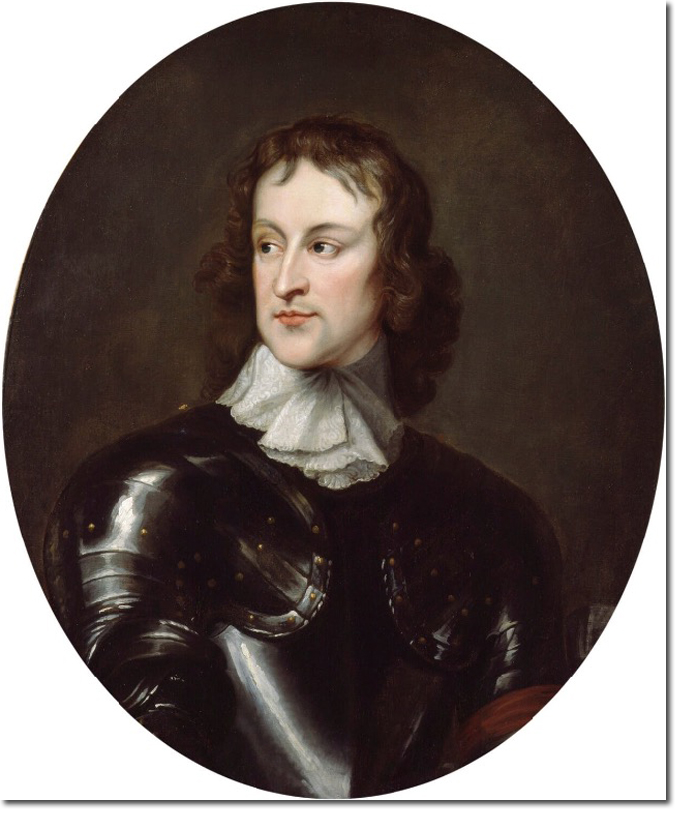
Drake’s Island, once a remote prison fortress, has held only eleven known captives throughout its history. Among them, one stands out—not just for the length of his confinement, but for the magnitude of his legacy: Major General John Lambert, often remembered simply as Colonel Lambert.
Born in Yorkshire in 1619, Lambert’s early life was shaped by tragedy. After his father’s death, he became the ward of Sir William Lister, who funded his legal studies at Cambridge. But the outbreak of the English Civil War in 1642—now often called the War of the Three Kingdoms—changed his path forever. Lambert joined the Parliamentary cause and quickly distinguished himself as a fearless soldier, masterful swordsman, and brilliant cavalry commander. His tactical genius and leadership propelled him through the ranks, playing a decisive role in defeating the Royalist Scots during the second war. By the end of the third, his contributions had helped secure Parliament’s victory.
Though he was still engaged in military operations at Pontefract when Charles I was executed, Lambert narrowly avoided retribution from Charles II, as he hadn’t signed the king’s death warrant.
Lambert’s political legacy is equally profound. He authored the world’s first written national constitution and championed broader suffrage—radical ideas for an age still gripped by monarchy and religious dogma. Admired by common soldiers and respected across political divides, Lambert was widely seen as Oliver Cromwell’s natural successor. But when Cromwell named his son Richard as heir, Lambert’s influence was abruptly curtailed. Nicknamed “Bottomless Lambert” for his depth of intellect and ambition, he was sidelined—perhaps seen as too powerful, too popular.
Forced into retirement, Lambert turned to gardening, sewing, and painting flowers—activities mocked by his critics but cherished by him. When Cromwell died and Richard’s rule faltered, Lambert was thrust back into command. He led Parliamentary forces against Royalist troops advancing from Scotland, but his unpaid, demoralized army dissolved. Captured and imprisoned in the Tower of London, Lambert famously escaped using a silk rope, attempting to rally support for the “good old cause” at Edgehill. Recaptured, he was exiled to Castle Cornet in Guernsey.
Later recalled to stand trial for treason, Lambert avoided execution but was sentenced to life imprisonment. Initially granted parole due to ill health, he lived with his family on the island—until a scandal erupted. The Governor’s son married Lambert’s daughter without permission, prompting the Governor to disinherit his son and exile Lambert alone to Drake’s Island.
Lambert’s wife, Frances, settled in Plymouth and was occasionally allowed to visit. Despite his status as a prisoner, Lambert remained a figure of fascination—visited by King Charles II and diarist Samuel Pepys. He died during the brutal winter of 1683–84 and was buried somewhere near St. Andrew’s Church in Plymouth. The exact location of his grave remains unknown.
Lambert is commemorated in Yorkshire, at the Tower of London for his daring escape, and at Castle Cornet, where a memorial garden honors his love of horticulture. Plans of Drake’s Island from 1715 show several gardens—perhaps tended by Lambert himself.
Yet in Plymouth, a city central to the Civil War and to Lambert’s own story, no memorial stands. His grave is lost, and his name largely forgotten. But if history had taken a different turn, Lambert might have become the first President of the English Republic—a visionary leader who dared to imagine a nation free from monarchy and tyranny.
Image courtesy of NPG

