

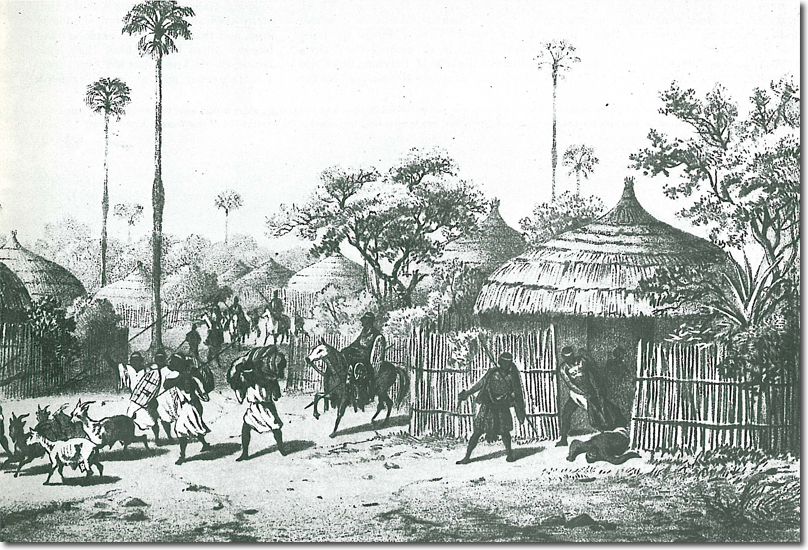
Although sketched by Heinrich Barth some fifty years before Charles' observations were made, the scene would have changed little over the intervening years. Heinrich Barth had been a German of enormous physical strength and self-discipline. With another German, Adolf Overweg, and James Richardson, the English leader of the expedition, Barth was sent by the British government to investigate the internal African slave trade, and in December, 1849, the trio left Tripoli for Mourzouk. At one point on the journey Barth spent 28 hours in the desert without water - keeping himself alive by sucking his own blood. Richardson died close to Lake Chad and Overweg some 18 months later. Barth, with unwavering loyalty to his employers, pressed on alone, interviewing chiefs, discussing treaties and compiling detailed reports with meticulous attention to detail. Once taken for a Turkish spy - because of his habit of writing everything down - and at other times for a rain-maker, a charm-writer and an angel, he was the first to record the existence of two highly developed empires the Gwandu and Hamd-Allahi - and he showed that the Beime, a tributary of the Niger, did not flow out of Lake Chad. His reports on the geography, history and peoples of the regions he visited constitute the most authoritative documents on 19th- Century north-central Africa, though his ponderous style denied him the fame he deserved.
Charles Orr's Memoirs Volume 4

