

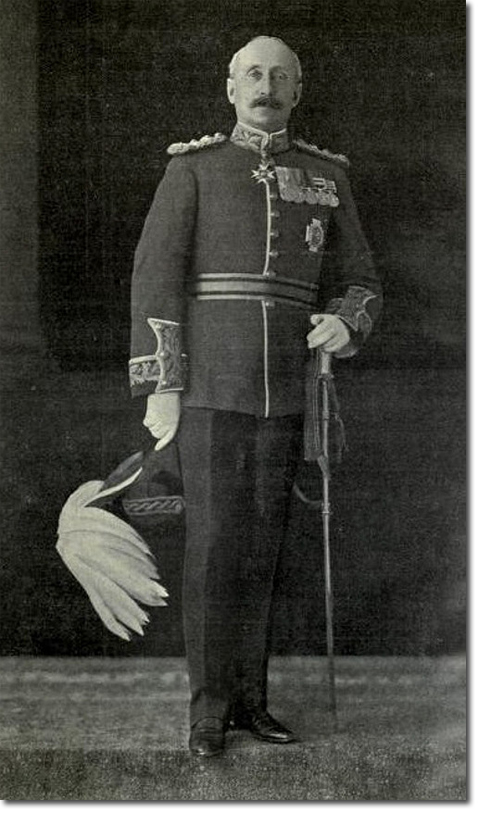
John Nixon was an officer in the 18th Bengal Lancers from 1878 to 1903 and went on to achieve notoriety as the general that failed dismally in Mesopotamia in WW1. He was born on 16 Aug 1857, the son of John Pigott Nixon and Ellen Sophie Cooper. His education was at Rossall School in Lancashire, and he trained at Sandhurst. He was commissioned into the 75th Stirlingshire Regiment in 1875 and transferred to the 18th Bengal Lancers in 1878. He served with distinction in the Second Afghan War, in George Richardson’s squadron’s actions against the Waziris. He was appointed Adjutant of the 18th from 11 Sep 1884 to 9 Sep 1886. In the Chitral Relief Force of 1895 he was employed on the staff as a captain which fast-tracked him to a Brevet Lieutenant-Colonel rank. He was senior staff officer of the Tochi Field Force in 1897 and appointed AQMG in charge of Intelligence at Indian Army HQ.
Nixon was a cavalry Brigade commander in the Boer War, promoted to lieutenant-colonel in Sep 1901 and given the CB. He held various GOC posts in India until WW1 when he was given command of the Mesopotamia Expeditionary Force. He planned to capture Baghdad from the Turks, and his advance up the Tigris and Euphrates was initially successful. Townshend’s Division captured Kut and went on to Ctesiphon but had to retreat to Kut. Nixon refused to let Townshend retreat from Kut and this resulted in the infamous surrender and imprisonment of thousands of British and Indian troops.
Nixon took his HQ upriver in a paddle steamer but came under attack from Arabs working for the Turks. His small force sustained heavy casualties and Nixon had to surrender and hand over a large sum of money. This was the lowest point in Nixon’s career and he was removed from command after a failed attempt to relieve Townshend at Kut. He suffered a mental breakdown and retired from active duty in March 1916.
In the History of the History of the 19th King George s Own Lancers General Hudson makes no mention of Nixon’s failure:
‘…he climbed to high rank, holding many important commands and finally being promoted to the rank of Lieutenant-General, serving with distinction during the war of 1914-1918 in the vicissitudes of the campaign in Mesopotamia, where his services were recognised by the award of the Grand Cross of the Order of St Michael and St George, in addition to the KCB and other decorations earned in other fields. He was a good polo player and a fine cricketer, full of zeal, had the pen of a ready writer and used it freely.
‘It is related of [Nixon] that, when employed as a Garrison Instructor, he was at first inclined to be intolerant at the mental incapacity and lack of interest displayed by his pupils, “but,” said he, “one day it occurred to me that perhaps it was I who was the fool, and was unable to teach and make my teaching interesting. Acting on this, I had no more trouble.”’
General Sir John Nixon GCMG KCB died on 15 December 1921.

