

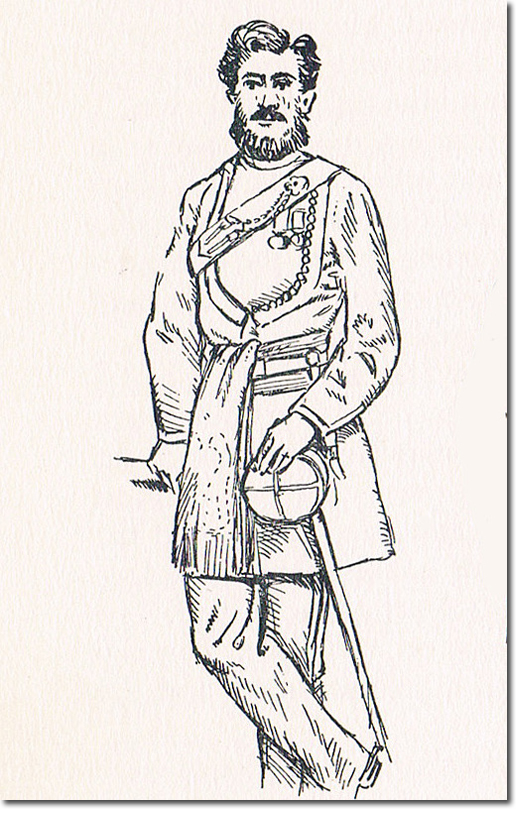
Charles William Campbell entered the army as a cornet on 20 Dec 1854, promoted to lieutenant on 30 June 1857. When the Mutiny broke out he was at Lucknow. He joined the Volunteer Cavalry and went on several reconnaissance patrols before the battle of Chinhut. During the battle he was severely wounded. He fought in the defence of the Residency at Lucknow where he was wounded again. He was at the recapture of Cawnpore from the Gwalior Contingent. In 1860 he served with Fane’s Horse in China and fought at Taku Forts and the surrender of Peking. He earned medals for the Mutiny campaign and the China War.
Campbell transferred to the 2nd Bengal Cavalry in 1861 and was appointed 2nd Squadron Officer on 15 Aug 1864. He was promoted to captain on 20 Dec 1866. In March 1871 he was 2nd in command of the regiment and Squadron Officer, and promoted to major on 20 Dec 1874. By 1878 he was officiating commandant of the regiment in the absence of Colonel O Wilkinson. He was appointed Commandant on 6 March 1880 and remained in command until February 1886. He did not go to Egypt with the regiment in 1882. The 2nd Bengal Cavalry was commanded at Tel-el-Kebir by Lt-Col Frederick Knowles.
The drawing is taken from W Y Carman’s book Indian Army Uniforms: Cavalry (1961). Bill Carman made the drawing from a photo in his possession, of Lieutenant C W Campbell, taken c1865. He describes the uniform as an alkalak, laced around the neck, the chest opening and around the cuffs. His trousers have a double row of lace. The round forage cap has a lace band and narrow braids across the top in lancer fashion. His lace pouch-belt has chains and pickers and his kummerbund of Kashmir pattern is tied narrow around the waist under the sword-belt. The scabbard is steel. The uniform at that time was described in the army list as emerald green with red facings and silver lace.

