

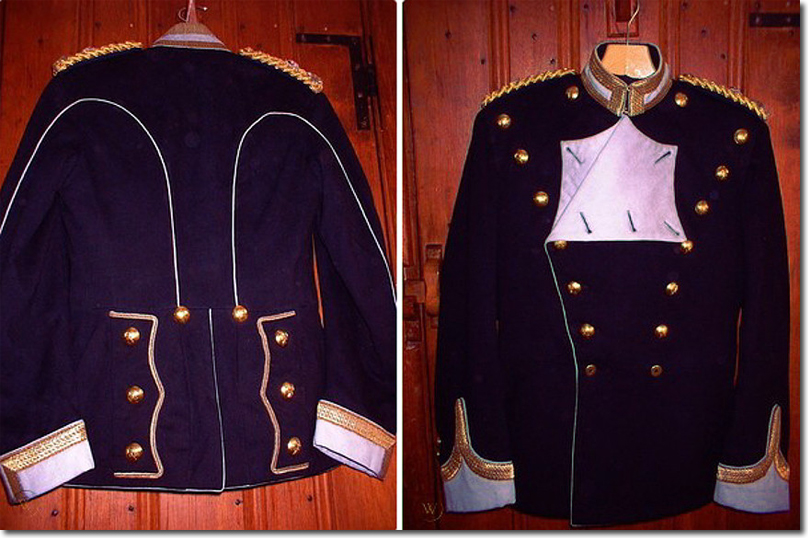
The tunic was worn by British officers only, in full dress. The General Order no.67 dated 18 June 1890 converted the 2nd Bengal Cavalry to Lancers. The pattern was the same as that laid down for Lancer regiments in 1874, and retained the sewn down lapels which had been replaced in the British service by the full chest plastron. The Regulation of 1899 described the lancer tunic as worn in the Indian Cavalry regiments.
TUNIC: Of cloth the colour of the uniform, double-breasted, two rows of buttons, seven in each row (the bottom one flat to go under the girdle), the distance between the rows, 8 in. at top, 4 in. at bottom. Lapels of regimental facings sewn down, instead of being hooked at the corners. Skirts lined with black. Collar 1.5 in. high, of regimental facing, edged all around with three quarter inch gold lace for Field Officers; round the top only, with cord on the lower seam, for captains and lieutenants. Cuffs pointed, with two rows of lace for field officers, showing the colour of the facings between the rows, and one row for captains and lieutenants. Cuffs 10.5 in. round of regimental facings with two small Bengal Lancer buttons. Two Bengal Lancer buttons at the hips; slash on each skirt, with three Bengal Lancer buttons, and edged with gold or silver cord…a welt of the regimental facings at the back of the sleeve and back seams, down the edge of the front and down the skirts. Shoulder straps of gold or silver wire cord lined with cloth the colour of the tunic, small buttons at top, and badges of rank in silver or gold embroidery according to lace. [the 13th and 19th Bengal Lancers had silver lace]
The 2nd Bengal Lancers had a narrow line of the pale blue facing colour showing above the gold lace on the pointed cuff. The universal Bengal Lancer buttons were not worn by the 2nd; they had their own pattern (see Badges). The collar did not follow the regulation in that the lower seam was covered by a half inch line of gold lace instead of gold cord. The pattern of the lace was Broken Bias. The cap-lines were passed only once round the body. The girdle was of gold lace, 2.5 inches wide, with two crimson stripes separating the three gold lace stripes. The back of the girdle was of pale blue morocco leather.

