
The uniforms of the Bombay regular cavalry prior to 1840 followed similar lines to the Bengal cavalry pattern, although the 1st Bombay Cavalry converted to lancers in 1842 but then changed to silladar light cavalry in 1861, and reverted to 1st Bombay Cavalry in 1862. They remained as such until 1880 when they once more became lancers.
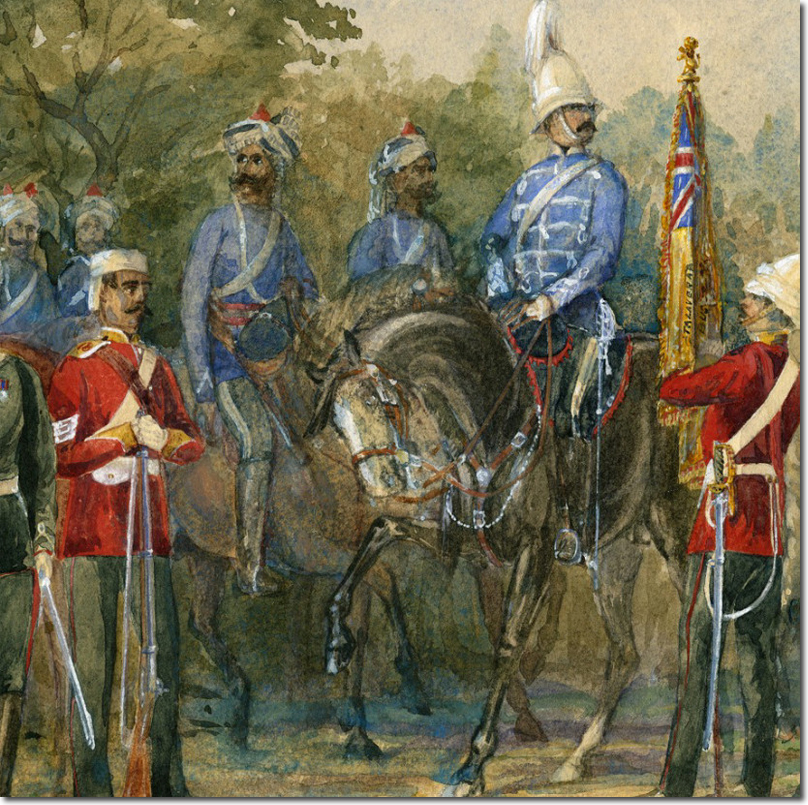
This detail from a painting of the Deesa Field Force in 1874 shows the uniform in that two decade period. The British officer is with Indian other ranks who are dressed quite differently. The 2nd and 3rd regiments of Bombay cavalry in the 1840s and 50s had adopted a silver metal dragoon helmet with a falling horsehair plume. This painting shows that the Bombay cavalry, in the years following the Indian Mutiny took to wearing a white helmet with the falling horsehair plume. The tunic is described as cavalry grey, the style adopted universally in the latter part of the 19th century to replace the heavily braided, waist-length light cavalry jacket. It is frogged with silver cord and the collar and cuffs are white.
The painting also depicts the early dress of the Indian other ranks which is a short alkalak also in cavalry grey, worn with native headdress; a lungi which appears to be blue and white, or buff, with a red pointed kulla. The breeches were dark blue with silver stripes, worn with knee boots.

