
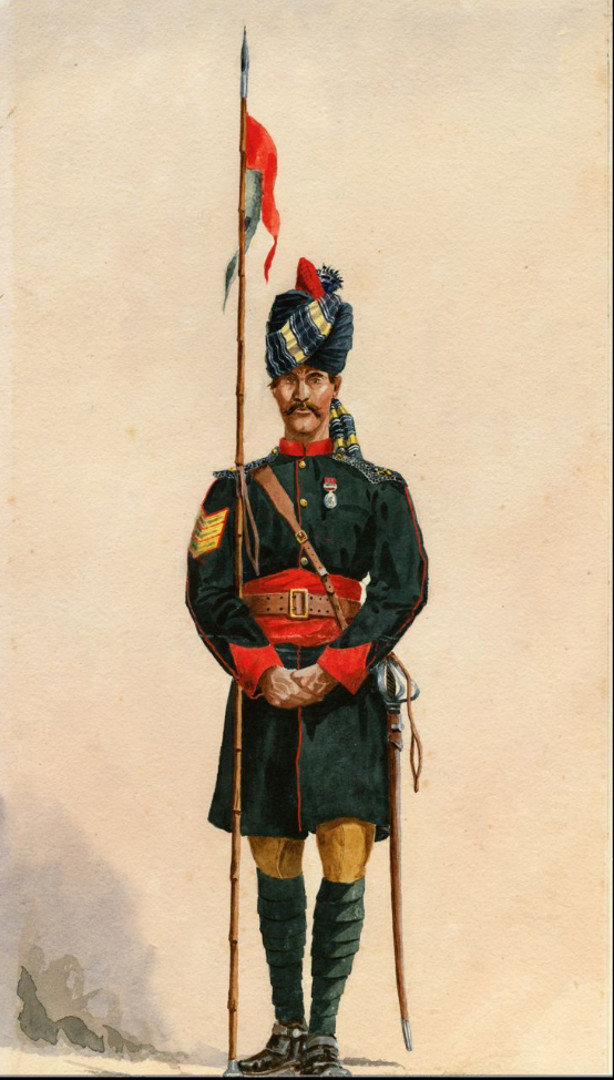
The artist/soldier, A C Lovett, is well known for his accurate paintings of Indian soldiers, mostly in the early 20th century. This study, unsigned or dated, was painted c1890, one of his earliest works, while he was stationed in India with the 2nd Battalion Gloucestershire Regiment from 1880 to 1894.
The daffadar wears a bottle green kurta with scarlet collar and cuffs. The collar would have been very uncomfortable for Indian soldiers, and photos of other ranks in the late 1890s show them wearing a kurta without the collar. The steel shoulder chains have a brass badge and the buttons are brass. The gold lace chevrons on the right arm are on a scarlet backing cloth. A red kummerbund is worn around the waist with a brown leather Sam Browne belt, although the artist was unclear about the method of attaching the shoulder strap to the waist-belt. The Simkin print of 1885 shows the sword suspended from a waist-belt without the shoulder strap, so the strap was added at some point in the late 1880s.
The kurta is embellished with scarlet piping down the front, which reaches the hem of the garment, also on the back seams of the sleeves, and presumably on the seams at the back in lancer-style. The lunghi is wrapped in a tall style, mostly dark blue cloth with yellow and blue stripes on the part showing on the front. The red kulla protrudes on top with the fringed end of the lunghi, and the other end hangs down the back. The man is probably a Pathan. At that time the regiment had 4 class squadrons; one Maharattas, one Jats, one Sikhs and one Pathans. The establishment allowed for 32 daffadars, 40 naiks and 518 sowars. The most senior NCO ranks consisted of a kote daffadar-major, 8 kote daffadars and a farrier major.
The kurta is quite long, almost to the knee. It would have been reserved for dress parades. It is worn here with the Mooltani muttee coloured breeches preferred by the Bombay cavalry, dark blue puttees, black boots and spurs. He wears a silver India General Service medal with a clasp for his service in the Third Burma War 1886-87. His lance is 9 feet long with a bamboo shaft and 1868 pattern spearhead and shoe. The pennon is red over white shaloon. Much of this information comes from an article by Rene Chartrand in the Journal of the Society for Army Historical Research no.405 (Summer 2023). The reproduction of Lovett’s artwork comes from the Anne S K Brown collection

