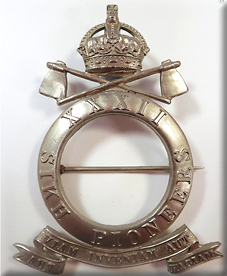
Raising of the Regiment, Jun – Sep 1857
The mutineers in 1857 gravitated towards Delhi, and the forces loyal to the British were sent to lay siege to the place. Brigadier-General Archdale Wilson commanded the army there, but it would have taken months for fresh troops to arrive from Calcutta. Meanwhile, John Lawrence was in Lahore, working hard to raise troops in the Punjab. No love was lost between Punjabis and Hindustanis, so he took advantage of this to recruit Sikhs, Pashtuns and Punjabi Muslims. Besides the 1st Sikh Irregular Cavalry he raised 18 new infantry regiments, two of which were pioneers, comprising Mazbi and Ramdasia Sikhs. One of these was the Punjab Pioneers which became the 32nd Sikh Pioneers (in 1903). The other Mazbi Sikh regiment became the 23rd Sikh Pioneers.
Delhi and Agra, 1857
The siege of Delhi came to an end on 21 Sep 1857. On 24 Sep a column of 2,800 men marched from Delhi under the command of Colonel Greathed of the 8th Foot. This force comprised 200 men of the Punjab Pioneers (32nd), detachments of the 1st, 2nd and 5th Punjab Cavalry and Hodson’s Horse. Other infantry regiments were the 2nd and 4th Punjab Infantry. They defeated mutineers at Bulandshahr, losing 47 killed and wounded. They then made a memorable march to Agra, a distance of 60 miles, covered in 36 hours. The garrison at Agra was not strong, so when the mutineers came to capture the place they were surprised to see Greathed’s force recently camped there. The enemy came from Mhow and Delhi and a battle was fought in which the rebels were thoroughly defeated and dispersed. Greathed’s column moved on to Cawnpore.
Colonel Seaton’s Column, Dec 1857
The Commander-in-Chief, Sir Colin Campbell, defeated Tantia Topi’s rebels at Cawnpore on 6 Dec, but remained inactive due to a lack of transport. A column under Colonel Seaton advanced from Delhi, escorting a convoy of stores for the army at Cawnpore. This column included Hodson’s Horse, the 7th Punjab Infantry, the 1st Bengal European Fusiliers and 120 men of the Punjab Pioneers (32nd). They fought the rebels at Gangari, between Aligarh and Khasganj, on 14 December. Also at Patiali on 17 Dec and Mainpuri on 27 Dec. They finally met up with Campbell at Fatehgarh on 2 Jan 1858.
Siege and Capture of Lucknow, Mar – Apr 1858
The Punjab Pioneers were part of Sir Colin Campbell’s army that arrived at the Alambagh on 1 March 1858. On 2 March they attacked the entrenched rebel position at Dilkusha Park. Outram crossed the River Gumti on 6 Mar with Punjabi cavalry and infantry. Meanwhile, Campbell arrived at the Martinière on 9 Mar and Bank’s House on 10 Mar. Over the next few days many battles were fought including the storming of the Imabara and the Kaisar Bagh. The city was captured by the 21st April after 20 days, with the loss of 127 killed, 595 wounded, and 13 missing.
Afghanistan 1878–80
The 32nd (Punjab) Native Infantry (Pioneers) was part of the Kandahar Column (afterwards designated the Southern Afghanistan Field Force) organised in two Divisions, the first under Lt-General D. M. Stewart and the second under Major-General Michael Biddulph. The 32nd Pioneers were in the 2nd Division assembled at Quetta. The 2nd Division set off and entered the Pishin Valley on 22 Nov 1878. They reached Haikalzai on 27 Nov and concentrated in the vicinity of the Kojak Pass on 12 Dec. They reached Kandahar, which was unoccupied, on 8 Jan 1879.
Line of Communications 1880
The regiment was part of the force protecting the line of communications. Extensive changes were made, many regiments and batteries were moved on to Kabul and several back to India, their places taken by other corps. At the end of March 1880 the troops employed were 5 batteries of Royal Artillery, No.1 Mountain Battery, a company of Bengal Sappers and 3 of Madras Sappers, 5 regiments of cavalry, 6 battalions of British infantry, 8 regiments of Bengal Infantry including the 32nd Punjab Pioneers, the 1st Gurkhas, and 3 Madras Infantry regiments. The line was divided into three divisions and a moveable column operated where it was needed. The line suffered several attacks, mainly in the Khyber.
Mazina, 20 May 1880
The Khyber continued to be a trouble hot-spot throughout April to August 1880. A punitive expedition under Brigadier-General Doran dispersed a group of Safis from Kunar on 19 May. At the same time there was a column under Brigadier-General Gib comprising four RA guns, detachments of cavalry, the 2nd battalion 14th Foot and the 32nd (Punjab) Regiment of Bengal Native Infantry (Pioneers). This column encountered and defeated a large gathering of Shinwaris at Mazina on 20 May. Four men were killed and two officers and 5 men wounded.
The Mahsud Waziris, 1881
The line of communications in the Kuram Valley had suffered numerous raids throughout the Afghan War carried out by the Mahsud Waziris. A punitive expedition led by Brigadier General Kennedy was organised at Tank, consisting of Mountain Artillery, cavalry and Sappers. The infantry contained a wing each of the 32nd Pioneers, the 1st and 4th Sikh Infantry and the 1st 2nd 3rd 4th and 6th Punjab Infantry. A similar column was also assembled at Bannu as a reserve. They set off on 21 April 1881 and received assurances of compliance from most tribes, but the Nana Khel held out and needed to be subdued. Kennedy’s column moved up the Shuhur Valley and then came under attack near Shah Alam Ragza. A large force of the Nana Khel launched a concerted assault on the column on 3 May. The charge was repulsed, mostly by the 1st Sikh Infantry (later 51st Sikhs) and the enemy was thoroughly beaten. The column went on to occupy Kaniguram and Makin. There was further skirmishing before the return to Tank, and the casualty figures for the whole force were 8 killed and 24 wounded.
Relief of Chitral 1895
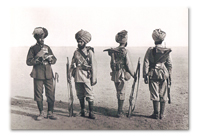
A large force was assembled for the relief of Fort Chitral which was besieged by Afghans. The force was commanded by Major-General Sir R. C. Low which included 6 battalions of British Infantry and 8 regiments of Indian infantry as well as artillery and sappers. At the same time the 32nd Pioneers was engaged in road-building in the Gilgat agency. Their CO Colonel J. G. Kelly was directed to assume command in that area and ‘make such arrangements as seemed to him to be possible to effect the relief of Chitral though he was prohibited from undertaking any operations which could afford a reasonable prospect of success.’
 |
|
|
At the fort there was a sortie on 3 March in which the British suffered 23 killed and 33 wounded, after which the place was under attack by Sher Afzal and his tribesmen who kept up the pressure for 46 days, making repeated attempts to storm the fort. Colonel Kelly defied orders by marching from Gilgat on 23 March 1895 with 2 guns of the No.1 Kashmir Mountain Battery and nearly 400 men of the 32nd Bengal Infantry (Pioneers). He was later reinforced by 40 Kashmir Sappers and 150 irregular troops. They passed Ghizr on 31 March and in early April succeeded in getting over the Shandur Pass (12,230 ft above sea level). This was an amazing feat considering the severely cold weather and the depth of the snow. On 9 April they encountered the tribesmen at Chakalwat which was heavily fortified.
Kelly’s force broke through this defence with the loss of 4 men wounded. On the same day they relieved Lieutenant Moberley at Mastuj fort. He now had the garrison of 100 men of the Kashmir Rifles to add to his relieving force. On 13 April they fought the enemy at Nisa Gol where the tribesmen were once more found to be in a well protected position. But the force overcame this difficulty, inflicting 160 casualties but sustaining only 20 themselves. They reached Chitral on 20 April. Sher Afzal withdrew his men when he heard of the approach of Kelly’s force.
|