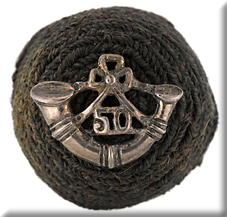
History
This battalion is not to be confused with the Gurkha battalion raised in 1815, known as the Kamaon Battalion which, in 1864, became the 3rd (Kamaon) Gurkha Regiment.
World War One
A battalion of Kumaonis was raised at Ranikhet in October 1917 as the 4th Battalion 39th Garhwal Rifles, changing its name the next month to the 4th Battalion 39th Kumaon Rifles. Kumaonis were not new to military service, having previously been employed in the Gurkha regiments, Garhwal Rifles and the Burma Military Police. In April 1918 the title changed again to become the 1st Battalion 50th Kumaon Rifles, and in May they sailed for Egypt where they joined the 60th London Division to serve with distinction in Palestine, alongside the 2nd Battalion 97th Deccan Infantry (which became the 3rd Battalion 19th Hyderabad Regiment). After the war the 1/50th went to Constantinople to join the Army of the Black Sea. On 1 June 1918, whilst the battalion was in action in Palestine, a second battalion was raised at Bareilly, made up of two companies of Kumaoni Rajputs, one company of Kumaoni Brahmins and one of Garhwali Brahmins. They were earmarked for service in Salonika but the armistice changed their destination and they were consigned to operate on the Northwest Frontier. In March 1923 the second battalion was disbanded.
Palestine 1918
The first battalion was placed in the 180th Brigade, 60th London Division. Other Indian battalions were the 2nd/Guides and 2nd/30th Punjabis. The 1st/50th Kumaon Rifles joined the Division on 23 July 1918 and took part in the Battles of Megiddo, Sharon and Tulkarm, fought in September 1918.
Post WW1
Initially the 1/50th Kumaon Rifles had been allocated to the 9th Jat Infantry Group due to the proximity of the Jat Training Centre at Bareilly to the Kumaoni recruiting areas, but on 15 March 1923 the battalion was placed with the 19th Hyderabad Regiment as the 1st Kumaon Rifles, a one-class battalion. The other six battalions of the 19th were formed from the former Hyderabad Regiments 94th, 95th, 96th, 97th, 98th and 99th. The Deccani and Hindustani Muslims were mustered out in 1923 to be replaced by a company of Kumaonis. After 1930 the composition of each battalion was one of Kumaonis, one of Jats and one of Ahirs and mixed. The Kumaon Rifles remained a one-class battalion.
WW2
The Kumaon Rifles were in Hong Kong initially but were sent to the Middle East as part of the 24th Indian Infantry Brigade. They took part in the invasion of Iran in 1941 and remained in Persia for the rest of World War Two. After the war the 19th Hyderabad Regiment was renamed the 19th Kumaon Regiment, and the Kumaon Rifles became the 3rd Battalion Kumaon Regiment (Rifles). The whole regiment became part of the Indian Army after 1947 as they were a Hindu unit.
|