

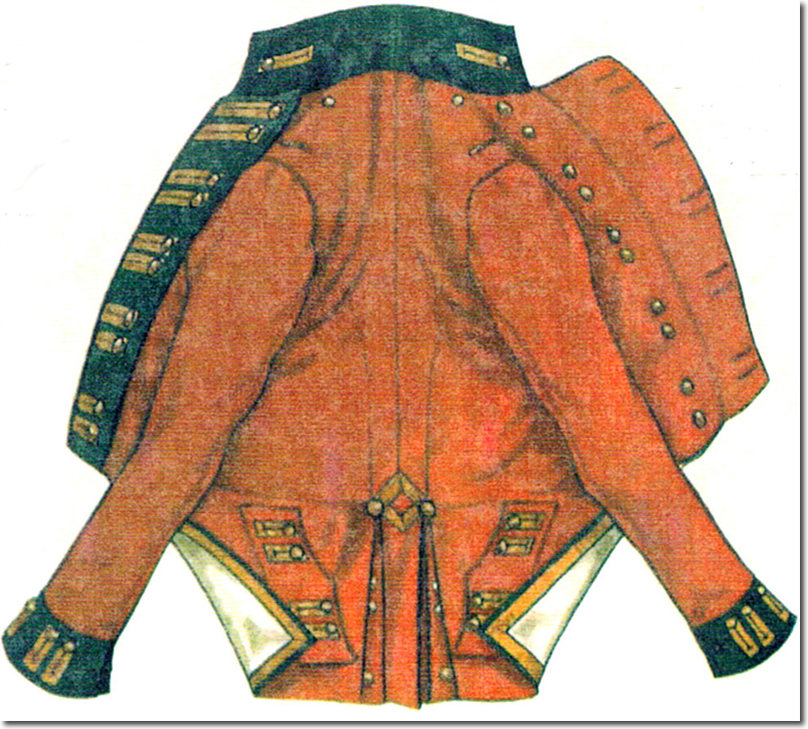
Officers’ jackets were worn buttoned up for military duties, either to the neck or with the top four buttons undone so that the lapels could be folded back, exposing the facings and gold lace button-hole loops. The back of the jacket shows the complex arrangement of the coat-tails which evolved from 18th century coats. The turn-backs are white with a green edge and gold laced just inside the edge. These are plain but for officers in grenadier or light companies there would be either an embroidered bomb or stringed bugle. The turn-backs partially cover the false pocket flaps that are decorated with gilt regimental buttons and gold lace loops. In the centre of the coat-tails are two more buttons at waist-level, connected with a square of gold lace.More buttons are concealed in the folds below this.
The left of the jacket in this illustration shows the lapel folded back all the way down to the waist to reveal the green facing colour and the gold lace in pairs. The right side shows the other side of the lapel which could be buttoned over to show a red-fronted jacket. On formal occasions and at levées the lapels would be folded back on both sides to present a showy green plastron with gold lace and buttons. In that case the jacket would be fastened with hidden hooks and eyes. This way of wearing the jacket became more prevalent in the 1820s.
The collar and cuffs are also in the same facing colour of dark green, the collar having a single lace loop and button on each side, and the cuffs each having four loops and buttons, in pairs. On the shoulders, there is a small gilt button on each side, near the neck, for securing a gold epaulette which also attached to a metal bar near the shoulder. This illustration is by Bryan Fosten, published in ‘Campaigns’ magazine in the 1970s. The basis for the illustration was a jacket belonging to Captain T Brown.

