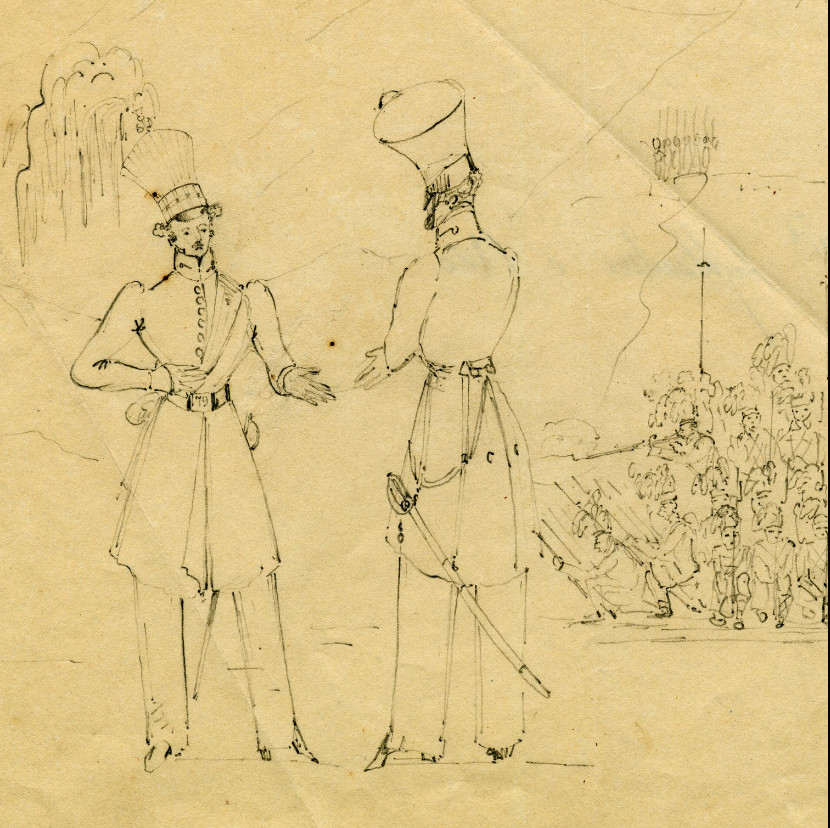
The engraver, William Heath is well known for his military subjects, bordering on caricatures, but he always took care to depict the uniforms accurately. This etching is based on a sketch made by Captain Unett who does not appear on the list of officers of the 79th.
The officer, on the left, is in the Grenadier Company. He has bullion-fringed wings which identifies him as a flank company officer, but the white plume on his bonnet confirms him as a Grenadier. His jacket has wide green lapels covered in gold lace and gilt buttons. His waist-belt is indistinct but supports a dirk. The sporran is of interest as it is based on observation and can therefore be relied on to be accurate. He has a broadsword suspended from a white leather shoulder-belt, and his crimson sash is worn over the belt but on the left shoulder. Also, a small gilt gorget can be seen at his throat; this was discontinued by 1830.
The soldier with a green plume is from the Light Company. The back view gives us an idea of how the fly was attached to his shoulder. This is a piece of tartan material that was a lighter alternative to the upper part of the belted plaid, and allowed to ‘fly’ out behind the wearer on the march. The soldier has no rank badges and does not carry a broadsword. His armament is a bayonet suspended from the white shoulder-belt. There is no belt on the left shoulder as there would be when he is armed with a musket. That would support a black leather ammunition pouch.
The stocky figure on the right is a sergeant of the Grenadier Company, armed with a sword as well as a bayonet. The front of his jacket can be seen from this angle and shows white lace button-hole loops in pairs. He has a sash on his left shoulder which is crimson with a green central stripe, although the stripe looks wrongly coloured. His sporran is special to his ranks, being similar to the officers but poorer quality. The white hackle on his bonnet is kept in place with a brass plume holder that looks as if it is part of a regimental badge on a black cockade.
Amongst the background figures are officers wearing frock coats and white summer trousers. Two of them have tall shakos with drooping feather plumes. This order of dress can be seen in a sketch of 1825, probably by F Newhouse, (see below) that shows an officer in a shako with a diced band and voluminous plume on top. His waist-belt clasp clearly shows the number 79. The print and the sketch were found on the Brown Digital Repository.