

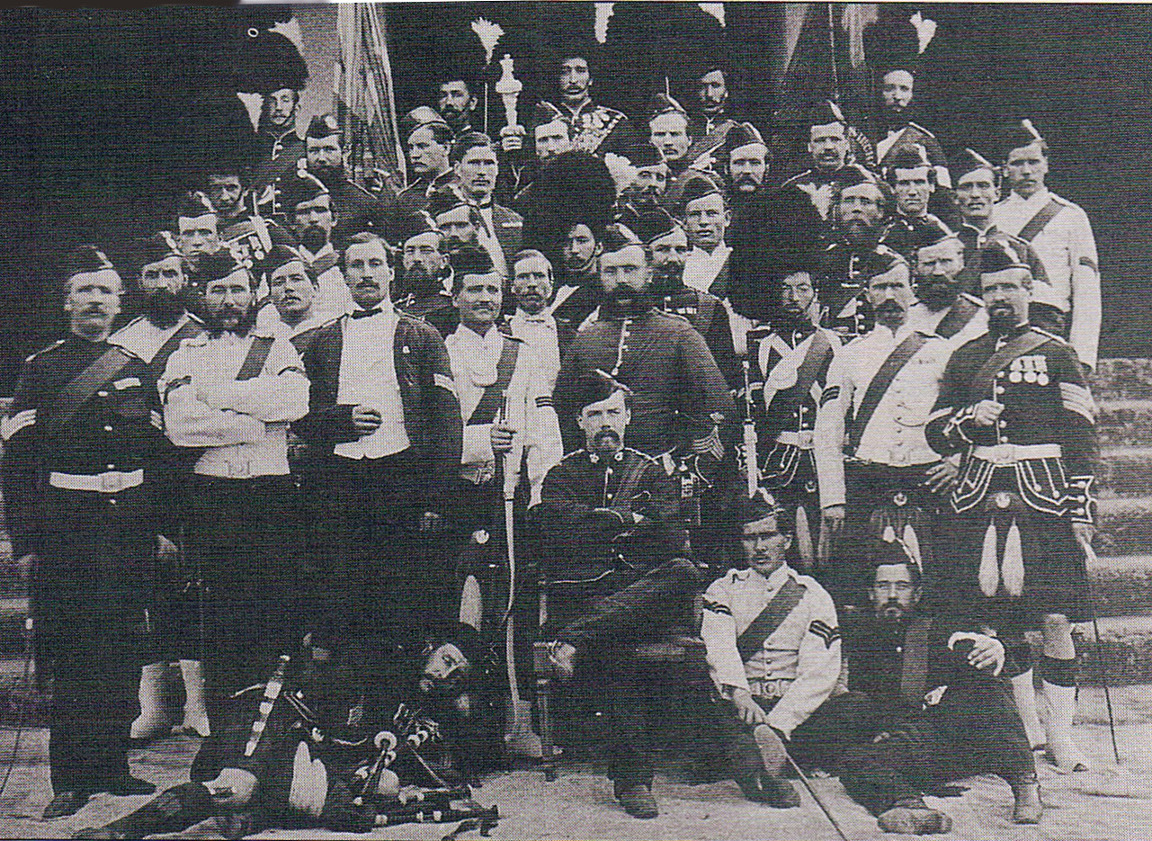
Non Commissioned Officers of the 79th Cameron Highlanders pose in a variety of regimental uniforms for this photo taken in India in 1867. The Army List of that year states that the regiment was in Roorkee while the 1866 List gives Murree as their station. The men are of differing ranks and there is one officer, Lieutenant Arthur Hume, the Adjutant, seated on a chair with arms and legs crossed. He has a red undress frock which has gold braid around the edges and embroidered crown rank badges on his collar.
Behind Adjutant Hume is the large figure of the Regimental Sergeant Major wearing a red shell jacket with gold braid edging and four gold stripes that have an embroidered crown above. These rank insignia are on both forearms. On the right of the photo, a Colour Sergeant wears dress uniform apart from his undress cap. On the left side of the cap he has a regimental badge with metal chevrons above and 79 below as seen in the 1850 photo of Colour Sergeant Leighton. The clothing instructions of 1862 stipulated that colour sergeants of light infantry, fusiliers and Highland regiments should have their single-stripe Colour badge on the right arm and three gold lace chevrons on the left arm. Rank badges on both arms was the custom in flank companies but they were discontinued in 1862.
Another colour sergeant standing behind the RSM’s left arm is in marching order. His chest is covered in straps. The broad white strap on his left shoulder is for the ammunition pouch on his rear right hip. It has a small white pouch on the front for percussion caps. The strap on the other shoulder is for his haversack. Two straps on his shoulders hold valise equipment on his back. He also has his sergeant’s sash on the left shoulder as do the rest of these NCOs. This is at odds with the photo of Sergeant Simpson photographed in 1859 who wears his sash on the right shoulder. It is notable also that the Adjutant and RSM have full sashes, bunching up to form folds, made of crimson silk.
Some of the sergeants wear white waist-length drill jackets with red chevrons on each arm. These are worn with a white leather waist-belt that holds the bayonet, and either kilt and sporran or trews. A piper lies on the ground in an undignified way, and on close inspection appears to have inverted chevrons on his sleeve so that he is in fact the Pipe Major. His counterpart in the pipes and drums, the Drum Major stands at the back in full dress, holding his silver-topped mace that has the figure of St Andrew prominently on show. He is flanked by Colour Sergeants who escort the Colours.
The sergeant’s mess uniform is modelled by the sergeant standing behind the recumbent Pipe Major. His jacket is based on the red shell jacket with the green collar turned down, forming lapels. A white shirt and black bow tie is worn with a white waistcoat. On the left of the photo is a sergeant in distinctly unScottish uniform who may be attached from another regiment. He wears his crimson sash higher up on his chest, allowing two rows of medal ribbons to be seen. The men in this photo are veterans of the Indian Mutiny and the Crimean War but few medal ribbons are on show.

