

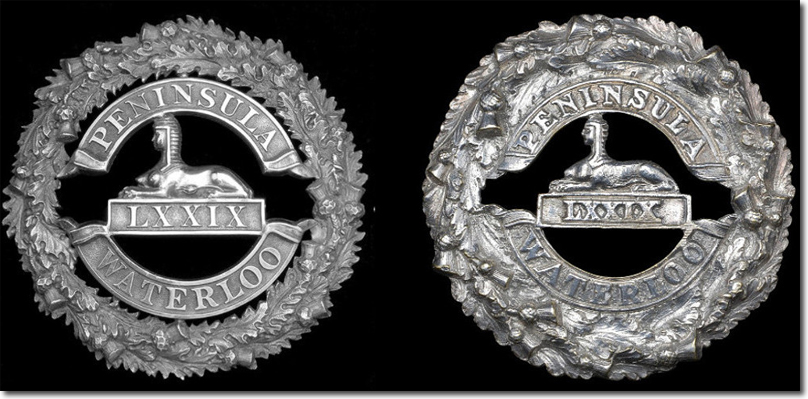
A wreath of thistles surrounds three battle honours. The Sphinx was the first honour, conferred on 6 July 1802. PENINSULA was awarded on 6 April 1815 and WATERLOO on 8 December 1815. Seven other battle honours for the Peninsula campaign and Egmont-op-Zee were awarded between 1816 and 1818 but the brooch confined itself to the three honours. The Sphinx usually has EGYPT inscribed below it but the regimental number LXXIX has replaced it. The number 79 was dropped from the regimental title in 1881 but as the regiment was one of the rare units to avoid amalgamation until 1961, the pride in the original number remained.
Two examples of the regimental plaid brooch are shown here to compare differing quality and slightly differing patterns. The brooch of the Cameron Highlanders was worn by officers when wearing the shoulder plaid in full dress. It was worn on parade by officers who were mounted such as the CO and adjutant, but in levée dress for the other officers.
The date of the brooch is not clear. As it does not have a crown it could have been worn during the reigns of Queen Victoria, Edward VII or George V and photos of officers show this to be the case. An early portrait of Ensign George Scovell dated 1854 shows him wearing full dress with a plaid brooch that does not quite match the pattern shown here. Scovell is wearing the pre-1855 uniform so it is possible that the brooch shown here was first adopted in 1855 to go with the new uniform.

