

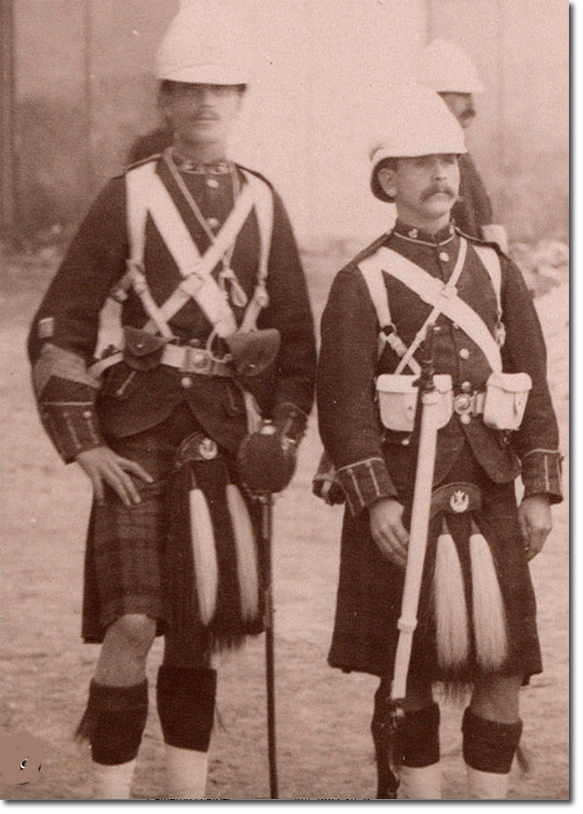
The rank of Drum-Major was down-graded to Sergeant-Drummer in 1881, although this made little difference to the status of the individual holding that rank. In dress uniform he would have the embroidered sash on his shoulder and carry a silver-topped mace. But on campaign in Egypt in 1882 Sergeant-Drummer Anderson, in this photo, appears little different from other senior NCOs such as Quartermaster Sergeant Emslie and RSM Joseph Campbell. His rank is shown on the right sleeve only, as four gold lace inverted chevrons with an embroidered drum badge above. His scarlet frock tunic has gold lace on the collar and gold braid along the bottom of the collar, the top edge of the gauntlet-style cuffs, and forming button-hole loops on his cuffs and false pocket flaps. Also the scarlet shoulder straps are edged with gold braid. The collar badges, crowned thistles, were adopted by Royal decree in 1873.
He has the same plethora of white strapping on his upper body as the private next to him. The white leather shoulder straps are part of his 1871-pattern valise equipment, although the valise and rolled greatcoat are not carried in this order of dress. His white waist-belt supports a broadsword and a brown leather holster for his pistol. A lanyard around his neck is attached to the butt of the pistol. There is also a small brown leather pouch in his belt, for spare ammunition. The other white straps are for the canvas haversack slung on his right shoulder, and a leather strap on the other shoulder for a water-bottle. He is kilted in the Cameron of Erracht tartan and has an undress sporran similar to the rank-and-file. White helmets were worn for the Egypt and Sudan campaigns.

