

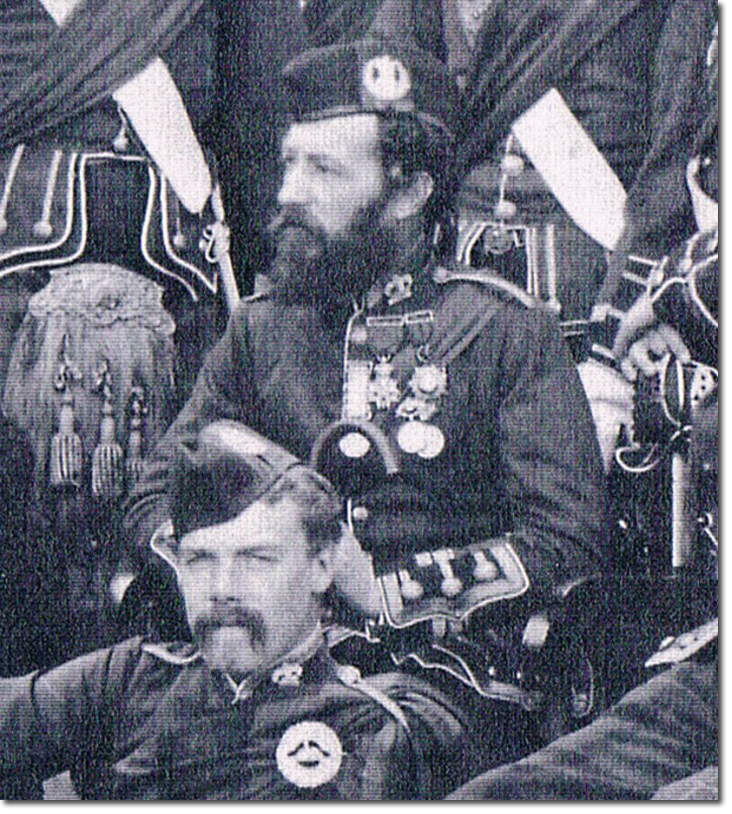
William Chauval Hodgson joined the regiment as an ensign on 18 Sep 1840 and rose to captain on 11 June 1847. He fought with the Cameron Highlanders in the Crimean War and was awarded a brevet of major on 2 Nov 1855. The regiment was sent to India to help quell the Mutiny in 1858 and Major Hodgson fought at the siege of Lucknow. By 10 July 1860 he was a lieutenant-colonel and officially placed in command of the 79th on 10 July 1864. The regiment returned to the UK in November 1872 and were stationed at Parkhurst, Isle of Wight. In February 1873 there was a royal command from Queen Victoria that the regiment should march along the east Cowes Road from Newport at a given hour on 16 Feb. Colonel Hodgson was in London at the time and an urgent message was sent to hime to return. Unfortunately he ‘took cold’ on the journey back to the Isle of Wight, but managed to attend the parade where the Queen was present. He was confined to his room the next day and on the fifth day of his illness, ‘erysipelas had set in’ and within a fortnight of the parade he had died. This occurred at Albany Barracks, Parkhurst. There is a discrepancy about the date of his death. The regimental history claims that he died in 1873, but the Friends of Newport and Carisbrooke Cemeteries website quotes the Hampshire Advertiser as publishing his obituary on 6 March 1872. No actual date of his death is given.
The photo of Colonel Hodgson is a detail from a group of officers of the 79th Cameron Highlanders taken at Murree in 1866. Hodgson had been promoted to full Colonel on 10 July 1865 but he displays an embroidered crown on his collar that denotes the rank of lieutenant-colonel, a colonel would have a star as well as a crown. The officer in front of him is a lieutenant, also with a crown on his collar, but with less gold lace around the top of his collar. Colonel Hodgson has a fine array of medals, for the Crimean War and Indian Mutiny. he also has the Order of the Medjidi, fifth class and the Legion of Honour from the French commanders.

