

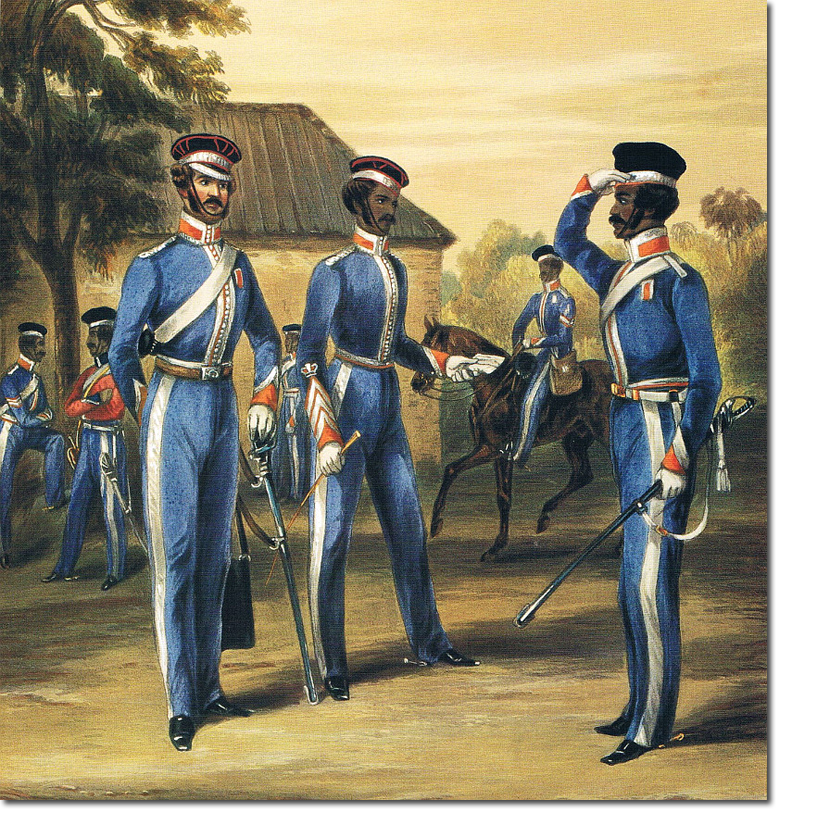
This Ackermann print was published on 8 Sep 1848, based on the artwork of Henry Martens, but copied from sketches made by Cornet Charles Wyndham, an officer who joined the 9th BLC in August 1843. The date of the original sketches made by Wyndham is not known but probably c1846. The regiment had recently returned from a hard campaign in Sindh where they had fought with distinction at Meeanee and Hyderabad in 1843. Some of the figures in this print have medal ribbons for the campaign which should be the rainbow watered Military Ribbon of India.
All the men are in undress uniform, or stable dress, French grey with orange facings and silver or white lace. They have forage caps and pouch-belts for their pistol ammunition. The officer, on the left, is distinguished by having a peak on his cap. It is edged with silver wire embroidery and has a silver lace cap-band. The dark blue top of the cap is edged with red piping and there are ‘quartering welts’ and red edges to the cap-band. Next to him is the Havildar-Major indicated by the three inverted silver stripes and crown above. His rank was the equivalent of a regimental sergeant-major in the British army. Later in the 19th century his rank would have been Kot Daffadar but the infantry terms of havildar and naik were used in the cavalry up until c1860.
The officer has a brown leather waist-belt to support his sword and plain black leather undress sabretache. The trooper, or sowar, who is saluting him has a white belt and sword knot, and no sabretache. His cap has a white cap-band and a red edge, but no quartering welts like the officer and havildar-major. They all wear French grey trousers with either a white or silver stripe depending on rank. The other image of the 9th BLC in undress, by Wyndham, shows dark blue trousers. French grey may have been for summer, although white trousers were the more usual summer-wear for India.
The background figures provide valuable information about the Bengal Light Cavalry. The man in the red jacket, with blue facings, has a trumpet strung from his left shoulder, so telling us that the trumpeters’ uniform followed the old custom of reverse colours for musicians and drummers. On the extreme left is a naik (corporal) with two silver stripes, edged with orange, on his right arm. The mounted man has one stripe on his left arm and a badge above the stripe that looks like a rough-riders’ spur. He has no sword but carries a bag. This indicates that he is a messenger or an official (moonshee) of some kind. If he is mounted to ride to another location outside the barracks he would need to be armed, so the lack of a sword is puzzling. Also the stripe on his left arm, when rank was indicated in the cavalry, by stripes on the right arm only.

