

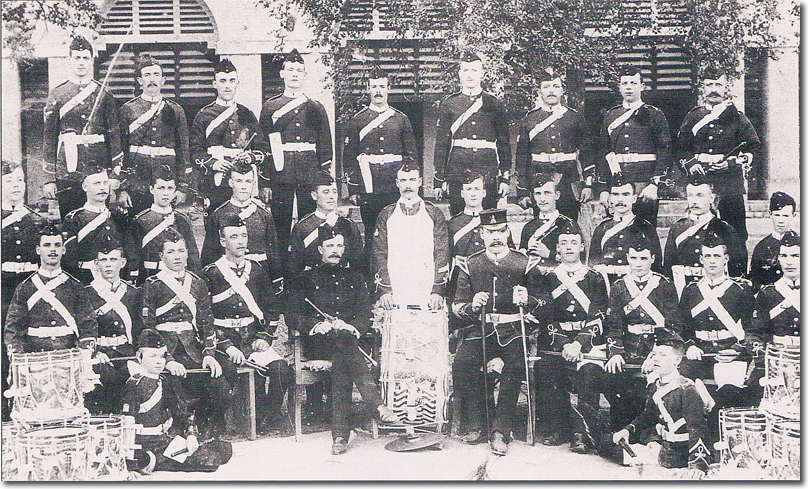
This group photo of the corps of drums of the 1st Battalion was taken in India at the turn of the century. The drummers are wearing undress red frock tunics which have white collars. The cuffs have white cord forming a point and a trefoil. The young boy seated on the ground on the right has a single good conduct stripe for two years service. Two stripes represented 6 years.
The drums are piled on each side, with the bass drum in the centre. The side drummers and tenor drummers have white belts crossed on their chest, the belt on the right shoulder being the drum carriage and the other belt was a pouch-belt for sheet music. They were all trained to play drums, bugle and fife. The back row of drummers have white fife cases attached to their waist-belt. Many of them have black or dark green tassels on the end of their bugle cords hanging on their left shoulder.
They have blue field service caps, normally worn for undress occasions. These caps replaced the glengarry caps in the mid 1890s. The drum major sits to one side of the bass drum holding his sword and short staff. His title was sergeant-drummer from 1881 but on dress occasions he would wear the embroidered drum-major’s sash and white gauntlets. His tunic is the undress frock, as indicated by the 5 buttons down the front, but he has white edging to the front and hem of the tunic, and shoulder wings which are probably laced with gold. He has an officer-style peaked forage cap with an embroidered Britannia badge.
The officer sitting the other side of the bass drum is in undress blue patrols. He is probably the Adjutant who at that time was Captain Arthur Edward Lascelles, appointed Adjutant of the 1st Battalion on 15 Mar 1902. He was later commanding officer of the 1st Bn Worcestershire Regiment.
Regimental Details | Band and Drummers

