

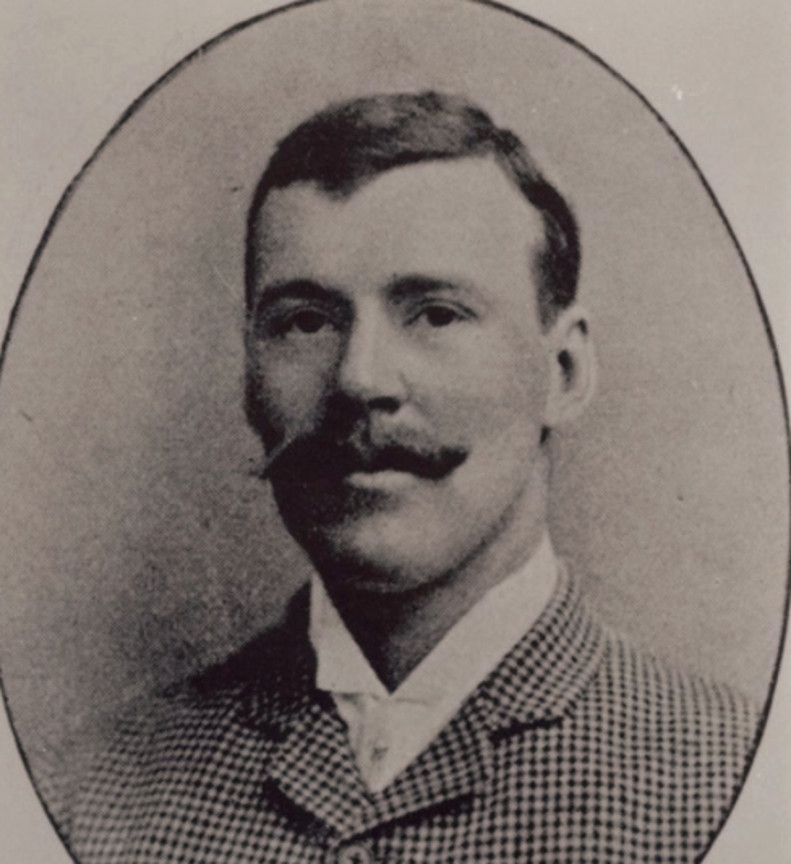
The citation for Lieutenant Manners-Smith’s award of the Victoria Cross:
‘For conspicuous bravery when leading the storming party at the attack and capture of the strong position occupied by the enemy near Nilt in the Hunza-Nagar Country, on the 20th December 1891. The position was, owing to the nature of the country, an extremely strong one, and had barred the advance of the force for 17 days. It was eventually forced by a small party of 50 rifles, with another of equal strength in support. The first of these parties was under the command of Lt Smith, and it was entirely owing to his splendid leading, and the coolness combined with dash he displayed while doing so, that success was obtained. For nearly 4 hours, on the face of a cliff which was almost precipitous, he steadily moved his handful of men from point to point, as the difficulties of the ground and showers of stones from above gave him an opportunity, and during the whole of this time he was in such a position as to be unable to defend himself from any attack the enemy might choose to make. He was the first man to reach the summit, within a few yards of one of the sangars, which was immediately rushed. Lieutenant Smith pistolled the first man.’
John Manners-Smith was born in Lahore on 30 August 1864, the fifth son of Surgeon-General Charles Manners-Smith of the Indian Medical Service. He was educated in England at Trinity, Stratford-upon-Avon, and King Edward VI School, Norwich. After Sandhurst he was commissioned into the Norfolk Regiment in 1883 and transferred to the Indian Staff Corps in 1885. Following two years with the 2nd Sikh Infantry he became a lieutenant in the 5th Goorkha Regiment, but was soon detached to the Political Department as Military Attaché to the Foreign Office, Government of India.
He accompanied Sir Mortimer Durand, Foreign Secretary of India, on his missions to Sikkim in 1888, and was on special duty in 1891 in Gilgit during the Hunza-Nagar Expedition. He joined the Field Force, which included the 5th Gurkha Rifles, as a Political Officer, enabling him to take part in the attack on Nilt Fortress in December and to lead riflemen from his regiment in the almost impossible assault.
He was gazetted for the Victoria Cross on 12 July 1892 and received the medal later that autumn. In 1896 he married Bertha Mabel Latham. His political career continued for more than two decades, with appointments in Kashmir, Bundelkhand, Balochistan, Rajputana, Central India and Nepal between 1889 and 1919. He also served militarily on the Punjab Frontier and in the Tirah Expedition of 1897–98, earning a campaign medal with three clasps. In 1917 he became Political Resident and Agent to the Governor-General in Rajputana.
After the First World War he returned to England, but ill health forced him into the Central London Nursing Home, where he died on 6 January 1920 at the age of 55. He is buried in Kensal Green Cemetery.
Sir Mortimer Durand wrote:
‘Manners-Smith was as kindly and trustworthy as he was brave. One could depend on him in all circumstances, not only upon his courage, but also upon his unselfish devotion to duty. Loyalty was the mainspring of his character.’
A fellow officer recalled:
‘He was a man of the toughest physique, great hardihood, unbounded energy, and indomitable courage. He was a keen sportsman and devoted to big game shooting, and the tough tribesmen of the high Himalayan valleys used to declare that he was the only Englishman who could surpass them on their own mountainsides.’

