

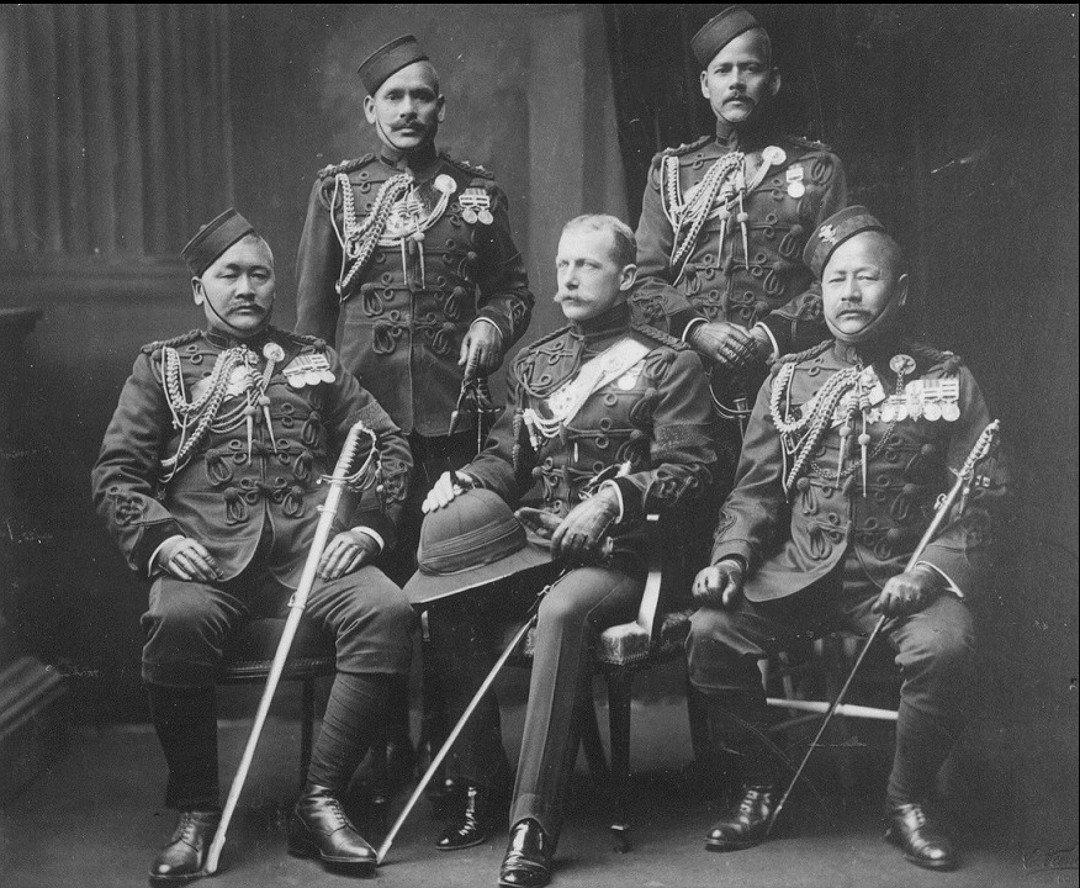
The King’s Indian Orderly officers for 1910 faced a much different court season than they expected. Usually the Indian officers were required to attend grand social functions and smart parades, but 1910 was the year of the death of King Edward VII. The season normally lasted from April to August but the King died on Friday 6 May. His body lay in state in Westminster Hall until the funeral on 20 May. The four Gurkha officers (two Gurkhas, two Garhwalis) took turns to stand guard beside the coffin in Westminster Hall for the two weeks, day and night, one hour on, three hours off.
Seated left: Subadar-Major Singbir Ghale Bahadur OBI, 2nd Battalion 3rd Queen Alexandra’s Own Gurkha Rifles. His rifle green tunic has black velvet collar and cuffs.
Seated centre: Major Hugh St Aubyn Wake, 2nd Battalion 8th Gurkha Rifles. This battalion was formerly the 43rd Gurkha Rifles, raised in 1835 as the Assam Sebundy Corps. They were titled 43rd Gurkha Light Infantry in 1886, and briefly the 7th Gurkha Rifles in 1903, but became the 2nd Battalion 8th Gurkha Rifles in 1907. The green uniform has black velvet facings. Major Hugh Wake was killed in action at Festubert on 30 October 1914. (see photo of a memorial plaque in Courtenhall, below)
Seated right: Subadar-Major Santbir Gurung Sardar Bahadur IOM OBI, 2nd Battalion 2nd King Edward’s Own Gurkha Rifles (The Sirmoor Regiment). His uniform is rifle green with scarlet collar and cuffs.
Standing left: Subadar Bude Sing Negi, Garhwali, 2nd Battalion 39th Garhwal Rifles.
Standing right: Subadar Baij Sing Rawat, Garhwali, 1st Battalion 39th Garhwal Rifles.
The 39th Garhwal Rifles originated from the 2nd Battalion 3rd (Kamaon) Gurkha Regiment, raised in 1887. In 1890 they were numbered 39th (Garhwali) Regiment of Bengal Infantry. The 2nd Battalion was raised in 1901. Both battalions were stationed at Lansdowne in 1910. Each battalion consisted of eight companies of Garhwalis, with 16 British officers. The Garhwalis were similar to Gurkhas but usually taller. Their home was the Himalayan foothills west of Nepal. The uniform was similar to the Gurkha uniform, these officers having black velvet collars and cuffs.
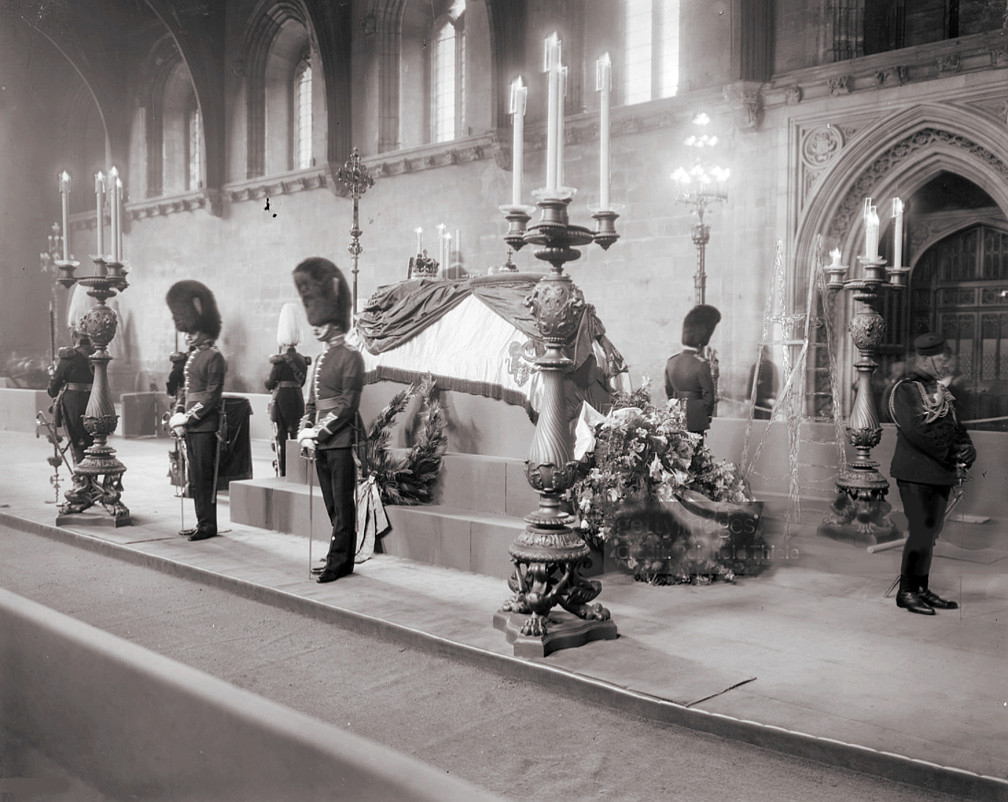
This photo shows one of the Gurkha officers (probably Subadar-Major Singbir Ghale, 3rd Gurkhas) standing guard at the end of the catafalque, to the right of the photo. The other guards are officers of the Grenadier Guards, all resting their hands on the hilts of their drawn swords. This photo must have been taken before the public were allowed to file past. These officers, with bowed heads, were only able to see peoples’ feet and legs as they passed by.
The four Gurkha officers of the King’s Indian Orderlies took it upon themselves to stand guard in Westminster Hall with their head bowed and their back to the catafalque; one at a time, while the other three rested, so that for the whole period of the King’s body lying in state there, they took it in turns to stand guard for a full hour, rest for three hours, and return again. This went on for two weeks.
The other officers standing guard were from the Brigade of Guards who were numerous enough to take longer rests, but the four Gurkhas, the only Indian officers in Britain at that time, insisted on carrying out this formidable task. The task was even more difficult than can be imagined. The stiff collar of the uniform meant that the continuously bowed head caused them pain.
Then there was the problem of eating. Indian troops of different castes had, throughout the time of the British India administration, been obliged to provide and cook for themselves because of strict dietary requirements. In Rudyard Kipling’s story, In The Presence, this is recounted by a young Sikh sergeant-major (havildar-major) who had been to England, telling the story to fellow Sikhs, including his uncle, the Subadar-Major:
“And it was their honour and right to furnish one who should stand in the Presence by day and by night till It went to burial. There were no more than four all told — four old men to furnish that guard.”
“Old? Old? What talk is this of old men?” said the Subadar-Major.
“Nay. My fault! Your pardon!” The Havildar-Major spread a deprecating hand. “They were strong, hot, valiant men, and the youngest was a lad of forty-five.”
“That is better,” the Subadar-Major laughed.
“But for all their strength and heat they could not eat strange food from the Sahibs’ hands. There was no cooking place in the Temple [Westminster Hall]; but a certain Colonel Forsyth Sahib, who had understanding, made arrangements whereby they should receive at least a little caste-clean parched grain; also cold rice maybe, and water which was pure. Yet, at best, this was no more than a hen’s mouthful, snatched as each came off his guard. They lived on grain and were thankful, as the saying is.”
“One hour’s guard in every four was each man’s burden, for, as I have shown, they were but four all told; and the honour of Our Armies in Hind was on their heads. The Sahibs could draw upon all the armies in England for the other watchers — thousands upon thousands of fresh men — if they needed; but these four were but four.”
“The Sahibs drew upon the Grenadiers for the other watchers. Grenadiers be very tall men under very tall bearskins, such as Fusilier regiments wear in cold weather. Thus, when a Grenadier bowed his head, but a very little over his stock, the bearskin sloped and showed as though he grieved exceedingly. Now the Goorkhas wear flat, green caps…”
“I see, I see,” said the Subadar-Major impatiently.
“They are bull-necked, too: and their stocks are hard, and when they bend deeply — deeply — to match the Grenadiers — they come nigh to choking themselves. That was a handicap against them, when it came to the observance of ritual.”
The full hour’s standing guard beside the King’s coffin proved too much for the Grenadiers so it was cut to a half-hour. However, the Gurkha officers insisted on remaining for the full hour, every fourth hour, night and day, for two weeks.
Flowers and wreaths were sent from world leaders to express their condolences and respect for King Edward VII. These were sent to Windsor Castle where they were accepted as funeral offerings. The Gurkha officers and Colonel Forsyth Sahib bought flowers and had them formed into a wreath but this had to be delivered to Windsor. Forsyth offered to make the delivery because it was felt only fitting that an officer of the Indian Army should do this. However, Forsyth had to admit that he was a desk-bound staff officer and the Gurkhas had recently been on active service. So as a matter of honour, the four, or at least the three off-duty officers, felt that they should all go to Windsor to deliver the wreath, leaving one of them on guard at Westminster Hall.
“Within that next hour they hired a large and strong mota-kahar for the journey from the Temple to Wanidza [Westminster to Windsor], which is twenty koss or more and they promised expedition. But he who took their guards said, ‘It is not seemly that we should for any cause appear to be in haste. There are eighteen medals with eleven clasps and three Orders to consider. Go at leisure. I can endure.”
“So the three with the offerings were absent three hours and a half, and having delivered the offering at Wanidza in the correct manner they returned and found the lad on guard, and they did not break his guard till his full hour was ended. So he endured four hours in the Presence, not stirring one hair, his eyes abased, and the river of feet, from the knee down, passing continually before his eyes. When he was relieved, it was seen that his eyeballs worked like weavers’ shuttles.”
The full Kipling story In the Presence can be read at: http://www.telelib.com/authors/K/KiplingRudyard/prose/DiversityOfCreatures/presence.html
