|
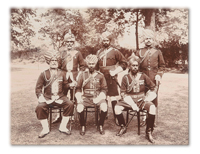
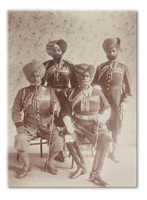
The appointment of officers from the Indian Army to attend the King during the summer court season began in 1903. It was the year after the Coronation of King Edward VII (9 August 1902), and it was he who ordered the annual attendance. The Army in India had undergone a reorganisation at the turn of the century under the authority of Lord Kitchener, Commander-in-Chief. He began the reorganisation in 1895, and it was completed in 1903 so that regiments of the Bengal, Bombay and Madras Presidencies were renumbered as a unified army. The Indian officers of 1903 belonged to regiments numbered before the reorganisation.
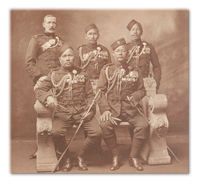
The King’s Indian Orderlies were appointed annually, consisting of a British officer and between three and five Indian officers, usually four. They normally came from different regiments of the cavalry, infantry, artillery, engineers or other corps. They were transported to London to spend the season (April–August) attending one of four monarchs: Edward VII, George V, Edward VIII and George VI. They were usually photographed in their dress uniforms, with the addition of gold-plaited cord aiguillettes on the right shoulder, which signified their staff status in royal attendance.
 |
|
|
Selection was highly prestigious. Officers were chosen from across the Indian Army’s regiments, and the honour was shared among different regiments; Gurkhas, Rajputs, Mahrattas, Pathans, and Sikhs all took turns in representing India at the royal household. This diversity was deliberate: it reflected the British Raj’s emphasis on martial traditions and reinforced the image of India as a loyal contributor to imperial defence. It also emphasised the monarchs role as Emperor of India in addition to being King of England.
 |
|
|
The annual attendance was interrupted by World War One, so there were no Orderlies sent to London from 1915 to 1918. They resumed in 1919, but in 1922 the regiments were once more reorganised so that amalgamations and renumbering need to be explained when referring to the officers’ units. The 1920s also saw the introduction of King’s Commissioned Indian Officers (KCIOs) — Indians trained at Sandhurst and given full commissions — marking a step towards the “Indianisation” of the officer corps. While the Orderlies were honorary attendants rather than commissioned staff officers, their visibility at court complemented these reforms by demonstrating Indian officers in positions of trust and honour. The last attendance was in 1939, the Second World War bringing these ceremonial customs to an end. King George VI did not revive the attendances after the War, and in 1947 India and Pakistan became independent, so the British Indian Army was transferred to their respective armies. Queen Elizabeth partially restarted the tradition by having two Gurkha officers from the British Army in attendance each season.
|