

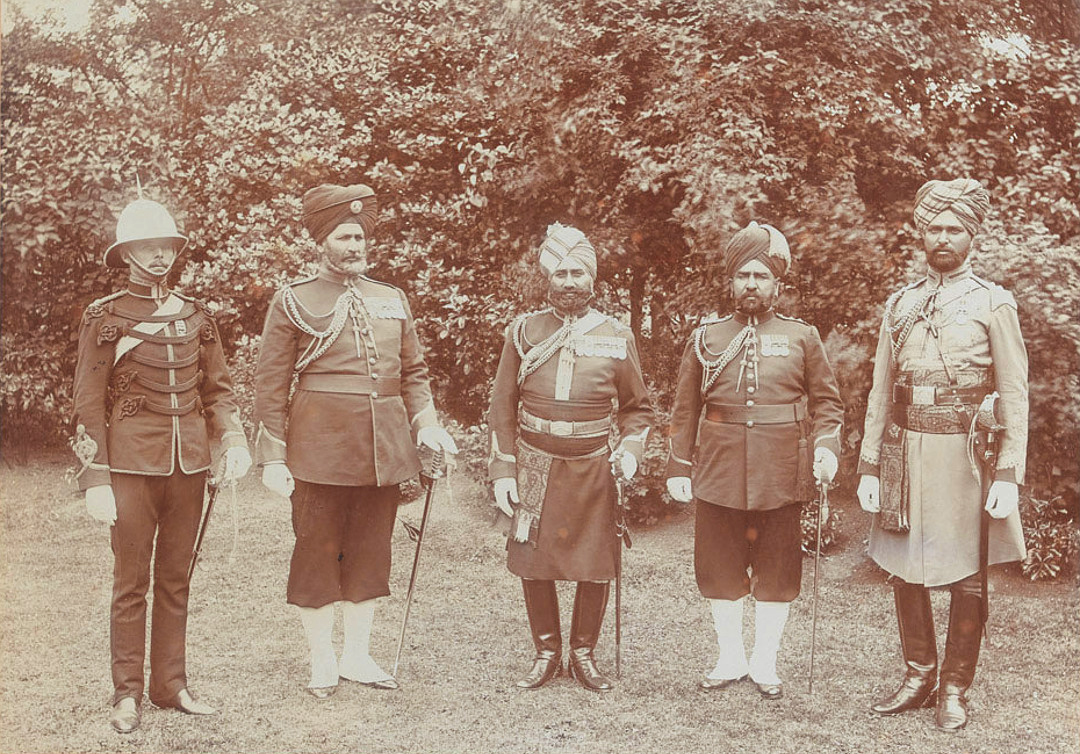
Left: Major C. H. Hawes, 23rd Cavalry (Frontier Force), formerly the 3rd Punjab Cavalry. Major Hawes’s uniform is blue with scarlet facings and gold lace. Across his chest are five rows of quadruple black cord hanging loosely. His shoulder straps are gold plaited gimp with a crown rank badge. He wears the Wolseley pattern foreign service helmet, distinguished by its wider brim and gilt spike on top.
Second from the left: Subadar‑Major Bhagwan Singh, Sardar Bahadur OBI IOM, 14th King George’s Own Ferozepore Sikhs. This regiment became famous for their defence of Chitral Fort against Afghan tribesmen over seven weeks in 1895, and later served in China in 1900. Bhagwan Singh’s uniform is a long‑skirted scarlet tunic with yellow facings and gold lace. At his neck hangs the gilt Order of British India 1st Class. His turban appears red in coloured versions of the photograph, though it may have been blue. The regimental badge is a circular quoit enclosing the Prince of Wales’s feathers and coronet.
Third from left: Risaldar Thakur Singh, Bahadur OBI IOM IDSM, 21st Prince Albert Victor’s Own Cavalry (Frontier Force), also known as Daly’s Horse. Before 1903 this regiment was the 1st Punjab Cavalry, raised in 1849 and honoured in 1890 with the title Prince Albert Victor’s Own. His uniform is a blue kurta with scarlet facings and gold lace, worn with a red kummerband. At his neck is the gilt Order of British India 2nd Class. He also wears the Indian Distinguished Service Medal alongside the Indian Order of Merit and several campaign medals for service in Afghanistan and on the North‑West Frontier.
Fourth from left: Subadar Mul Raj, 69th Punjabis. The regiment was formerly the 9th Madras Infantry, raised in 1762. Mul Raj was a Punjabi Hindu. His uniform is a long‑skirted scarlet tunic with emerald green collar and cuffs, reflecting the traditional facings of his regiment.
Right: Risaldar Abnashi Ram, Queen Victoria’s Own Corps of Guides (Frontier Force), also known as Lumsden’s. Abnashi Ram was a Punjabi Hindu. His uniform is a drab or khaki kurta with scarlet facings and drab lace and braid. Silver shoulder chains with two rank stars mark his position. The cavalry arm of the Guides was distinguished by a brown leather pouch belt combined with a Sam Browne belt for the sword, worn over a red kummerband. He wears pale khaki breeches and black boots.
The Indian Orderly Officers were selected annually to attend the King, representing the loyalty and diversity of the Indian Army. Their uniforms, decorations, and regimental traditions displayed the breadth of service across infantry, pioneers, and cavalry. The 1913 group exemplifies the ceremonial splendour and military distinction of these officers, whose careers spanned campaigns from Afghanistan to China and the North‑West Frontier.
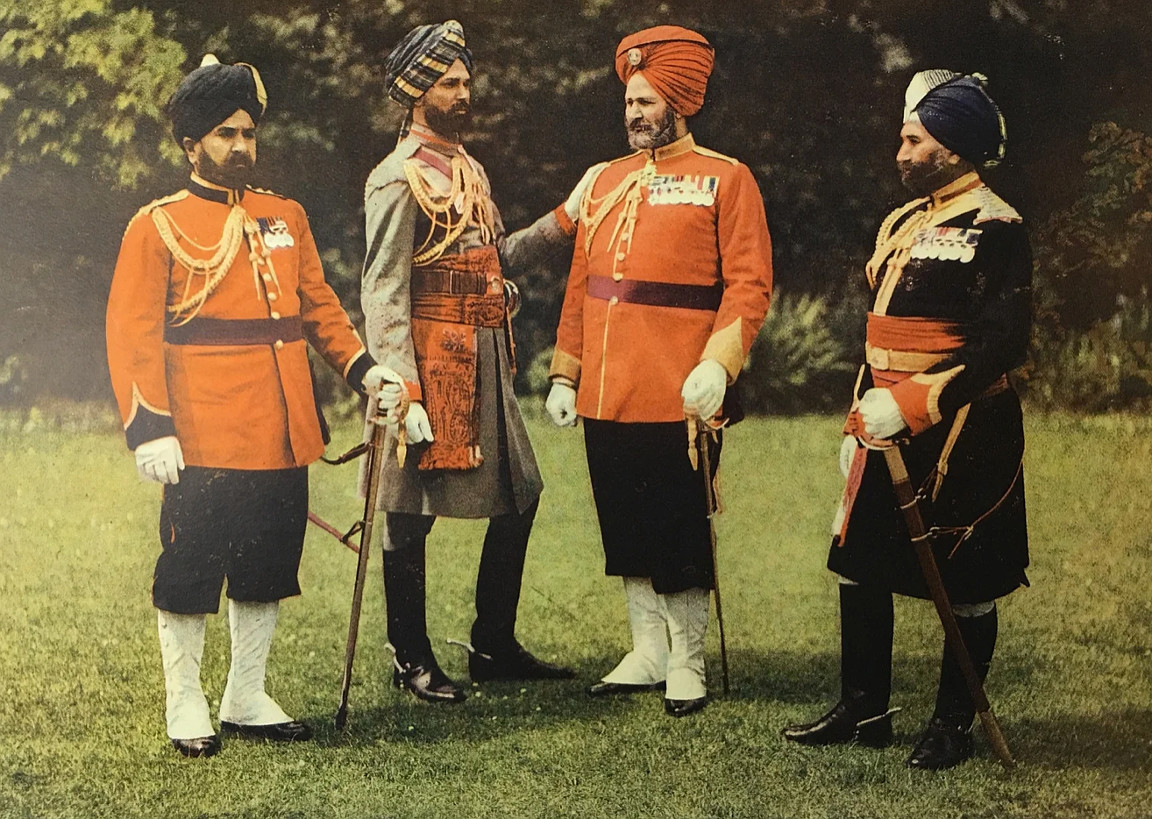
The colouring of this photo is basically correct but has some questionable aspects. The figure on the left, Subadar Mul Raj of the 69th Punjabis should have emerald green collar and cuffs. The Sikh officer second from the right, Subadar‑Major Bhagwan Singh, has a red turban as seen in the Chater painting, but Edward M. Nevins in his book Forces of the British Empire 1914 (Vandamere Press, 1992) says that the 14th Sikhs wore blue turbans. The taller man second from the left is Risaldar Adnashi Ram who is probably turning to show his right side to conceal the fact that he only has one medal. The Sikh officer on the right is Risaldar Thakur Singh of the 21st Cavalry.
