

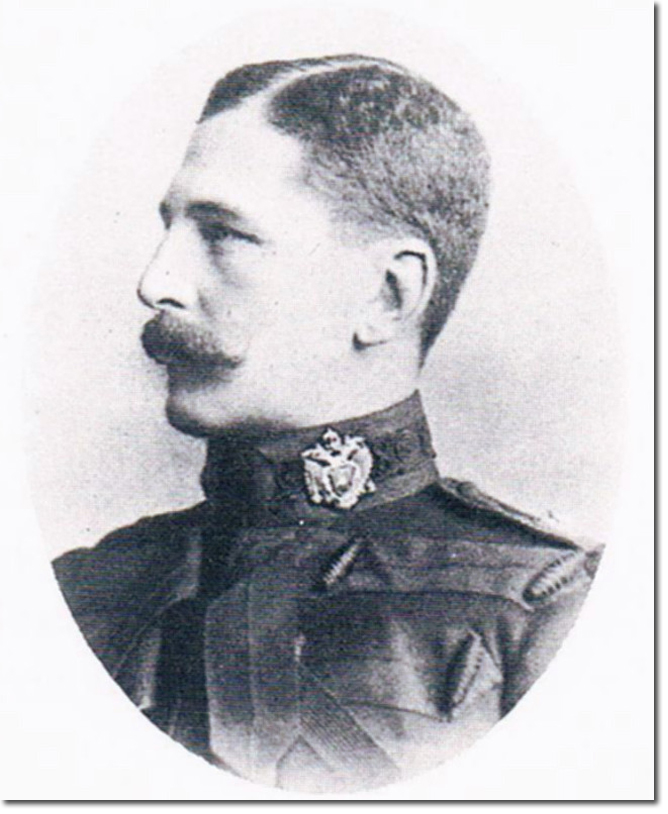
William Henry Birkbeck was born in Settle, West Riding, Yorkshire, on 8 April 1863. His father was Joseph Birkbeck, a banker, and his mother was Mary Elizabeth Mackesy. He was educated at Wellington and went on to RMC Sandhurst. William joined the King’s Dragoon Guards as a lieutenant on 25 Aug 1883. He served on the Hazara Expedition in 1888 as Assistant Superintendent of Army Signalling. He then served on the Chin-Lushai Expeditionary Force in 1889-90 in the same role. For both expeditions he was mentioned in despatches and gained the India medal with a clasp for each campaign. He was promoted to captain on 31 Jan 1890, and major on 3 April 1897. In 1893 Captain Birkbeck commanded the escort for the Duke and Duchess of York when they visited Norwich.
He was second-in-command of the KDG from 14 June 1898. But when war broke out in South Africa he was appointed Assistant Inspector of Remounts in South Africa, on 5 Oct 1899. He was promoted to Brevet Lieutenant-Colonel on 29 Nov 1900. The going had been so hard, and the wear and tear on the horses was tremendous, so much so that the supply of remounts became crucial to the success of the campaign. He had trouble buying horses until the tide of victory turned, after which purchase of horses became rapid and easy. He mostly bought them off the Basutos and wrote, ‘During the period of tension on the frontier, owing to the presence of the Boers round Wepener, not a pony could be got, and again, after the relief of Wepener, the supply flowed in, but not for gold. Cattle was the form in which the Basutos preferred payment, and another 1,000 were obtained by this means.’ After Roberts took command of the army, the need for mounted troops increased and horses had to be imported from Hungary, Argentina, India and England, so the amount of organisation and negotiation was prodigious.
Douglas Haig, with whom he studied at Staff College, commented, ‘No-one could have done this remount work as well as Birkbeck has.’ And Kitchener referred to him as ‘perturbed by nothing’ and having ‘considerable ability’. He was awarded the CB in October 1902. After the Boer War he served in the War Office under Field Marshal Sir Henry Wilson. In 1905 he was posted to the Japanese Army in Manchuria and then returned home to command the Cavalry School at Netheravon. In 1912 he was appointed Director of Remounts until 1920.
He was married in 1905 to Mabel Shaw, an American. They had three sons. He was a very tall man and, ironically for a man who had spent his life working with horses, it was a fall from a horse in 1915 that proved his undoing. He never fully recovered, but survived until his death on 16 April 1929 after a fall while hiking at St Briac, near Dinard in France. He had been appointed Companion of the Order of St Michael and St George in 1906 and Knight Commander of the Order of the Bath in 1915. The photo shows him in a frock-coat proudly displaying his KDG embroidered badge, not normally seen on a frock-coat collar.

