

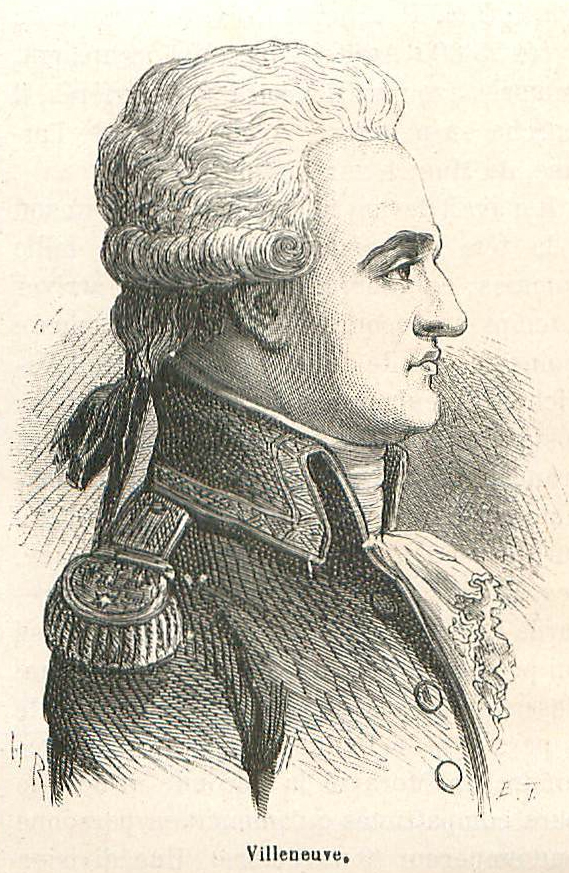
Admiral Pierre‑Charles‑Jean‑Baptiste‑Silvestre de Villeneuve (1763–1806) was one of the most controversial naval commanders of the Napoleonic era. His career spanned the collapse of the French monarchy, the turmoil of the Revolution, and the rise of Napoleon. Although remembered chiefly for his defeat at Trafalgar, Villeneuve’s career illustrates the structural weaknesses of the French Navy during this period: rapid promotion, political pressure, and the near‑impossibility of matching a Royal Navy with decades of uninterrupted sea experience.
Villeneuve entered the navy of Louis XVI and served in the War of American Independence, including the Battle of the Saintes in 1782. He remained in service through the Revolution, rising rapidly as aristocratic officers emigrated or were purged. By the late 1790s he had commanded squadrons in the Mediterranean and the West Indies and had gained Napoleon’s confidence, though the First Consul never fully trusted him. During the Egyptian campaign he served under Admiral Brueys and survived the destruction of the French fleet at Aboukir Bay in 1798 by escaping with a handful of ships — an act later used by critics to suggest excessive caution.
In 1805 Napoleon placed Villeneuve in command of the Toulon fleet and assigned him a central role in the invasion plan against Britain. The strategy required him to break out, cross the Atlantic, unite with the Brest fleet, and return to the Channel in overwhelming strength. The plan collapsed almost immediately. Villeneuve reached the West Indies but failed to act decisively, then returned to Europe pursued by Nelson. After a confused series of movements he took refuge at Cádiz, where his fleet remained blockaded. Napoleon, furious at the failure of the wider strategy, ordered him replaced.
Before the order reached him, Villeneuve sailed. On 21 October 1805 he faced Nelson off Cape Trafalgar. The Franco‑Spanish fleet was poorly trained, badly coordinated, and out‑manoeuvred. Villeneuve fought with determination but lacked the tactical flexibility to counter Nelson’s attack. The result was a decisive British victory: 18 allied ships captured or destroyed, and the end of any realistic French challenge to British naval supremacy. Villeneuve was taken prisoner and brought to England.
After Trafalgar, Villeneuve and around 200 French officers were granted parole and billeted in Bishop’s Waltham. They lodged at the Crown Inn, having surrendered their swords and given their word not to escape. Contemporary accounts describe Villeneuve as courteous, reserved, and deeply affected by the defeat. His presence in the town is one of the more unusual episodes in its history, and the Crown Inn remains the building most closely associated with his captivity.
In 1806 Villeneuve was exchanged and returned to France. His reception was cold. Napoleon blamed him for the failure of the invasion plan and for the scale of the defeat at Trafalgar, though the structural weaknesses of the French Navy were far more significant. Ordered to Paris, Villeneuve travelled slowly, apparently fearing the Emperor’s anger. On 22 April 1806 he was found dead in his hotel room at Rennes with multiple stab wounds to the chest. The official verdict was suicide, but the number and placement of the wounds made this explanation implausible to contemporaries. Many believed he had been assassinated on Napoleon’s orders to prevent him defending his conduct. No conclusive proof has ever emerged.
Villeneuve’s career reflects the contradictions of the French Navy during the Revolutionary and Napoleonic wars: political instability, rapid promotion, and the difficulty of matching a Royal Navy that had maintained continuous sea service for decades. His brief residence in Bishop’s Waltham links the town to one of the most significant naval events in European history, and his mysterious death remains one of the unresolved episodes of the Napoleonic era.


