|
|
|
Rupert suggested to me that we should join English Heritage, pointing out that unlike say the National Trust, they welcome dogs to the vast majority of their properties. I duly checked and sure enough he was correct. Better yet, Rupert doesn’t even have to pay an entrance ticket! Duly armed we set off for the home of Protector Seymour at Berry Pomeroy Castle just outside of Totnes. We came close to visiting what Elizabeth Goudge called in her book;
The Castle on the Hill
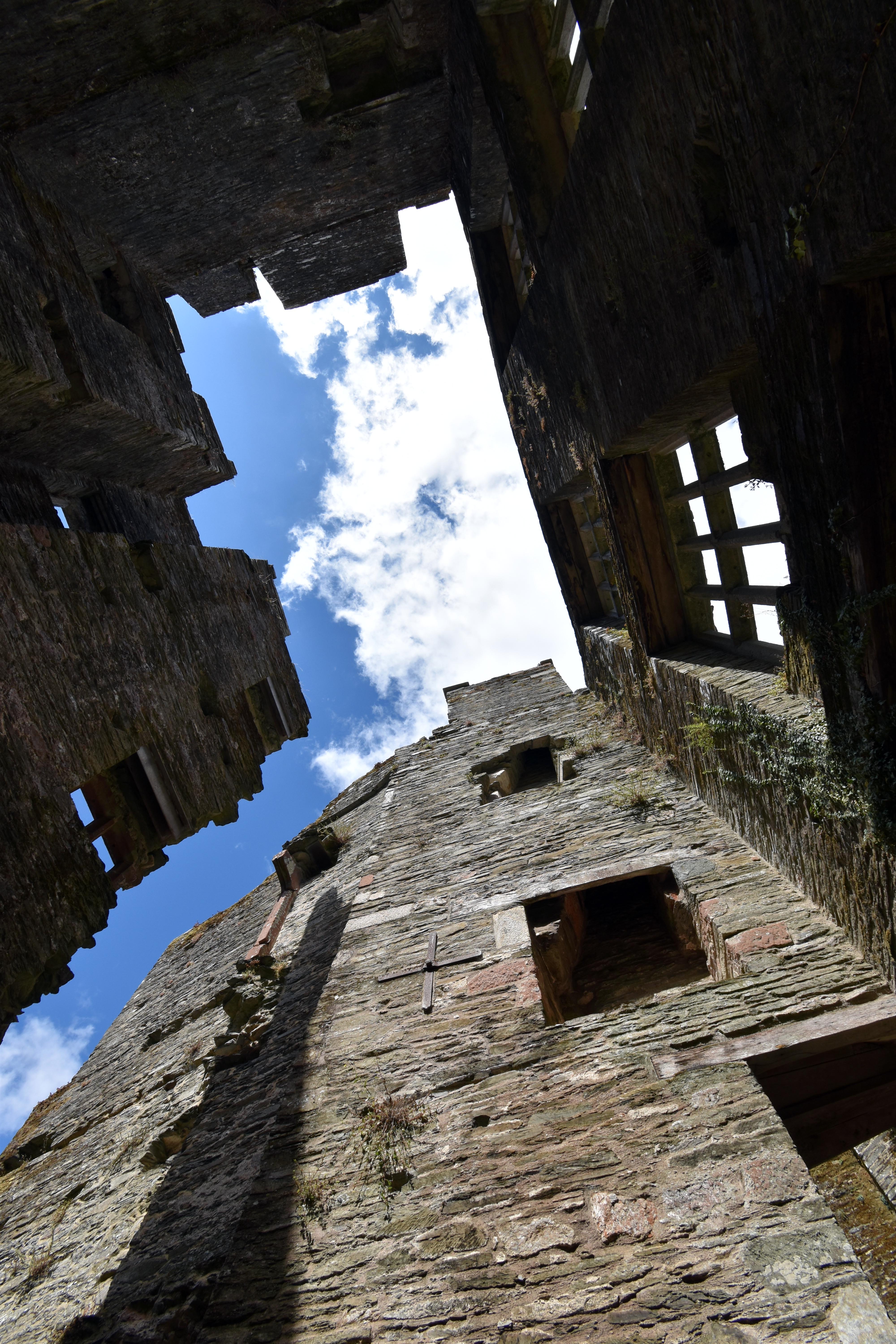
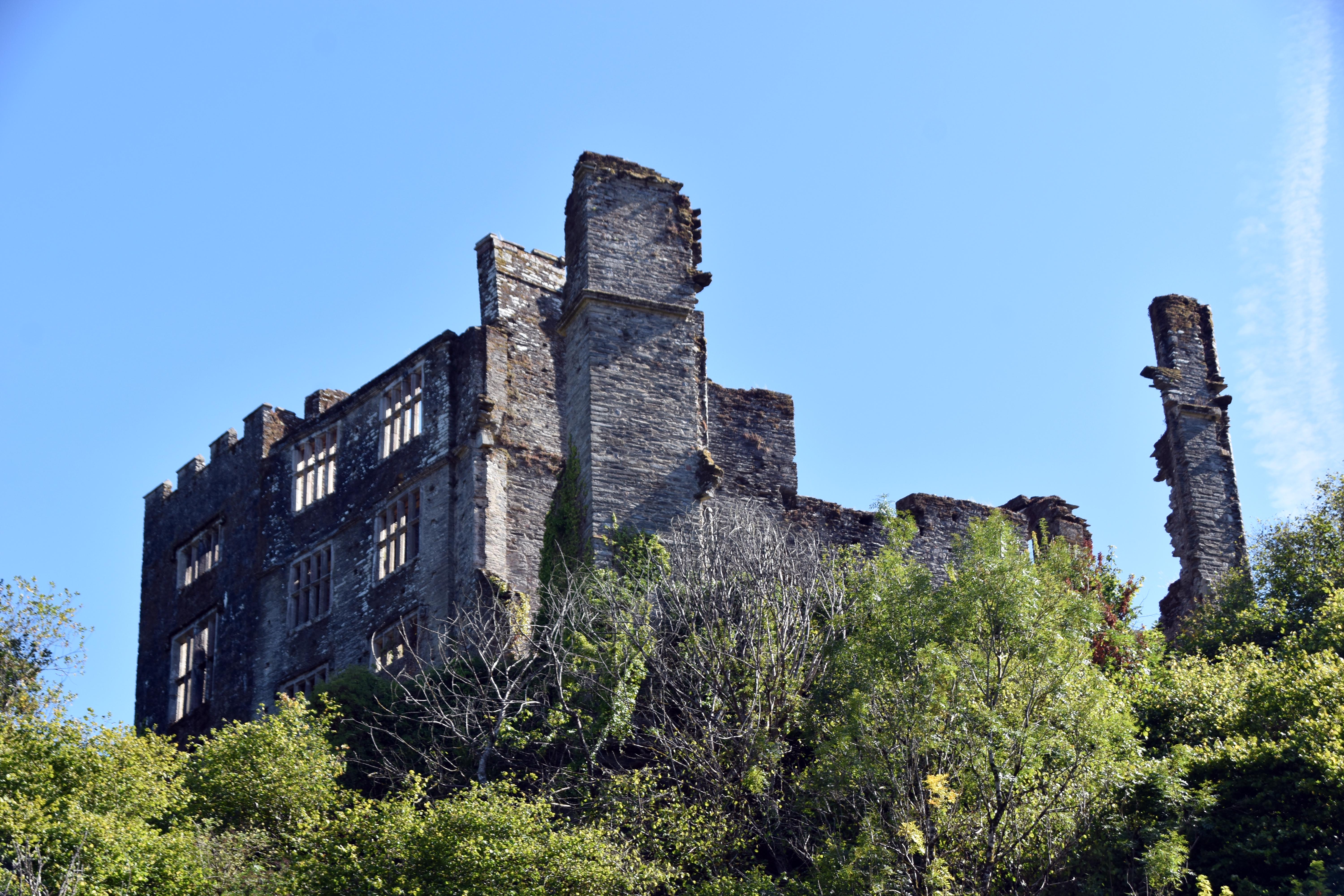
when we set off from Marldon a few months back. We caught an enigmatic glimpse of the castle from Afton Bridge across Gatcombe Brook before circling back to Marldon. Few castles combine elaborately jutting ruins with such a beautiful location as Berry Pomeroy – at least looking at it from the North. It is no surprise that over the centuries artists have flocked to paint what was once more of a grand fortified Manor House than a military castle. This residential evolution means that its northern remains in particular are very unusual as they were supports for windows to enjoy the magnificent views rather than defensive features.
 |
|
|
However, when you approach the castle from its main southern entrance it looks far more like a traditional castle albeit with some interesting quirks. This is because the castle was built in three different phases, with the southern gatehouse being the first phase, built in the late 15th century during the closing years of the Wars of the Roses.
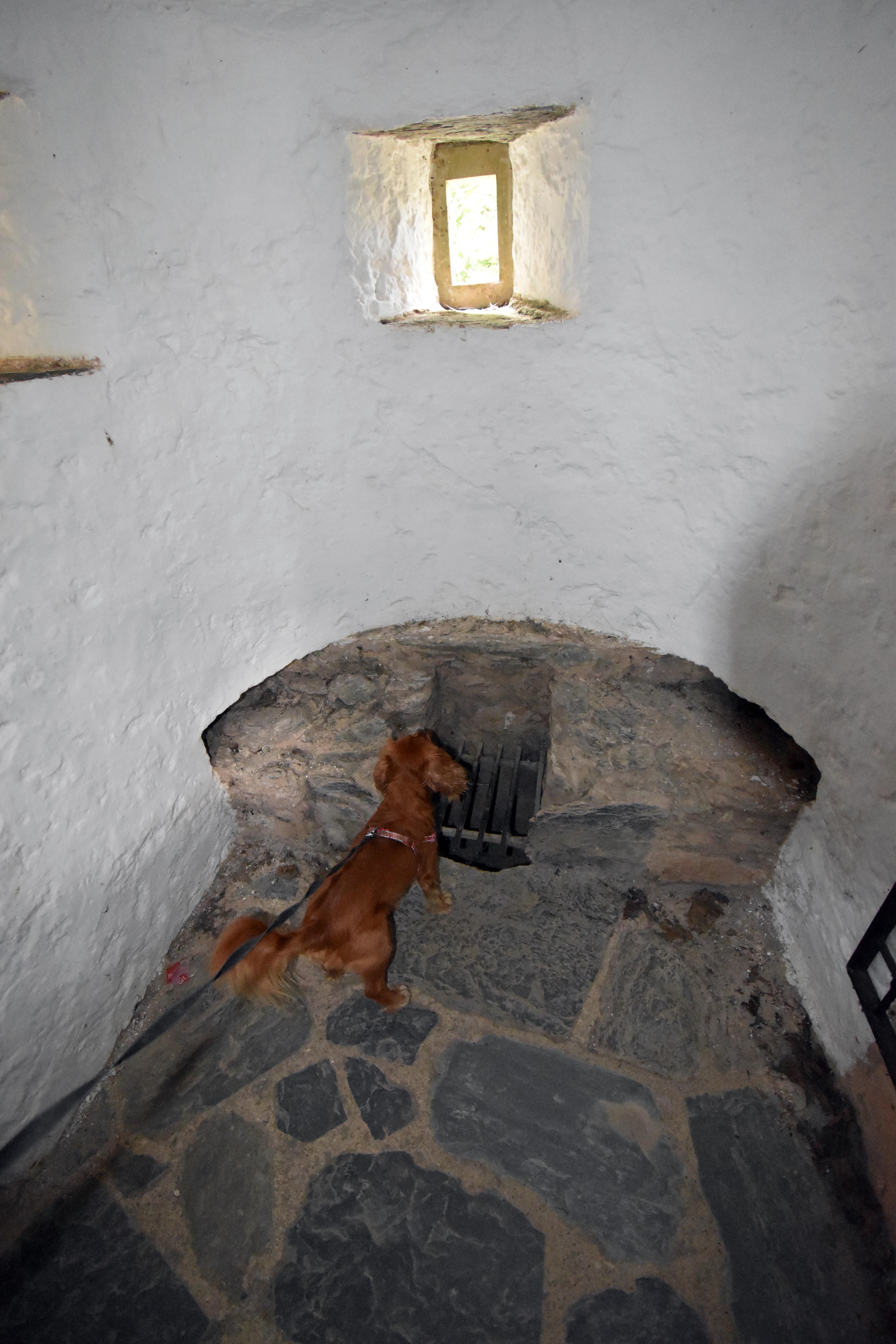
The castle was to be built by the Pomeroy family who had held ‘Berri Manor’ in what is now called Berry Pomeroy village since the reign of William the Conqueror. In the 15th Century, the Pomeroys were backers of the House of York during the interminable years of political upheaval. Partly in response to these new dangers, they felt the need to build a defensible castle. Possibly constructed by Henry Pomeroy whose eldest son Sir Saintclaire Pomeroy was to die of wounds sustained at the battle of Tewkesbury in 1471. However, it may well have been at the instigation of Henry’s second son Richard Pomeroy who was to inherit the Pomeroy lands. Either way it was built in a manner to be defended with a gatehouse, drawbridge, moat (no longer obvious), portcullis, murder holes, high windows and their coat of arms prominently displayed. Being built in the late 15th century though, one of the quirks are the strange arrow loops which have a circle in the middle of them. This was because the bows and arrows and crossbows of the Medieval ages were being replaced by arquebuses which are effectively heavy early muskets with a very thick barrel. These holes in the loops would allow the barrel to be pushed out giving a wider angle of fire and also disperse at least some of the smoke that would be created in the firing of the gun. In fact in St Margaret’s Tower to the east of the gatehouse is an almost unique double arquebus position with a third even wider hole below to allow for a light frame gun to fire along the length of the wall at any attackers. So theoretically three weapons could fire from the same position at the same time. This part of the castle was designed for war.
Perhaps because of their support for the Yorkist cause, Pomeroy influence waxed and waned in the Tudor court although this was shored up by marriages to influential Tudor backers such as that of Sir Thomas Pomeroy to the daughter of Sir Piers Edgcumbe of Cotehele House. It didn’t help that the Pomeroys also attached their allegiance to Cardinal Wolsey who burned brightly in Henry VIII’s court for a while before being snuffed out entirely with Henry VIII’s desire for a divorce and a son. The demise of Wolsey would usher in the rise of another family who would ultimately take over Berry Pomeroy Castle in 1547; that of the Seymour family. The Seymour’s rise was tightly bound up with Henry VIII finally getting the male he wanted through his third wife Jane Seymour who though sadly died days after the birth of Edward. Her brother, also called Edward, would be instrumental in raising and educating his nephew and when Henry VIII died in 1547, Edward became known as the Lord Protector of the 9 year old Edward VI and de facto regent of the kingdom.

|
|
|
With his newfound influence, Protector Seymour wished to enhance Seymour prestige and saw an opportunity in acquiring Berry Pomeroy Castle from the declining Pomeroy family who were struggling to keep up the maintenance and upkeep of their ancestral home. They sold it perhaps in the hope of gaining some influence in the new regime as well as the financial payout. If so, they were to be more than a little disappointed as Protector Seymour acquired more influence for himself and his family and began to accelerate the Protestant Revolution with serious consequences for the Westcountry and for the Pomeroy family itself. Rupert and I have already tracked the 1549 Prayer Book Rebellion which started in Cornwall and spilled into Devon with widespread fighting from Exeter to Fenny Bridges. It was Edward Seymour’s desire for an English prayer book and simplified liturgy and decorations in churches that had provoked this serious rebellion. Seymour’s men had had to rely on overseas mercenaries to meet and eventually defeat the rebels with the closing battle at Sampford Courtenay. However, one of the rebels to join this rebellion was Sir Thomas Pomeroy with his Cornish wife. Indeed at the battle of Clyst St Mary Sir Thomas Pomeroy is credited with personally leading a successful ambush that completely disorientated the attacking King’s army. They were to lose the battle for the lack of cavalry to exploit local successes such as Sir Thomas’ but it is interesting to consider whether Sir Thomas was only motivated by religious concerns to join the rebels or whether he was harbouring resentment at having to sell his ancestral home to Edward Seymour? Sadly for Sir Thomas being on the losing side would seal his family’s fate. Although he was not executed he was imprisoned and his lands became forfeit. Ultimately he died in 1566 but in debt and relative poverty. Not that Protector Seymour’s fate was much better. He was to be blamed by the Privy Council for instigating the 1549 rebellion and was arrested and taken to the Tower of London. John Dudley, the Earl of Warwick and soon to be Duke of Northumberland was the lead instigator who took advantage of Seymour’s weakness in the aftermath of the rebellion and ultimately engineered Edward Seymour’s 1552 execution. So in a strange way both owners of Berry Pomeroy Castle were victims of the 1549 Prayer Book Rebellion!
|
|
|
Fortunately for Protector Seymour’s son, also confusingly called Edward, the Seymours even after the death of Edward in 1553 were regarded as family by Elizabeth who depended on her half-brother’s claim to the throne through Henry’s 3rd wife in order to help legitimise her own claim to the throne through Henry’s 2nd wife. Many Catholics in particular did not regard Henry’s divorce from Catherine of Aragon to be based in legality. The upside to this was that Edward Seymour was allowed to inherit the titles and lands of his father including that of Berry Pomeroy.

|
|
|
It was this Edward Seymour who would set about transforming the defensive gatehouse with an elaborate Elizabethan mansion to the east of the gatehouse with the emphasis on light and comfort rather than defence. As you come through the gatehouse it is the building to your right which was the focus of this second section of development. You can see a plethora of tell tale Tudor windows which had no defensive utility whatsoever. This mansion was built for a country at peace and had been so since the accession of Henry VII in 1485. There was no living memory of wars amongst competing factions. This was now the golden age of Elizabethan England and Edward hoped that one day his cousin might visit him there.
The third phase was to see an even more ambitious Great Hall and Long Gallery along the north precipice with glorious views over the Gatcombe Valley and towards Dartmoor. It is the remains of this third section that probably evoked the title ‘The Castle on the Hill’ by Elizabeth Goudge and the various artists who would later flock to paint the decaying mansion. This was built by yet another Edward Seymour (they really were not imaginative in their naming conventions – but of course they wanted to keep the royal connection to Edward VI in everyone’s minds). This third Edward Seymour to own the house wanted to build an even grander Jacobean extension with even larger windows to show off his wealth. There was also intended to be a promenading terrace outside the front over the sharp drop to the Gatcombe river below. This particular project was never finished but the Great Hall and a 63 metre Long Gallery above it was completed in the early years of King James I.
For the Seymours who were so closely identified with the Tudor Family, the era of the Stuarts was to prove a difficult one to live through. They were to remain staunch loyalists and backed the Stuarts to the hilt as their cousin Queen Elizabeth wished, however in so doing they would ultimately attach themselves to the Royalist cause in the English Civil War with profound consequences for both their finances and the ultimate fate of Berry Pomeroy Castle. Although there was no active fighting in and around the castle itself, it was used as recruiting, training and logistical base for the Royalists in their various campaigns in the Westcountry. But this also meant that with the accession of the Commonwealth, the Seymours were politically and economically vulnerable and their finances suffered tremendously. With the restoration in 1660, the Stuarts remembered their support and granted yet another Edward Seymour the role of Speaker of the House of Commons for his family’s loyalty but Berry Pomeroy was now seen as an expensive liability for a family that had sacrificed much for the Royal cause. It was then left to yet another Edward Seymour to abandon this expensive property and consolidate the Seymour family at Bradley House in Maiden Bradley in Wiltshire where they still live to this day. Technically they still own Berry Pomeroy although now it is managed by English Heritage who also have taken on the considerable expenses of maintaining the ruins and making them accessible to the public. This is a remarkable building with a remarkable history. It really only operated as a castle for less than two centuries and yet managed to have three significant phases of development in that short history. What we see now is more the remains of a Tudor Mansion House rather than a castle. In fact the castle aspect with its thick defensive walls is probably the best preserved section of all despite being the oldest.
Now it would have been easy to get in the car and drive away after an interesting visit around these fascinating ruins, but of course Berry Pomeroy Castle only tells part of the Pomeroy and of the Seymour family. With this in mind we decided to walk south to the village of Berry Pomeroy. If you recall I mentioned that the Pomeroy family had held Berri manor since the reign of William the Conqueror and had indeed lived there at least two centuries before they built the Gatehouse at Berry Pomeroy Castle. The Manor House still stands in the village and even more coincidentally I believe that it is still owned by the Seymour family who presumably bought all the local lands of the Pomeroy family in that transaction in 1547. We went to see if we could catch a glimpse of it as we passed the Berry Pomeroy lodge and then walked over some farmland down into the village. It is the church of St Mary’s that you see first and of course this would have been the local church for the Pomeroys and the Seymours for most of their history although the gatehouse was built with a chapel inside it back at the Castle.

|
|
|
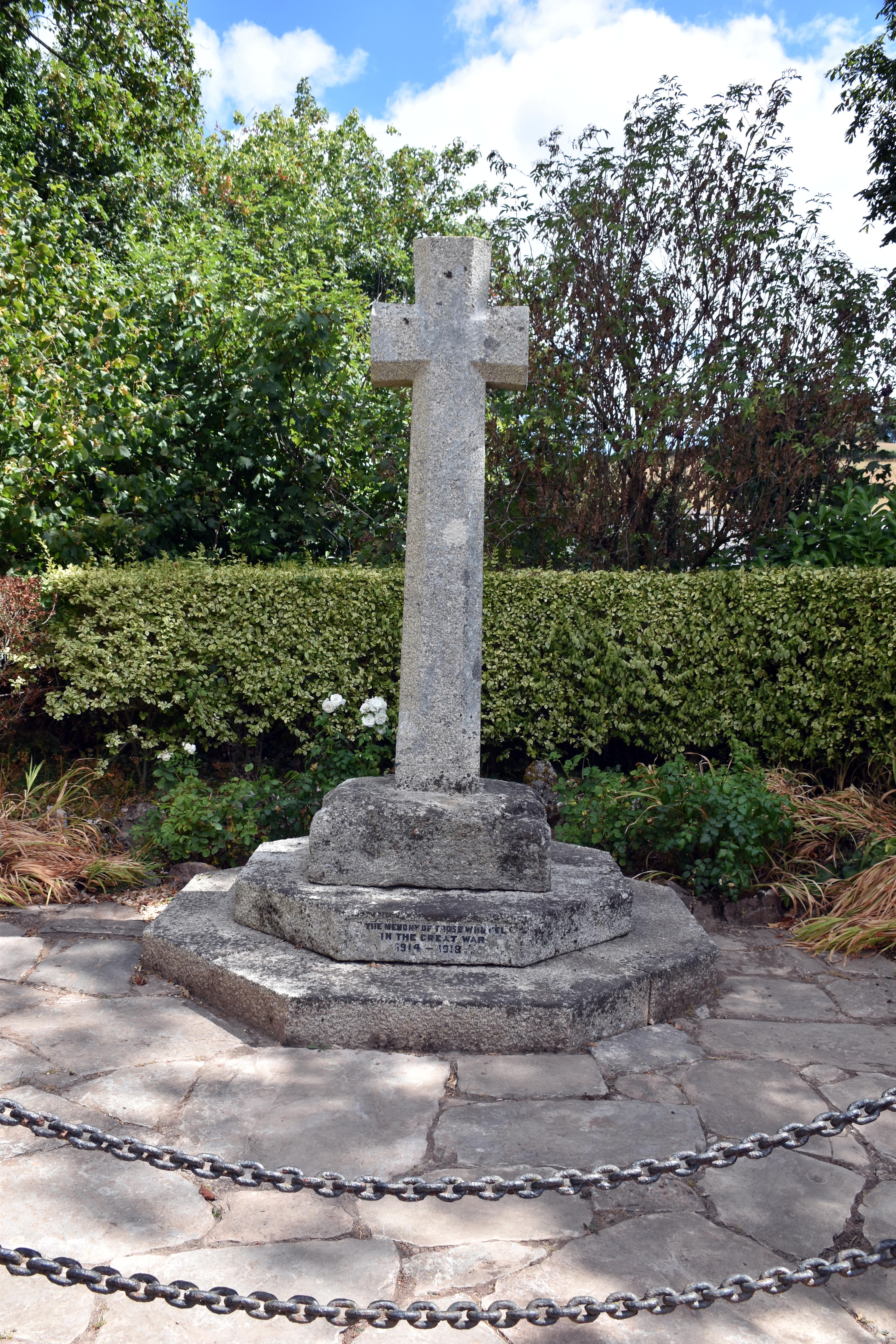
As we descended into the village with the church guiding us in, we saw an enormous barn. It was so large it made me wonder if it might originally have been a tithe barn where all local families could leave their church contributions in the form of produce. I cannot conceive of who else would have required such a large barn in the pre-industrialised agricultural era. We also passed the War Memorial before coming to Berry House which did have the sign Manor House in case we were unsure we got the right place. It is very idyllically placed next to the church. Interesting to think that only two families have owned this site for nearly a thousand years!
As we stepped through the Lych gate we saw almost immediately what appeared to be a grave to one of the Seymours; a memorial stone to Archibald Henry Algernon Seymour, born in 1810 and who died in 1891. At first I thought it curious that he was not buried in Wiltshire, but as we were about to find out, St Mary’s holds some remarkable Seymour family connections and memorials. But in fact this stone is not a grave at all but a Victorian memorial placed here in the ancestral parish of the family, as Archibald was indeed buried at their home in Maiden Bradley. This memorial is carved to look identical to his actual grave in Wiltshire. It was erected to maintain the Seymour family’s connection to both locations. It is interesting that the ancient castle ruins became even more famous in the Victorian era as Romantic painters and poets flocked to see the decaying building for themselves. Perhaps Archibald was swept up in that Victorian romanticism and wished to re‑establish a link to not one but both ancestral homes.

|
|
|
This was not the only interesting grave we saw. Just to the south of the church was a remarkable looking Pyramid Tomb for Elizabeth Howard dated to 1810. It is huge and so different from all the other graves in the churchyard. It appears that she may have died from consumption, the period term for tuberculosis, but the date of her death may give a clue to this Egyptian‑inspired monolith. After Napoleon invaded Egypt and was defeated by the British there in 1801 there was a vogue for all things Egyptian and some people preferred it to the otherwise ubiquitous Greek Revival style. It was not just the invasion of Egypt but the fact that a great many scientists and academics began working on discovering more about the Ancient Egyptian world in the opening decades of the 19th century. It is intriguing that this fashion even reached such a remote place as Berry Pomeroy.
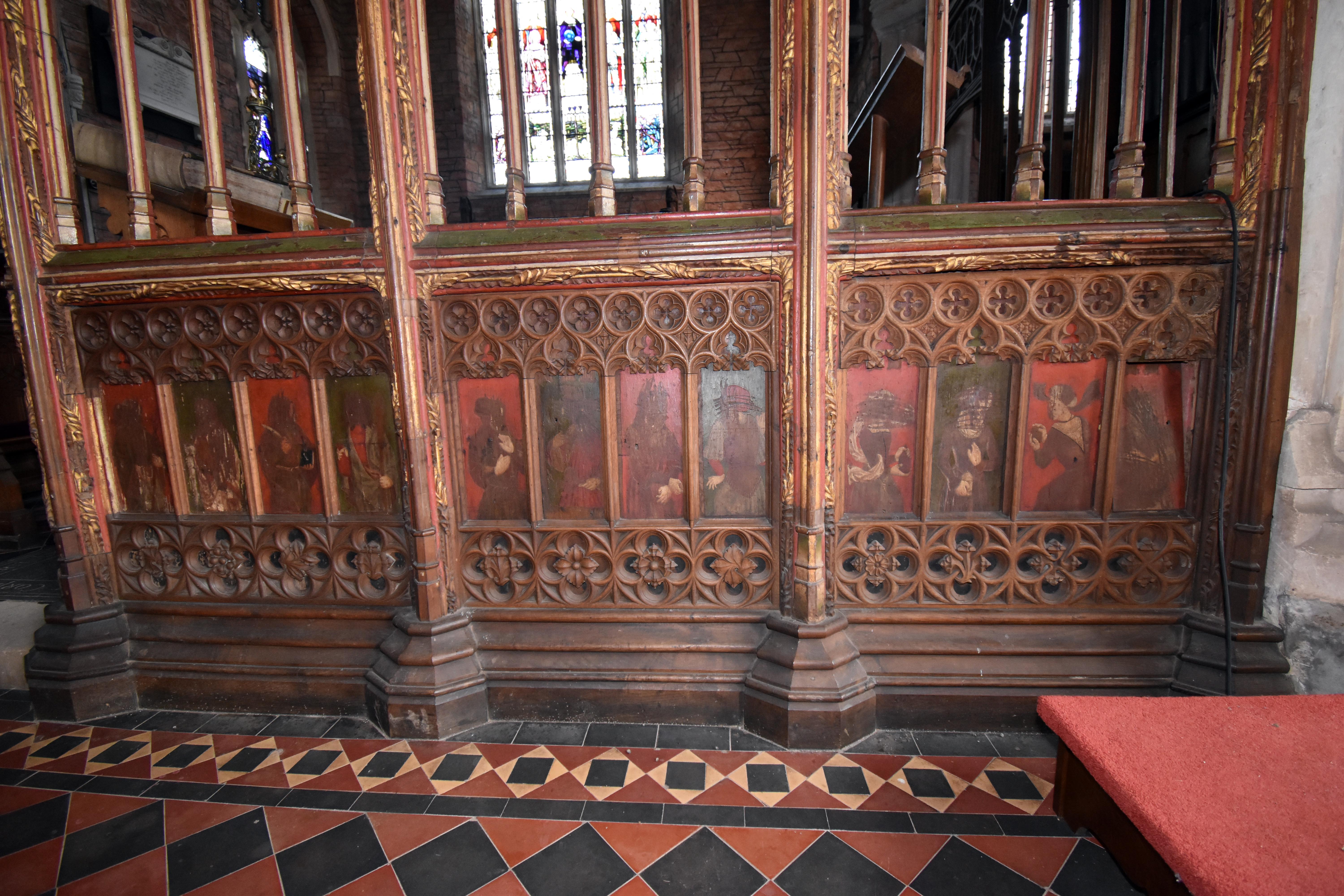
After a delightful lunch on a churchyard bench overlooking a field of cows opposite, we entered St Mary’s Church. It was a most welcoming church with some refreshments available by donation at the back for visitors which was a nice touch and also some books were for sale to help raise funds for the church. Rural churches are fundamentally so much more welcoming than their urban counterparts. This church has a lovely rood screen, but with decorations that perhaps reveal that the Commonwealth really were keeping a close eye on the Seymours in the aftermath of the Civil War, as nearly all the religious figures portrayed have their faces scratched out. This was common practice for strict Parliamentarian iconoclasts, but one does wonder if it was a particular message to the local lords of the time, the Seymours, to show who was in charge. Interestingly a couple of faces were not scratched out — those of local people with no obvious religious connection. It was simply religious iconoclasm that strict Protestants had a problem with.
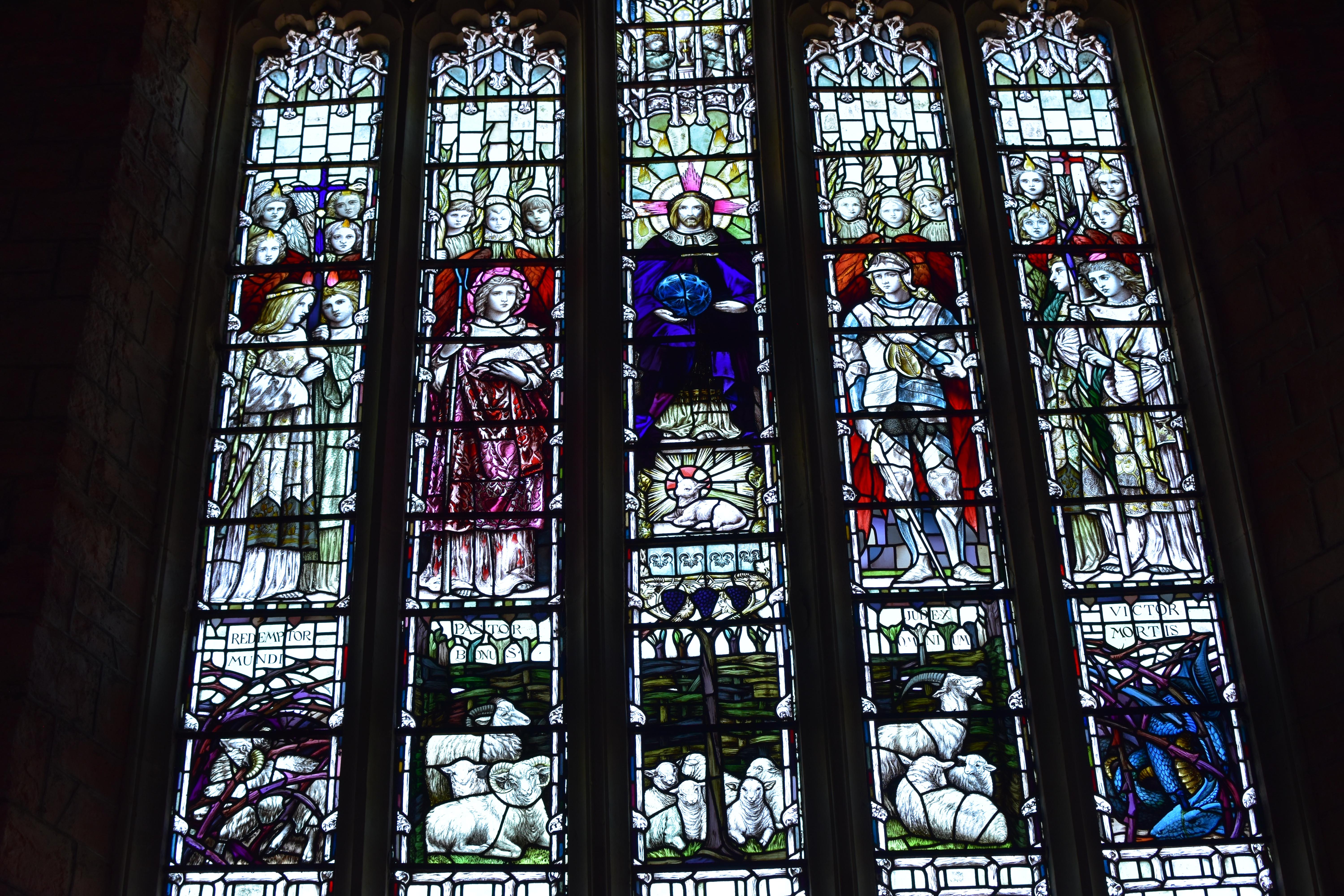
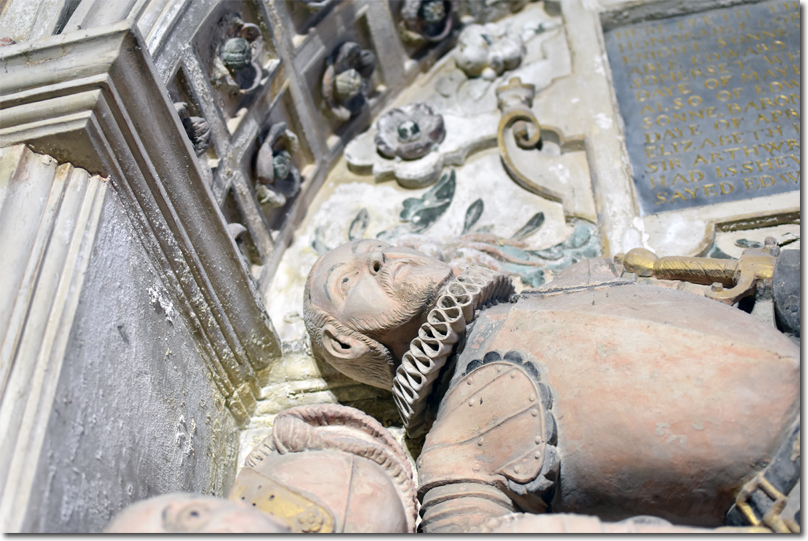
In the north‑east corner is the stand‑out monument in the appropriately named Seymour Chapel. This is a massive memorial to the second and third Edward Seymours of Berry Pomeroy, and to Elizabeth Seymour née Champernowne of Dartington Manor. Remember that the first Edward Seymour was executed and his body was buried within the Tower of London in an unmarked grave — the fate of traitors. Elizabeth is surrounded by depictions of her children. Immediately below her are statuettes of nine children, five boys and four daughters. At her head lies a baby who presumably died as an infant. But even more interesting is that at her feet sits a girl who may also have died at a young age but also may actually reflect a disabled child born to her who may or may not have survived into adulthood. I should say that the stained glass windows in this chapel are particularly vibrant and beautiful and are dedicated to the 15th Duke of Somerset who died in 1923.
In the Chancel is a memorial to a past vicar who also knew how to ingratiate himself to the local aristocracy. His name was the Reverend John Prince who, as the memorial explains, was the vicar of this parish from 1681 until 1723 and was the author of The Worthies of Devon. This was a book that set out the family trees and manorial residences of the great and good of the county of Devonshire. It also would have given him an excellent excuse to call on the great and the good, most of whom would have been delighted to share their family histories to help embed themselves as “worthies” of long lineage. The book was a substantial 600 pages in length with woodcuts to illustrate the 191 biographies. Not unsurprisingly he struggled to find funding for it. The printer was forced to advertise for subscribers while the book languished for four years until its final publication in 1701. It is also interesting to consider that he would have been the vicar when the Seymours finally abandoned their residence of Berry Pomeroy Castle and would have seen it begin its descent into a ruin. He also would have been the vicar when William of Orange marched close by after having landed at Brixham in 1688. It is perhaps no accident that the Royal Coat of Arms in this church happens to be that of William of Orange.
Amongst the many other memorials the empire ones always jump out at me. There is one to William Augustus Brown who died at the tender age of 25 on my birthday (4th of October) in 1822 in Bangalore in India (they call it the East Indies). He had been a Lieutenant with the 13th Light Dragoons. With no way for his family to visit his grave, this memorial, which looks like a tomb with a cross on top of it, would have had to have served the function of a grave for his surviving family.
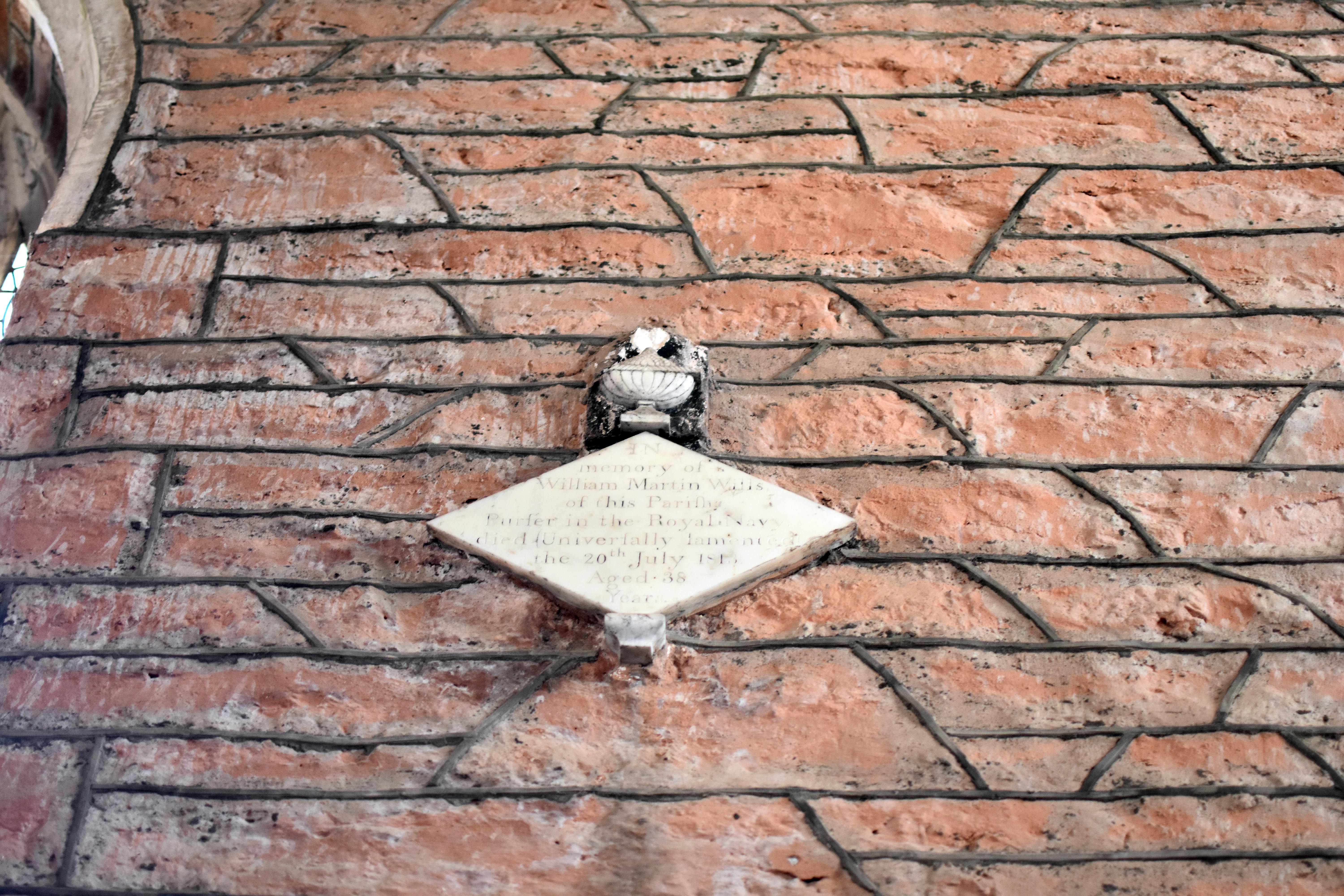
By the door were two interesting naval memorials. One was tiny and up high to William Martin Wills of this parish who had been a purser in the Royal Navy and died in 1813 at the age of 38. This would have meant that his service would have coincided with the Napoleonic Wars. One wonders what battles and campaigns he participated in. Just below him was a far more detailed memorial to another family of sailors. The first of these was to William Bundock which remarkably says that he had served his country by sea for 60 years before dying in 1841 at the age of 76. Presumably he started his career as a young child, perhaps at the time of the American Revolution even. There is a William Bundock recorded as serving on HMS Ajax before and during the Battle of Trafalgar in 1805. For a while the ship was under the command of one of the most famous English captains of the era, Alexander Cochrane, and funnily enough served in the Egyptian campaign in 1801 when the British landed their army to fight the French. After Trafalgar she participated in the 1807 attempt to seize the Dardanelles, so quite a varied career in just these few short years. One wonders what he saw in his full 60 years of service. Coincidentally he was a purser too. Beneath him remembers his son William Thomas who predeceased him in Totnes in 1837 at the age of 42. But below him is an even sadder memorial to William Thomas’s son and William’s grandson, also called William, who it says “was accidentally drowned at sea” in 1844 at the age of just 16. Sadly I do not know the story behind this accident, but so many Devon families would send their sons to sea throughout our history.

|
|
|
The war memorial at the back is carved as St George and the Dragon. In addition to the seven beautifully carved names of soldiers who died is a piece of card with the name of a Lieutenant who served with the American Army; Lieutenant Robert F. Coffey of Lansdale, Pennsylvania who was serving with the 115th Infantry Regiment of the 29th US Infantry Division. This got me intrigued as to why an American officer had been added to this list. It transpires that Lieutenant Coffey had married Joyce Alice Hall before D‑Day took him across the English Channel. He was to die on June 8th, just two days after the invasion, whilst leading an attack to capture St Lô. He is buried in Normandy, leaving a very young widow here in Devon. He was posthumously awarded a Silver Star for his bravery.
This was a lovely church with so much more to see than what I have written about here — oh and it has a toilet which far too few churches appear to have and is always a relief (excuse the pun) for walkers. After a little more rummaging around the graveyard we headed north‑west out of the village towards Gatcombe House, another old country manor that was once the house of William Bogan, one‑time mayor of Totnes, who married the sister of Thomas Bodley — the man who established the Bodleian Library in Oxford. It was also the home in the 17th century of Zachary Bogan, who was an important early expert on Homer and tried to cross‑reference the vocabulary of the Iliad with that of the Greek translations of the Bible.
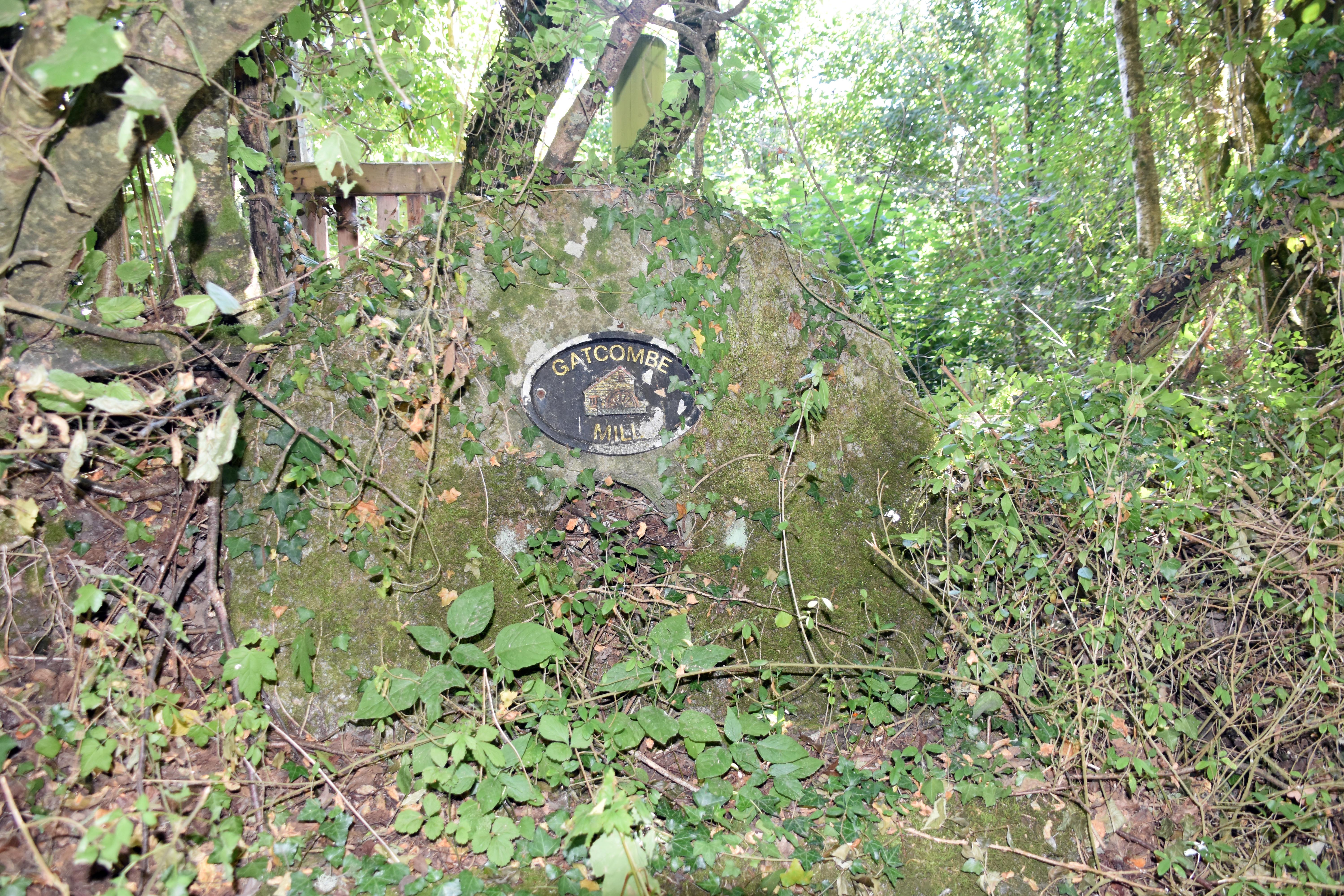
After Gatcombe House we crossed over the Gatcombe Brook where we saw a millstone announcing the location of Gatcombe Mill. Mills of course were so important to the rural economy in allowing the local farmers to convert their produce into a saleable commodity. We then followed the Gatcombe Brook back into the English Heritage lands around Berry Pomeroy Castle and walked under the house in order to appreciate once more its “Castle on the Hill” perspective. The weather was quite sweltering and the water levels low and the grass all too brown. However, the castle remains still looked majestic, jutting up above the green trees that have slowly engulfed it since it was abandoned. It is worth considering that there would have been far fewer trees in the Tudor and Stuart years and consequently far more impressive views from the castle itself. Nature though has slowly reclaimed much of this valley, but especially the lands around the castle. We were to climb back up to the car park and take one last look at the castle which, although only operated for two centuries, feels far older and far more ancient than it actually is. Two families though connect us here today all the way back to William the Conqueror. But their differing fates illustrate that dynastic power struggles can play out in unforeseen ways and that the fortunes of families can rise and fall even with generational wealth behind them. The consequences of falling out of favour at various times in history helped turn one of the most impressive homes of the late Tudor and early Stuart period into this abandoned “Castle on the Hill.”
|