

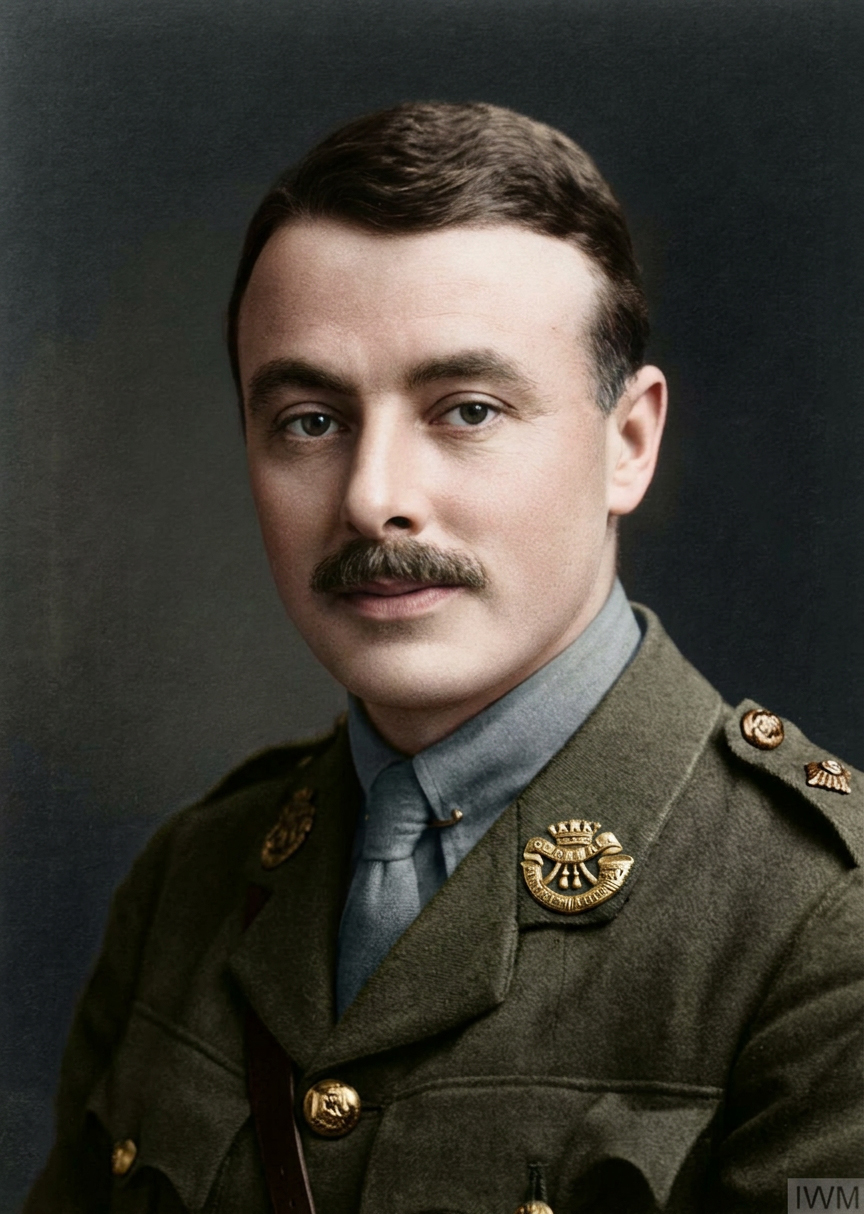
Captain Douglas Eckley Langdon of the Duke of Cornwall’s Light Infantry was the second son of William Langdon of Launceston. He was born at Huelva, Spain, on 3rd April 1884. His early education was at Ipswich Grammar School, after which he began an apprenticeship in April 1900 at the works of Messrs. Saxby and Farmer at Chippenham.
Three years later he entered the service of the Great Western Railway as an improver in their locomotive works at Newton Abbot. Over four years he passed through the fitting, erecting, and machine shops, as well as the drawing office. During this period and afterwards he attended Technical Schools at Bath, Chippenham, and Newton Abbot, building a solid engineering foundation that shaped the early part of his career.
In September 1907 he joined the Buenos Aires and Pacific Railway, working first in the drawing office at Junin, Argentina. In February the following year he was sent as assistant shed foreman to Villa Mercedes. Two years later he became assistant to the Divisional Locomotive Superintendent at Justo Dorset, and the following January he was promoted to take charge of the Company’s running‑shed at Beazley. His rise through the railway service was steady and well‑earned, reflecting both competence and reliability.
When war broke out in August 1914 he immediately applied for leave to return home. On the day after his arrival in London he enlisted in A Company of the Public Schools and Universities Corps, then forming and later designated the 18th Battalion, London Royal Fusiliers. In May 1915 he was offered a commission in the Duke of Cornwall’s Light Infantry, and in September 1916 he was promoted Acting Captain abroad.
In March of that year he was sent out at night with a small party to repair the wire in front of their trenches and was hit below the knee by a rifle bullet. After eight weeks in the Red Cross Hospital at Rouen he returned to his battalion at the front. His recovery and return to duty were typical of the determination shown by many officers of the period.
On the night of 22nd–23rd April 1917 he led his Company into action and was killed instantly while clearing the enemy out of ruined houses near Lens. In this action all the officers of the Company were killed or wounded. He was thirty‑three years of age. The memorial at St Mary Magdalene Church records his death as occurring “whilst gallantly leading his company in an attack on strongly held ruined houses,” a concise but powerful summary of the circumstances.
Captain Langdon was elected a Graduate of the Institution of Mechanical Engineers in 1908 and an Associate Member in 1911. His career, both in engineering and in military service, reflects the breadth of experience common to many men of his generation: technical skill, overseas work, and ultimately the call to arms in the First World War. His memorial in Launceston preserves the essential facts of a life lived with commitment, competence, and courage.

