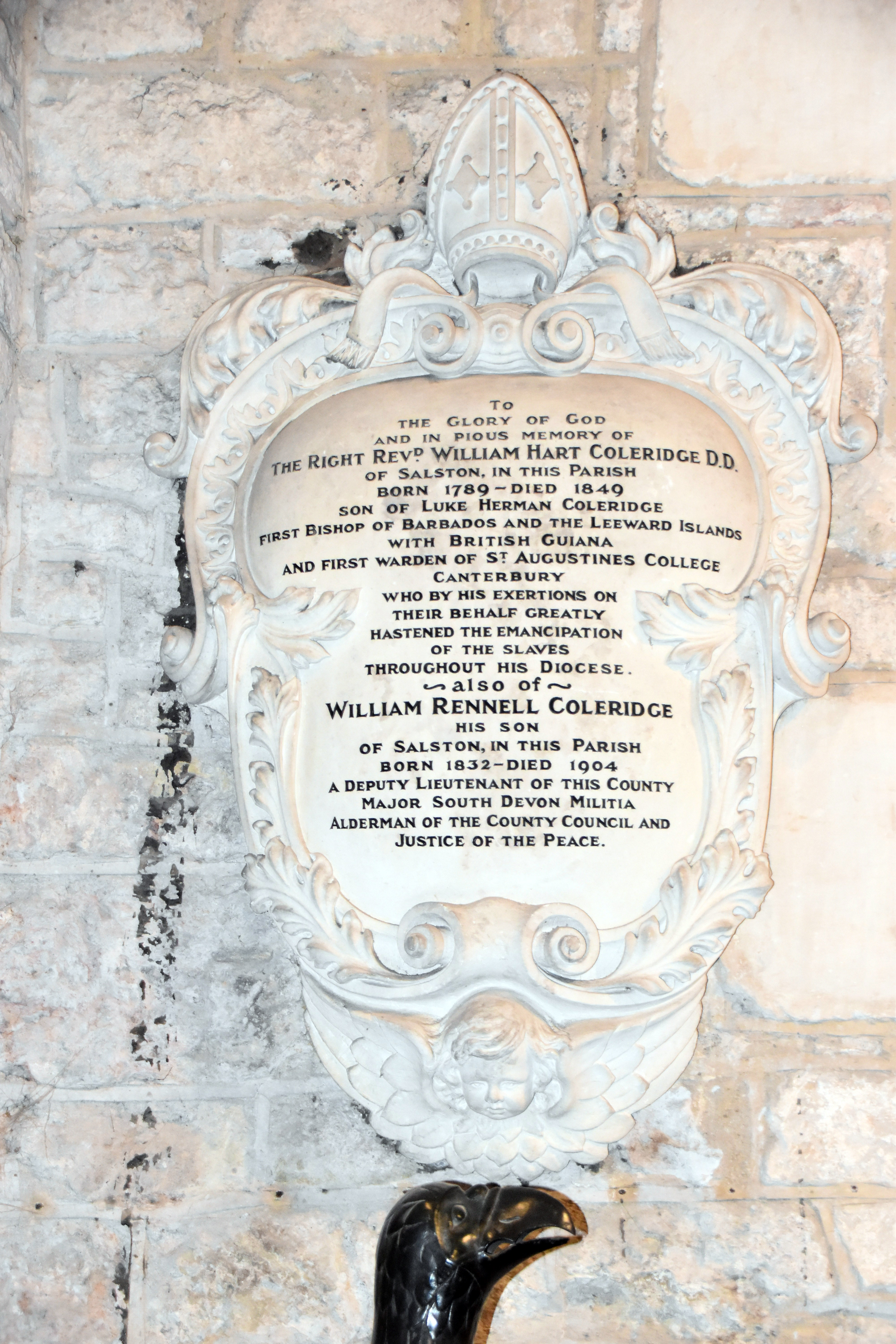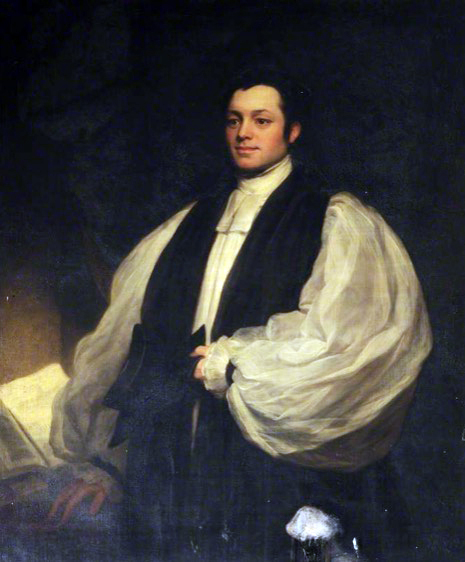
William Hart Coleridge, born on 27 June 1789, was the only son of Luke Herman Coleridge of Thorverton and Sarah Hart of Exeter. His father, a brother of Samuel Taylor Coleridge, died during his infancy, and William was brought up in Ottery St Mary under the care of his uncle, the Revd George Coleridge, master of the King’s School. From Ottery he went up to Christ Church, Oxford, in 1808, where he was noted for his hard work and good manners and took a first in both classics and mathematics. He graduated B.A. in 1811 and M.A. in 1814, and took his B.D. and D.D. in 1824.
After leaving Oxford he served as a curate at St Andrew’s, Holborn, and later became secretary to the Society for Promoting Christian Knowledge. He also preached at the National Society’s chapel in Ely Place.
In July 1824 Coleridge was consecrated the first Bishop of Barbados and the Leeward Islands. He arrived at Bridgetown on 29 January 1825, and his installation was marked by a procession through streets lined by the militia. He found the diocese in a poor way, with too few clergy, too few churches and very little schooling. His first charge in 1830 noted gradual improvement, particularly among the enslaved and formerly enslaved population, who were increasingly attending church and abandoning older funerary customs. By 1838, on the eve of full emancipation in the British West Indies, he reported unusually large numbers of communicants and a marked increase in church attendance. The diocese then contained ninety nine clergy, forty two schoolhouses and fifty three parish churches. Seven of these had been rebuilt after the great hurricane of 11 August 1831, which had destroyed eight churches and seven chapels on Barbados alone. Interestingly, the clergy of Barbados itself reckoned that during his time there the number of clergy on the island had doubled from 15 to 31, and the number of schools had gone from 8 to 83.
After some eighteen years Coleridge’s health gave way, as he had begun to suffer from fainting fits, and in 1842 he resigned the see. The diocese was subsequently divided into three: Barbados, Antigua and Guiana. He returned to England and, when St Augustine’s Missionary College was founded at Canterbury, became its first warden in 1848. He was back at Salston, his house at Ottery St Mary, for the Christmas holidays in 1849 when he was taken ill while walking in the grounds, and he died suddenly on 21 December. He was buried at Thorverton, where he had been born.
Coleridge was also a member of the Canterbury Association from 1848 until his death, linking him to the wider movement of Anglican settlement and missionary activity that founded Christchurch in New Zealand. He may well have provided inspiration for his young kinsman John Coleridge Patteson.