|
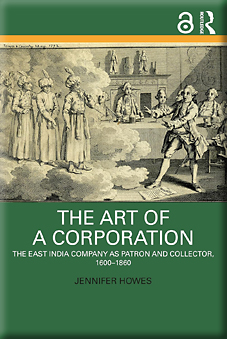
The rather unpromising title of this book disguises a most impressive and interesting study of the diverse collection of artworks commissioned and assembled by the East India Company over its long history. In 1985 Mildred Archer catalogued the remains of this collection held by the India Office Library and it was published in a poorly produced book: The India Office Library Collection ofPaintings and Sculpture. Although it contained useful information it made turgid reading. Jennifer Howes’ book is very different. The book takes a chronological approach starting with the very early paintings commissioned before the Company had a permanent home. It required impressive detective work to trace and bring back together these diverse early commissions. The second chapter looks at the career of the first, but little-known, professional landscape painter to visit India-Francis Swain Ward - and how his work reflected the British expansion in India in the third quarter of the 18th century. Ten of his paintings, sold to the Company in 1773, still survive in the British Library. They reflect not only the artist’s military career in Southern India but more importantly the Company’s rapid expansion and territorial acquisitions during this period. The next chapter looks at how the neo-classical discourse became deeply embedded within the Company through commissions of sculpture - the new ‘Empire in India’ being directly compared with the Roman Empire.
Peter Scheemakers’ impressive full-length sculpture of Robert Clive of 1764 casts him in the role of a Roman Emperor - a self-fashioning that sought to elevate a commercial organisation onto a higher plane. Howe then turns to the deep scandals that were so pervasive in the East India Company at its zenith in the second half of the 18th century. In London at this period art was frequently used as satire for the scandals of the age.
The downfall of Clive’s reputation from his excessive greed and the perceived mismanagement of government by Warren Hastings resulted in numerous clever cartoons deriding their characters. The Company sought to exorcise these wrong doings through a series of commissions including the magnificent memorial to Stringer Lawrence in Westminster Abbey (by William Tyler in 1777) and various impressive portraits. George Romney’s full-length portrait of 1795 of Warren Hastings marked the end of his long impeachment trial and his acquittal on all charges. The Company itself showed little interest in Indian sculpture despite the pioneering work of scholars like Sir William Jones and Charles Wilkins. But in 1809 the Oriental Repository Gallery in East India House was opened to display sculptures that were gifted to the Company. These included superb sculptures and bronzes from Bihar, the Carnatic and even Ceylon. Amongst these was the magnificent sculpture from Bihar of Surya, donated by the gifted artist Samuel Davis and the equally splendid statue of Parsvanath from Garsoppa, in the Carnatic, sent to the East India House by Colin Mackenzie - both survive in the Victoria & Albert Museum.
Howe concludes her fascinating book with a brief look at the dispersal of the collection and how this corporate collection reflects both the Company’s complexity and its own interpretations of its difficult history. In a post colonial world it is all too often over-looked how useful art is in understanding Empire and the role of capitalism. My only criticism is that for such an expensive book - £110.50 on the publisher’s website - one would have expected at least some colour illustrations - all are in black and white!
|