|
A vast literature exists concerning the causes and evolution of British Imperialism,
ranging from Seeley's "fit of absence of mind" at one extreme to Marxist theories of
exploitation at the other. The authors' own view is graphically depicted in a painting
used for the cover of the second volume. Entitled The Heart o f the Empire this shows the
City of London, not Whitehall. It was a financial, not a political imperative, they argue
convincingly and at length, which played a crucial role in determining the development
of imperial and later of colonial history. Furthermore, the City's leadership was accepted,
even taken for granted, because the generals, the administrators and the bankers all came
from the same social class, that of the landed gentry in the south east of England, later
enlarged to include the output of British public schools.
Any new interpretation of history must, according to the authors, "succeed either in
commanding acceptance or in generating the creative dissent needed to inspire a superior
alternative". It can be hoped that they will achieve the latter, but there must be doubts
about the former. Some pieces still seem to be missing. For example, there were other
empires besides our own, for which it seems unlikely that a similar motivation could be
applied. Yet why should the British case be unique?
It is impossible in the space of a short review to do justice to the breadth and depth of
the evidence deployed in these two volumes, which reveal how the influence of the City
of London extended far beyond those countries coloured red on the map; Argentina and
Chile, to name only two, were as much part of its sphere of operations as were Canada
and Nigeria. But congratulations to the authors must be accompanied by some apprehension
lest their arguments be oversimplified, when they escape from academic circles and
are taken up by the general public. We do not want our descendants, when asked what
grandpa did, after explaining that he was a District Officer in such-and-such a colony, to
feel compelled to add that he was not working for the Bank of England.
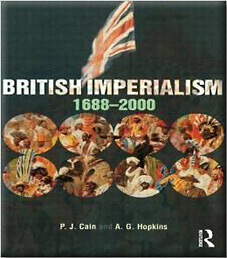
Originally it was published as two separate volumes: British Imperialism: Innovation and Expansion, 1688-1914 and British Imperialism: Crisis and Deconstruction, 1914-90 and British Imperialism: Crisis and Deconstruction, 1914-90
|