|
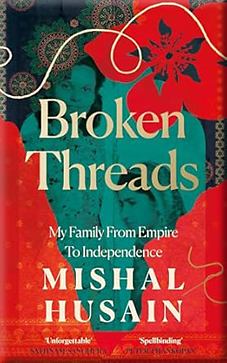
This is a family history with a difference, the story of parents and grandparents who lived through momentous times, being born in one country — India, and dying in another — Pakistan. The author, a journalist and broadcaster, has concentrated on four members of her family: her paternal grandparents, Mumtaz and Mary, and her maternal grandparents, Shahid and Tahirah. She was lucky enough to find diaries, a long audio recording, and a great aunt, Anne, who was still alive, living in Oldham, with memories of her sister Mary. This is one of the most interesting chapters. Mary was the daughter of Francis Quinn, a man born in India, which in theory made him Indian, but the son of an Irishman who had emigrated to India as a medical officer in the 19th century. Francis Quinn was a widower in south India and he employed a young Hindu girl, Mariamma, to keep house for him and look after his two children. Francis got the young girl pregnant, and having been told by the local Catholic priest that he was a sinner and had to marry Mariamma, he was persuaded to do so after the baby, fair-skinned and blue-eyed, arrived. This was Mary, baptised as a Catholic, who was to face lifelong prejudice when she fell in love with Mumtaz, a Muslim from an orthodox family in Multan. The couple managed to find both a Catholic and a Muslim priest who were willing to marry them in their respective church and mosque, but Mary was never accepted by her parents-in-law.
Shahid and Tahirah had an easier ride, both Muslim, from good families and both well educated. Shahid, who was born in Lucknow in 1910, joined the Indian Army almost by chance. He rose quickly through its hierarchy to become private secretary to Field Marshal Sir Claude Auchinleck, Commander-in-Chief of the Indian Army. When Shahid opted for Pakistan (where he was to become the youngest General of the Pakistan Army), it was only with Auchinleck’s help that Tahirah was able to join him in 1947. Auchinleck insisted she travel by air, in his plane, and after a dangerous road journey from Shimla to Ambala, she was evacuated to Lahore. Had she gone by train, as originally planned, Tahirah and her children would have become victims of the mass slaughter of passengers trying to cross the new border. No one could anticipate what the creation of Pakistan would mean, or how difficult it would become to travel back to India and the family homes left behind. The grandparents’ personal stories are perhaps of more interest than the discussion of political events at the time of Partition, but the author weaves her way through this difficult period with impartiality and clarity. She only slips up once when she reports that Indians were barred from entering Hazratganj, the main street in Lucknow. This is incorrect. It was the British tommies who were restricted, being only allowed to go as far as the Mayfair Cinema, halfway along the street.
|