 |
The Colonial Period of American History by Charles M. Andrews New Haven 1934 - 38 (in 4 volumes) Charles Andrews argued that Britain's commercial empire began to change due to success in wars in the mid-18th Century against the French. He believed that the huge expansion of empire after 1763 was an indication that 'to the old and well tried colonial policy of mercantilism was now to be added a new and untried policy of imperialism' concerned with 'extent of territory and the exercise of authority'.
|
 |
Trade, Plunder and Settlement: Maritime Enterprise and the Genesis of The British Empire by Kenneth R. Andrews Cambridge, 1984 Kenneth Andrews writes that the First Empire was created as a seaborne empire during the reign of James I. Having said that he argues that it was hardly due to an organised and conscious effort on the part of the King or his government but due to the lure of profit for private individuals keen to take advantage of the new commercial opportunities in an age of exploration.
|
 |
Imperial Meridian: The British Empire and the World 1780 - 1830 by C. A. Bayly London, 1989 C. A. Bayly wrote that Britain's imperial impulses were changing from the Whig Libertarianism of the settler colonies to a more authoritarian, conservative nationalism of colonial despotism: "Characterised by a form of aristocratic military government supporting a viceregal autocracy." Emphasisising "hierarchy and racial subordination". He believed that these reflected a shift towards Conservative values at home - amplified by Britain's response and concern at French Revolutionary ideas. He rejects ideas of local actors being responsible for the spread of empire but returns the emphasis back to larger underlying themes such as nationalism and conservatism.
|
 |
The Origins of the British Colonial System by George L. Beer New York, 1908 George Beer was one of the first historians to separate the First and Second Empires and treat them as distinct phases. He counted the start of the empire as starting with the very first voyages of Cabot and expanding into the Elizabethan era. He focussed very much on the economic imperatives, influenced heavily by Adam Smith's writings. Beer would sympathetically add that 'the underlying principles of English colonial policy were expressed by 'the laws of trade and navigation'."
|
 |
The Old Colonial System by George L. Beer New York, 1912 As an American writing at the beginning of the 20th Century, it may well have suited George Beer to claim much earlier motivations for imperial expansion in order to bring in and explain the role of the Virginia and Plymouth plantation companies and validate the European expansion into North America and join it within larger historical forces at work.
|
 |
The Royal African Company by K. G. Davies London, 1957 K. G. Davies' writings allowed for a deeper examination of the role of slavery and its importance to the development of the First Empire. It described the role and importance of the West African Slave Trade to the Caribbean and North American colonies.
|
 |
Sugar and Slaves: The Rise of the Planter Class in the English West Indies 1624 - 1713 by Richard S. Dunn Chapel Hill, NC, 1972 Richard Dunn has also examined the role of slavery in the New World but came to the conclusion that the Caribbean Island economy and treatment of slaves was vastly different from that found on the mainland of North America. He conducted a comparative study that showed that the death rates on West Indian plantations amongst slaves vastly exceeded birth rates until well into the Nineteenth Century. Whereas plantations in Virginia and Maryland achieved a stabilising framework far earlier.
|
 |
The British Empire before the American Revolution by Lawrence Henry Gipson Caldwell and New York, 1936 - 70 (15 vols) Gipson believed that the empire began to change its emphasis due to success in wars against the French in the 18th Century. He believed that this process really got underway after 1748. He wrote that the empire was exhibiting 'certain aspects of what can be called "modern imperialism", meaning the effective control of both distant lands and foreign peoples comprehended within the territorial possessions of the expanding state'.
|
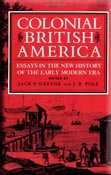 |
Colonial British America: Essays in the New History of the Early Modern Era by Jack P. Greene and J. R. Pole Baltimore, 1984 Greene and Pole believed that the planter elite of the Caribbean were not quite so removed from those of the mainland. They believe that they were not solely concerned by economic motives and were becoming a politically aware society which had many similarities with the continental colonists.
|
 |
The Founding of the Second British Empire 1763 - 1793 by Vincent T. Harlow London, 1952 - 64, (2 vols) Despite the title, Vincent Harlow does examine the final stages of the First Empire and its transition to the Second Empire. He came up with the concept of a 'swing to the East' to explain the different priorities between the two empires. He detected a 'change of outlook on the part of British merchants and politicians which effected a diversion of interest and enterprise from the Western World to the potentialities of the Africa and Asia' in the later stages of the Eighteenth Century. 'We prefer trade to dominion' was used to explain the replacement of the First Empire to the Second.
|
 |
England in the Age of the American Revolution by Sir Lewis Namier London, 1961 Namier did not see any particular civilising characteristics in either the first or second empires. He did not believe in ideological sweeps forging historical forces. Rather, he believed that individuals were merely responding to events and promoting their own interests - sometimes in concert but often in competition with one another.
|
 |
War and Trade in the West Indies, 1763 - 1793 by Richard Pares Oxford, 1936 Richard Pares challenged Vincent T. Harlow's ideas on a shift to trade and towards more enlightened and less authoritarian rule. Rather, Pares provided evidence that the Caribbean and West Indies' plantation economies were hardly becoming more enlightened and that British trading and industrial confidence was not as significant as supposed in the 18th Century. He did not share Harlow's simple transition model from the First to Second Empires.
|
 |
The Cambridge History of The British Empire Volume I: The Old Empire from the Beginnings to 1783 Ed by J. Holland Rose, A. P. Newton, E. A. Benians Cambridge, 1929 The Cambridge History started the first empire from John Cabot's journeys but pushed back the Second Empire to the end of the Napoleonic Wars from 1815. It strongly focussed on 'mercantilism' as being the driving force or 'the economic expression' of English or British 'nationalism'. It 'assumed that it was the business of the State to promote the economic interests of country.'
|
 |
The Expansion of England: Two Courses of Lectures by J. R. Seeley London, 1883 A groundbreaking commentator in the field of imperial studies, he certainly divided the two empires into a First and Second Empire and furthermore explained that the First had been based on an 'old colonial system'. He went on to explain that this empire was inherently unstable as it allowed local autonomies to grow to challenge any exercise of control - especially by those nurtured in English traditions of liberty. He felt it was for this reason that the American Revolution was an inevitable consequence.
|
 |
The East India Company in Eighteenth Century Politics by L. S. Sutherland Oxford, 1952 Lucy Sutherland followed the ideas of Namier and applied them to the East India Company. She was interested in establishing the relationships of pressure groups within parliament and in the Company from London to Calcutta.
|
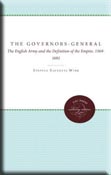 |
The Governors-General: The English Army and the Definition of Empire, 1569 - 1681 by Stephen Saunders Webb Chapel Hill, 1979 Stephen Saunders Webb counters the view of mercantilist and commercial imperialists claiming that the military exercise of power was a far more defining characteristic of the First Empire. According to him, this would become especially true post English Civil War when standing armies and forces became more widespread. He basically believed that the military was able to carve out justifications for expansion and consolidation of the colonies.
|
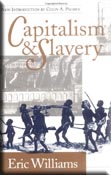 |
Capitalism and Slavery by Eric Williams 1944, London, 1964 Eric Williams was an economic historian who believed that the First Empire was both created and eventually overthrown by primarily economic forces. For example, he believed that the role of abolitionists was grossly overblown and that slavery was eventually allowed to lapse due to changes in economic conditions. These were brought about due to the fallout from the American Revolution - as American independence destroyed the mercantilist scheme of triangular trading that slavery had depended upon.
|