|
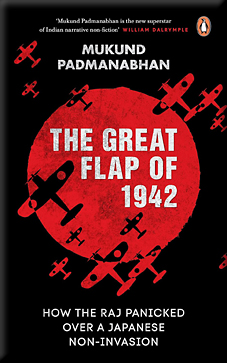
Any author wishing to write about the Second World War will struggle to find a subject that has not been previously described in forensic detail by multiple authors. Mukund Padmanabhan achieves this in his first book The Great Flap of 1942, which was inspired by his mother’s stories of her family’s exodus from Madras in early 1942 because of potential Japanese air raids and invasion. Her family reluctantly left the city when over 75% of the population had already gone. When the family returned a year later, all their possessions had been stolen, the house stripped of any resaleable materials, and their chowkidar had fled. While the movement of refugees from Malaya and Burma following the Fall of Singapore is well known, little has been written about mass movement of people within India during this period.
Having read the book’s jacket notes, I expected a social history of India’s home front. However, Padmanabhan has written a wide-ranging Indian political, economic and social history spanning the final inter-war years and extending to early 1943. The book tells the story of the growing Japanese threat; hubris and inaction by the Government of India; the battles for Malaya and Burma; Japanese raids against Ceylon; the influx of refugees; and finally the response within India including mass evacuation, planning to move the Government from New Delhi and possibly killing the animals in Madras Zoo.
As would be expected from a former editor of The Hindu and a political correspondent, the author skilfully explains key political events and the evolving debates and groupings within the independence movement as the war progressed. His style is elegant, engaging and hugely readable. Potentially dry topics are enlivened by anecdotes and contemporary detail which maintain the reader’s interest and demonstrate the author’s extensive knowledge and research. Mukund Padmanabhan’s skill at telling human stories also shines through, especially in the final chapters which cover the exodus from Madras and Calcutta. At times, he does not fully understand the structure and relationships within the Indian Army, which is reflected in some of his commentary about the Indian National Army. However, he is not a military historian and this does not detract from the book’s overall quality.
The book is subtitled ‘how the Raj panicked over the Japanese non-invasion’ and proposes that the Government of India’s response was disproportionate to the actual invasion threat. We now know that the Japanese advance had faltered because they had outrun their logistics, but Japan had appeared unstoppable in early 1942. In addition, experience from the Spanish Civil War and the London Blitz proved that the ‘bomber always got through’ and further reinforced the perceived threat. As rumours flourished and retreating soldiers and refugees arrived in India, it was completely logical to believe that an invasion was probable and imminent. The Government of India slammed shut the stable door far too late and imperfect decisions were made by imperfect people using imperfect information. Although the Japanese invasion did not finally come until spring 1944, the threat two years earlier was credible and probable. It is accurate to describe the threat as a ‘non-invasion’ but somewhat misleading.
The Great Flap of1942 is thoroughly researched, clear, informative, well written and an enjoyable and compelling read. Mukund Padmanabhan expertly guides the reader through an under-researched area of early 1942 and offers a different perspective on the Indian home front and the impact of the retreat from Malaya and Burma. This book is an excellent addition to any bookshelf.
|