Anthony Kirk-Greene, the Colonial Service's own historian, in a foreword to a bibliography compiled by Terry Barringer entitled Administering Empire: An Annotated Checklist of Personal Memoirs and Related Studies (published 2004 by the
Institute of Commonwealth Studies, University of London) writes that "Colonial Service
memoirs have an importance which, with the revisiting of the colonial era by postcolonial
scholars, is now beginning to be recognised." Lucky Me was too late to be
included in this compilation, but will be included in the next edition now into
preparation. There are 94 titles from Nigeria alone and Lucky Me will be a most
interesting and enjoyable addition. (published 2004 by the
Institute of Commonwealth Studies, University of London) writes that "Colonial Service
memoirs have an importance which, with the revisiting of the colonial era by postcolonial
scholars, is now beginning to be recognised." Lucky Me was too late to be
included in this compilation, but will be included in the next edition now into
preparation. There are 94 titles from Nigeria alone and Lucky Me will be a most
interesting and enjoyable addition.
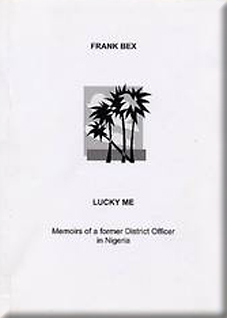
Frank Bex has already written four interesting sections for the book Palm Wine and
Leopard's Whiskers - Reminiscences of Eastern Nigeria, edited by Ronnie Anderson.
Frank has expanded these memories into a full book covering his early years and his
years in Eastern Nigeria but also including his time spent in Lagos as ADC to the
Governor (Lord Milverton) at the time when the Private Secretary was Peter Balmer:
both served later on the Executive Committee of the British-Nigeria Association.
Frank also covers his leaves and his family; two daughters and a son (at the time they
left) and another son who sadly died in infancy.
Frank always seemed destined to be a high flyer. In 1944 when he was serving in the
Royal Artillery, the War Office received a request from the Colonial Office for 2/Lt Bex
to be released from the Army for a posting to West Africa where they were very shorthanded.
The request was granted. The posting to Lagos as ADC to the Governor (who
had met him previously when on tour in the East) was another mark of approval. But
Frank was at heart a 'bush-whacker'. He was assured a promising career in the Civil
Service Commission (after his ADC stint) but opted to return to administrative duties in
the East, despite having recently married in Lagos where he and his wife were enjoying
the social round, so as to return to real life in the real Nigeria. And there they remained
happily, with the usual ups and downs, until they left in 1956.
Though momentous events were occurring on the political front during those twelve
years, they often made little impact locally, as new constitution followed new
constitution, and Chief Commissioners became Lieutenant-Governors and then Regional
Governors. Self-government came to the East on 5 August 1957 with Nigerian
independence on 1 October 1960.
Frank and his wife were in Port Harcourt at the time of the Queen's visit in 1956 and
he shared in preparations for the visit with the Acting Resident, Stan King. The visit was
a resounding success. But for Frank, the writing was on the wall. The cost of living was
expensive for expatriates and the family had by then to face the education of their eldest
daughter and did not wish to be separated. Seeing self-government on the horizon (and
inevitably increased Nigerianisation), the Bexes decided to take premature retirement at
the end of 1956. Frank soon got a better paid job with Unilever.
But as with so many others, Nigeria was not forgotten. Way back as a DO, Frank had
persuaded the District Education Committee to help a certain young man, Ezeka Okafor,
to subscribe to a scholarship to help him through medical studies at Ibadan University to
which he had won a coveted place. Years later, after retirement from Unilever, the Bexes
received an invitation from Dr Ezeka Okafor and his wife Eunice to visit them and to
take part in the opening of their new 75-bed hospital in Onitsha which was to be named
the Bex Memorial Hospital. Other visits followed in 1987 and 1990. On the 1987 visit,
they attended the celebration of Chief Patrick's Jubilee at Orlu - the 50th anniversary of
his succession to the title of Igwe of Orlu. Dignitaries from all over Nigeria, including
the Emir of Kano, attended. Frank was awarded a title, Ogbuagu of Orlu (Leopard
Killer), and a Certificate of Merit. The book is well worth reading for this section alone,
and it is sometimes encouraging to find out how conditions in Nigeria at that time were.
This reviewer well remembers a symposium convened by Anthony Kirk-Greene on The
Transfer of Power - The Colonial Administrator in the Age of Decolonisation in 1978,
held in St Antony's College, Oxford. There the late Sir Rex Niven who had served for over
40 years in Northern Nigeria spoke in the discussion and said "I regard wives who
supported their husbands in Africa as being as important as those they were supporting".
Proceeds from the sale of the book will be given by the author to the Margaret Bex
Charitable Trust (Margaret sadly died in 2001) and used to assist poor patients at the Bex
Memorial Hospitals, Onitsha and Nempi, in Eastern Nigeria.
|