|
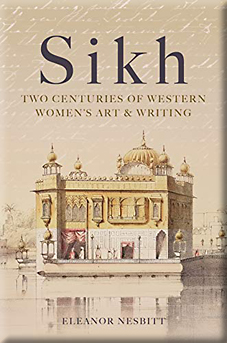
The author who has produced this very substantial accumulation of information from Western women’s writing and depiction of the Sikhs, their culture, history and religion, is a teacher and academic who married into the Sikh community and has written on many of its features. The women concerned span a wide period of two centuries, from the beginning of the 19th century, and cover a broad spectrum of nationalities, backgrounds and interests. First came the British wives and relatives of men concerned with the civilian administration and the military. These were joined later in the century by women missionaries, whose number included Americans, as well as independent travellers. Changing opportunities for women meant that the 20th century brought a new cohort of women professionals, including reporters and photojournalists, several of them also American. While the women of the 19th century were largely upper middle class or aristocratic, class background as well as nationality expanded widely to include the Spanish dancer Anita Delgado Briones who married the Maharajah of Kapurthala. The manner in which women reported and depicted their impressions changed too. The long-drawn out process of letter and journal writing and subsequent publication gave way to the immediacy of journalism. Drawing and watercolour and their translation into lithography and other print forms were challenged by photography and its ability to catch the moment.
The structure of the book is thematic, with significant emphasis on the personalities involved. The author rightly claims that this extremely varied material provides new insights into the Sikh community, firstly in India, and latterly in other countries such as Britain to which Sikhs emigrated, and it complements the information already available from male sources. She does not suggest that there is a specifically female perspective and it would be impossible to do so, given the variety of views expressed, varying from support for British imperialism with its roots in Protestantism, to endorsement ofrising Indian nationalism which had strong support in the Sikh community. Indeed, foreign women seemed to have missed a gendered opportunity to engage intimately with Sikh women, from whom, in the India of the 19th century, at least, they appear largely to have been cut off by language and culture. A closer encounter had to await the 20th century. On the other hand, and a point which the author does not stress, the gendered qualities of ease and lightness which, in the 19th century, women’s writing was assumed to possess, meant that their published letters and narratives often reached a wider audience than male-authored work. The Sikhs were to provide a crucial point of engagement with the British in the 19th and early 20th century in India. In the 1830s, Ranjit Singh, the ruler of the Punjab, was involved by the British in their attempt to contain Afghanistan. The chaos following his death resulted in two Anglo-Sikh wars, and the annexation of the Punjab by the British in 1849. Ranjit’s heir, the young Duleep Singh, was taken into custody by the British and then sent to Britain along with the spectacular Koh-i-Noor diamond, which was presented to Queen Victoria. All these events were narrated and illustrated by the women who accompanied their menfolk serving as soldiers or administrators, and provide a particularly rich episode in the study.
The Eden sisters, Emily and Fanny, whose brother was the Governor General and who visited Ranjit Singh, both provided a range of illustrations of Sikh leaders and their followers - regarded by British women as fine and impressive men as well as their jewellery and the spectacular Koh-i-Noor. Helen Mackenzie, whose husband was a soldier, published an account of the British engagement with the Sikhs, illustrated with her own drawings. Eena Login, married to Dr Login who was guardian of Duleep Singh, gave an insight into his change of destiny. Queen Victoria who was very fond of the young Maharajah, also sketched him. Other women like Matilda Saunders, whose husband was a civil administrator in the Punjab in the 1850s, painted a series of views in the Punjab including the iconic Golden Temple in Amritsar. Charlotte Canning, wife of the Governor General in the 1850s, also depicted the Punjab, as did the independent traveller Constance Gordon-Cumming.
Another defining moment in British relations with the Sikhs was the massacre at Amritsar in 1919, when General Dyer, fearing unrest in the city, opened fire in Jallianwala Bagh on an unarmed crowd. The event caused outrage in India and Britain and was reported by Melicent Wathen, wife of the principal of the Khalsa College for Sikh boys in Amritsar. She was more sympathetic to Dyer than some. The rising tide of nationalism, involving Sikh movements, brought in women reporters from further afield. The events preceding Partition in 1947, and the carnage it involved, were conveyed by several American women reporters and photojournalists. Margaret Burke-White’s photographs of Sikhs fleeing from what was to be the new Pakistan to east Punjab in India are particularly telling. This magnificently illustrated volume is weighty in every sense. At nearly 700 pages and 10 lbs, it is dense with information.
At the end, the author enumerates new lines of enquiry, and invites readers’ contributions. While valuable for an academic and those specially interested in the Sikhs, this may not be a book for the general reader, who could be daunted by the price in excess of £150. ft is, however, a splendid addition to a library.
|