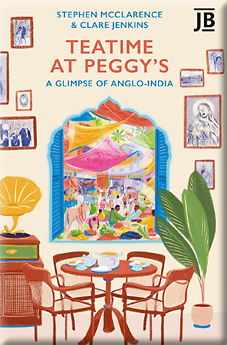
| Teatime at Peggy’s, the title of this charming book suggests perhaps a sedate afternoon gathering of a few female friends, dainty sandwiches and a convivial catch-up chat. If, however, the ‘Peggy’ was Peggy Cantem (née Mabel Kane), of Jhansi - the leading light in the Anglo-Indian community, the driving force behind Operation Cemetery, and an unfailingly sociable, warm- hearted, person to boot, her house was always open, with much ‘aana aur jaana’ (‘coming and going’), so an invitation to tea meant joining fluctuating numbers of friends round a table continually being replenished with cake and ‘small eats’. Excited chatter ranged from Anglo- Indian culture (domestic architecture, food, clothes, pastimes, choices) to fond memories of May Queen Balls, and moonlit dances in the jungle at nearby Orchha. ‘Teatimes‘ at Peggy’s would inevitably be watched over by St Jude, flanked by a faded print of the Last Supper. What’s that Bollywood sound? Oh, it’s Peggy’s phone, buried under a letter from the British High Commission. The Mad Hatter is on his way…
Sensing that the incredibly busy Anglo-Indian philanthropic Peggy (‘It was always my ambition to go out and help the poor’) and her friends epitomised a fast-disappearing way of life, Clare, a BBC Radio journalist, and her husband Stephen, a travel writer, recorded conversations with them over a period of nearly 20 years. Their book is both a delight to read, and a compelling example of oral history. The daughter of a railway employee, Peggy was born in Jhansi in 1923. A crucial junction for trains from Delhi to both Bombay and Madras, Jhansi was home to large numbers of railway staff whose families would send their children to the railway school, take their infirm to the railway hospital, and socialise with each other at the Railway Institute, ‘the most beautiful place in the world for railway people’ where they could enjoy games, sport and ‘fabulous’ dances – ‘a little waltzing, a little foxtrotting and a twilight waltz, with the lights turned off!’ (Small wonder these octogenarian ladies had so much to reminisce about.)
After Independence, most of the 500,000 strong Anglo-Indian community emigrated – to the UK, USA, Canada, Australia and elsewhere. Many others married out. By 2004 the Anglo-Indian Association at Jhansi had dwindled to fewer than 500 members – a far cry from the days when Peggy had to source Christmas toys for 900 children. As well as supporting ‘poor children’ (with books, food, clothes and medication) and ‘poor widows’ within the Anglo-Indian community, Peggy undertook the responsibility of giving the dead ‘the dignity they deserve’, through her Operation Cemetery. With BACSA support, she gradually oversaw the transformation of Jhansi Cemetery from equatorial jungle to a clean, tidy, well-protected 10-acre graveyard of around 4,000 graves. In her 90s, she still visited the Cemetery twice a week, to ensure her designated successor (Claudette ‘Buddie’ Hars) understood the task in hand.
Teatime at Peggy’s is co-dedicated to Peggy’s lifelong friend, Captain Roy Abbott, who introduced her to Clare and Stephen in 2004. Described variously as a ‘burra-sahib’, ‘the last zamindar’, and ‘British India preserved in aspic’, Roy’s meticulously organised daily life was a sharp contrast to Peggy’s. He too practiced philanthropy, but as a benevolent landowner rather than a fellow-suffering fundraiser. In addition to the Abbott family bungalow at Jhansi, Roy owned four village farms covering about 600 acres, through which he oversaw the lives of around 3,000 people, paying for their medical treatment, family weddings, and unforeseen hardships. A one-man welfare state, he built schools, clinics, wells and roads in the villages, and was venerated as ‘Uncle Abbott’.
Inveterate users of the Indian railway network, Clare and Stephen coupled their ‘Teatime’
recording visits to Jhansi with research trips to destinations all over the subcontinent, ranging from Okha in the west, Madurai in the south and Ledo in the east. Being ‘travellers’, rather than ‘tourists’ they withstood discomfort and delays, relishing the opportunities for memorable encounters with fellow passengers and observations of platform life. Their accounts of Anglo- Indian life at Jhansi are interspersed with lyrical descriptions of the timeless landscapes they traversed, particularly at ‘godhuli bela’ (‘cowdust time’). BACSA members interested in Jhansi, and/or the Anglo-Indian community in general, will find this book a gem. So too will anyone interested in rail travel in India, or the travellers’ tales about the far-flung destinations visited by Clare and Stephen. (Which of us, for example, would forgo a haircut at the Verma salon in Delhi?)
|